critique of proposed guidelines for writing Taiwan place names

Several months ago I wrote about the move by Taiwan’s Ministry of the Interior (MOI) to impose Tongyong Pinyin by instituting standards for the writing of place names. (See MOI and Tongyong Pinyin: update). I was told that my remarks had been translated into Mandarin and distributed to those involved. But I have never received any response, despite more than one follow-up call. Although I never much expected to receive a useful response anyway, I had hoped for at least something.

Keep in mind that these are remarks aimed at those in the central government, who, at least for the time being, are compelled to work within the framework of Tongyong Pinyin. Also, I tried to stick as much as possible to the examples in the government’s draft, thus my use of “Jhuzih Hu,” which is both Tongyong Pinyin and a name whose word parsing is more complicated than most.

I have amended a few details, deleted some sections with personal details, and removed the conclusion, which was mainly polite blah-blah-blah.

I would welcome comments and suggestions for revisions.

Response to Taiwan’s Proposed Guidelines for Place Names in Romanization and English

As you are surely aware, Taiwan’s government has a very poor record when it comes to romanization. So the government now has an important opportunity to show Taiwan’s foreign community and others here who care about standards and are pained by the nation’s sloppiness in this regard that it is finally giving the issue the care it deserves. Unfortunately, the proposed guidelines in their present state would do little to improve the situation and in some cases could make things worse. Specifically, the proposed guidelines have seven basic problems.

  1. Failure to use Hanyu Pinyin
  2. Failure to use apostrophes correctly
  3. Failure to use hyphens correctly
  4. Partial failure to indicate individual words correctly
  5. Failure to handle non-Chinese names correctly
  6. Failure to consider instances where tone marks might be useful or even necessary
  7. Failure to fix old, misleading spellings

Before I give details about the problems listed above I would like to note that the guidelines are, however, correct in one important way: Place names should begin with a capital letter followed by lower-case letters. The Taipei City Government made an enormous mistake when it instituted the practice of adding extra capital letters where none are needed.

WRONG RIGHT
NanJing East Road Nanjing East Road
TianMu Tianmu
TaiNan Tainan

The Taipei City Government’s foolish policy of ExTra CaPiTal LettErs also helped bring about another major problem in Taipei: the omission of apostrophes before syllables beginning with a, e, and o. This will be addressed in my second point. But first comes the introductory one.

1. Failure to use Hanyu Pinyin

I know that the issue of Hanyu Pinyin vs. Tongyong Pinyin is not supposed to be on the table, so I do not expect any action to be taken on this for now. Nevertheless, I believe it necessary to remind the Ministry and those responsible for reviewing the guidelines that members of the international community — both within and outside of Taiwan — overwhelmingly support the adoption of Hanyu Pinyin for Mandarin and oppose the use of Tongyong Pinyin. There is simply no green/blue divide among foreigners on this issue; an overwhelming majority of “green” foreigners oppose Tongyong Pinyin and strongly support Hanyu Pinyin; and an overwhelming majority of “blue” foreigners feel the same way. For foreigners, this is a practical matter, not a political one.

The government’s insistence upon the use of Tongyong Pinyin has cost Taiwan respect and is having an impact on students’ choices of where to study Mandarin. Moreover, the lack of a consistent, correct, and internationalized romanization system considerably complicates Taiwan’s efforts to lure more tourists to the island. The government should abandon Tongyong Pinyin immediately, before it does any more harm. Too much time, money, and effort have been wasted already.

Nevertheless, some of the damage that has been done could be repaired if the government implements the best possible guidelines for the use of the romanization system it continues to insist upon. The proposed guidelines, however, are at best insufficient and thus are in need of significant revision.

This brings me to my main points.

2. Failure to use apostrophes correctly

The MOI guidelines correctly indicate that something is needed to distinguish syllables beginning with a, e, and o. But the MOI guidelines use the wrong method to indicate these breaks.

The MOI says that people should use a hyphen before syllables beginning with a, e, and o. This is a very bad idea. The correct way to do this is by using an apostrophe. Here is the rule Taiwan should adopt: “Put an apostrophe before any syllable that begins with a, e, or o, unless that syllable comes at the beginning of a word or immediately follows a hyphen or other dash.”

Table: Examples of how to write words that have inner syllables beginning with a, e, or o

WRONG RIGHT
Da-an Da’an
Su-ao Su’ao
Ren-ai Ren’ai

The main reason it is crucial not to use a hyphen in such places is that hyphens have other important uses, which I will discuss next.

3. Failure to use hyphens correctly

Hyphens are especially important when it comes to assigning names to places and things (especially things representing abbreviations and things that join two places).

WRONG RIGHT REASON
Suhua Expressway Su-Hua Expressway This road runs between Su‘ao and Hualian
Beiyi Expressway Bei-Yi Expressway This road runs between Taipei (Taibei) and Yilan. (And for heaven’s sake don’t make this “Pei-Yi.”)
Jianan dazun Jia-Nan dazun Jia-Nan refers to Jiayi and Tainan (嘉南大圳).
Huajiang Bridge Hua-Jiang Bridge The bridge joins Wanhua and Jiangzicui.
Sun Moon Lake Sun-Moon Lake These are joined elements.
Taida Tai-Da An abbreviation for Taiwan Daxue (台灣大學)

See https://pinyin.info/readings/texts/hyphens.html for details and additional ways that hyphens can help clarify Pinyin.

4. Partial failure to indicate individual words correctly

The guidelines are correct that there should be spaces between words (詞) but not between mere syllables (字). But the guidelines are too vague — and sometimes incorrect! — about how to determine what a word is (and thus what should be written separately).

Taiwan should use the guidelines that have already been worked out for these principles and have been accepted internationally. I am referring, of course, to the guidelines for Hanyu Pinyin, which are covered in general here — https://pinyin.info/rules/pinyinrules.html — and in detail in two books: Chinese Romanization: Pronunciation and Orthography (漢語拼音和正詞法) (ISBN 7-80052-148-6) and 新華拼寫詞典 (ISBN 7-100-03414-0). The latter book is sometimes available at the main Eslite bookstore near Taipei City Hall. The best Mandarin-English dictionary following these principles is the ABC Chinese-English Comprehensive Dictionary, edited by John DeFrancis; you should also use it as a standard reference.

Supporters of Tongyong Pinyin have often touted that system’s supposed “compatibility” with Hanyu Pinyin. Having the two systems share the same basic guidelines would be a good way to demonstrate that this is something more than empty words.

Most of the examples in the guidelines are correct. A few need revision.

WRONG RIGHT
Yangmingshan Yangming Shan
Jhuzihhu Jhuzih Hu [Zhuzi Hu]

5. Failure to handle non-Chinese names correctly

Just a few days ago President Chen Shui-bian (whose name, I note, is spelled in Hanyu Pinyin, not Tongyong Pinyin; but no one confuses him with the president of the People’s Republic of China!) was in Tainan County to mark the opening of some new roads around the Southern Taiwan Science Park. Each of the three roads has been given a name from an aboriginal language, something the president praised. Yet the government’s guidelines would force Mandarin upon the aboriginal names, changing them to something that would be incorrect.

Similarly, the administration has supported Aborigines regaining their original names and even villages reacquiring their original, non-Chinese names. (See, for example, http://news.yam.com/cna/garden/200708/20070801554267.html )

Ideally, no Chinese characters would be used with some of these names; but I don’t expect that to happen soon.

WRONG RIGHT
Kaidagelan Ketagalan
Tailuge Taroko
Sihmakusih (司馬庫斯) Smangus

Attention must also eventually be given to the issue of using Sinitic languages other than Mandarin (specifically Taiwanese and Hakka) in place names.

6. Failure to consider instances where tone marks might be useful or even necessary

Because Mandarin is a tonal language, a few names that are different may appear to be identical in romanization unless tone marks are included. In practice, only a very small percentage of names are subject to this ambiguity. Taipei, for example, has more than 600 different street names; but only the following would need attention there.

Chinese characters Pinyin and English mix
景華街 Jǐnghuá St.
景化街 Jǐnghuà St.
同安街 Tóng’ān St.
通安街 Tōng’ān St.
萬慶街 Wànqìng St.
萬青街 Wànqīng St.
五常街 Wǔcháng St.
武昌街 Wǔchāng St.
向陽路 Xiàngyáng Rd.
襄陽路 Xiāngyáng Rd.

For the benefit of foreigners and to aid clarity, tone marks should follow the practice of Hanyu Pinyin, not of Zhuyin Fuhao, i.e. first tone should be indicated (ā, ē, ī, ō, ū, and ǖ; not a, e, i, o, u, and ü). This is especially important because most names are written without tone marks; we should not get these confused with words that have only first-tone syllables, such as Tōng’ān (通安).

One possibility would be to tone marks on only the less common name(s). For example, we would write 五常街 as “Wǔcháng Street” but 武昌街 simply as “Wuchang Street” (rather than as “Wǔchāng Street“).

Some would advocate using tone marks on most if not all signage with Pinyin. This deserves study.

7. Failure to fix old, misleading spellings

Several years ago when the central government promulgated Tongyong Pinyin it kept the old spellings for some cities and all counties (other than Yilan, which changed from “Ilan”). This was a mistake. The old spellings are inherently ambiguous in pronunciation and are often quite simply misleading.

The government should end the policy of retaining most old spellings. Quite simply, there is nothing useful to foreigners or anyone else about retaining, for example, “Taitung” for what should be spelled “Taidong.” A limited, practical approach for the time being would be to immediately change all names that are spelled the same way in Tongyong Pinyin and Hanyu Pinyin, with the possible exception of retaining “Taipei” instead of switching to “Taibei.”

WRONG RIGHT
Taitung Taidong
Matsu Mazu
Kinmen Jinmen
Hualien Hualian
Chiayi Jiayi
Pingtung Pingdong
Keelung Jilong

exam completed in Pinyin

This season is the thirty-first anniversary of the reinstatement of China’s national college entrance examinations after the end of the disastrous Cultural Revolution. Here’s the story of something that happened the year of the reinstatement (1977), when Zhang Huiming, a professor in the Chinese department of Xianyang Normal College, grading exams from Xianyang, Shaanxi, and its surrounding areas.

That year, after the start of the third day of work grading the exams had begun, one of the teachers on the grading team suddenly shouted in amazement, “Come look at this exam!” There before all of us was a language exam that had been answered completely in Hanyu Pinyin. Facing this situation, everyone discussed it. Right away, some said, “This is simply horsing around, putting on a show. Give it a zero!” The head of the grading team was inclined toward this idea. But Zhang Huiming insisted on first putting the exam into Chinese characters. “Who wouldn’t allow such an exam? There’s no rule against it. And Chairman Mao long ago indicted, ‘Writing should follow the world’s common Pinyin trend [i.e., use an alphabet like everyone else].’”

Everyone fell silent. Zhang Huiming took about half an hour to annotate the Hanyu Pinyin with Chinese characters. It turned out that the exam was nearly without errors in spelling or tone marks. The score, to everyone’s surprise, was 88. The teachers who corrected the exams were all convinced by this examinee of the soundness of training in Hanyu Pinyin.

A nice story. But I can’t help but note sadly that a bunch of well-educated people didn’t simply read the essay as it was written. Such are the prejudices against it. What I’d really like is a story that doesn’t treat Pinyin as if it were merely a set of training wheels.

“Gāokǎo huīfù 30 nián” zhǔtí bàodào tuīchū hòu, hěn duō dúzhě fā lái diànzǐ yóujiàn, jiǎngshù dāngnián de gāokǎo gùshi. Xiányáng Shīfàn Xuéyuàn Zhōngwénxì jiàoshòu Zhāng Huìmín, shì 1977 nián Xiányáng dìqū yǔwén yuèjuàn lǎoshī zhīyī. Dāngnián, yī fèn wánquán yòng Hànyǔ Pīnyīn wánchéng de yǔwén dájuàn ràng tā zhìjīn nánwàng.

Dāngnián, yuèjuàn gōngzuò kāishǐ hòu de dì-sān tiān, yuèjuànzǔ yī lǎoshī tūrán jīngyà de shuō: “Kuài kàn, zhè fèn shìjuàn!” Yī piān wánquán yòng Hànyǔ Pīnyīn zuòdá de yǔwén shìjuàn chéngxiàn zài dàjiā miànqián. Suíhòu, zhè fèn tèshū de shìjuàn zài quántǐ lǎoshī zhōngjiān kāishǐ chuányuè. Miànduì zhè yī qíngkuàng, dàjiā yìlùnfēnfēn. Yǒurén dāngchǎng biǎoshì: “Jiǎnzhí jiùshì húnào, biāoxīnlìyì, gěi língfēn!” Yuèjuànzǔ zǔzhǎng yě qīngxiàng gāi yìjian. Dàn Zhāng Huìmín jiānchí yīng xiān jiāng kǎojuàn fānyì chéng Hànzì. “Shuí bù ràng tā zhèyàng dájuàn? Gāokǎo bìng méiyǒu bùyǔn xǔyòng Hànyǔ Pīnyīn zuò dá’àn de guīdìng, kuàngqiě Máo zhǔxí zǎojiù zhǐshì: ‘Wénzì yào zǒu shìjiè gòngtóng Pīnyīn de fāngxiàng.’”

Chénmò le yīhuìr zhīhòu, Zhāng Huìmín yòng jìn bàn ge xiǎoshí de shíjiān, gěi zhěng fèn dájuàn shàng de Hànyǔ Pīnyīn biāozhù le Hànzì. Ràng Zhāng Huìmín nányǐ wàngjì de shì, nà fèn kǎojuàn, yīnjié, shēngdiào jīhū méiyǒu cuòwù. Jiéguǒ, zhè fèn fèijìn zhōuzhé de yǔwén dájuàn jīng gě fùzé lǎoshī píngyuè hòu, zǒng fēn jìngrán shì 88 fēn. Quántǐ yuèjuàn lǎoshī dōu bèi zhè wèi kǎoshēng zhāshi de Hàn yǔyán gōngdǐ suǒ zhéfú.

source: Yī fèn yòng pīnyīn wánchéng de yǔwén shìjuàn (一份用拼音完成的语文试卷), Huash.com, March 27, 2007

Pinyin-related plugin for WordPress

Adsotrans — which offers the best free, online Pinyin transcription tool — has just released a plugin for WordPress, the most popular software for blogging. This will annotate Chinese characters with all-important word parsing. Trevelyan’s post provides a download link and directions.

Check it out.

ChinesePod is helping sponsor this project, so they deserve thanks.

source: Our Adsotrans WordPress Plugin, Adsotrans blog, February 14, 2008

Results of US AP exams: first year for Mandarin, Japanese

2007 was the first year that the U.S. College Board offered an Advanced Placement (AP) exam for “Chinese Language and Culture.” It was also the first year students could take an AP exam in “Japanese Language and Culture.”

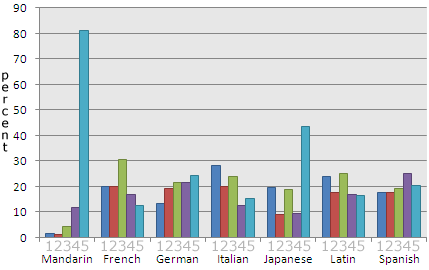
Data for the results as a whole have just been released. The figures for Mandarin are remarkably lopsided.

A total of 81.1 percent of those taking the exam for Mandarin and Chinese culture achieved the top score of 5, a much higher percentage than with any other test. The subject with the second highest percentage of 5’s was Japanese (43.4 percent), followed by Electricity and Magnetism (33.8 percent), Mechanics (26.1 percent), and German (24.4 percent). In most other subjects a score of 5 was achieved by only about 10 percent to 20 percent of test takers.

Let’s look at those who achieved only the lowest score (1). Here, too, Mandarin stands out, with by far the lowest percentage of test takers with this score (1.5 percent). Next are Drawing, 2-D Design, and 3-D Design (5.8 percent); English Language and Composition (10.9 percent); and Calculus BC (13.5 percent). Most subjects have “1” rates in the 20s.

Comparison of Scores Across Language Exams
chart comparing how well test takers did in various language exams, with scores for 'Chinese' being far higher than all others; languages listed: Mandarin, French, German, Italian, Japanese, Latin, and Spanish

Comparison of Lowest Scores Across Language Exams
comparing percentages of test takers receiving the low score of '1', with all languages other than Mandarin falling above 13% -- Mandarin at a mere 1.5%

So, does this indicate Mandarin isn’t damn hard for students after all or that the perfect pedagogy for this subject has been reached? Of course not.

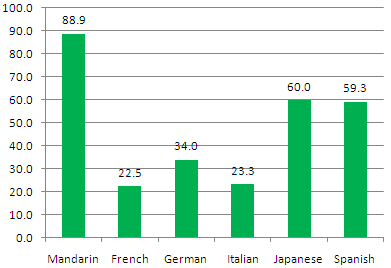
Only 11.1 percent of the 3,260 people taking the Mandarin exam did not indicate on their test that they “regularly speak or hear the foreign language of the examination at home, or that they have lived for one month or more in a country where the language is spoken.”

Percent of test takers who “regularly speak or hear the foreign language of the examination at home” or “have lived for one month or more in a country where the language is spoken”
chart showing that far more students taking the Mandarin AP exam are already speakers of that langauge

Thus, it’s no surprise to see that 89.4 percent of those taking the Mandarin exam identified themselves as “Asian, Asian American, or Pacific Islander.” Of all those across the entire United States who took the Mandarin exam last year, only 363 people did not identify themselves as falling within that category. This certainly does not match the hype about Mandarin as the foreign language being studied.

While I congratulate those who scored well on the exam (Chinese characters can certainly be a pain to learn regardless of your background), the test — and perhaps the curriculum, too — evidently needs considerable revision, which isn’t too surprising considering this was its first appearance. I’m a bit saddened, though, to see that more students from a wider variety of backgrounds aren’t taking up the challenge of Mandarin.

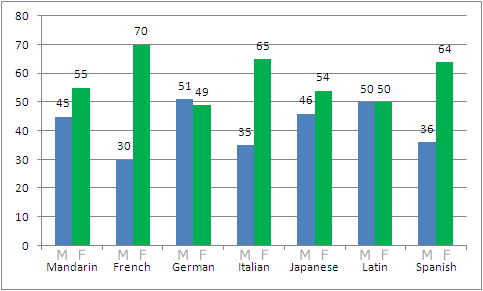
There doesn’t appear to be much of a gender imbalance, however, in AP Mandarin classes.

Percentages of students in AP language exams, by sex
chart showing the percentages of students in various AP language exams, by sex

Within a week or two I’ll be posting some interesting figures about U.S. post-secondary enrollments in Mandarin and other languages.

source: The 4th Annual AP Report to the Nation, College Board, February 13, 2008

Zhou Youguang awarded

Zhou Youguang, often called the father of Hanyu Pinyin, has received another award.

Dì-wǔ jiè Wú Yùzhāng Jiǎng 31 rì zài Zhōngguó Rénmín Dàxué bānfā, céng cānyù “Hànyǔ Pīnyīn Fāng’àn” zhìdìng de “Hànyǔ Pīnyīn zhī fù” Zhōu Yǒuguāng huòdé Wú Yùzhāng rénwén shèhuì kēxué jiǎng tè děng jiǎng.

Zhè wèi 102 suì gāolíng de yǔyánxuéjiā yǐ qí sì juǎn běn “Zhōu Yǒuguāng yǔwén lùn jí” huòjiǎng. Tā zǎonián xuéxí jīngjì xué, yè yú cóngshì yǔyán wénzì yánjiū. 1955 nián chūrèn Zhōngguó wénzì gǎigé wěiyuánhuì dì-yī yánjiūshì zhǔrèn, yánjiū wénzì gǎigé hé Hànyǔ Pīnyīn, bìng yú liù nián hòu chūbǎn “Hànzì gǎigé gàilùn,” quánmiàn xì tǒng de lùnshù le Zhōngguó de wénzì gǎigé wèntí. Tā hái cānyù zhìdìng “Hànyǔ Pīnyīn Fāng’àn,” cùchéng “Hànyǔ Pīnyīn Fāng’àn” chéngwéi yòng Luómǎ zìmǔ pīnxiě Hànyǔ de guójì biāozhǔn, bèi yùwéi “Hànyǔ Pīnyīn zhī fù.” Rújīn, zài Měiguó Guóhuì Túshūguǎn lǐ, jì cáng yǒu jīngjìxuéjiā Zhōu Yǒuguāng de zhùzuò, yòu yǒu zuòwéi yǔyán wénzìxué jiā Zhōu Yǒuguāng de zhùzuò.

Zhōu Yǒuguāng zài huòjiǎng gǎnyán zhōng chēng: “Wǒ de sūnnǚ zài xiǎoxué shí duì wǒ shuō, yéye nín kuī le, nín gǎo jīngjì bàntú ér fèi, gǎo yǔwén bànlùchūjiā, liǎng ge bànyuán hé qǐlai shì yī ge líng. Wǒ jīnhòu yào zàicì cóng líng zuòqǐ, hǎohāo xuéxí, lǎodāngyìzhuàng, gǎnshàng shídài. “Yōumò de fāyán yíngdé quánchǎng chíjiǔ de zhǎngshēng.

Jùxī, Zhōu Yǒuguāng 83 suì shí “huàn bǐ” yòng diànnǎo gōngzuò, 98 suì kāishǐ chàngdǎo “jīchǔ Huáwén” yùndòng, 100 suì, 101 suì, 102 suì shí jūn yǒu zhùzuò chūbǎn.

Tóngshí huòdé tèděng jiǎng de háiyǒu Zhōngguó Rénmín Dàxué jiàoshòu, zhùmíng fǎxuéjiā Xǔ Chóngdé. Xǔ Chóngdé céng cānyù qǐcǎo 1954 nián xiànfǎ, 1982 nián xiànfǎ, “Xiāng Gǎng tèqū jīběnfǎ” hé “Àomén tèqū jīběnfǎ” sìbù fǎ lǜ, jiànzhèng le Zhōngguó xiànzhèng fāzhǎn jìnchéng. Tā de huòjiǎng zhùzuò wèi “Zhōnghuá Rénmín Gònghéguó xiànfǎ shǐ.”

Cǐwài, běn cì Wú Yùzhāng rénwén shèhuì kēxué jiǎng hái bānfā yīděng jiǎng 12 xiàng, yōuxiù jiǎng 25 xiàng.

Wú Yùzhāng rénwén shèhuì kēxué jiǎng yóu Wú Yùzhāng jījīn shèlì, miànxiàng quánguó jiǎnglì guónèi yǒu zhòngdà yǐngxiǎng de yōuxiù zhé xué shèhuì kēxué lùnzhù. Jù Wú Yùzhāng jījīn wěiyuánhuì zhǔrèn wěiyuán, Zhōngguó Rénmín Dàxué yuán xiàozhǎng Yuán Bǎohuà jièshào, zhèige jiǎng xiàng měi wǔ nián píngxuǎn yīcì, xiàn píngjiǎng xuékē wèi Mǎkèsīzhǔyì lǐlùn, zhéxué, jiàoyùxué, lì shǐxué, Zhōngguó chuántǒng wénhuà yǔ yǔyán wénzìxué, xīnwénxué, jīngjìxué hé fǎxué děng bā ge xuékē, měi ge xuékē shè tèděng jiǎng, yīděng jiǎng jí yōuxiù jiǎng. Zì 1987 nián zhìjīn, zhèige jiǎng yǐ bānfā wǔ jiè, Guō Mòruò, Lǚ Shūxiāng, Hú Shéng, Wáng Lì děng xiān-hòu huòjiǎng, yǐ chéngwéi quánguóxìng zhéxué shèhuì kēxué yánjiū guīgé jiào gāo de jiǎnglì.

Wú Yùzhāng jījīn yóu Zhōngguó Rénmín Dàxué shèlì, yǐ jìniàn wúchǎn jiējí gémìngjiā, jiàoyùjiā, lìshǐxuéjiā, yǔ yán wénzìxué jiā, Rénmín Dàxué dì-yī rèn xiàozhǎng Wú Yùzhāng.

source: ‘Hànyǔ Pīnyīn zhī fù’ huò Wú Yùzhāng rénwén shèhuì kēxué jiǎng (“漢語拼音之父”獲吳玉章人文社會科學獎), Xinhua, November 1, 2007

further reading:

Pioneer Mandarin ‘immersion’ program sinking?

Some eleven years after it began, what is touted as the first U.S. elementary school Mandarin immersion program is reportedly in trouble.

In September 1996, Montgomery County [Maryland] started what it promoted as the first Mandarin Chinese immersion program for elementary students in the country. The program at Potomac Elementary School became a national model, and acclaim and fame followed.

Today, the original class of first-graders are seniors preparing for college. Many continued to study Chinese in middle and high school, but most dropped out in recent years — a handful as late as this fall — citing confusion in the curriculum and difficulties with the instructor. Now, just three of the first 22 students continue to study Chinese at the cluster’s high school….

Critics say there is a lack of resources and appropriate materials, poor coordination among grade levels and inadequate teacher development. There’s even disagreement among educators on what immersion is.

“Immersion can mean many things to different people in the field,” said Elena Izquierdo, vice president of the District-based nonprofit National Association for Bilingual Education and a professor at the University of Texas at El Paso. “For some, immersion is total immersion, for others it is partial, and some people call one class in foreign language an immersion class.”

It is also important to define the goal of each program; all are not the same, Izquierdo said. Some aim for complete reading, writing and oral proficiency in a foreign language; others might be geared to gaining conversational skills.

At first, the Chinese immersion students at Potomac were “a school within a school,” sticking together from kindergarten through fifth grade. Principal Linda Goldberg changed the format when she arrived in 2002, believing that students learning Chinese needed more interaction with the other students.

Today, 137 students at Potomac, from kindergarten to fifth grade, take math and science in Chinese and other subjects in English, she said.

Judith Klimpl, supervisor of foreign languages for Montgomery public schools, said math and science were chosen because the subjects are taught with many hands-on activities and have concrete vocabulary. There is no intensive grammar or writing instruction in Chinese at this level.

Once students move to Hoover Middle School, lessons in language acquisition intensify, Principal Billie-Jean Bensen said. The students, who used to have two periods in Chinese, now have one, including an “immersion class” in the sixth grade. But, Bensen conceded, the title of the class is probably “not correct.” A single class shouldn’t be labeled immersion, she said.

.

Children at Potomac Elementary who enroll in the Chinese partial immersion program are taught mathematics and science in the Chinese language, but not the language itself. The result, parents say, is a familiarity with the language and enhanced listening skills when they reach middle school and a more formal language program begins….

The transition to middle school, and then from middle school to high school, lies at the heart of the program’s problems.

“There’s definitely issues with transitioning from Potomac Elementary to Hoover and from Hoover to Churchill,” said Sees. “If you look at the dropout rate in the high school itself, it’s abysmal.”

Immersion students take an immersion class in sixth grade and then are filtered into the standard one-period-per-day Chinese language classes with students who were not in an immersion program in seventh grade, said Hoover Principal Billie-Jean Bensen. They then continue in that traditional language course structure in high school. Schick said that the transition process at Hoover has improved in the last two years.

The first three levels of Chinese language instruction in the county’s schools are generally completed in middle school and the first year of high school, said Duffield….

sources and further reading:

Chinese New Year’s resolutions: a suggestion

Happy year of the rat, everyone!

Several years ago I made some resolutions for Chinese New Year that others might find useful, if you haven’t adopted similar ones already.

  1. If I’m referring to Mandarin I will use the word “Mandarin,” not “Chinese.”
  2. If I’m referring to a language, I’ll call it a language, not a dialect.

Pretty basic. But these greatly help clarity. And they have the benefit of being correct.

The reason you’ll sometimes find the phrase “Mandarin Chinese” rather than just “Mandarin” on my site is I want to help people find this through search engines. But for the most part the inclusion of the word “Chinese” is easily accomplished through tags or mention of “Chinese characters.”

I’d like to note that even many of those who really should know better have things backwards. They might note that “Chinese” is not a language but a family of languages — and even then one that should be known as Sinitic rather than “Chinese.” And they tend to spend a line or so explaining that what many people refer to as Chinese “dialects” are really languages. This is all well and good. But then they go on to use “Chinese” and “dialects” over and over.

The messages they’re sending out:

Chinese Chinese Chinese Mandarin Chinese Chinese Chinese Chinese Chinese Chinese Chinese Chinese Chinese Chinese Chinese Chinese Chinese Chinese Chinese Chinese.

and

Dialect dialect language dialect dialect dialect dialect dialect dialect dialect dialect dialect dialect dialect dialect dialect dialect dialect dialect.

So what people hear is “Chinese” and “dialect” — both of which are usually wrong.

I have made some resolutions of my own for this year: the first being to answer e-mail messages much quicker than my present average of three or more months behind when I should. Although I’m terrible at writing, I am indeed grateful for all of the messages I receive.

Xinnian kuaile!