Tibetan-English sample sentences

It seems like a good time for something related to Tibet.

The newest rerelease from Sino-Platonic Papers comprises 900 sample sentences in romanized Tibetan and English, the Tibetan being specifically Kham Tibetan.

From the introduction:

The reader is undoubtedly aware that written Tibetan radically differs from what is spoken and that there are also many differences in, for example, written Tibetan in Amdo regions and that of Lhasa. The value of this material is that it presents one of the most widely used Tibetan dialects as it is actually spoken.

Renchin-Jashe, a native of Yulshul (Yushu) Tibetan Autonomous Prefecture in Qinghai Province where Kham is spoken, wrote these sentences using a system that he devised. I then edited the sentences…. We have tried throughout to present sentences that reflect Tibetan culture.

This issue is Kham Tibetan Language Materials (2.7 MB PDF), by Renchin-Jashe and Kevin Stuart.

Here are the first 15 of the 900 sentences.

  1. Qa e tel.
    Hello.
  2. Chou ghale-jiele en?
    Is your life well?
  3. Nga Norbu Sangbho yin.
    I’m Norbu Sangbho.
  4. Chou Doje e rei?
    Are you Doje?
  5. Nga yin.
    Yes, I am.
  6. Chou dhemo yin nam?
    How are you?
  7. Nga dhemo yin, tujeche.
    Fine, thanks.
  8. Droma dhele ghale e ree?
    How is Droma?
  9. Mo ni dhele ghale ree tujeche.
    She is very well, thank you.
  10. Chou dhehi eyou, Avo Qalsang?
    How are you, Mr. Qalsang?
  11. Ghongmo zang, Ashe Yudron.
    Good evening, Ms. Yudron.
  12. Ghong mo chou dhemo en?
    How are you this evening?
  13. Da do nub dhe mo jie Tshering.
    Good night Tshering.
  14. Ghashou, Dondrub.
    Good-bye, Dondrub.
  15. Sang nyin tutree zei.
    See you tomorrow.

The work also contains a guide to pronunciation and sentences for learners at the intermediate level.

It was first published in November 1993 as issue no. 42 of Sino-Platonic Papers.

video of Pinyin’s ‘father,’ Zhou Youguang, in English

Roddy of Chinese Forums, Signese, Dreams of White Tiles, and even more sites, found a new video (4 min. 40 sec.) of Zhou Youguang speaking, in English, to a reporter from the Guardian.

I was kind of surprised to see this featured on the Guardian’s front page under the ‘Father of Pinyin’ title – I’d wager 9/10ths upwards of the Guardian’s readership doesn’t know what pinyin is. Somewhat unforgivably they’ve managed to spell the guy’s name wrong and not bothered to add tones to the pinyin used in the video, and the interview is pretty weak – basically it’s ‘here’s a nice old Chinese guy talking for a few minutes’ but there’s really very little of depth. They’ve also opted to add subtitles to what sounds to me like perfectly comprehensible English.

But enough negativity, if you want to get a look at the guy who rescued you from bopomofo, have a look.

As happy as I am about the video, I’m going to add a bit more negativity. Failure to get the word parsing correct is also a major error: not “pin yin zhi fu” but “Pīnyīn zhī fù.” Actually, even that isn’t so good, because Pinyin is meant for modern baihua, not the style of Literary Sinitic and its many short forms. Thus, “Pīnyīn de fùqin” would be better.

The accompanying article is amazingly sloppy in parts.

Although the article manages to spell Zhou Youguang’s name correctly, it consistently refers to him not by his family name but by his given name, “Youguang.” It’s almost inconceivable that any reporter in China could (repeatedly) make such an elementary mistake; so perhaps this is the fault of an overzealous copy editor.

I’m not going to sort out and list what’s correct and what’s incorrect in the rest of the article, other than mention one point at the end.

Confusingly, Taiwan uses several different romanisation methods — including a variant of pinyin, tongyong pinyin — and zuiyin.

Zuiyin? Of course what is meant is zhuyin (zhùyīn/註音/注音), which is spelled correctly earlier in the article. Zuiyin (zuìyīn/罪因) is a noun meaning “cause of a crime.”

sources:

Mandarin borrow-ing English grammatical forms

click for image of complete campaign poster; the slogan, shown in this image, reads '台灣維新ing'Putting English words in Mandarin sentences is of course extremely common in Taiwan and elsewhere in Asia, generally because this is thought to look cool and modern. But last month I was surprised to see Mandarin sentences with just English’s -ing added — and not one but two examples of this.

The image here is from a poster for the DPP’s presidential candidate, Frank Hsieh, that came out in March but which I didn’t see until a few days ago. It reads 台灣維新ing (“Táiwān wéixīn-ing“): “Taiwan is modernizing.” (Click the image to see the whole poster.)

The other example I noticed was in a newspaper headline about the Hong Kong pop diva Faye Wong: 明年拚老三 天后暫不復出 李亞鵬王菲 積極做人ING (Míngnián pīn lǎosān — tiān hòu zàn bù fùchū — Lǐ Yàpéng, Wáng Fěi jījí zuòrén-ing. “Next year work hard to produce third child — superstar temporarily not appearing — Li Yapeng and Faye Wong are energetically working on making a baby.”)

There are several other interesting things about the Faye Wong headline, such as the way in most other contexts zuòrén (lit. “be/make a person”) means something like “be a mensch.” But I don’t want to digress too much lest I never finish this post.

In both of these examples, -ing is used to emphasize the currentness of the actions. But it is of course possible in Mandarin to stress that something is going on now — and to do so without borrowing forms from English. For example, with zài:

  • Lǐ Yàpéng, Wáng Fěi jījí zài zuòrén
  • Táiwān zài wéixīn

Has anyone seen or heard other examples of this -ing grafting?

sources:

For lagniappe: lyrics to the Faye Wong song “Bù liú” in Pinyin, which has lots of examples of Mandarin’s .

Taiwan presidential candidate Ma on English teaching

On Tuesday the KMT’s presidential candidate, Ma Ying-jeou (Mǎ Yīngjiǔ / 馬英九), made a campaign promise to establish a national “English village” to promote English education. This would be part of strengthening “practical English teaching” in Taiwan, Ma said, according to the Taipei Times report.

Scott Sommers has already written about the prospect of English villages in Taiwan and about the Korean model that Ma wants to copy. Johan has touched on this, too. So I’ll leave further discussion of Ma’s at best naive position on English villages in their capable hands.

But the article had some other points I’d like to address.

When approached by reporters later, Ma said he believed fifth grade is the best time for elementary schoolchildren to study English.

This is very strange. In 2002, when Ma was mayor of Taipei, the city moved the start of the teaching of English in Taipei from third grade to first grade. The move from fifth grade to third grade was made just a few years before; this might also have been under Ma, though perhaps it was late in the Chen administration.

At any rate, under Ma Taipei moved to teaching English quite early, something that has prompted the KMT-led Taipei County Government to follow suit, with English classes in Taipei County now beginning in first grade rather than third grade.

So is Ma saying he was wrong before?

He said he was opposed to having kindergarten children spend the whole day learning English because they should master Mandarin before they learn any second language. Ma also said it was unnecessary and unfeasible to make English an official language.

Just something for the record.

source: Ma promises to set up a national ‘English village’, Taipei Times, December 12, 2007

Taiwan’s ‘energetically Englsih-friendly environment’

It’s English Carnival time again, which means another taxpayer-funded Chinglish website to promote what a supposedly great English environment Taiwan has.

The site is closer to that for 2006 than the FUBAR one of 2005; but that’s still not exactly good.

The 2007 English environment Theme Park will bring you our great achievements of the energetically Englsih-friendly environment. In the meantime, each outstanding organization of the year will present amazing activities and exhibitions that you don’t want to miss it.

Sic.

Also, is it really too much to ask that the domain for such sites be a .tw one — or at least a .org, .com, or .info? This year’s site is on a domain for Tonga, of all places.

sources and further reading:

stret-sgn

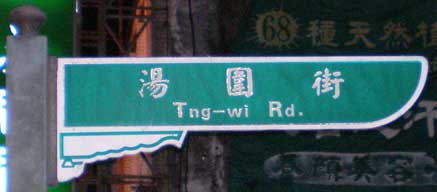
I don’t bother with typos much, but this street sign stood out enough that I wanted to share it with everyone. I took this photo last weekend in Jiaoxi, Yilan County, a town on Taiwan’s east coast that is known for its hot springs (wēnquán). (Nice hiking there, too.) Taiwan’s official signage used to be rife with just this sort of sloppiness; the situation has improved somewhat this decade.

street sign reading '湯圍街 Tng-wi Rd.'

This should be “Tangwei St.” (Tāngwéi Jiē), not “Tng-wi Rd.”

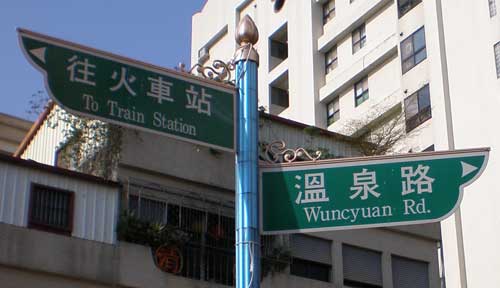
I don’t know how old that sign is. Perhaps it dates from the MPS2 era. I saw only a few more street signs in Jiaoxi, and they were in Tongyong Pinyin, such as this one for what in Hanyu Pinyin would be Wēnquán Lù (Wenquan Road /溫泉路)

two steet signs atop one pole: one reading 'To Train Station', the other 'Wuncyuan Rd'
The strokes in the roman letters are a bit too thin for this sort of use.

Taipei to stick with Hanyu Pinyin, despite pressure from central gov’t: mayor

Taipei Mayor Hau Lung-bin (Hǎo Lóngbīn / 郝龍斌) said on Sunday that Taipei will not switch from Hanyu Pinyin to Tongyong Pinyin, despite pressure from the Ministry of the Interior to do so.

Questioned by reporters at the wedding of Taiwan’s top “Go” player, Hau stressed that the Taipei City Government would continue to use Hanyu Pinyin despite the Interior Ministry’s push as it’s the most commonly used pinyin system in the international community.

“Taipei City has decided to continue using Hanyu Pinyin to connect with other countries in the world,” Hau said.

He suggested that the Interior Ministry consult with linguistic scholars and learn to respect their expertise when standardizing the romanization of Taiwan’s place and street names.

Yes, the MOI would do well to follow this advice — as would the Taipei City Government itself. Taipei’s stupid @#$%! InTerCaPiTaLiZaTion and lack of apostrophes are significant errors. And sometimes the lack of tone marks is a problem. And don’t get me started about Taipei’s “nicknumbering” system.

Taipei City is the only city in Taiwan that has adopted Hanyu Pinyin.

This is incorrect. Several cities around Taiwan use Hanyu Pinyin, such as Xinzhu and Taizhong, though none as consistently as Taipei.

TVBS is reporting that Taipei will be forced to switch, which I very much doubt will happen — certainly not before the presidential election in March 2008.

Nèizhèngbù de xíngzhèng mìnglìng yīdàn bānbù, bùyòng sòngjiāo Lìyuàn tóngyì, Táiběi shìzhèngfǔ zhǐyǒu zhàobàn de fèn, 5 nián qián, Mǎ Yīngjiǔ qiángshì zhǔdǎo Hànyǔ Pīnyīn, ràng Táiběi Shì chéngwéi tā yǎnzhōng, gēn guójì jiēguǐ de dūshì, 5 nián hòu, Nèizhèngbù dìngdìng fǎlìng qiǎngpò zhíxíng, gěi le yī jì huímǎqiāng.

TVBS also gives the cost for changing Taipei’s signs at NT$8 million (US$250,000).

The TVBS video gives lots of pictures of signs.

sources:

Taipei City Government screws the English language again

In addition to skewering Tongyong Pinyin in his latest column, Johnny Neihu reports on a new Web site from the Taipei City Government with bizarre romanization and completely crappy English.

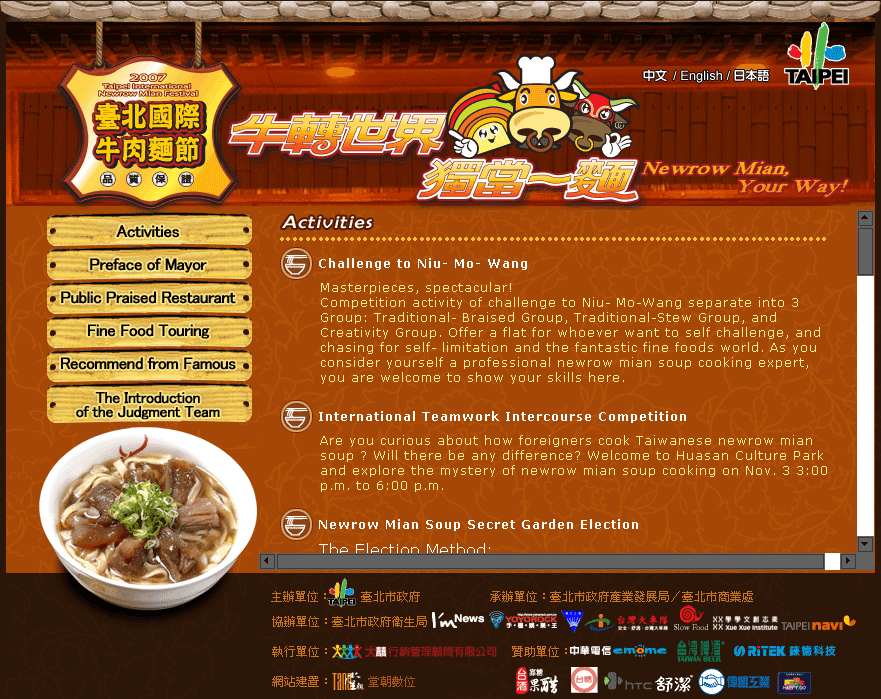
However, it hasn’t taken long for things [in Taipei’s English-language environment] to start deteriorating — 11 months to be precise. Mayor Hau Lung-bin (郝龍斌) has already begun to make his mark, if the English moniker of the metropolis’ most recent culinary fiesta is anything to go by.

I am talking about Taipei’s “Newrow Mian” Festival, which, for those ignorant of Mayor Hau’s personal Romanization system, means beef noodles. “Newrow”? It sounds more like the sort of French-accented Mandarin you would expect from a badly congested Inspector Clouseau if they ever made The Pink Panther in Beijing. But then what can you expect from a mayor with a master’s degree in food science?

Any laowai getting into a cab and asking for a lift to the nearest “newrow” store will no doubt be greeted with a look more vacant than that of Hau at a council meeting.

My guess is that the city government brokered some sort of deal on purchasing livestock for the festival with “La New” of shoes fame. The city got the right to use La New’s dodgy transliteration of the Mandarin word for cow, and so the carcasses were split, with the shoe company getting the leather and the noodle festival getting the beef, so to speak.

But the title of the noodle extravaganza was not the only questionable translation circulating last week. One of the festival’s contests was named the “International Teamwork Intercourse Competition.” What that has to do with beef noodles is anyone’s guess, but I bet the tickets sold pretty fast.

The Web site was set up to promote a “festival” for one of Taipei’s standard foods: niúròumiàn (beef noodle soup / 牛肉麵).

This is yet another example of Taiwan trying to promote its English-language environment by using machine-generated Chinglish, and by coming up with Anglicizations that don’t work as romanizations of Mandarin and mean nothing to local Mandarin speakers. Although the sound of the English word “row” is not too far from that of the Mandarin ròu, “new” for niú is a much bigger stretch. In fact, “new” is probably closer to (女), meaning female, which would give us a female flesh festival (nǚ ròu jié). Maybe the organizers could work in that International Teamwork Intercourse Competition after all. Now that would likely be a successful tourist draw, albeit the wrong sort.

This gives me an excuse to toss in something for lagniappe: niúròu chǎng (牛肉場), which literally means “beef area” but which is actually a slang term for a place with strippers — a place to see “meat” on display. (Compare this with English, in which “beefcake” refers to men, not women.) Even within the not-so-high-class world of strip joints, niurou chang are relatively low class.

According to the 2005 Mandarin-language article linked to below, niurou chang began in Taiwan in 1984. The article also provides an etymolgy, though perhaps an invented one.

Biǎoyǎn de nèiróng dōu gēn niúròu wúguān, wèihé jiào niúròu chǎng?

Yuánlái niúròu de Táiyǔ jiù zuò “yǒu ròu,” suǒyǐ lù “ròu,” mài ròu de suǒzài jiù jiào “niúròu chǎng.” Zhèige bù mài ròu què jiào “niúròu chǎng de sèqíng chǎngsuǒ.”

This states that such places were originally called in Taiwanese “have meat,” which sounds like “reveal flesh.” Perhaps Taffy, A-giâu, or someone else who knows Taiwanese can comment.

Just in case the Taipei City Government should develop a sense of shame and fix the English on this Web site (ha!), click on the image for a screen shot of the first page of the English site.
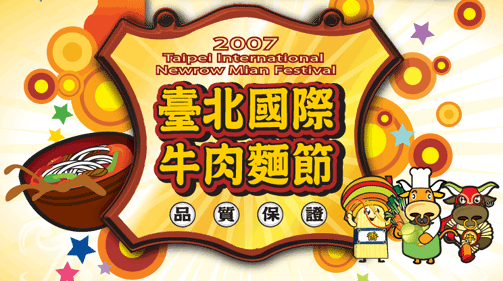
website image reading '2007 Taipei International Newrow Mian Festival' and '臺北國際牛肉麵節' (i.e., Taibei guoji niuroumian jie)

sources: