Malaysia exams not to be restricted to English yet

Plans to have primary and secondary students in Malaysia use only English in their exams for science and mathmatics have been put on hold. Instead, the government’s current policy of allowing students to answer in English, Bahasa Malaysia, or the language of their school (such as “Chinese” or Tamil) will remain in force for at least a few more years, Malaysian Education Minister Datuk Seri Hishammuddin Tun Hussein announced earlier this week.

The teaching of science and math in English has been phased in over several years.

Hishammuddin said secondary students would also continue to have the dual-language option although many of them have a “decent command” of English.

He said the weak students were mostly from the rural areas.

“I will not do things on an ad hoc and piecemeal basis. I want to do it (using English) as a whole.

“I want the foundation to be solid (at the primary level) before we look at the secondary schools,” he said.

He added, however, that many secondary students chose to do the papers in English.

Citing matriculation students, he said 95% of them did their papers in English.

sources:

see also teaching in English in Malaysia, Pinyin News, February 3, 2006

more on Taiwan’s new Tongyong move

This morning all three of Taiwan’s English-language newspapers ran the AP story on the Ministry of the Interior’s plan to expand the use of Tongyong Pinyin. (Bonus points to the copy editor at the Taipei Times who changed the original article’s sloppy “Taiwan will standardize the English transliterations of its Chinese Mandarin place names by the end of the year” to “The Romanization of Mandarin place names will be standardized by the end of this year.”)

I have made a few calls about this, but to little effect so far. Unfortunately, I haven’t had the time today to track down someone at the Ministry of the Interior who can give some definitive information about this.

Meanwhile, here’s another article. It gives a little more information: no intercapping (good), hyphens instead of apostrophes (bad), some screwed-up word parsing (bad).

But all of this sounds like old news. How this will be any different in implementation is still unclear.

Wàijí rénshì lái Táiwān gōngzuò huò lǚyóu, zǒng bèi Táiwān de dìmíng yì xiě gǎo de “wù shàsha,” jiéjú cháng yǐ mílù shōuchǎng. Nèizhèngbù 30 rì gōng bù “biāozhǔn dìmíng yì xiě zhǔnzé” cǎo’àn, míng dìng dìmíng yì xiě yǐ “yīnyì” wèi yuánzé, bìng cǎi “Tōngyòng Pīnyīn” wèi jīzhǔn, ruò dìmíng yǒu lìshǐ, yǔyán, guójì guànyòng, shùzì děng tèxìng, zé yǐ dìmíng xìngzhì fānyì, rú Rìyuè Tán yì wéi “Sun Moon Lake;” 306 gāodì yì wéi “Highland 306.”

Gāi cǎo’àn shì yījù “guótǔ cèhuì fǎ” dìngdìng, bìng nàrù Jiàoyùbù zhìdìng de “Zhōngwén yìyīn shǐyòng yuánzé” zuòwéi yì xiě biāozhǔn, dìmíng yì xiě fāngshì yóu dìmíng zhǔguǎn jīguān zìxíng juédìng.

Cǎo’àn zhǐchū, wèi bìmiǎn yì xiě zhě duì wényì rènzhī bùtóng, chǎnshēng yì xiě chāyì, tǒngyī xíngzhèng qūyù de biāozhǔn yì xiě fāngshì, shěng “Province,” shì “City,” xiàn “County,” xiāng-zhèn “Township,” qū “District,” cūnli “Village.” Jiēdào míngchēng yě tǒngyī yì xiě, dàdào “Boulevard,” lù “Road,” jiē “Street,” xiàng “lane,” nòng “Alley.” Lìrú Kǎidágélán Dàdào wéi “Kaidagelan Boulevard.”

Cǎo’àn míng dìng, biāozhǔn dìmíng de yì xiě cǎi tōngyòng pīnyīn, dàn dìmíng hányǒu “shǔxìng míngchēng” shí, yǐ shǔxìng míngchēng yìyì fāngshì yì xiě, rú Dōng Fēng zhíyì wéi “East Peak.”

Ruò shǔxìng míngchēng yǔ biāozhǔn dìmíng zhěngtǐ shìwéi yī ge zhuānyǒu míngchēng shí, bù lìng yǐ yìyì fāngshì fēnkāi yì xiě, rú “Jiā-Nán dà zùn [zhèn?]” yì wéi “Jianan dazun;” Yángmíng Shān yì wéi “Yangmingshan;” Zhúzi Hú yì wéi “Jhuzihhu.”

Lìngwài dìmíng yǒu dāngdì lìshǐ, yǔyán, fēngsúxíguàn, zōngjiào xìnyǎng, guójì guànyòng huò qítā tèshū yuányīn, jīng zhǔguǎn jīguān bào zhōngyāng zhǔguǎn jīguān hédìng hòu, bù shòu “shǔxìng míngchēng” xiànzhì, rú Yù Shān zhíyì wéi Jade Mountain; zhōngyāng shānmài yì wéi “Central Mountains.”

Cǎo’àn guīdìng, biāozhǔn dìmíng yì xiě shūxiě fāngshì, dì-yī ge zìmǔ dàxiě, qíyú zìmǔ xiǎoxiě, rú bǎnqiáo yì wéi “Banciao,” ér fēi “Ban Ciao” huò “Ban-ciao.” Dàn dìmíng de dì-yī ge zì yǐhòu de pīnyīn zìmǔ, chūxiàn a, o, e shí, yǔ qián dānzì jiān yǐ duǎnxiàn liánjiē, rú Qīlǐ’àn yì wéi “Cili-an,” Rén’ài Xiāng wéi “Ren-ai Township.”

Cǐwài, cǎo’àn yě tǒngyī zìrán dìlǐ shítǐ shǔxìng míngchēng, rú píngyuán, péndì, dǎoyǔ, qúndǎo, liè yǔ, jiāo, tān, shāzhōu, jiǎjiǎo, shān, shānmài, fēng, hé xī, hú, tán děng shíwǔ zhǒng yì xiě fāngshì. Lìrú, Dōngshā Qúndǎo yì wéi “Dongsha Islands;” Diàoyútái liè yǔ “Diaoyutai Archipelago;” Běiwèi Tān “Beiwei Bank;” “Ālǐ Shān shānmài” yì wéi “Alishan Mountains;” zhǔfēng yì wéi “Main Peak;” Shānhútán zhíyì wéi “Shanhu Pond.”

source: Yīngyì yǒu “zhǔn” — lǎowài zhǎo lù bùzài wù shàsha (英譯有「準」 老外找路不再霧煞煞), China Times, October 31, 2007

The Tao of semiotics. Zen and etymology.

Sino-Platonic Papers has rereleased for free Tracks of the Tao, Semantics of Zen (950 KB PDF), by Victor H. Mair.

After a brief introduction, Mair, who has translated more than one classic Taoist text, asks, “How did Tao and Zen enter our vocabulary? And what do these two extraordinarily powerful words really mean?”

He then enters into a “somewhat lengthy excursion into the neglected realm of philology” but keeps to his word to “try to make it as painless and entertaining as possible.”

It’s a fascinating and wide-ranging essay, especially for those interested in historical linguistics.

This is issue no. 17 of Sino-Platonic Papers. It was originally released in April 1990.

Street names in English translation: trend or error?

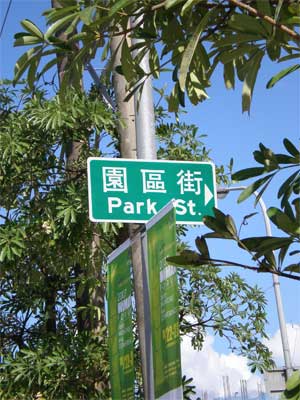
Taipei street sign reading '園區街 Park St.'Ah, Park Street: Taipei’s lovely tree-lined boulevard next to a wonderful oasis of well-manicured nature.
Nope.

Here, “park” refers to Nangang Software Park (Nángǎng Ruǎntǐ Yuánqū, 南港軟體園區), an area in eastern Taipei of new buildings housing mainly software-development and biomedical companies. The software park itself is a pretty nice place and looks fine; its surrounding area, however, is anything but green and leafy, comprising mainly dreary brick buildings and vacant lots.

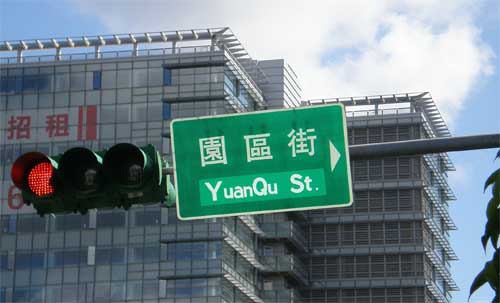
But what’s odder than the name itself is that it appears in English rather than in the mix of Hanyu Pinyin (with StuPid, StuPid InTerCapITaLiZaTion) and English (e.g., St., Rd.) that has become standard in Taipei. Also odd is that at one end of the street the signs read “Park St,” but at the other end “YuanQu St.” This is a fairly new street name, as the software park is only a few years old.

Taipei street sign reading '園區街 YuanQu St.'

The flash on my camera helps reveal that the part of the sign reading “YuanQu St.” is pasted on top of something else — quite possibly “Park St.”

I spent about 15 minutes today getting my phone call to the Taipei City Government transferred from one desk to another before I was able to speak with someone who knew what she was doing. She stated that the Park Street version is in error and would be corrected to Yuanqu Street.

I really wish I’d asked for her extension number, because I’m certain to be making similar calls in the future.

New story in Pinyin: ‘Dashui Guohuo’ (‘After the Flood’)

I’m very pleased to announce that Pinyin Info has a new story in Hanyu Pinyin: “Dàshuǐ Guòhòu,” by Zhang Liqing. It’s available here in two versions: Pinyin alone and Pinyin with English translation (as “After the Flood”), so one doesn’t even have to know Mandarin or Pinyin to read this.

The story recalls a girlhood friend in China, not long after the end of the Second World War.

Zhang is an associate editor of the ABC Chinese-English Comprehensive Dictionary and has translated a number of important works into English, including Zhou Youguang’s The Historical Evolution of Chinese Languages and Scripts and Lü Shuxiang’s Comparing Chinese Characters and a Chinese Spelling Script — an evening conversation on the reform of Chinese characters.

bilingualism among immigrant families in Southern California

Rubén G. Rumbaut of the University of California, Irvine, has written an interesting study titled The Evolution of Language Competencies, Preferences and Use Among Immigrants and their Children in the United States Today (PDF). It was prepared for the U.S. House Subcommittee on Immigration, Citizenship, Refugees, Border Security, and International Law for a hearing in May on immigration reform and U.S. immigrant integration.

Rumbaut’s findings back up the reputation of the United States as a graveyard for languages. The study has much of interest; but for this post I’ll focus just on Asian languages, which Rumbaut said “can be expected to die out at or near the second generation.”

Of special interest to readers of this site are the figures for foreign language fluency among longitudinal samples of young adult children of immigrants, as surveyed in 1992 (age 14), 1995, and 2002 (age 24).

The groups in the longitudinal study are Mexican, Cuban, Nicaraguan, Colombian, Dominican, Haitian, Filipino, Vietnamese, Laotian & Cambodian, and Chinese. Between 1992 and 2002, the percentages of those who said they could speak their foreign language “very well” increased — often substantially — for every group but two: Vietnamese (dropping from 33.8 percent to 29.7 percent) and Chinese (falling much more sharply, from 29.4 percent to 17.6 percent).

The figures for reading and writing also follow a downward trend among Chinese — and only among Chinese. Moreover, Chinese had the lowest rates among the tracked groups for those who can read very well or write very well. In 2002 a mere 2 percent of the Chinese group reported they could write Chinese very well.

‘I now pronounce this character Taiwanese and English’

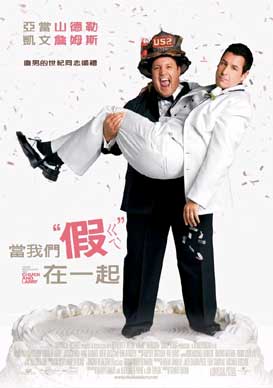
click for larger image of the full movie posterA movie currently doing well at the box office in both the United States and Taiwan is I Now Pronounce You Chuck and Larry. In Taiwan, the film has been given the linguistically interesting title Dāng wǒmen gèi zài yīqǐ (《當我們ㄍㄟˋ在一起》 / 《當我們假在一起》 ).

The title is a Mandarin phrase that uses Taiwanese in order to make a pun involving English — an apt mix for the island.

The movie title is an allusion a well-known children’s song, “Dāng wǒmen tóng zài yīqǐ” (當我們同在一起), which was taken from the English-language children’s song “The More We Are Together.”

The more we get together,
Together, together,
The more we get together,
The happier we’ll be;
For your friends are my friends
And my friends are your friends,
The more we get together,
The happier we’ll be.

This song uses the tune of Ach du lieber Augustin but has radically different words.

close-up of the text described in this post -- with the Getting back to the Taiwanese title, “tóng” (同) of “Dāng wǒmen tóng zài yīqǐ” has been replaced by what in Mandarin is jiǎ (假 — false, fake). But the character 假 has been assigned a Taiwanese reading, gèi, as can be seen by the inclusion of zhuyin fuhao to the right of the character (ㄍㄟˋ = gèi in Hanyu Pinyin).

Gèi is of course meant to call to mind not just the “false” of the relationship in the movie but also the English word “gay” — this being a movie about two men pretending to be a homosexual couple.

In China, where foreign movies often receive titles different from those in Taiwan, the movie is called Wǒ shèngdà de tóngzhì hūnlǐ (《我盛大的同志婚礼》/ My Magnificent Comrade’s Wedding). Although the usual translation for tongzhi is “comrade,” the word has also become Mandarin slang for homosexual. Perhaps some readers can comment on how prominent or passé this use of tongzhi is now.

new book on bilingual education in China

Last month saw the release of Bilingual Education in China: Practices, Policies and Concepts, edited by Anwei Feng (University of Durham).

I have not seen a copy of this yet but thought it might be of interest to some readers of Pinyin News. Here’s the publisher’s description:

This work compares and contrasts two strands of bilingualism in China, one for minority nationality groups, the other for majority. It examines the history, policy, philosophy, politics, provision and practice in bilingual, trilingual or multilingual education involving Mandarin Chinese, English, and minority languages. This volume brings a mixed group of researchers together to discuss issues in bilingual or trilingual education for the majority and minority nationality groups in China and to explore the relationship between the two. Articles range from reports of bilingual or trilingual education projects in remote minority regions to discussions about Chinese-English bilingual education in major economic centres.

For a list of articles in the book, see the table of contents (PDF).

hardback:
ISBN: 1-85359-992-1
13 Digit ISBN: 978-1-85359-992-7

paperback:
ISBN-10: 1853599913
ISBN-13: 978-1853599910