
Taiwan to expand use of Tongyong Pinyin?

The Associated Press is reporting what appears to be an expansion of the Taiwan government’s monumentally misguided promotion of its Tongyong Pinyin romanization system.

No one is answering the phones at the Ministry of the Interior now, and I haven’t been able to find out more information on the Web site yet. But I’ll be following this closely.

The story follows, with a few of my notes in brackets.

Taiwan will standardize the English transliterations of its Chinese Mandarin place names by the end of the year, an official said Wednesday, after years of confusion stemming from multiple spellings.

An official from the Ministry of Interior said the island would use the locally developed “Tongyong,” system in its transliterations, rejecting use of mainland China’s [Hanyu] Pinyin system, and the once common Wade-Giles system, introduced by two Englishmen in the late 19th century.

Over the past decade [Hanyu] Pinyin has gained wide acceptance among foreign students of Chinese, even as Wade-Giles and other foreign systems have diminished in importance.

Taiwan’s Tongyong system is virtually unknown outside the island.

But the Interior Ministry official insisted that Tongyong was still a good choice for a standard transliteration system.

“In the past, diverse spellings have caused confusion, so we have decided to remedy the situation,” he said, speaking on condition of anonymity because he was not authorized to talk to the press.

Multiple transliterations of place names have often caused confusion for non-Chinese-literate visitors to Taiwan.

For example, a busy shopping street in Taipei is variously rendered as Chunghsiao [in bastardized Wade-Giles — but no official signs on this street in Taipei use this system], Zhongxiao [in Hanyu Pinyin] and Jhongsiao [in Tongyong Pinyin — but no official signs on this street in Taipei use this system].

According to Ministry of Interior’s Web site, exceptions to the Tongyong system will still be allowed for some well known tourist attractions, including Jade Mountain in central Taiwan and Taipei’s Yangmingshan [Yangmingshan is the same in Tongyong Pinyin and Hanyu Pinyin, though it is properly written Yangming Shan].

source: Taiwan to standarize English [sic] spellings of place names, AP, via the International Herald Tribune, October 31, 2007

Hong Kong moves to increase teaching in Mandarin, decrease teaching in Cantonese

The Hong Kong government’s Standing Committee on Language Education and Research (“Scolar” — heh) yesterday launched a HK$200 million (US$25.8 million) campaign to help schools use Mandarin as the medium for instruction.

Half of the money will be used to hire extra teachers, with the other half used to bring in mainland teaching experts.

To qualify for this funding, schools must demonstrate competence in teaching “Chinese” in Mandarin and be ready to switch 40 percent of “Chinese language teaching” from Cantonese to Mandarin within three years. The scheme is expected to start at the beginning of the next academic year and last for more than three years.

Each year about 30 primary and 10 secondary schools will be added to the program.

Scolar Chairman Michael Tien Puk-sun said that his committee “has agreed that Putonghua [i.e., Mandarin] should be used as a medium of instruction for Chinese language subjects in the long term.”

This does not bode well for the future of Cantonese.

sources:

Pure Land Buddhism and Amida Buddha: a historical and philological analysis

Sino-Platonic Papers has rereleased for free Life and Light, the Infinite: A Historical and Philological Analysis of the Amida Cult (2.2 MB PDF), by Soho Machida.

Here’s a bit of borrowed biographical information about the author:

Soho Machida spent twenty years as a Zen monk at Daitokuji monastery, Kyoto, before moving to the United States, where he received a master’s degree in theological studies from Harvard University and a Ph.D. from the University of Pennsylvania. He has taught at Princeton University and the National University of Singapore, and is now a professor at the Tokyo University of Foreign Studies. He has written extensively on religion and ethics.

And here’s the table of contents of the work.

  1. Two Names of Amida Buddha
  2. Amida, Amita, or Amrta?
  3. Amida Buddha and Indian Mythology
  4. Which came first, Amitayus or Amitabha?
  5. The Idea of Luminosity in Mahayana Thought
  6. The Encounter of Buddhism and Zoroastrianism
  7. Luminosity and the Cult of Mithra
  8. Parallel Features with Iranian Religion
  9. The Old Religion of the Indo-Iranians
  10. Conclusion
  11. Endnotes
  12. Bibliography

This was originally published in December 1988 as issue no. 9 of Sino-Platonic Papers.

On dictionary compilation and the etymology of loanwords in Sinitic

The latest free reissue by Sino-Platonic Papers is Hànyǔ wàiláicí de yǔyuán kǎozhèng hé cídiǎn biānzuǎn (Philological Research on the Etymology of Loanwords in Sinitic and Dictionary Compilation / 漢語外來詞的語源考證和詞典編纂 / 汉语外来词的语源考证和词典编纂 ), by Xú Wénkān (徐文堪 / Xu Wenkan) of the editorial offices of the Hanyu Da Cidian.

It was first published in February 1993 as issue no. 36 of Sino-Platonic Papers.

This issue is in Mandarin, not English, and is written (by hand) in Chinese characters.

The file of this issue is a 1 MB PDF.

Questions on the origin of writing: SPP 26

a cross potent, which looks like a plus sign with perpendicular stems on the end of each of the four lines, but not so long as to make a cross in a square; image copied from Wikipedia

Sino-Platonic Papers has rereleased another issue related to the history of writing: Questions on the Origins of Writing Raised by the Silk Road (1.0 MB PDF), by Jao Tsung-i (Ráo Zōngyí, 饒宗頤) of the Chinese University of Hong Kong.

This work focuses especially on the use of two symbols, shown at right, in China and elsewhere.

This is issue no. 26 of Sino-Platonic Papers. It was first published in September 1991.

additional reading:

The Tao of semiotics. Zen and etymology.

Sino-Platonic Papers has rereleased for free Tracks of the Tao, Semantics of Zen (950 KB PDF), by Victor H. Mair.

After a brief introduction, Mair, who has translated more than one classic Taoist text, asks, “How did Tao and Zen enter our vocabulary? And what do these two extraordinarily powerful words really mean?”

He then enters into a “somewhat lengthy excursion into the neglected realm of philology” but keeps to his word to “try to make it as painless and entertaining as possible.”

It’s a fascinating and wide-ranging essay, especially for those interested in historical linguistics.

This is issue no. 17 of Sino-Platonic Papers. It was originally released in April 1990.

An apology

Sorry for the horrible state of the coding in my blog recently. WordPress has not acted well since the last upgrade. So far my attempts to fix the situation have been ineffective and, worse still, have made me even slower than usual to respond to e-mail.

I’m working to resolve this.

Street names in English translation: trend or error?

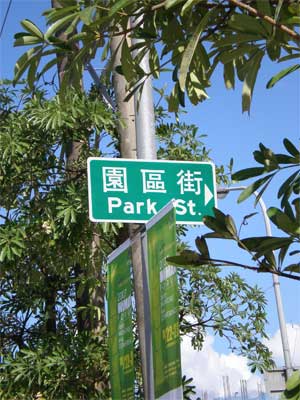
Taipei street sign reading '園區街 Park St.'Ah, Park Street: Taipei’s lovely tree-lined boulevard next to a wonderful oasis of well-manicured nature.
Nope.

Here, “park” refers to Nangang Software Park (Nángǎng Ruǎntǐ Yuánqū, 南港軟體園區), an area in eastern Taipei of new buildings housing mainly software-development and biomedical companies. The software park itself is a pretty nice place and looks fine; its surrounding area, however, is anything but green and leafy, comprising mainly dreary brick buildings and vacant lots.

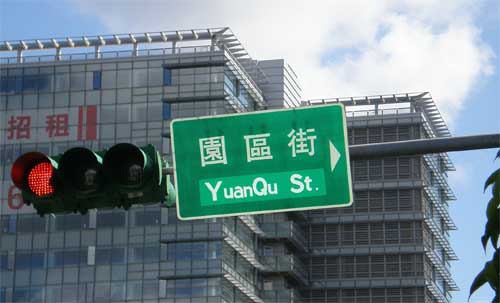
But what’s odder than the name itself is that it appears in English rather than in the mix of Hanyu Pinyin (with StuPid, StuPid InTerCapITaLiZaTion) and English (e.g., St., Rd.) that has become standard in Taipei. Also odd is that at one end of the street the signs read “Park St,” but at the other end “YuanQu St.” This is a fairly new street name, as the software park is only a few years old.

Taipei street sign reading '園區街 YuanQu St.'

The flash on my camera helps reveal that the part of the sign reading “YuanQu St.” is pasted on top of something else — quite possibly “Park St.”

I spent about 15 minutes today getting my phone call to the Taipei City Government transferred from one desk to another before I was able to speak with someone who knew what she was doing. She stated that the Park Street version is in error and would be corrected to Yuanqu Street.

I really wish I’d asked for her extension number, because I’m certain to be making similar calls in the future.