Roddy of Chinese Forums, Signese, Dreams of White Tiles, and even more sites, found a new video (4 min. 40 sec.) of Zhou Youguang speaking, in English, to a reporter from the Guardian.
I was kind of surprised to see this featured on the Guardian’s front page under the ‘Father of Pinyin’ title – I’d wager 9/10ths upwards of the Guardian’s readership doesn’t know what pinyin is. Somewhat unforgivably they’ve managed to spell the guy’s name wrong and not bothered to add tones to the pinyin used in the video, and the interview is pretty weak – basically it’s ‘here’s a nice old Chinese guy talking for a few minutes’ but there’s really very little of depth. They’ve also opted to add subtitles to what sounds to me like perfectly comprehensible English.
But enough negativity, if you want to get a look at the guy who rescued you from bopomofo, have a look.
As happy as I am about the video, I’m going to add a bit more negativity. Failure to get the word parsing correct is also a major error: not “pin yin zhi fu” but “Pīnyīn zhī fù.” Actually, even that isn’t so good, because Pinyin is meant for modern baihua, not the style of Literary Sinitic and its many short forms. Thus, “Pīnyīn de fùqin” would be better.
The accompanying article is amazingly sloppy in parts.
Although the article manages to spell Zhou Youguang’s name correctly, it consistently refers to him not by his family name but by his given name, “Youguang.” It’s almost inconceivable that any reporter in China could (repeatedly) make such an elementary mistake; so perhaps this is the fault of an overzealous copy editor.
I’m not going to sort out and list what’s correct and what’s incorrect in the rest of the article, other than mention one point at the end.
Confusingly, Taiwan uses several different romanisation methods — including a variant of pinyin, tongyong pinyin — and zuiyin.
Zuiyin? Of course what is meant is zhuyin (zhùyīn/註音/注音), which is spelled correctly earlier in the article. Zuiyin (zuìyīn/罪因) is a noun meaning “cause of a crime.”
sources:
- Sound principles: On the 50th anniversary of the introduction of his alphabet, Tania Branigan meets 102-year-old Zhou Youguang, the man credited with helping millions of Chinese to read and write, Guardian, February 21, 2008
- Guardian Interview with “The Father of Pinyin”, Chinese Forums

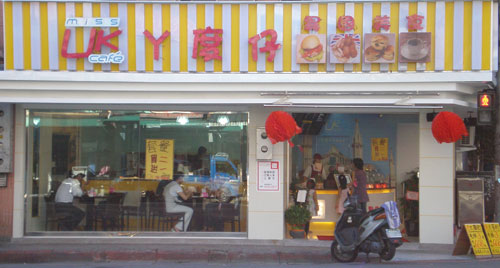
 Something written with three different scripts (Chinese characters, zhuyin, and the roman alphabet) is very much the sort of thing that attracts my attention, as is a product that mixes scripts in its name. So this ad for a new product from Taiwan’s Pizza Hut definitely caught my eye, though it did not inspire me to actually taste the item being touted, which is a rice pizza. (Generally, I do not care for pizzas with Taiwanese characteristics, such as those with peas, corn, or squid. For that matter, I don’t even like pineapple on pizza.)