Japanese
Archived Posts from this Category
news and discussions related to romanization
Archived Posts from this Category
Posted by Pinyin Info on 06 Sep 2008 | Tagged as: Chinese, Hanyu, Japanese, Mandarin, languages, teach Chinese
New Zealand’s Ministry of Education has released figures on secondary school enrollments in foreign languages in 2007, according to a newspaper report.
Education Ministry figures show nearly 70,000 pupils studied foreign languages at secondary schools last year, with 27,284 learning French.
Japanese was also popular (18,440), followed by Spanish (9531) and German (6623).
Chinese… attracted just 1687 pupils.
The total of those figures (63,565) seems considerably shy of “nearly 70,000.” So I suspect some languages more popular than Mandarin have been left off the list. Either way, Mandarin takes only about 2.5 percent of the total. And no indication is given of what percentage of those are “heritage” students.
That’s a lot of kids taking Japanese, though. Can anyone familiar with the situation in New Zealand comment on that?
I wasn’t able to locate the source of these figures. I did, however, find some figures from ten years ago, though they don’t include Mandarin. Also, I don’t understand the categories. But, FWIW:
Numbers of students studying second languages, July 1998
| language | secondary learners | primary & intermediate learners |
|---|---|---|
| Japanese | 21,701 | 13,625 |
| French | 20,990 | 8,413 |
| German | 7,377 | 3,877 |
| Spanish | 2,247 | 5,172 |
A few more lines from the 2008 report:
Under the new curriculum, schools must be “working toward” offering pupils in years 7 to 10 the option of learning a second language from 2011, in a push to make more Kiwis bilingual.
However, the ministry says it is up to schools and their communities to choose which languages are offered - meaning French is likely to remain popular.
A ministry spokesman said measures were underway to boost teachers’ ability to teach a variety of foreign languages in schools.
They included Maori medium scholarship and overseas exchange programmes.
sources:
further reading:
Posted by Pinyin Info on 23 Aug 2008 | Tagged as: Japan, Japanese, kana, languages
The Yomiuri Shimbun reports, “A series of classic works by renowned novelists is proving popular due to innovative designs and the fact the text is printed using lateral text rather than the vertical columns usually used for Japanese novels.”
The first two books in the Meisaku Bungaku (Masterpiece Literature) series are single volume editions of Soseki Natsume’s “Kokoro” (Heart) and Osamu Dazai’s “Ningen Shikkaku” (No Longer Human), both published on Aug. 1.
The venture by the publisher, Goma Books, is aimed at getting young people to read classic fiction in a similar manner to the way they read novels on mobile phones.
The two books feature photographs of actresses on their front covers, and the type is not the usual black, but features colors such as orange and bright green to give the books a casual feel. Such designs, coupled with the horizontal text, have helped the publisher sell more than 50,000 copies of the novels since they were put on sale.
The two books were among 60 novels made available on the Goma Books mobile phone Web site in April last year. They were selected due to their great popularity.
Copyright on all the site’s books has expired because at least 50 years have passed since the death of their authors.
Some site users said they found it easy to read the masterpieces when they were written horizontally rather than vertically. The site attracts about 100 million hits a month, prompting the publisher to put out printed forms of the works.
As well as the switch from vertical to horizontal text, other ideas also were adopted.
Reading ease was taken into account, with the publisher using fewer words per page and more space between lines. Kana syllables are also frequently printed alongside kanji to aid readers.
My favorite bit, in part because I wonder if the first sentence had ever been uttered before, comes next. Or is this a topic that has been hotly debated among the Japanese literati?
“The emotions [of the work] are not lost with lateral writing,” said Yutaka Akiyama–a former editor at publisher Iwanami Shoten–who was responsible for compiling the complete works of Soseki. “Soseki himself wrote his notes horizontally.”
The second batch of three works, which include Ryunosuke Akutagawa’s “Kumo no Ito” (The Spider’s Thread), came out Friday.
source: Laterally printed classics prove hit, Daily Yomiuri Online, August 23, 2008
Posted by Pinyin Info on 18 Aug 2008 | Tagged as: Cantonese, Chinese, Classical Chinese, Hanyu, Hokkien, Hoklo, Japanese, Mandarin, Taiwanese, languages
From the way the U.S. media talk about the boom in Mandarin classes, it’s easy to get the impression that Mandarin is about to become the most studied language in the United States. So I offer the following overdue reality check.
The data come from the results of a large survey of foreign-language enrollments in U.S. post-secondary schools. The survey was conducted by the Modern Language Association. I started work on this post when the results were released in November 2007; but, well, I got distracted.
This post has lots of tables and figures, so for those who don’t want to scan through everything I offer some basic points up front.
A few summary remarks of my own:
OK, now on to some details.
Look below at the growth for American Sign Language since 1990. If Mandarin had had that sort of growth (4,820 percent!) the pundits would no doubt be telling us that the Chinese had already taken over the planet and were going to rule the entire galaxy within the next decade. (And don’t get me started about the supposed Mandarin in Serenity/Firefly.) But American Sign Language just doesn’t seem to get the same sort of respect, despite the fact that it still has more than 50 percent more enrollments than Mandarin. Arabic, which has also had a much faster growth rate than that of Mandarin, hasn’t received the same level of hype either.
| Enrollments | 1990 | 2006 | % Growth 2002-06 | % Growth 1990-2006 |
|---|---|---|---|---|
| American Sign Language | 1,602 | 78,829 | 29.7 | 4820.7 |
| Arabic | 3,475 | 23,974 | 126.5 | 589.9 |
| Korean | 2,286 | 7,145 | 37.1 | 212.6 |
| Mandarin | 19,490 | 51,582 | 51.0 | 164.7 |
| Hebrew | 12,995 | 23,752 | 4.2 | 82.8 |
| Portuguese | 6,211 | 10,267 | 22.4 | 65.3 |
| Italian | 49,699 | 78,368 | 22.6 | 57.7 |
| Spanish | 533,944 | 822,985 | 10.3 | 54.1 |
| Japanese | 45,717 | 66,605 | 27.5 | 45.7 |
| French | 272,472 | 206,426 | 2.2 | -24.2 |
| German | 133,348 | 94,264 | 3.5 | -29.3 |
| Russian | 44,626 | 24,845 | 3.9 | -44.3 |
| Total | 1,125,865 | 1,489,042 | 12.7 | 32.3 |
| Change between Surveys | 1995-98 | 1998-2002 | 2002-06 |
|---|---|---|---|
| Spanish | 8.3% | 13.7% | 10.3% |
| French | -3.1% | 1.5% | 2.2% |
| German | -7.5% | 2.3% | 3.5% |
| American Sign Language | 165.3% | 432.2% | 29.7% |
| Italian | 12.6% | 29.6% | 22.6% |
| Japanese | -3.5% | 21.1% | 27.5% |
| Mandarin | 7.5% | 20.0% | 51.0% |
| Russian | -3.8% | 0.5% | 3.9% |
| Arabic | 23.9% | 92.3% | 126.5% |
| Hebrew * | 20.6% | 44.0% | 4.2% |
| Portuguese | 6.0% | 21.1% | 22.4% |
| Korean | 34.0% | 16.3% | 37.1% |
| Total | 5.0% | 16.6% | 12.7% |
* Modern and Biblical Hebrew combined
Below: Russian may not have the top number of enrollments, but it certainly has some motivated students, given the high numbers of them in advanced courses.
| Intro Enr. | Advanced Enr. | Total Enrollment | Ratio of Intro Enr. to Advanced Enr. | |
|---|---|---|---|---|
| Russian | 17,527 | 6,569 | 24,096 | 2.67:1 |
| Portuguese | 7,387 | 2,422 | 9,809 | 3.05:1 |
| German | 72,434 | 18,758 | 91,192 | 3.86:1 |
| French | 160,736 | 40,927 | 201,663 | 3.93:1 |
| Korean | 5,511 | 1,397 | 6,908 | 3.94:1 |
| Greek, Ancient | 13,250 | 3,176 | 16,426 | 4.17:1 |
| Mandarin | 41,193 | 9,262 | 50,455 | 4.45:1 |
| Spanish | 669,432 | 142,602 | 812,034 | 4.69:1 |
| Japanese | 55,161 | 10,585 | 65,746 | 5.21:1 |
| Latin | 26,787 | 4,383 | 31,170 | 6.11:1 |
| Hebrew, Modern | 7,665 | 1,250 | 8,915 | 6.13:1 |
| Arabic | 20,571 | 2,463 | 23,034 | 8.35:1 |
| Italian | 69,757 | 7,593 | 77,350 | 9.19:1 |
| Hebrew, Biblical | 7,854 | 705 | 8,559 | 11.14:1 |
| American Sign Language | 72,694 | 5,249 | 77,943 | 13.85:1 |
| Other languages | 27,836 | 3,478 | 31,314 | 8.00:1 |
| Total | 1,275,795 | 260,819 | 1,536,614 | 4.89:1 |
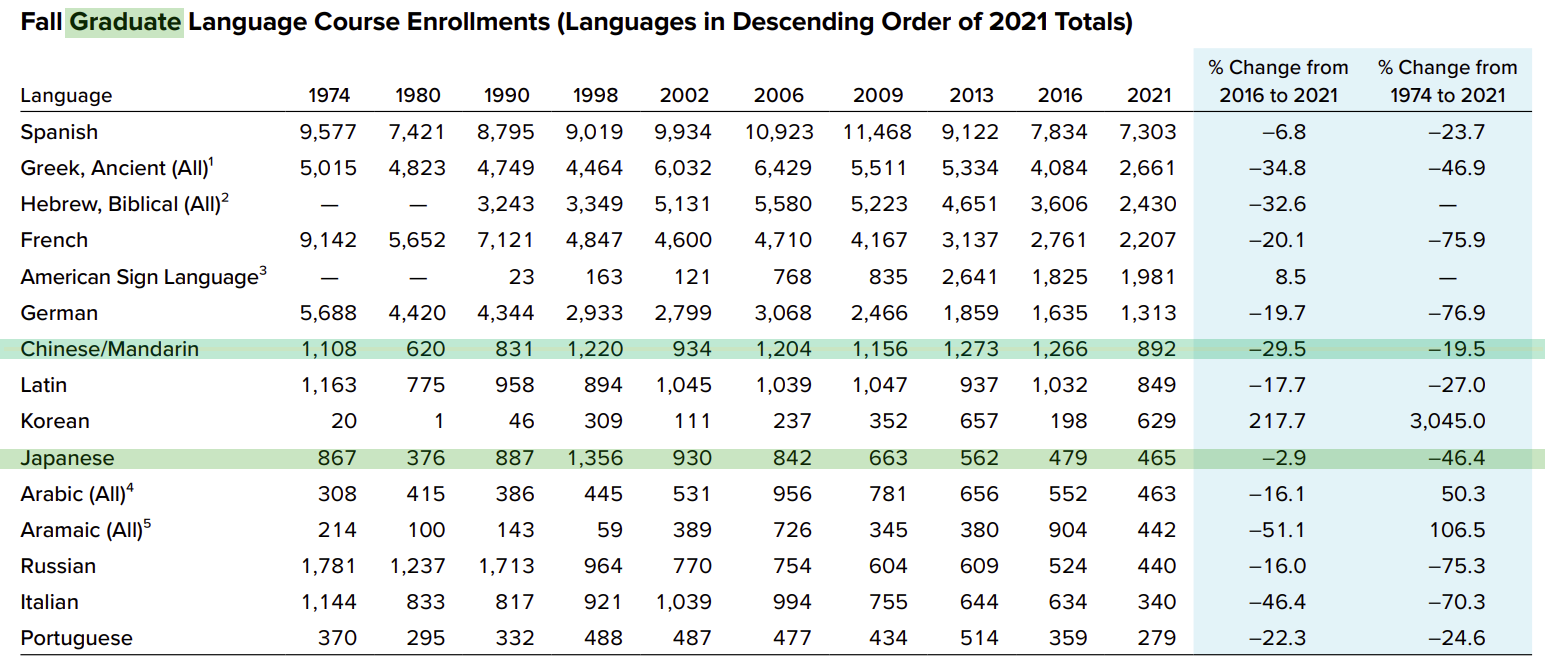
One thing I find particularly troubling is that the number of graduate students studying Mandarin has fallen. (Please click on the link in the previous sentence, since the relevant table is too wide to fit on this page.) The much-ballyhooed but also much-deserved increase in students studying Mandarin has all been at the undergraduate level. Given that the grad enrollment as a percentage of total enrollment for Mandarin is about the same as that for French (2.63 percent and 2.73 percent, respectively) it might appear that Mandarin has simply reached a “normal” ratio in this regard. But native speakers of English generally need much more time to master Mandarin than to master French. Simply put, four years, say, of post-secondary study of French provides students with a much greater level of fluency than four years of post-secondary study of Mandarin.
Also, there is a great deal more work that needs to be done in terms of translations from Mandarin. I do not at all mean to belittle the work being done in French — or in any other language. In fact it pains me that the MLA’s list of languages being studied included neither Old French nor Provençal, both of which I have studied and love dearly. I just mean that Mandarin has historically been underrepresented in U.S. universities given the number of speakers it has and its body of texts that have not yet been translated into English. U.S. universities need to be producing many more qualified grad students who can handle this specialized work. And right now, unfortunately, that’s not happening.
| Two-Year Colleges | Undergrad Programs | Grad Programs | Total | |||||
|---|---|---|---|---|---|---|---|---|
| Language | 2002 | 2006 | 2002 | 2006 | 2002 | 2006 | 2002 | 2006 |
| Cantonese | 47 | 96 | 128 | 82 | 5 | 0 | 180 | 178 |
| Literary Sinitic | 0 | 0 | 56 | 101 | 18 | 12 | 74 | 113 |
| Japanese, Classical | 0 | 0 | 8 | 23 | 11 | 7 | 19 | 30 |
| Taiwanese | 0 | 0 | 34 | 21 | 13 | 0 | 47 | 21 |
| Tibetan | 0 | 0 | 43 | 56 | 35 | 64 | 78 | 120 |
| Tibetan, Classical | 0 | 0 | 8 | 11 | 20 | 33 | 28 | 44 |
The figures in the table above are probably too low. Literary Sinitic (”classical Chinese”) is probably especially underrepresented because often too little differentiation is given between it and modern standard Mandarin. But at least the numbers can provide minimum figures.
| Language | Ratio of Intro Enr. in 2-Year Schools to Intro Enr. in 4-Year Schools |
|---|---|
| Greek, Ancient | 0.00:1 |
| Hebrew, Biblical | 0.01:1 |
| Latin | 0.04:1 |
| Hebrew, Modern | 0.07:1 |
| Portuguese | 0.11:1 |
| Russian | 0.15:1 |
| German | 0.20:1 |
| Italian | 0.23:1 |
| French | 0.24:1 |
| Arabic | 0.26:1 |
| Mandarin | 0.26:1 |
| Korean | 0.28:1 |
| Japanese | 0.39:1 |
| Spanish | 0.49:1 |
| American Sign Language | 1.47:1 |
| Other languages | 0.24:1 |
American Sign Language sticks out here as the only language that more people take at the introductory level at junior colleges than at universities. Roughly twice as many people take introductory Spanish in universities as at junior colleges. Introductory Japanese classes are surprisingly popular at the two-year college level, well above the level for introductory Mandarin, though Mandarin is not unpopular itself.
| Language | 1998 | 2002 | 2006 | % Change 2002–06 |
|---|---|---|---|---|
| Hindi/Urdu | 1314 | 2009 | 2683 | 33.55 |
| Vietnamese | 899 | 2236 | 2485 | 11.14 |
| Tagalog/Filipino | 794 | 1142 | 1569 | 37.39 |
| Sanskrit | 363 | 487 | 607 | 24.64 |
| Hmong | 15 | 283 | 402 | 42.05 |
| Thai | 272 | 330 | 307 | -6.97 |
| Indonesian | 223 | 225 | 301 | 33.78 |
| Samoan | 207 | 201 | 280 | 39.30 |
| Cantonese | 39 | 180 | 178 | -1.11 |
| Tibetan | 80 | 78 | 120 | 53.85 |
| Literary Sinitic | 32 | 74 | 113 | 52.70 |
| Pashto | – | 14 | 103 | 635.71 |
| Punjabi | 32 | 99 | 103 | 4.04 |
| Total | 4270 | 7358 | 9251 | 25.73 |
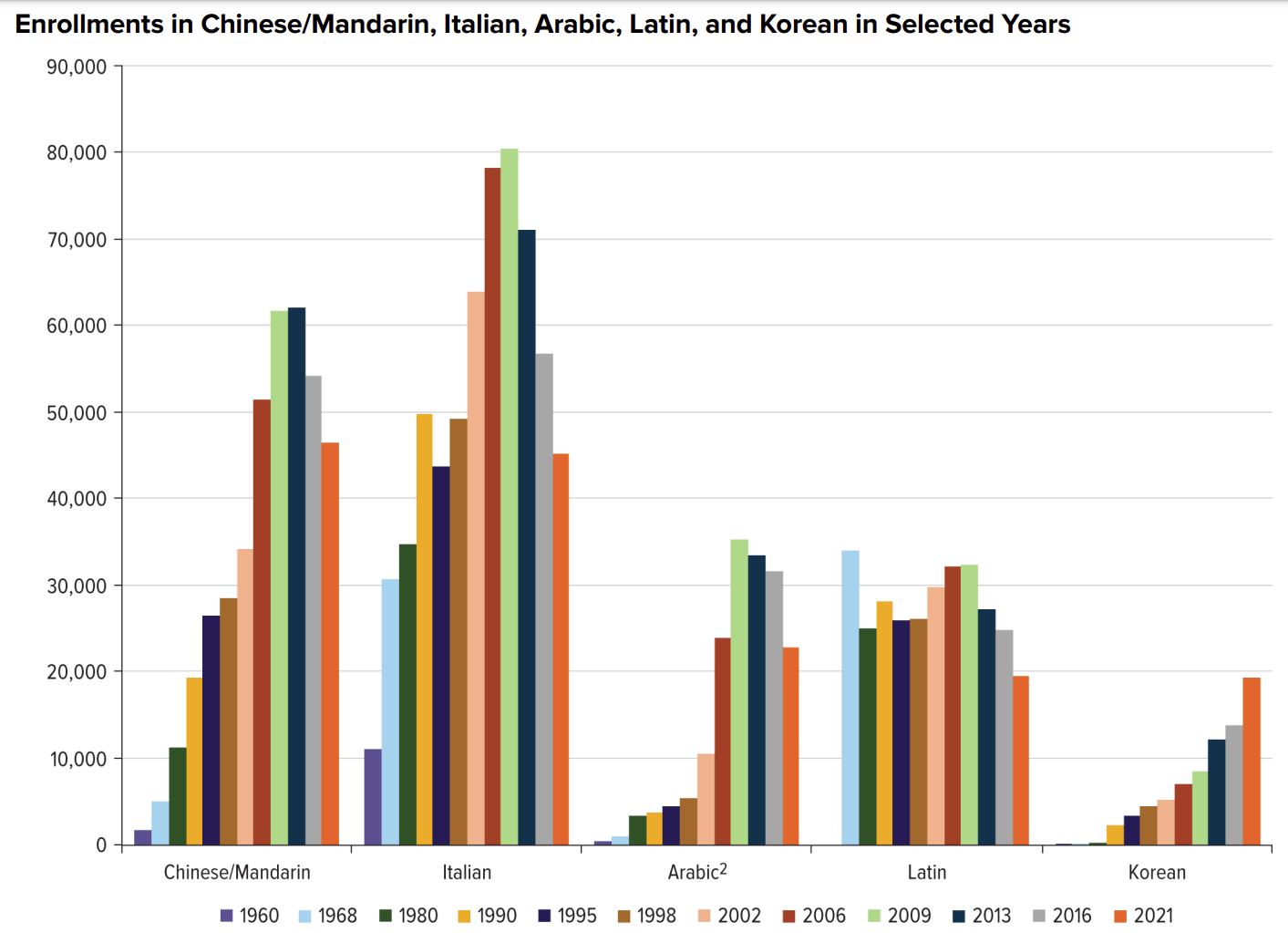
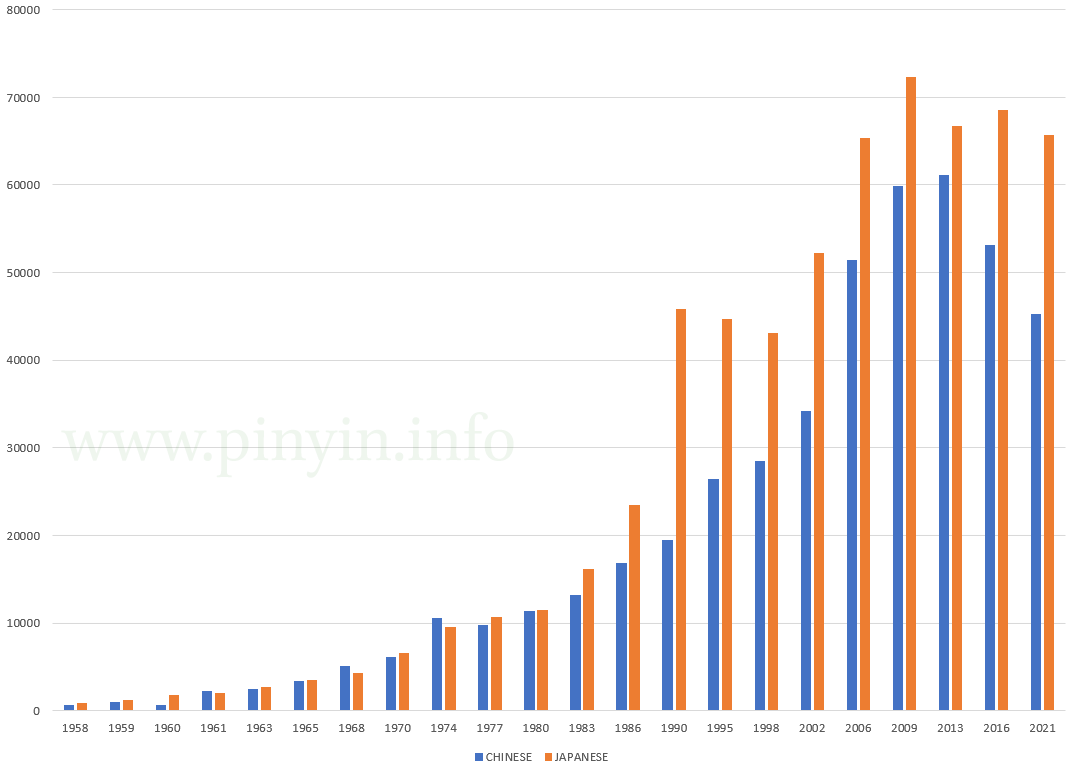
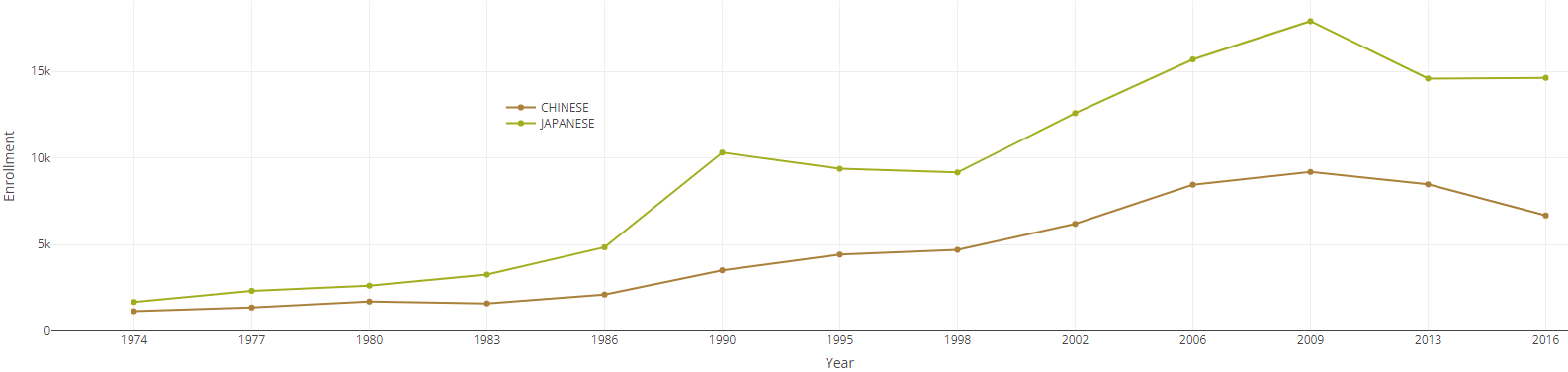
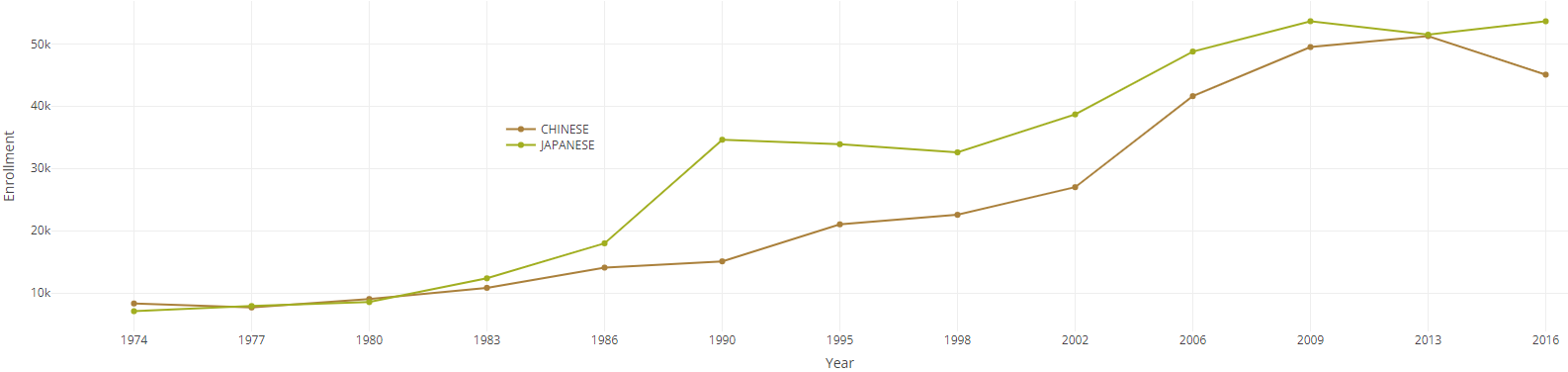
Although more U.S. postsecondary students are studying languages other than English than ever before, that’s unfortunately not because U.S. students as a whole have finally embraced the study of languages. Rather, there are simply more students now. Relatively speaking, enrollments in foreign languages are much lower than they were 30 years ago.

If “ancient” foreign languages such as Latin and Ancient Greek were included in the graph, the imbalance between the 1960s and the present in foreign-language enrollments would be even greater.
source: Enrollments in Languages Other Than English in United States Institutions of Higher Education, Fall 2006 (PDF), MLA, November 13, 2007
Posted by Pinyin Info on 14 Feb 2008 | Tagged as: Chinese, Hanyu, Japanese, Latin, Mandarin, languages, teach Chinese
2007 was the first year that the U.S. College Board offered an Advanced Placement (AP) exam for “Chinese Language and Culture.” It was also the first year students could take an AP exam in “Japanese Language and Culture.”
Data for the results as a whole have just been released. The figures for Mandarin are remarkably lopsided.
A total of 81.1 percent of those taking the exam for Mandarin and Chinese culture achieved the top score of 5, a much higher percentage than with any other test. The subject with the second highest percentage of 5’s was Japanese (43.4 percent), followed by Electricity and Magnetism (33.8 percent), Mechanics (26.1 percent), and German (24.4 percent). In most other subjects a score of 5 was achieved by only about 10 percent to 20 percent of test takers.
Let’s look at those who achieved only the lowest score (1). Here, too, Mandarin stands out, with by far the lowest percentage of test takers with this score (1.5 percent). Next are Drawing, 2-D Design, and 3-D Design (5.8 percent); English Language and Composition (10.9 percent); and Calculus BC (13.5 percent). Most subjects have “1″ rates in the 20s.
Comparison of Scores Across Language Exams

Comparison of Lowest Scores Across Language Exams

So, does this indicate Mandarin isn’t damn hard for students after all or that the perfect pedagogy for this subject has been reached? Of course not.
Only 11.1 percent of the 3,260 people taking the Mandarin exam did not indicate on their test that they “regularly speak or hear the foreign language of the examination at home, or that they have lived for one month or more in a country where the language is spoken.”
Percent of test takers who “regularly speak or hear the foreign language of the examination at home” or “have lived for one month or more in a country where the language is spoken”

Thus, it’s no surprise to see that 89.4 percent of those taking the Mandarin exam identified themselves as “Asian, Asian American, or Pacific Islander.” Of all those across the entire United States who took the Mandarin exam last year, only 363 people did not identify themselves as falling within that category. This certainly does not match the hype about Mandarin as the foreign language being studied.
While I congratulate those who scored well on the exam (Chinese characters can certainly be a pain to learn regardless of your background), the test — and perhaps the curriculum, too — evidently needs considerable revision, which isn’t too surprising considering this was its first appearance. I’m a bit saddened, though, to see that more students from a wider variety of backgrounds aren’t taking up the challenge of Mandarin.
There doesn’t appear to be much of a gender imbalance, however, in AP Mandarin classes.
Percentages of students in AP language exams, by sex

Within a week or two I’ll be posting some interesting figures about U.S. post-secondary enrollments in Mandarin and other languages.
source: The 4th Annual AP Report to the Nation, College Board, February 13, 2008
Posted by Pinyin Info on 09 Dec 2007 | Tagged as: Chinese characters, Japan, Japanese, computers, kana, kanji, languages, writing systems
A Japanese man who says he invented the technology behind the context-based conversion of a sentence written solely in kana into one in both kanji and kana, as well as another related technology, filed suit against Toshiba on December 7, seeking some US$2.3 million in compensation from his former employer.
Shinya Amano, a professor at Shonan Institute of Technology, said in a written complaint that although the firm received patents for the technologies in conjunction with him and three others and paid him tens of thousands of yen annually in remuneration, he actually developed the technologies alone.
Amano is claiming 10 percent of an estimated ¥2.6 billion in profit Toshiba made in 1996 and 1997 — much higher than the roughly ¥230,000 he was actually awarded for the work over the two-year span.
His claim is believed valid, taking into account the statute of limitations and the terms of the patents.
“This is not about the sum of the money — I filed the suit for my honor,” Amano said in a press conference after bringing the case to the Tokyo District Court.
“Japan is a technology-oriented country, but engineers are treated too lightly here,” he said.
Toshiba said through its public relations office that it believes it paid Amano fair compensation in line with company policy. The company declined to comment on the lawsuit before receiving the complaint in writing.
Amano claims that he invented the technology that converts a sentence composed of kana alone into a sentence composed of both kanji and kana by assessing its context, and another technology needed to prioritize kanji previously used in such conversions.
Using theories of artificial intelligence, the two technologies developed in 1977 and 1978 are still used today in most Japanese word-processing software, he said.
source: Word-processor inventor sues Toshiba over redress, Kyodo News, via Japan Times, December 9, 2007
Posted by Pinyin Info on 06 Nov 2007 | Tagged as: China, Chinese, Chinese characters, Japan, Japanese, Korea, Korean, Taiwan, languages, writing systems
Many Web sites in China are running the story that Chinese, Japanese, Korean, and Taiwanese scholars have reached an agreement on unification of Chinese characters — and that this involves using many traditional characters.
If any “agreement” has indeed been reached, it probably won’t mean much, if anything at all — certainly not to the government of China. But the number of sites running this story and the prominence of some of the members of the PRC delegation make me wonder if this might just be a little more than much ado about nothing.
Zhōng xīn wǎng 11 yuè 5 rì diàn jù hǎiwài méitǐ pīlù, shǔyú Hànzì wénhuà quān de Zhōngguó, Rìběn, Hánguó Sānguó hé Zhōngguó Táiwān dìqū de xuézhě juédìng zhìzuò tǒngyī zìxíng (wénzì de xíngzhuàng) de 5000-6000 ge chángyòng Hànzì biāozhǔn zì.
Hánguó “Cháoxiǎn rìbào” kānzǎi wénzì jí shìpín bàodào chēng, dì-bā jiè “guójì Hànzì yántǎohuì” shàngzhōu zài Zhōngguó Běijīng chuánméi dàxué lóngzhòng zhàokāi, huìyì yóu Zhōngguó Jiàoyùbù yǔyán wénzì yìngyòng yánjiūsuǒ hé guójiā Hànyǔ guójì tuīguǎng lǐngdǎo xiǎozǔ bàngōngshì zhǔbàn. Huìyì jìhuà jiāng Yuènán, Mǎláixīyà, Xīnjiāpō, Xiāng Gǎng, Àomén xīshōu wéi xīn huìyuán, kuòdà Hànzì shǐyòng guójiā huò dìqū de cānyù fànwéi. Huìyì juédìng zhìzuò gè guójiā dìqū Hànzì “bǐjiào yánjiū cídiǎn”, zhújiàn tǒngyī gèguó shǐyòng de zìxíng. Huìyì hái jiù míngnián zài shǒu ěr jǔxíng dì jiǔ jiè yántǎohuì, gèguó fēnbié shèzhì 3 míng liánluòyuán (yánjiū fùzérén) dáchéng le xiéyì.
Jù bàodào, “guójì Hànzì yántǎohuì” yú 1991 nián fāqǐ. Qí mùdìzàiyú, yùfáng Dōngyà guójiā yīnwèi shǐyòng Zhōngguó Táiwān de fántǐzì, Zhōngguó de jiǎntǐzì, Rìběn de lüèzì děng bùtóng xíngzhuàng de Hànzì chǎnshēng hùnluàn, quèdìng chángyòng Hànzì de zìshù, tuījìn zìxíng biāozhǔnhuà (tǒngyī).
Běnjiè huìyì yǔ 2003 nián zài Rìběn Dōngjīng jǔxíng de dì-qī jiè yántǎohuì xiānggé 4 nián. Jù bàodào, běn cì huìyì tíyì, 5000 duō ge chángyòng biāozhǔn zì jiāng yǐ “fántǐzì” wéizhǔ jìnxíng tǒngyī, rúguǒ gèbié Hànzì yǒu jiǎntǐzì, jiù jìxù bǎoliú.
Chūxí cǐcì huìyì de Zhōngfāng dàibiǎo yǒu Wáng Tiěkūn (Jiàoyùbù yǔyán wénzì xìnxī guǎnlǐ sī fù sīzhǎng, Zhōngguó Wénzì Xuéhuì fùhuìzhǎng jiān mìshūzhǎng), Huáng Dékuān (Ānhuī Dàxué xiàozhǎng, Zhōngguó Wénzì Xuéhuì huìzhǎng), Sū Péichéng (Běijīng Dàxué jiàoshòu), Lǐ Dàsuì (Běijīng Dàxué jiàoshòu); Hánguó fāng dàibiǎo yǒu Lǐ Dàchún (Guójì Hànzì Zhènxīng Xiéhuì huìzhǎng), Lǐ Yīngbǎi (Shǒu’ěr Dàxué míngyù jiàoshòu), Jiāng Xìnhàng (Chéngjūnguǎn Dàxué míngyù jiàoshòu), Chén Tàixià (Rénjǐ Dàxué shǒuxí jiàoshòu), Jīn Yànzhōng (Gāolí Dàxué jiàoshòu); Rìběn fāng dàibiǎo yǒu Zuǒténg Gòngyuè (Zhùbō Dàxué jiàoshòu), Qīngyuán Chúnpíng (qīnshàn bù huìzhǎng); Zhōngguó Táiwān dìqū [sic] dàibiǎo yǒu Xǔ Xuérén (“Zhōngguó Wénzì Xiéhuì” lǐshìzhǎng).
source: Zhōngguo, Rìběn, Hánguó yǔ Zhōngguó Táiwān dìqū xuéjiè jiù “tǒngyī Hànzì” dáchéng xiéyì (中日韩与中国台湾地区学界就“统一汉字”达成协议), November 5, 2007
Posted by Pinyin Info on 06 Nov 2007 | Tagged as: Chinese, Chinese characters, Japanese, computers, hanja, kanji
A submission to the Unicode Consortium’s Ideographic [sic] Variation Database for the “Combined registration of the Adobe-Japan1 collection and of sequences in that collection” is available for review through November 25. This submission, PRI 108, is a revision of PRI 98.
This set “enumerates 23,058 glyphs” and contains 14,664 tetragraphs (Chinese characters / kanji). About three quarters of Unicode pertains to Chinese characters.
Two sets of charts are available: the complete one (4.4 MB PDF), which shows all the submitted sequences, and the partial one (776 KB PDF), which shows “only the characters for which multiple sequences are submitted.”
Below is a more or less random sample of some of the tetragraphs.
Initially I was going to combine this announcement with a rant against Unicode’s continued misuse of the term “ideographic.” But I’ve decided to save that for a separate post.

Posted by Pinyin Info on 25 Sep 2007 | Tagged as: Buddhism, China, Chinese, Classical Chinese, India, Japanese, Korean, Mandarin, Sino-Platonic Papers, Tibet, Victor H. Mair, dictionary, languages, linguistics
Sino-Platonic Papers has rereleased for free another book-length back issue: A Partial Bibliography for the Study of Indian Influence on Chinese Popular Literature (10.8 MB PDF), by Victor H. Mair.
Here are the contents:
The introduction is also online in quick-loading HTML format.
This was first published in March 1987 as issue no. 3 of Sino-Platonic Papers.