Kindles and Pinyin

Sure, Amazon Kindles can store thousands of books, play mp3 files, provide Web access, and allow one to spend money on books with alarming ease. But can they handle Pinyin?

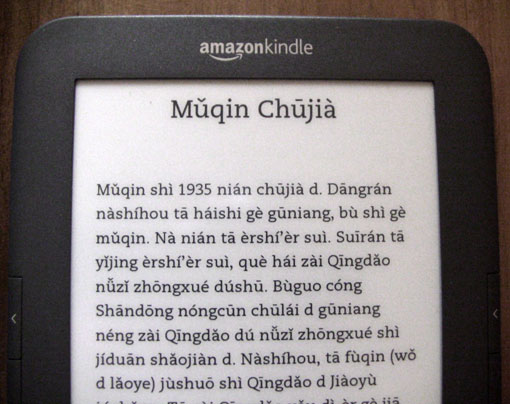
photo of a Kindle 3 displaying the opening of 'Muqin Chujia' -- showing that all tone marks appear correctly

Yes!

This test was made on a Kindle 3 purchased at a U.S. retail store. All three typefaces — regular, condensed, and sans serif — worked well.

Yes, Kindles can display Hanzi as well — though there may be some problems with those appearing correctly in book titles in the device’s index.

Below are links to my files, in case you want to test this yourself. I’d appreciate hearing about how Nook and other devices handle this. Thanks.

Script font for Pinyin

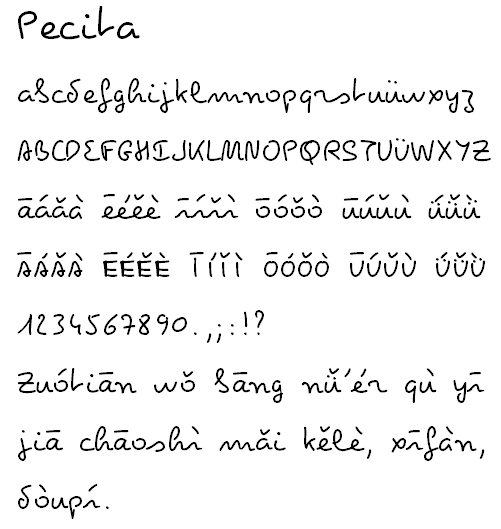
Unfortunately, relatively few fonts support Hanyu Pinyin (with tone marks, that is). So I was surprised to come across Pecita, by Philippe Cochy. This is the first script typeface I recall seeing that covers Pinyin … and a lot more.

It might be too individualistic for much Pinyin use. But I’m very glad to know it exists and hope to see many more creations like it.

GIF of Pecita in action: A-Z, a-z, plus the diacritics used in Pinyin and a pinyin pangram

Pecita is licensed under the SIL Open Font License, Version 1.1.

Additional links:

Google Web fonts and Hanyu Pinyin

Back in the last century, getting Web browsers to correctly display Pinyin was such a troublesome task that I remember once even employing GIFs of first- and third-tone letters to get those to look right. So there were a whole lotta IMG tags in my text. Sure, I put the necessary info in ALT tags (e.g., “alt=’a3′”), just in case. But, still, I shudder to recall having to resort to that particular hack.

Things are better now, though still far from ideal. Something that promises to considerably improve the situation of website viewers not all having the same font you may wish to use is CSS3’s @font-face, which allows those creating Web pages to employ fonts that are provided online. Google is helping with this through its Google Web Fonts. (Current count: 252 font families.)

But is anything in Google’s collection capable of dealing with Hanyu Pinyin? Armed with a handy-dandy Pinyin pangram, I had a look at what Google has made available.

Not surprisingly, most of the 29 font families marked as offering the “Latin Extended” character set failed to handle the entire Hanyu Pinyin set. The ??? group is the most likely to be unsupported at present, with third-tone vowels also frequently missing.

Here are the Google Web fonts that do support Hanyu Pinyin with tone marks:
Serifs

  • EB Garamond (227 KB)
  • Gentium Basic (263 KB — and about the same for each of the three accompanying styles: italic, bold, bold italic)
  • Gentium Book Basic (267 KB — and about the same for each of the three accompanying styles: italic, bold, bold italic)
  • Neuton (56 KB — and about the same for each of the five accompanying styles: italic, bold, light, extra light, extra bold)

screenshot of the Pinyin fonts above

Note:

  • Neuton has relatively weak tone marks, so I wouldn’t recommend it for Web pages aimed at beginning students of Mandarin.

Sans Serifs

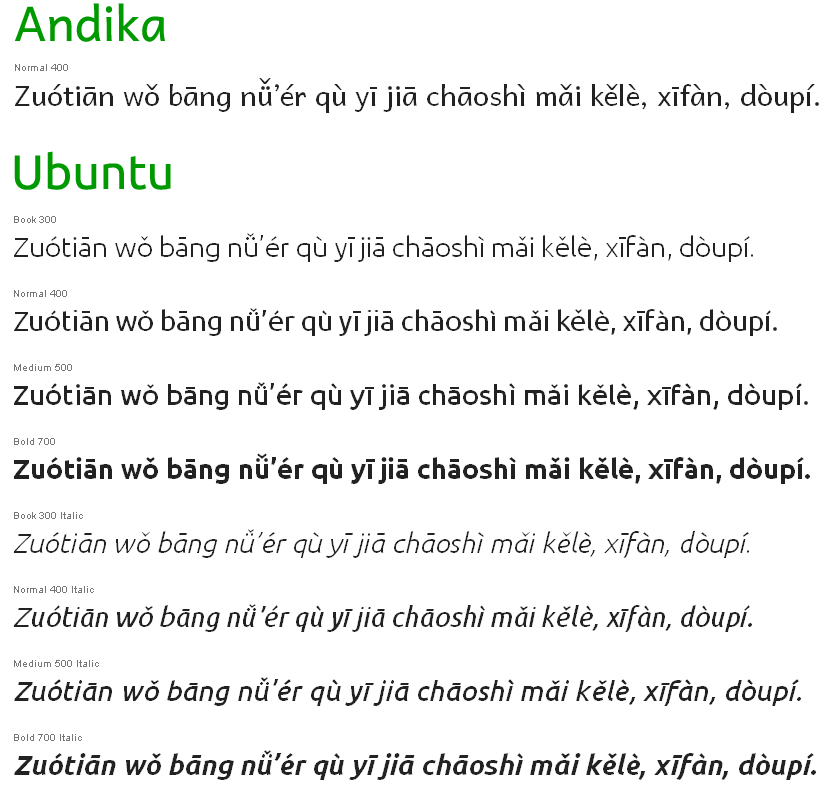
  • Andika (1.4 MB)
  • Ubuntu (350 KB) — available in eight styles

screenshot of the Pinyin fonts above

Some Ubuntu sample PDFs: Ubuntu regular, Ubuntu italic, Ubuntu bold, Ubuntu bold italic, Ubuntu light, Ubuntu light italic, Ubuntu medium, Ubuntu medium italic.

Andika sample PDF.

Note:

  • Andika’s relatively large size (1.4 MB) makes it unsuitable for @font-face use because of download time. (Its license, however, would permit someone with the time and energy to crack it open and remove lots of the glyphs not needed for Pinyin, thus reducing the size.) More fundamentally, though, I don’t much like the look of it; but YMMV.

Since Google is likely to expand the number of fonts it offers, I’m including the list of all 29 faces I tried for this experiment, which should make it easier for those wanting to test only new fonts. (It is possible, however, that Pinyin support will be added later to some fonts that fail in this area now. If anyone hears of any such changes, please let me know.) Use of bold indicates Pinyin support; everything else failed.

Display Faces with Latin Extended (all fail)

  • Abril Fatface
  • Forum
  • Kelly Slab
  • Lobster
  • MedievalSharp
  • Modern Antiqua
  • Ruslan Display
  • Tenor Sans

Handwriting Faces with Latin Extended (all fail)

  • Patrick Hand

Serif Faces with Latin Extended

  • Cardo
  • Caudex
  • EB Garamond
  • Gentium Basic
  • Gentium Book Basic
  • Neuton
  • Playfair Display
  • Sorts Mill Goudy

Sans Serif Faces with Latin Extended

  • Andika
  • Anonymous Pro
  • Anton
  • Didact Gothic
  • Francois One
  • Istok Web
  • Jura
  • Open Sans
  • Open Sans Condensed
  • Play
  • Ubuntu
  • Varela

Additional resource: SIL Fonts for downloading (including the full versions of Andika and Gentium).

Taiwanese romanization used for Hanzi input method

Since I just posted about the new Hakka-based Chinese character input method I would be amiss not to note as well the release early this year of a different Chinese character input method based on Taiwanese romanization.

This one is available in Windows, Mac, and Linux flavors.

See the FAQ and documents below for more information (Mandarin only).

Táiwān Mǐnnányǔ Hànzì shūrùfǎ 2.0 bǎn xiàzài (臺灣閩南語漢字輸入法 2.0版下載) [Readers may wish to note the use of Minnan, which is generally preferred among unificationists and some advocates of Hakka and the languages of Taiwan’s tribes.]

source: Jiàoyùbù Táiwān Mǐnnányǔ Hànzì shūrùfǎ (教育部臺灣閩南語漢字輸入法); Ministry of Education, Taiwan; June 16, 2010(?) / February 14, 2011(?) [Perhaps the Windows and Linux versions came first, with the Mac version following in 2011.]

Hakka romanization used for new Hanzi input method

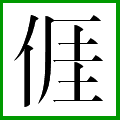
Chinese character associated with Hakka morpheme ngǎiTaiwan’s Ministry of Education has released software for Windows and Linux systems that uses Hakka romanization for the inputting of Chinese characters.

This appears to be aimed mainly at those who wish to input Hanzi used primarily in writing Hakka, such as that shown here.

See also Taiwanese romanization used for Hanzi input method.

sources:

Pinyin pangram challenge

One of the many things I plan to do eventually is to put up some graphics of how Pinyin looks in various font faces. A Pinyin pangram would do nicely for a sample text. You know: a short Mandarin sentence in Hanyu Pinyin that uses all of the following 26 letters: abcdefghijklmnopqrstuüwxyz (i.e., the English alphabet’s a-z, minus v but plus ü).

But then I couldn’t find one. So I put the question out to some people I know and quickly got back two Pinyin pangrams.

Ruanwo bushi yingzuo; putongfan bushi xican; maibuqi lüde kan jusede. (57 letters)

and

Zuotian wo bang wo de pengyou Lü Xisheng qu chengli mai yi wan doufuru he ban zhi kaoji. (70 letters)

from Robert Sanders and Cynthia Ning, respectively.

James Dew weighed in with some helpful advice. And, with some additional help from the original two contributors and my wife, I made some additional modifications, eventually resulting in a variant reduced to 48 letters:

Zuotian wo bang nü’er qu yi jia chaoshi mai kele, xifan, doupi.

With tone marks, that’s “Zuótiān wǒ bāng nǚ’ér qù yī jiā chāoshì mǎi kělè, xīfàn, dòupí.”

I suppose xīfàn is not really the sort of thing one buys at a chāoshì. On the other hand, people probably don’t worry much about whether jackdaws really do love someone’s big sphinx of quartz, so I think we’re OK. Still, something shorter than 48 letters should be possible — though pangram-friendly brevity is more easily accomplished in English than in Mandarin as spelled in Hanyu Pinyin. As one correspondent noted:

Most of the “excess” letters are vowels. Trouble is that Chinese doesn’t pile up the consonants much. Brown, for example, takes care of b, r, w, and n, while only expending one little o…. There’s no word like string in Chinese (5 consonants; one vowel). Chinese piles up vowels: zuotian and chaoshi and doufu and kaoji all use more vowels than consonants.

I’m challenging readers to come up with more Pinyin pangrams.

But I don’t want this to be a reversed shi shi shi stunt, so let’s stay away from Literary Sinitic. And I’d prefer the equivalent of “The quick brown fox jumps over the lazy dog” to that of “Cwm fjord veg balks nth pyx quiz.” In other words, wherever possible this should be in real-world, sayable Mandarin.

One possible variant on this would be to use “abcdefghijklmnopqrstuüwxyz” plus all the forms with diacritics āáǎàēéěèīíǐìōóǒòūúǔùǘǚǜ.” (No ǖ — first-tone ü, that is — is necessary.) But that would be even more work.

Those who devise good pangrams will will be covered in róngyào — or something like that.

Happy hunting.

DPP position on romanization

(BTW, this is my 7 KB JPG version of the 442 KB(!) BMP(!) file used on the DPP's site.)With Taiwan’s presidential election less than six months away and various position papers being issued, perhaps it’s time to take a look at where the opposition stands on romanization.

Sure, various politicians rant from time to time. But they may or may not be taken seriously. What about the party itself and its candidate?

Google doesn’t find any instances of “拼音” (“pīnyīn”) on the official Web site of the Democratic Progressive Party’s presidential candidate, Tsai Ing-wen (Cài Yīngwén / 蔡英文). But searching for “拼音” on the DPP’s official Web site does yield at least a few results. (See the “sources” at the end of this piece.) It’s probably no surprise that none of them contain anything but bad news for those who support Taiwan’s continued use of Hanyu Pinyin.

Typical is the “e-paper” piece from 2008 that states the change to Hanyu Pinyin will cost NT$7 billion (about US$240 million). (If the DPP candidate wins, will the DPP follow its own assertions and logic and say that it would be far too expensive for Taiwan to change from the existing Hanyu Pinyin to Tongyong Pinyin?) I have no more faith in that inflated figure than I have in the other claims there, such as that the use of Hanyu Pinyin would not be convenient for foreigners and that there is no relationship between internationalization and using the world’s one and only significant romanization system for Mandarin (Hanyu Pinyin).

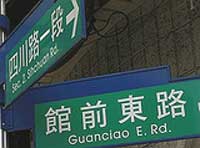
Then there’s the delicious irony that the image of a Tongyong Pinyin street sign the DPP chose to use in that anti-Hanyu Pinyin message has a typo! The sign, shown at top right, should read Guancian, not Guanciao. (In Hanyu Pinyin it would be “Guanqian.”) That’s right: The DPP says Taiwan needs to use Tongyong — but the supposed expert who put together that very argument apparently doesn’t know the difference between Tongyong Pinyin and a hole in the wall..

That document is a few years old, though. What about something more recent? Just three months ago the DPP spokesman, Chen Qimai (Chen Chi-mai / 陳其邁), complained that the Ma Ying-jeou administration had replaced Tongyong Pinyin with Hanyu Pinyin, calling this an example of removing Taiwan culture and abandoning Taiwan’s sovereignty. So there’s nothing to indicate a change in position over time.

It’s worth remembering that there’s a lot of blame to go around for the inconsistencies and sloppiness that characterize Taiwan’s romanization situation. Historically speaking, the KMT is certainly responsible for much of the mess. And the Ma administration’s willingness to go along with “New Taipei City” instead of “Xinbei,” “Tamsui” instead of “Danshui,” and “Lukang” instead of “Lugang” demonstrates that it is OK with cutting back its own policy in favor of Hanyu Pinyin. Nevertheless, it’s now the DPP — or at least some very loud and opinionated people within it — that represents the main force for screwing up perfectly good signage, etc.

Back when I was more often around DPP politicians, I would occasionally ask them privately about their opinions of Hanyu Pinyin. For the most part, they had no opposition to Taiwan’s use of it, regarding this as simply a practical matter. But they would not say so publicly because President Chen Shui-bian’s dumping of Ovid Tzeng made it clear what fate would meet those who opposed Chen on this issue.

Even though Chen is no longer in the picture, I fear that many in the DPP have come to believe their own propaganda on this issue.

I urge individuals (esp. those with known pro-green sentiments) and organizations (Hey, ECCT and AmCham: that means you especially!) that want to avoid a return to the national embarrassment that is Tongyong Pinyin to tell Cai Yingwen and the DPP now that Taiwan’s continued use of Hanyu Pinyin is simply good policy and is supported by the vast majority of the foreign community here, including pro-green foreigners.

sources: