Pioneer Mandarin ‘immersion’ program sinking?

Some eleven years after it began, what is touted as the first U.S. elementary school Mandarin immersion program is reportedly in trouble.

In September 1996, Montgomery County [Maryland] started what it promoted as the first Mandarin Chinese immersion program for elementary students in the country. The program at Potomac Elementary School became a national model, and acclaim and fame followed.

Today, the original class of first-graders are seniors preparing for college. Many continued to study Chinese in middle and high school, but most dropped out in recent years — a handful as late as this fall — citing confusion in the curriculum and difficulties with the instructor. Now, just three of the first 22 students continue to study Chinese at the cluster’s high school….

Critics say there is a lack of resources and appropriate materials, poor coordination among grade levels and inadequate teacher development. There’s even disagreement among educators on what immersion is.

“Immersion can mean many things to different people in the field,” said Elena Izquierdo, vice president of the District-based nonprofit National Association for Bilingual Education and a professor at the University of Texas at El Paso. “For some, immersion is total immersion, for others it is partial, and some people call one class in foreign language an immersion class.”

It is also important to define the goal of each program; all are not the same, Izquierdo said. Some aim for complete reading, writing and oral proficiency in a foreign language; others might be geared to gaining conversational skills.

At first, the Chinese immersion students at Potomac were “a school within a school,” sticking together from kindergarten through fifth grade. Principal Linda Goldberg changed the format when she arrived in 2002, believing that students learning Chinese needed more interaction with the other students.

Today, 137 students at Potomac, from kindergarten to fifth grade, take math and science in Chinese and other subjects in English, she said.

Judith Klimpl, supervisor of foreign languages for Montgomery public schools, said math and science were chosen because the subjects are taught with many hands-on activities and have concrete vocabulary. There is no intensive grammar or writing instruction in Chinese at this level.

Once students move to Hoover Middle School, lessons in language acquisition intensify, Principal Billie-Jean Bensen said. The students, who used to have two periods in Chinese, now have one, including an “immersion class” in the sixth grade. But, Bensen conceded, the title of the class is probably “not correct.” A single class shouldn’t be labeled immersion, she said.

.

Children at Potomac Elementary who enroll in the Chinese partial immersion program are taught mathematics and science in the Chinese language, but not the language itself. The result, parents say, is a familiarity with the language and enhanced listening skills when they reach middle school and a more formal language program begins….

The transition to middle school, and then from middle school to high school, lies at the heart of the program’s problems.

“There’s definitely issues with transitioning from Potomac Elementary to Hoover and from Hoover to Churchill,” said Sees. “If you look at the dropout rate in the high school itself, it’s abysmal.”

Immersion students take an immersion class in sixth grade and then are filtered into the standard one-period-per-day Chinese language classes with students who were not in an immersion program in seventh grade, said Hoover Principal Billie-Jean Bensen. They then continue in that traditional language course structure in high school. Schick said that the transition process at Hoover has improved in the last two years.

The first three levels of Chinese language instruction in the county’s schools are generally completed in middle school and the first year of high school, said Duffield….

sources and further reading:

Taiwanese, eh?

I’m so far behind on posts that when Taffy of Tailingua sent this to me people in Taipei probably really were wearing short sleeves. They’re certainly not wearing so little now, with the cold, damp, miserable weather we’ve been having lately. Oh well, at least it’s better than what so many people have been having to endure in China. I hope Pinyin News readers there are keeping warm and didn’t get stuck in some transportation-related hell.
photo discussed in this post -- large blue text against a white background, Ma and Siew shown from the waist up with their arms crossed; a blue bird on the left
This poster on the back of a bus is for Taiwan’s presidential campaign.

It reads:

Táiwān ei lìliang
Shìjiè dǎ tōngguān

Mǎ Yīngjiǔ — Xiāo Wàncháng

.

台灣ㄟ力量
世界打通關

馬英九 蕭萬長

It’s hard to put this into English that makes sense. Perhaps “Taiwan shows its power to the world.” The idea is something like “Taiwan can overcome all obstacles.” It doesn’t strike me as a good slogan. But maybe I’m missing something.

The interesting part is that it has Taiwanese written with zhuyin (bopomofo): ㄟ (ei). But the ㄟ is basically just for show, since it doesn’t serve any linguistic purpose that the expected Chinese character — 的 (de), indicating the possessive — wouldn’t provide. The sign is still in Mandarin. (Dǎ tōngguān, for example, is not a Taiwanese expression, according to several native speakers I questioned about this.)

For those who don’t know, Mǎ Yīngjiǔ and Xiāo Wàncháng comprise the KMT’s ticket for next month’s presidential election.

Both Ma and Xiao use unusual spellings for the way they write their names in the Roman alphabet: Ma Ying-jeou and Vincent Siew, respectively.

The “Ying-jeou” of Ma’s name gives the appearance of Gwoyeu Romatzyh. But in that system his name would be “Maa Ing-jeou.”

“Siew” for Hanyu Pinyin’s Xiāo indicates that the source is likely a language other than Mandarin. But Taiwanese isn’t it, though Siew, unlike Ma, was born here. Because of that spelling, many foreigners in Taiwan pronounce his family name like the English word “shoe.” “Vincent” is of course an “English name” rather than a romanization of his birth name.

As I’m fond of pointing out, perhaps the only prominent Taiwan politician whose name is recognizably Hanyu Pinyin and only Hanyu Pinyin is President Chen Shui-bian, the man most responsible for seeing that Taiwan did not adopt Hanyu Pinyin during his tenure.

Language, writing, and tradition in Iran: SPP

The most recent rerelease from Sino-Platonic Papers is Language, Writing, and Tradition in Iran (1.5 MB PDF), by David A. Utz.

In discussing language, writing, and tradition in Iran, we must begin with some clarification. What we, want to examine is the crystallization and development of a particular method and pattern of scribal practice, and its implications and consequences for the historical development and legacy of a particular cultural tradition. For this purpose we need to consider a particular geographical area, Iran, which for our purposes includes not only the modern Islamic Republic of Iran, but also Afghanistan, Armenia, and much of Central Asia. Furthermore, we are particularly concerned with a specific span of time, from the early Achaemenian period in the latter half of the 6th century B.C.E. until the progressive advent of Islam in these regions during the 7th-l0th centuries C.E. Throughout this period, the paramount characteristic of language and writing was that they were separate and distinct: language was not writing and writing was not language.

The semi-independent development of writing became a powerful historical factor influencing tradition in this region. Moreover, orthographic systems and methods tend to define, at least for modern scholarship, distinctions between so-called Old, Middle, and New Iranian languages. Examples of Old Iranian languages are Old Persian and Avestan. Examples of Middle Iranian languages are Middle Persian, Parthian, Sogdian, Khwarezmian, Khotanese, and Bactrian. Examples of New Iranian languages are Persian (including Farsi, Dari, and Tajiki), Pashtu, Baluchi, so-called “Kurdish” (in its disparate manifestations), as well as more obscure languages such as Ossetic, Yaghnobi, and the various Pamir languages. For our present purposes, we will be primarily concerned with Middle Iranian languages. Language, itself, did not become an historical force of consequence until the 20th century, due primarily to the introduction of 19th century European ideas about language and ethnicity and their exploitation for purely utilitarian political purposes by 20th century governments in this entire region.

To better understand the highly idiosyncratic development of writing in Iran in this crucial period, it may be helpful to see it in the larger context of one of the major operative factors in the formation of Iranian culture and tradition: the process of incessant dialectic and synthesis of the indigenous heritage of the Iranians, especially their distinctive religious and ethical ideology, and the accumulated traditions and methods of the Ancient Near East, especially the urban and mercantile society of Syria and Mesopotamia. Furthermore, it might be most effective to illustrate this process with a specific non-linguistic, non-scribal example: two specific major concepts within the Iranian view of history as presented in the Šāhnāma of Abu’l-Qāsim Firdausī. Although this work, which contains the history of the Iranians from creation until the Arab conquest, was completed only in the very early 11th century, the historical ideas and information it embodies originate from late Sasanian times (i.e., at the end of the particular span of time we want to consider) and from Sasanian historiographical works such as the Kārnāmak i Artaxšēr i Pāpakān and the famous Xuatāi-nāmak, translated into Arabic by Ibnu’l-Muqaffa` in the 8th century and used extensively by Islamic historiographers such as aṭ-Ṭabarī. It should be pointed out in passing that, even if these concepts originate in the late Sasanian environment and in some sense reflect the self-image of that time and place, it is puzzling that some of them, such as Cosmic Kingship, exemplified in the Šāhnāma especially by the four kings of the Pīšdādiyān dynasty [Kayūmars̱, Hūšang, Tahmūras̱, and Jamšīd], do not at all reflect the reality of that environment….

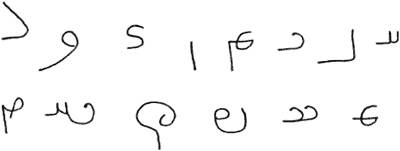
Sample of late Sasanian book script, commonly called “Book Pahlavi.”
basic character set of the late Sasanian book script

This is issue no. 24 of Sino-Platonic Papers. It was first published in August 1991.

Pinyin in/as art

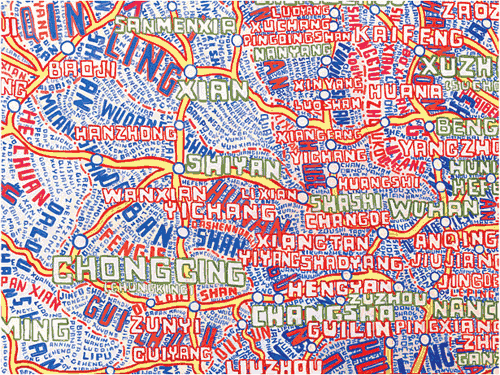
close-up of the map of China, by Paula Scher, with the densely packed names of the cities and towns (often written in a filled-in-outline style) making up the bulk of the painting
Detail of the painting China (2006), by Paula Scher.

The map has a few misspellings; but that’s not what’s important here.

Paula Scher has made some other works that might especially appeal to those interested in scripts, especially her terrific Publikum Calendar for 2007. It’s the sort of thing I think Languagehat would have hanging on his wall. (This is a Flash site, so I can’t provide a better link. Click on “2007” near the bottom right of the screen, and then click on the names of individual months.)

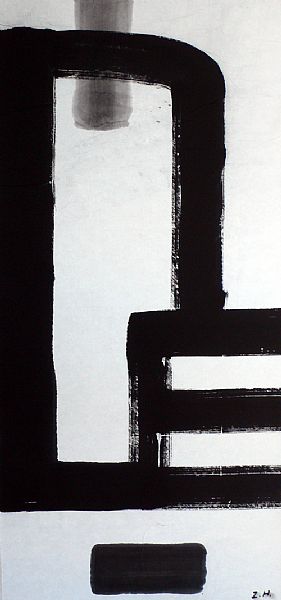
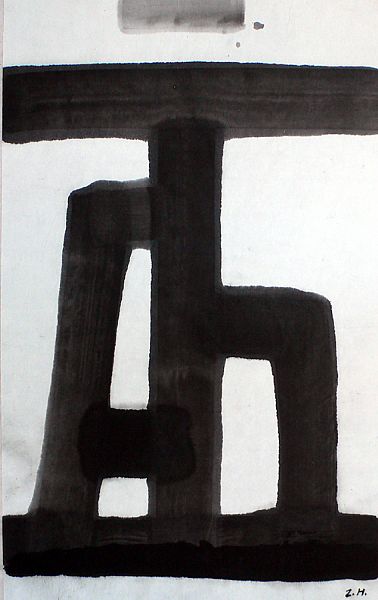
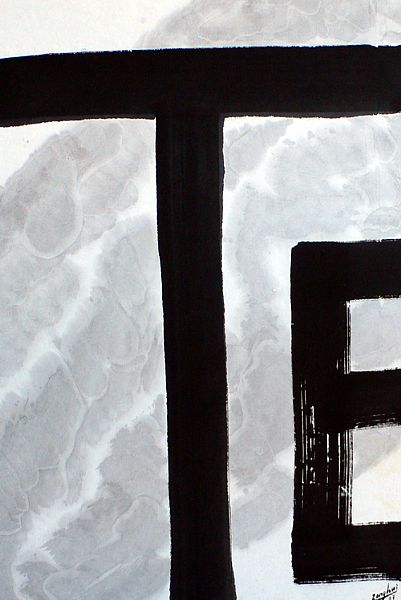
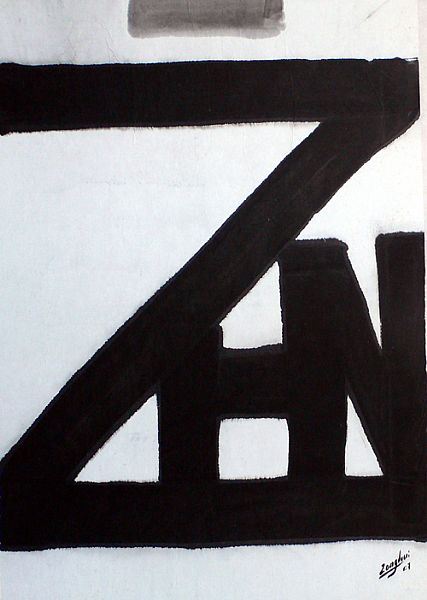
image of 'DE' in Chinese ink on rice paper. Click for larger image.The artist Xu Zonghui (Xú Zōnghuī / 徐宗揮 / 徐宗挥) takes a different approach, starting from the Chinese tradition of ink on rice paper. A few of his works in a recent show in Spain use the Roman alphabet, one with Hanyu Pinyin’s “de.”

Here are a few others with the Roman alphabet:
Chinese-style ink-on-rice-paper image of the word 'TAO'Chinese-style ink-on-rice-paper image of the word 'TE'Chinese-style ink-on-rice-paper image of the word 'ZEN'

What, no “Ching” (Jing)?

sources and further reading/viewing:

The Art of War: a new translation

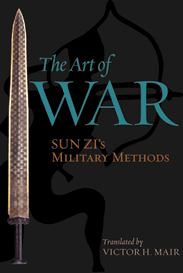
cover illustration for 'The Art of War', translated by Victor H. MairColumbia University Press recently published what I hope will become recognized as the standard English translation of the Art of War (Sūnzǐ Bīngfǎ / 孫子兵法). This is by my friend Victor H. Mair of the University of Pennsylvania’s department of Asian and Middle Eastern studies.

With the permission of the author and publisher, I offer below two excerpts from this work.

But first a bit of information from the publisher’s page for this title.

Victor Mair’s translation is the first to remain true to the original structure and essential style of the text.

Mair’s fidelity to the original, along with his insightful commentary and reliance on archaeologically recovered manuscripts, breaks new ground in solving The Art of War‘s difficult textual and contextual problems. He confronts complex questions concerning the authorship of the work, asserting that Sun Wu, a supposed strategist of the Spring and Autumn period (770-476 B.C.E.) to whom the text is traditionally attributed, never existed. Instead, Mair claims that The Art of War coalesced over a period of around seventy-five years, from the middle of the fourth century to the first quarter of the third century B.C.E.

Mair also reveals the way The Art of War reflects historical developments in technological and military strategy in civilizations throughout Eurasia, especially in regards to iron metallurgy. He demonstrates the close link between the philosophy in The Art of War and Taoism and discusses the reception of the text from the classical period to today. Finally, Mair highlights previously unaddressed stylistic and statistical aspects and includes philological annotations that present new ways of approaching the intellectual and social background of the work.

The book also features a foreword by Arthur Waldron that compares and contrasts Sun Zi and Clausewitz (1780-1831).

For those who would rather read the selections below in the original format, they are also available as PDFs:

Please note that at the time of this writing, Amazon’s “search inside” function for this book is screwed up. Instead it uses someone else’s translation. So don’t order what is listed on that site as the paperback edition; because it is the wrong book. (As of February 2008 there is no paperback of Mair’s translation.) But ordering what Amazon lists as the hardback should get you the correct book (ISBN: 978-0-231-13382-1). Or order directly from the publisher should your local bookstores not have this in stock.

OK, now here are the excerpts I promised.

Key Terms

Here are highlighted only several of the more important words and subtle concepts used in the book. Other technical terms and proper nouns are defined in the notes or in the introduction. For a superb handbook of basic Chinese philosophical terms, including many that are featured in the Sun Zi, see Zhang Dainian, Key Concepts in Chinese Philosophy, trans. Edmund Ryden.

From The Art of War: Sun Zi’s Military Methods, translated by Victor H. Mair, © 2007 by Columbia University Press. Used by permission of Columbia University Press.

[Webmaster’s note: As Mair notes elsewhere, giving the pronunciations in Pinyin for Modern Standard Mandarin is “purely a convention of modern scholarship and does not reflect at all the pronunciation of Sinitic during the late Warring States period when this text was compiled.”]

bian. Variation, variety, transformation.

bing. The earliest form of the character used to write this word depicts two arms holding up an adze. The basic idea conveyed by this graph subsequently developed from the concrete and limited to the more general and abstract: weapon ? soldier ? troops ? war.

fa. Law, method, model.

bing. The earliest form of the character used to write this word depicts two arms holding up an adze. The basic idea conveyed by this graph subsequently developed from the concrete and limited to the more general and abstract: weapon → soldier → troops → war.

fa. Law, method, model.

bingfa. The combination of the previous two terms, it is usually rendered as “art of war” in English but may more literally be rendered as “soldierly methods,” “military methods,” etc. For further discussion of bingfa, see the introduction, n. 2.

gui. Deceit, deception; something contrary to the norm.

. Pivot, moment of change (functions somewhat like a tipping point); the instant just before a new development or shift occurs; the nodal point of a situation in flux. also refers to the first, imperceptible beginning of movement in an unstable situation. In organic metaphors, it means “seed, germ.” The sage or superior man can recognize the immanence or incipience of these crucial moments before they become manifest to others. It cannot be stressed too heavily that by itself does not mean “opportunity” nor does it mean “crisis,” although it is closer to the latter than to the former because of the extreme instability of a given situation and the unforeseen consequences that may follow.

. Count, calculate; plan; intention. Another word in the Sun Zi sometimes rendered as “plan” is mou (as in the title of chap. 3), though it tends more in the direction of “scheme” or “counsel.” Depending upon the context, and mou may also convey the idea of “strategy” or “stratagem.”

. A traditional measure of length equivalent to 300 paces (hence “tricent” in English). It is easy to think of how long a tricent is (about a third of a mile) by recalling that the English word “mile” is derived from Latin milia, millia (“a thousand [paces]”). For those who are not familiar with miles, a tricent is equal to approximately half a kilometer.

. Advantage, benefit; profit, interest (the basic meaning is “sharp,” which is why the character used to write it has a “knife” radical).

mou. See .

. Unformed, energetic substrate of matter; material energy; the primal “stuff ” of the universe; configural energy. In the Sun Zi, it usually refers to the vital force, energy, or morale of the men in the army. For more information on and its metaphysical implications, see Mair (1990:137–38) and Zhang (2002:45–63).

. See zheng.

quan. Power, expedient (assessment)—exerted by the commander in the field. The literal meaning of the morpheme is “horizontal balance,” hence “weigh, judge, (exert) power / authority.” Quan is often associated with bian or (qq.v.).

shi. Configuration, circumstances, efficacy, inertia, power / force (of circumstances), authority, (strategic / positional) advantage. The subject of chap. 5, but also discussed elsewhere in the text, this is one of the key concepts of the Sun Zi. It is also one of the most ineffable.

tianxia. All under heaven, i.e., the empire (writ large).

wen. Civil, culture (contrasts with wu). The evolution of the primary meanings of the graph used to write this word, in simplest terms, is as follows: tattoo → pattern → culture / civilization / writing. The earliest meaning of wen as “tattoo” still survives in the expression wen shen (“tattoo the body”). By the time of the Warring States period, however, when the Sun Zi was written, tattooing had become a form of punishment, and different words were used to refer to it, wen itself having transmuted into one of the most exalted terms in the language. See chapter 9, n. 12 and the biography of Sun Bin in the introduction.

wu. Martial, military (contrasts with wen). The character used to write this word shows a shafted weapon and a foot, i.e., a man going off to fight in a war.

xing. Form, shape, disposition. One of the most important tactical concepts in the Sun Zi, it occurs with particularly high frequency in chapter 6, where it means mainly the arrangement of forces, and in chapter 10, where it signifies different types of terrain. There is another word, meaning “punishment,” that is pronounced exactly alike (xing) and is written with a very similar character that one might well expect to find in a work of strategy such as the Sun Zi, but it does not occur even once. The xing meaning “form, shape, disposition” occurs a total of thirty-one times in the Sun Zi. In stark contrast, the xing meaning “punishment” occurs a total of twenty-four times in the Wei Liao Zi, a work which has very little to say about the xing meaning “form, shape, disposition.” Thus the Sun Zi and the Wei Liao Zi, which probably coalesced at approximately the same time (the second half of the fourth century and the early third century, though with the Wei Liao Zi being slightly later) may be said to be in mutual complementarity with regard to the advocacy of these two key concepts of strategy. Clearly the Sun Zi is concerned with tactics but not punishment, and vice versa for the Wei Liao Zi. Similar analyses could be carried out for other principal concepts in all of the extant military treatises from the Warring States and Han periods.

zhan. Battle; specific military actions and engagements, in contrast to bing (q.v.), which is more general and abstract.

zheng. Used in combination with to signify contrasting types of warfare; variously translated as “direct / indirect,” “regular / irregular,” “conventional / unconventional,” “orthodox / unorthodox,” “ordinary / extraordinary,” and so forth. Of these two terms, the more difficult to grasp is , which may be thought of as signifying “odd, strange, singular, unique, craft(y)” or whatever is not zheng (“straight, upright, correct, right, orthodox, normative,” etc). In purely military applications, may be thought of as “special operations” or “unconventional warfare,” whereas zheng are main force deployments and maneuvers. The counterposing of and zheng was not restricted merely to military operations but was applied to politics and morality as well:

Rule the state with uprightness,
Deploy your troops with craft
Gain all under heaven with noninterference.
(Tao te Ching / Dao de jing, 57)

When there is no uprightness,
correct reverts to crafty,
good reverts to gruesome.
(Tao te Ching / Dao de jing, 58)

Nine1 Varieties2

This chapter addresses the question of responding deftly to contingencies and advises awareness of both the advantages and the disadvantages of any action that might be contemplated. The principle of preparedness is proposed as the surest way to avoid disaster.

Master Sun said,
The method of waging war is ordinarily that the general receives a mandate from the ruler, then assembles the army and brings together the masses. He does not encamp on unfavorable terrain; he joins with allies at terrain having a crossroads; he does not linger on forsaken terrain; he devises plans to extricate his forces from surrounded terrain; if he finds himself on desperate terrain he does battle.

There are paths that he does not take; there are armies that he does not strike; there are cities that he does not attack; there are terrains that he does not contest; there are ruler’s orders that he does not accept.3

Therefore,
the general who is versed in the advantages4 of the nine varieties of terrain5 knows how to wage war; the general who is not versed in the advantages of the nine varieties, although he may know the types of terrain, cannot gain the advantages of the terrain. If one prosecutes war without knowing the techniques of the nine varieties, although one may know the five advantages,6 one will not be able to gain the use of one’s men.

For this reason,
in his considerations, he who is wise must pay attention both to advantage and to disadvantage. By paying attention to advantage, his affairs will proceed with assurance; by paying attention to disadvantage, his troubles will be resolved.

For this reason,
that which causes the feudal lords to submit is disadvantage; that which causes the feudal lords to serve is encumbrance; that which causes the feudal lords to give allegiance is advantage.

Therefore,
the method of waging war is not to rely upon the enemy’s not coming, but to rely upon my waiting in readiness for him; it is not to rely upon the enemy’s not attacking, but to rely upon making myself invulnerable to attack.

Therefore,
there are five fatal flaws in a general: recklessness, for he may be killed by the enemy; timidity, for he may be captured by the enemy; irascibility, for he may be provoked by the enemy; incorruptibility, for he may be insulted by the enemy; solicitousness, for he may be made anxious by the enemy. In all of these respects, if a general overdoes them, it will be disastrous for waging war.

The overthrow of an enemy and the killing of a general are the inevitable consequences of these five fatal flaws. They cannot be left unexamined.7

NOTES

  1. There is vast controversy among Chinese commentators over the significance of “nine” in the title. Some say that it only means “a large number of,” while others contend that it literally means “nine.” In either case, there have been many proposals put forward for which particular group of nine (or many) items is intended. After careful study, the reader is invited to suggest his or her own set of nine (or many) variations. A good place to begin might be to look at chapter 11, “Nine Types of Terrain,” with which the present chapter
    shares considerable overlap and resonance.
    Wang Xi: “I claim that ‘nine’ is simply a very large number. The method of waging war requires infinite variations.”
    Zhang Yu: “‘Variation’ is the method of not being constrained by constancy. This implies that, when one is confronting an evolving situation [i.e., something that is happening], one should follow what is appropriate and act accordingly. Whenever one is struggling with someone else for advantage, it is necessary to know the nine varieties of terrain. Therefore, this chapter comes after ‘The Struggle of Armies.'”
  2. The term bian may be more literally rendered as “transformations.” However, no single translation of bian is suitable for this chapter, since the term is applied to widely different phenomena, including “alternatives” and “contingencies,” aside from “varieties” and “transformations.”
  3. The Yinque Shan bamboo strip manuscripts (pp. 98-99) include a commentary on these five exclusionary (“that he does not”) clauses. The commentary emphasizes and explains the specific conditions under which a general may choose not to carry out certain (viz., the first four) courses of action that he would normally be expected to take. The fifth exclusionary clause subsumes the preceding four clauses: “When the ruler’s orders contravene these four contingencies, they are not to be carried out.”
  4. And disadvantages, of course.
  5. This word is missing in the Song-period Wu jing qi shu (Seven military classics) and Taiping yulan (Imperial survey of the Great Peace [reign period]) editions of the text.
  6. This probably refers to the advantages deriving from the exclusionary clauses iterated above and discussed in n. 3.
  7. Since it appears so frequently at the conclusion of a passage, the injunction “they cannot be left unexamined” would appear to be a formulaic expression in the rhetoric of the period.

Other works by Mair published by Columbia University Press include The Columbia Anthology of Traditional Chinese Literature, The Shorter Columbia Anthology of Traditional Chinese Literature, and The Columbia History of Chinese Literature.


Chinese New Year’s resolutions: a suggestion

Happy year of the rat, everyone!

Several years ago I made some resolutions for Chinese New Year that others might find useful, if you haven’t adopted similar ones already.

  1. If I’m referring to Mandarin I will use the word “Mandarin,” not “Chinese.”
  2. If I’m referring to a language, I’ll call it a language, not a dialect.

Pretty basic. But these greatly help clarity. And they have the benefit of being correct.

The reason you’ll sometimes find the phrase “Mandarin Chinese” rather than just “Mandarin” on my site is I want to help people find this through search engines. But for the most part the inclusion of the word “Chinese” is easily accomplished through tags or mention of “Chinese characters.”

I’d like to note that even many of those who really should know better have things backwards. They might note that “Chinese” is not a language but a family of languages — and even then one that should be known as Sinitic rather than “Chinese.” And they tend to spend a line or so explaining that what many people refer to as Chinese “dialects” are really languages. This is all well and good. But then they go on to use “Chinese” and “dialects” over and over.

The messages they’re sending out:

Chinese Chinese Chinese Mandarin Chinese Chinese Chinese Chinese Chinese Chinese Chinese Chinese Chinese Chinese Chinese Chinese Chinese Chinese Chinese Chinese.

and

Dialect dialect language dialect dialect dialect dialect dialect dialect dialect dialect dialect dialect dialect dialect dialect dialect dialect dialect.

So what people hear is “Chinese” and “dialect” — both of which are usually wrong.

I have made some resolutions of my own for this year: the first being to answer e-mail messages much quicker than my present average of three or more months behind when I should. Although I’m terrible at writing, I am indeed grateful for all of the messages I receive.

Xinnian kuaile!

Orality and textuality in the Indian context: SPP

The latest rerelease from Sino-Platonic Papers is Orality and Textuality in the Indian Context (1.7 MB PDF), by Ludo Rocher of the University of Pennsylvania.

An excerpt:

Friedrich Max Müller noted: “We can form no opinion of the power of memory in a state of society so different from ours as the Indian Parishads are from our universities. Feats of memory, such as we hear of now and then, show that our notions of the limits of that faculty are quite arbitrary. Our own memory has been systematically undermined for many generations.” More succinctly, the German indologist Heinrich Lüders described some Indian pandits as “nothing but waking, living text books.”

But Western scholars went further than being amazed. They also raised the question why Indians resort to memorization “even at the present day when manuscripts are neither scarce nor expensive.” Memorization is something one expects in illiterate societies, and that includes India before the introduction of script. But why did Indians continue to memorize so much, even after the time when script came to India?

The age of the introduction of script in India — rather its reintroduction after it disappeared with the Indus Valley Civilization — is still debated, and I will not touch on that problem since it is beyond the scope of this paper. Suffice it to say that there are inscriptions, all over the subcontinent, as early as the third century B.C.E., which means that Indians still resort to oral transmission more than two thousand years after they could have resorted to written transmission.

I will argue in this paper that the question of oral transmission versus written transmission in India is far more complex than it has often been presented. There are a number of factors at work, and these factors are different for different branches of the extensive literary legacy of classical India.

This is issue no. 49 of Sino-Platonic Papers. It was originally released in October 1994.