Taiwan to adopt Hanyu Pinyin!

I don’t have time to write a proper post on this now. But the big news is that Taiwan will adopt Hanyu Pinyin, with Tongyong Pinyin left to wither away.

Here’s the story: Zhōngwén yìyīn cǎi Hànyǔ Pīnyīn — bù bǔzhù Tōngyòng Pīnyīn (中文譯音採漢語 不補助通用), United Daily News, September 17, 2008.

The Forumosa thread on this topic supplies some information for those of you who want to read something on this in English: MOE Approves Hanyu Pinyin as Taiwan Transliteration Policy?

(Thanks, Jidanni, for the heads up.)

letters with diacritics: a roughly alphabetical chart

þ

For those who don’t know an ogonek from a retroflex hook — and sometimes for those who do — finding a needed letter with a diacritical mark can be a time-consuming process. (I look forward to the days when combining marks are much better supported.)

So I made a chart with lots of — but certainly not all — diacritics, sorted alphabetically by appearance as well as name and sound. That means, for example, that a thorn (þ) can be found under p as well as under t (as in th), even though — I know, I know — p and þ are unrelated.

Perhaps some people will find it quicker to use than going through the various Unicode charts or searching through various other charts in which the letters are grouped by sound rather than appearance. Someone has probably already made one of these, and done a better job. But I didn’t have any luck finding it before hacking out my own.

Here it is, for what it’s worth: letters with diacritical marks, grouped alphabetically.

I hope some people find it useful.

foreign languages in NZ secondary schools

New Zealand’s Ministry of Education has released figures on secondary school enrollments in foreign languages in 2007, according to a newspaper report.

Education Ministry figures show nearly 70,000 pupils studied foreign languages at secondary schools last year, with 27,284 learning French.

Japanese was also popular (18,440), followed by Spanish (9531) and German (6623).

Chinese… attracted just 1687 pupils.

The total of those figures (63,565) seems considerably shy of “nearly 70,000.” So I suspect some languages more popular than Mandarin have been left off the list. Either way, Mandarin takes only about 2.5 percent of the total. And no indication is given of what percentage of those are “heritage” students.

That’s a lot of kids taking Japanese, though. Can anyone familiar with the situation in New Zealand comment on that?

I wasn’t able to locate the source of these figures. I did, however, find some figures from ten years ago, though they don’t include Mandarin. Also, I don’t understand the categories. But, FWIW:

Numbers of students studying second languages, July 1998

language secondary learners primary & intermediate learners
Japanese 21,701 13,625
French 20,990 8,413
German 7,377 3,877
Spanish 2,247 5,172

A few more lines from the 2008 report:

Under the new curriculum, schools must be “working toward” offering pupils in years 7 to 10 the option of learning a second language from 2011, in a push to make more Kiwis bilingual.

However, the ministry says it is up to schools and their communities to choose which languages are offered – meaning French is likely to remain popular.

A ministry spokesman said measures were underway to boost teachers’ ability to teach a variety of foreign languages in schools.

They included Maori medium scholarship and overseas exchange programmes.

sources:

further reading:

Ma administration still undecided on how to teach Taiwanese

Under the new administration of President Ma Ying-jeou, Taiwan’s Ministry of Education has worked out its plan for teaching pretty much everything … except for Hoklo (the language better known in these parts as “Taiwanese”). There have been a lot of arguments. How early to start teaching the language? How much should be taught? Use romanization? Use zhuyin? May teachers use any kind of soap or only special kinds when washing out the mouths of students speaking the language? (OK, they don’t do that last one anymore.)

So the ministry has decided to appoint a new committee to review such questions. Decisions on these issues are expected in six months or so.

My guess would be that the ministry is going to pack the new committee with conservatives who will see to it that romanization is avoided or at least belittled, that little of the language will actually be taught, and that students will not be tested seriously on the subject. But I’ll be happy if I’m wrong.

sources:

that horizontal feeling

The Yomiuri Shimbun reports, “A series of classic works by renowned novelists is proving popular due to innovative designs and the fact the text is printed using lateral text rather than the vertical columns usually used for Japanese novels.”

The first two books in the Meisaku Bungaku (Masterpiece Literature) series are single volume editions of Soseki Natsume’s “Kokoro” (Heart) and Osamu Dazai’s “Ningen Shikkaku” (No Longer Human), both published on Aug. 1.

The venture by the publisher, Goma Books, is aimed at getting young people to read classic fiction in a similar manner to the way they read novels on mobile phones.

The two books feature photographs of actresses on their front covers, and the type is not the usual black, but features colors such as orange and bright green to give the books a casual feel. Such designs, coupled with the horizontal text, have helped the publisher sell more than 50,000 copies of the novels since they were put on sale.

The two books were among 60 novels made available on the Goma Books mobile phone Web site in April last year. They were selected due to their great popularity.

Copyright on all the site’s books has expired because at least 50 years have passed since the death of their authors.

Some site users said they found it easy to read the masterpieces when they were written horizontally rather than vertically. The site attracts about 100 million hits a month, prompting the publisher to put out printed forms of the works.

As well as the switch from vertical to horizontal text, other ideas also were adopted.

Reading ease was taken into account, with the publisher using fewer words per page and more space between lines. Kana syllables are also frequently printed alongside kanji to aid readers.

My favorite bit, in part because I wonder if the first sentence had ever been uttered before, comes next. Or is this a topic that has been hotly debated among the Japanese literati?

“The emotions [of the work] are not lost with lateral writing,” said Yutaka Akiyama–a former editor at publisher Iwanami Shoten–who was responsible for compiling the complete works of Soseki. “Soseki himself wrote his notes horizontally.”

The second batch of three works, which include Ryunosuke Akutagawa’s “Kumo no Ito” (The Spider’s Thread), came out Friday.

source: Laterally printed classics prove hit, Daily Yomiuri Online, August 23, 2008

Park Street redux

As some of you may recall, last October I wrote about finding official signs for a Taipei street that used English rather than romanization (Street names in English translation: trend or error?).

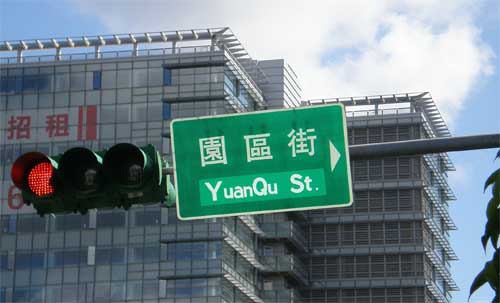
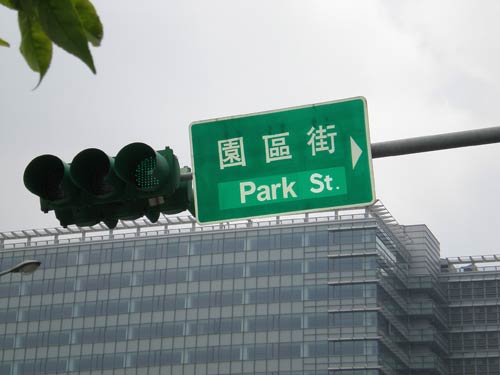
Some of the signs for what is written in Hanzi “園區街” (Yuánqū Jiē) read, in Taipei’s standard but stupid InTerCaPiTaLiZaTion, “YuanQu St.” while others read “Park St.” (which, by the way, is a misleading translation). I called the Taipei City Government about this and was informed that Park was an error and that the signs would be fixed to read Yuanqu.

Nearly a year has gone by since then. Have any of the street signs been changed?

The answer is yes. The signs, including some new ones, are indeed consistent. All of them now read — have you guessed it yet? — “Park St.”

That’s right: They eliminated the signs that were correct and put up new signs that are wrong. I’m trying to relax, so I won’t write out all of the many maledictions I have been muttering about Taipei City Government and its bureaucracy.

Here’s one of the street signs in October 2007:
YuanQu St.

Here’s the same sign in August 2008:
Park St.

A close-up, showing how “Park” was pasted over “YuanQu”.
closeup of the sign, showing how 'Park' was pasted over 'YuanQu'

UK degree-program enrollments in foreign languages

Ozaru‘s link in a comment on my previous post led me eventually to a report on “community languages” in higher education in Britain. The report provides numbers for those in degree programs for various foreign languages.

Students accepted on U.K. language-degree courses, 1996-2007

Language 1996 2001 2005 2007 % change 1996-2007 % of total in 1996 % of total in 2007
French 5655 4077 3964 3700 -34.57 33.02 28.83
Italian 837 786 639 2461 194.03 4.89 19.18
Spanish 2155 2331 2547 1401 -34.99 12.58 10.92
German 2288 1736 1503 610 -73.34 13.36 4.75
Russian and Eastern European 418 380 425 409 -2.15 2.44 3.19
Mandarin 165 165 352 392 137.58 0.96 3.05
Modern Middle Eastern 214 260 362 378 76.64 1.25 2.95
Japanese 272 249 331 306 12.50 1.59 2.38
Portuguese 128 117 118 141 10.16 0.75 1.10
Other Asian 161 171 142 118 -26.71 0.94 0.92
African 54 57 57 67 24.07 0.32 0.52
Scandinavian 65 36 57 19 -70.77 0.38 0.15
Other European 2200 1507 1667 1647 -25.14 12.85 12.83
Other non-European 2514 1900 1248 1185 -52.86 14.68 9.23
ALL 17126 13772 13412 12834 -25.06 100 100

(Adapted from Table 3.3 in the report)

If I understand the report correctly, the figures are not for total enrollments, just for students majoring or minoring in the languages in question. Thus, the actual enrollment numbers are likely much higher, though certainly not distributed evenly across the languages.

I’m pleased to note that the number of students in Mandarin programs has more than doubled in the last dozen years, though this doesn’t match the even more impressive growth rate for Italian. (I have no idea why Italian received such a boost, especially during a period in which most other European languages were shedding students.)

Mandarin now ranks sixth (or perhaps fifth, depending on how many Polish majors there are) among foreign language majors, with 3 percent of foreign language majors concentrating on this.

On the other hand, because native English speakers must devote a great deal more time and effort to learning Mandarin than most other languages, the levels of learning and achievement aren’t the same. Simply put, for most native English speakers Mandarin is damn hard, and students won’t gain nearly the same level of fluency in four years as they would studying most other languages.

For example, in 2002 Goldsmiths, University of London, which is the “largest provider of community languages in a PGCE,” set up its Postgraduate Certificate in Education in community languages, starting with Arabic, Mandarin, and Punjabi, and adding Urdu in 2004. So far all of the students enrolled in the Mandarin program have had “some knowledge of the language as a community/family/heritage language.” In other words, most — perhaps all — students have been ethnic Chinese and have a background in the language beyond the classroom.

Although the College does not especially seek to attract students who have some knowledge of the language as a community/family/heritage language, all the students accepted so far do have this background. This may change in the next five to ten years, as more non-native speaker students graduate with UK degrees in Mandarin, and some may wish to go on to teach it. However, this will only take place if there is good progression in the language from school to university level so that graduates can reach a high enough level in the language to teach up to A level. Currently, this is not the case, and those who have applied so far do not have this level of expertise.

Ouch. So it’s not that non-Chinese didn’t apply to the program, it’s that none of them were judged up to the requisite level of fluency to teach the language, despite having attained university degrees in Mandarin. (This only reinforces my worry about the drop in graduate enrollments in Mandarin in the United States.)

The report also notes, “There are no degree courses in the four most widely used community languages in England: Urdu, Cantonese, Punjabi and Bengali, although SOAS will offer a degree course in Bengali from autumn 2008.”

The situation is more promising for those taking A-levels in “Chinese.” (NB: The chart does not distinguish between Cantonese and Mandarin — even though these have separate oral exams — but lumps them together as “Chinese.” The majority will likely be Cantonese.)

presentations in the main community languages for GCSE and A-level examinations in 2007

GCSE and A-level examinations

(The figures for Spanish have not been included in the chart because it seems likely that most pupils study this as a foreign language rather than a community language: in 2007, 63,978 candidates sat GCSE and 7,152 A-level Spanish. Hindi is not included in this chart as it is not available at GCSE or A-Level.)

The total number of A-Level presentations in these languages in 2007 is 5347, indicating potential numbers in a good position to continue their studies in these languages in higher education. The ‘retention rate’ for most of languages listed above is high. This is a percentage calculated by comparing the numbers sitting a GCSE examination in a given year compared with those sitting an A-level in the same language two years later. It has to be regarded as a proxy measure, however, as not all those sitting A-levels took the relevant examination two years earlier. The retention rate over all languages (i.e. including French, German and Spanish), between GCSEs sat in 2005 and A-levels in 2007, is 7.5%. Most of the languages likely to be studied as community languages have a retention rate considerably higher than those typically studied as ‘foreign’ languages. Chinese is the most spectacular, with a retention rate of 78%, followed by Polish (51%) and Russian (42%). Only Bengali (3%) and Punjabi (4%) have retention rates below the overall figure. The high retention rate for the majority indicates that community language learners can, generally speaking, be regarded as committed students, and potentially good candidates for continued study of these languages in higher education.

source:

further reading: