Mandarin pop/rock lyrics in Pinyin

Lately I’ve been adding the lyrics to some songs, including titles by Cui Jian, Faye Wong, Wu Bai and China Blue, and Jay Chou.

I haven’t included Chinese characters. Keep in mind that songs are meant to be heard, not read. Also, tones generally disappear when words are sung. Thus, these songs should be considerably easier to understand when read in Pinyin transcriptions than when listened to alone. (It’s the same with other languages, too, of course.) If you find you’re having trouble, liànxí, liànxí.

Taiwan citizenship and Mandarin

Today’s Taipei Times has the following note:

Citizenship changes proceed

Foreign nationals seeking Taiwanese citizenship will be required to have a basic grasp of Mandarin and an understanding of the rights and responsibilities of being a Taiwanese citizen if an amendment to the Nationality Law (國籍法 guójí fǎ) is passed. The amendment was approved by the legislature’s Home and Nations Committee yesterday and sent for further screening to a legislative plenary session. According to the amendment, the Ministry of the Interior will set the standards regarding basic language ability and knowledge of citizen rights and responsibilities. The ministry will also be responsible for testing applicants. Vice Minister of the Interior Chien Tai-lang (簡太郎) said that the amendment is aimed at bringing naturalization laws in line with those of such English-speaking countries as the US, Canada and New Zealand.

According to an official U.S. government Web site on U.S. citizenship and immigration services, “To be eligible for naturalization, you must be able to read, write, and speak basic English.” (Emphasis mine.)

The few Web pages I’ve scanned about Canadian citizenship are not as specific about the language requirement. I get the impression, though, that being able to read and write French or English is not required as long as speaking ability exists. I didn’t see anything specific about the English-language requirement for New Zealand, either.

Official talk of a language requirement for ROC (Taiwan) citizenship surfaced about a year ago. At the time, I called the Ministry of the Interior to inquire about the situation. If applicants for citizenship are required to be able to read and write Mandarin in Chinese characters, this would be a substantial barrier to naturalization — much more so than being able to read or write a language that is written in an alphabetic script.

I was told that reading and writing Chinese characters would not be required. I hope that is still the intention of the government.

I also inquired whether languages of Taiwan other than Mandarin would be acceptable, and I was told they would be. Thus, someone able to speak Taiwanese (Hokkien, Minnan, Holo…), Hakka, or, rather less likely, one of the languages of Taiwan’s tribes, would be able to meet the language requirement without knowledge of Mandarin. I hope that this, too, is still the intention of the government.

I suspect some of the ambiguity may lie in how Guóyǔ (國語) is translated. Most of the time the word refers to Mandarin. Recently, however, the government has occasionally chosen to translate Guóyǔ not as “national language” (i.e. Mandarin) but “national languages” (i.e. the more than one dozen languages of Taiwan: Mandarin, Taiwanese, Hakka, and the languages of Taiwan’s tribes).

Mayor Ma on learning Hakka and Taiwanese

In 馬英九怕被叫馬爺爺 開心唱客家歌, Taipei Mayor Ma Ying-jeou offers a few remarks on Hakka, Taiwanese, and how they may be learned.

Mǎ Yīngjiǔ shuō, Kèyǔ hé Táiyǔ qíshí dōu kěyǐ yòng zhùyīn fúhào, zàijiā shàng jǐ gè yīn lái jiào, xiǎopéngyou kěyǐ yīcì xué sān zhǒng yǔyán, bùyīdìng yào yòng Luómǎ pīnyīn, zēngjiā xuéxí nándù.

馬英九說,客語和台語其實都可以用注音符號,再加上幾個音來教,小朋友可以一次學三種語言,不一定要用羅馬拼音,增加學習難度。

The article isn’t very well written. But Ma seems to have a prejudice against romanization that should be corrected. Nonetheless, it’s hard for this Pinyin advocate to get too worked up about this because Ma is the one who finally brought some order to the signage of Taipei with the thorough implementation of Hanyu Pinyin.

Whatever they might think of other aspects of his politics, many foreigners in Taiwan are deeply appreciative of Ma’s administration for this, despite the awful, awful InTerCaPiTaLiZaTion.

romanization in old documents by Pingpu (Taiwan tribe)

平埔族人 曾用羅馬拼音寫契約
記者溫筆良/枋寮報導 05/10 04:06

中央研究院台灣研究所博士研究員陳秋坤最近發現,平埔族人在清朝乾隆到嘉慶年間,使用羅馬文字拼音書寫契約,閩南話中的「牽手」、「抓狂」等都沿用自平埔族用語,閩南話也可以用羅馬文字拼寫出來。

專門研究台灣近代史的陳秋坤博士最近受高雄縣政府委託,以大崗山地區古契約書為題作專題研究,在高雄、屏東地區蒐集近兩、三百年來的古契文書,找出清朝康熙、乾隆年間到民國初年的各種土地買賣契約。

陳秋坤昨天說,平埔族、漢人買賣土地可推演到荷蘭人佔據台灣時代,當時荷蘭人教導不識字的平埔族人用羅馬拼音書寫買賣契約,買賣雙方用羅馬拼音書寫閩話或漢字,把買賣約定內容寫成白紙黑字。

陳秋坤說,難得發現的羅馬拼音平埔族文字,流傳至今已找不到可以完全解讀的人,不過還好這些羅馬拼音都有漢字對照,互相比對可以完全了解契約內容。有深入研究價值,正帶領研究人員深入研究。

對客家六堆有深入研究的客家公益會理事長李貴文說,用羅馬拼音書寫平埔族、閩南話,在台南、高屏曾發現過,但數量稀少,中央研應引導專家作更入研究,根據古契約文書留下資料,閩南話常用的「牽手」、「抓狂」、「搞丟」都是平埔族用語,平埔族漢化後繼續使用。

German paper on Chinese language reform

Another paper I’ve come across in my Web surfing: Ideen zur Sprachreform in China ab den ersten phonetischen Transkribtionssystemen unter besonderer Berücksichtigung des Schriftstellers Lu Xun (“Thoughts on language reform in China, starting from the first phonetic transcription and with special consideration of the writer Lu Xun”).

I don’t read German, so I can’t vouch for the correctness of the paper. Actually, from what little I can read, it seems that the author has a few all-too-common notions about “dialects”, etc. But the paper might be worthwhile anyway.

script reform in the Qing era

I recently came across W.K. Cheng’s “Enlightenment and Unity: Language Reformism in Late Qing China,” an interesting article from 2001 that covers much of the same ground as Victor Mair’s “Sound and Meaning in the History of Characters: Views of China’s Earliest Script Reformers,” but from a wider, social perspective.

new Taiwan ID cards

Nèizhèngbù guānyuán zhǐchū, bǐjiào xīn-jiù shì shēnfenzhèng shèjì de chābié, xīnshì shēnfenzhèng jiāng zàochéng shǐyòng xíguàn de gǎibiàn, qízhōng bāokuò xìngmíng lán zuìduō kě tiánrù 22 ge zì, fāngbiàn yuánzhùmín tóngshí biāozhù Hànzì yǔ Luómǎ pīnyīn xìngmíng; tóupiào shí bùbì yú shēnfenzhèng shàng gàizhāng, jǐn jìnxíng shēnfen biànshí, héduì míngcè, tóupiào tōngzhīdān děng dòngzuò; qiānyí hùjí jiùděi chóngxīn huàn fā; shēnfenzhèng bùzài yǒu xìngbié de yánsè qūgé.

內政部官員指出,比較新舊式身分證設計的差別,新式身分證將造成使用習慣的改變,其中包括姓名欄最多可填入廿二個字,方便原住民同時標註漢字與羅馬拼音姓名;投票時不必於身分證上蓋章,僅進行身分辨識、核對名冊、投票通知單等動作;遷移戶籍就得重新換發;身分證不再有性別的顏色區隔。

Spaces for 22 zì on the new Taiwan ID cards. I wonder if that means Hanzi, because my complete name (first, middle, and last, along with my three-character “Chinese name”) is longer than 22 letters.
If a proportional font is used, more than 22 alphabetic letters should fit within the space for 22 Hanzi. But if 22 zì does mean alphabetic letters, then there’s going to be a problem.

sign of ignorance

I came across an article today about some sign designers working in China. The title alone, “Graphics That Bridge a Linguistic Divide”, was enough to raise a red flag (pun not intended), because for many it will evoke the widespread myth that Chinese characters transcend languages.

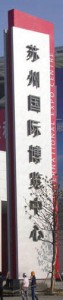
The designers were describing the making of a large sign for the “Suzhou International Exposition Centre” (苏州国际博览中心 Sūzhōu guójì bólǎn zhōngxīn).

Here’s a good example of the problems with their remarks:

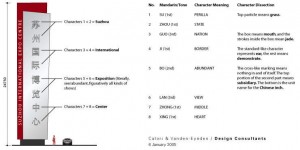
“The last two characters for Centre–it’s interesting they went with the British spelling–are actually redundant,” Calori says. “Often you see the seventh character–it means ‘middle’–for center. But the client also added the eighth character, which is the symbol of ‘heart.’ The heart is the middle, so they reinforce each other. This was a total embellishment.” Adds Vanden-Eynden: “They wanted the warm, fuzzy heart center, as opposed to the cold, hard center of hell.”

This is so wrongheaded and absurd it’s hard to know whether to laugh or cry. The client didn’t add the eighth character (心). It’s used in writing the word for “center,” which is zhōngxīn (中心). The only thing “fuzzy” here is the thinking behind this nonsense. It’s possible, though, that the designers aren’t responsible for this way of thinking; few Chinese people are aware of how their own writing system works and thus tend to believe such crap.

Colors: … “There are certain colors, you don’t use. White, for instance, is the color of death. It’s like directing people to a funeral.”

Well, yes, white can have that connotation. But white is the background color of the sign! Are the designers saying they wanted to direct people to a funeral? Of course not. The reality is that white has that connotation only in certain contexts. So what’s all this talk about leading people to a funeral? Sheesh.

Letters vs. Characters: … “Each character is really an idea,” Calori says.

Wrong.

“They’re called ideograms.”

Although some people, through ignorance or force of habit, might use this unfortunate term, the fact remains that Chinese characters aren’t ideograms.

The pullbox giving “character dissection” is also an embarrassment. Almost everything there is wrong or at least misleading. They couldn’t even get many of the tones right.
But the article isn’t a total washout. A few points are of interest.

Sizing: English characters tend to be heavy compositionally, while Chinese is complex and delicate. “So we always size Chinese twenty percent taller to give it balance,” Vanden-Eynden says.

Type Position: The Chinese characters appear here in the “superior” position, on the left side. “In Hong Kong, before the handover, English always appeared first,” Vanden-Eynden says. “On the mainland today, Chinese is always in the superior position, but the Chinese still want English on all their signs, even if there are no tourists around, because to them it makes it look like [they are part of] the 21st century.”

Fonts: Due to the seemingly infinite nature of Chinese, there are a limited amount of usable fonts. “Unlike here, you don’t have 10,000 readable options,” Vanden-Eynden says. “You have what they call the big five type faces.”