v for ü

Typing the letter v to produce ü is pretty standard in most Pinyin-related software — the letter v not being used in Pinyin except for loan words, and the letter ü not being found on traditional qwerty keyboards.

Here’s an official sign not far from Tian’anmen Square in Beijing that provides an example of an unconverted v.
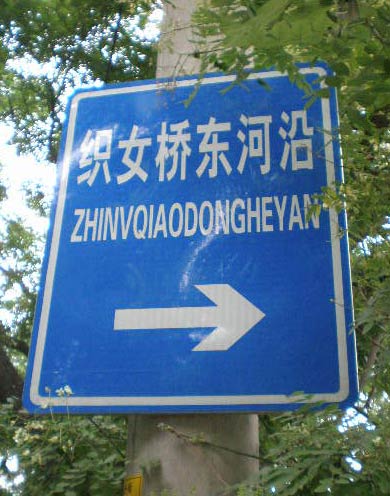
official directional sign reading '织女桥东河沿 ZHINVQIAODONGHEYAN' in white letters against a blue background

Of course there’s the usual word-parsing trouble as well, which can indeed be tricky in some cases (but not so much that everythingneedstobewrittensolidlikethis).

This should be “Zhīnǚ Qiáo dōng héyán” (织女桥东河沿 / 織女橋東河沿 / Weaver Girl’s Bridge, east bank) or perhaps “Zhinü Qiao Dong Heyan” or “ZHINÜ QIAO DONG HEYAN”.

Some people might not think this is worth categorizing as a problem. My position, however, is that government has an obligation to write things properly on its official signage. (If this were on some ad hoc sign put up privately it would still be interesting but less problematic.) So, if anyone’s OK with the V, would you also be OK with, say, “之釹喬冬和言”?

OTOH, as mistakes go, at least v remains distinct, unlike when ü gets incorrectly written as u, which is so common in Taiwan that I don’t recall ever having seen a ü on official signage. (Pinyin has the following distinct pairs: and nu, and lu; nüe (rare) and lüe are also used but not nue or lue since the latter two sounds are not used in modern standard Mandarin.
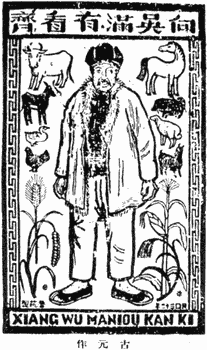
romanization in early communist propaganda

pre-1949 Chinese communist propaganda woodblock featuring Sin Wenz romanization; a peasant man is shown with crops and farm animalsI’ve been reading War and Popular Culture: Resistance in Modern China, 1937–1945, by Chang-tai Hung, which is one of the University of California Press books available for free online. It contains a reproduction of a woodcut with with the following text in romanization:

XIANG WU MANIOU KAN KI
(齊看有满吴向)

To my disappointment, the book does not discuss the romanization movement at all, though the presence of Sin Wenz (Xīn Wénzì / 新文字) in the woodcut is an indication of its relevence.

Note: DeFrancis’s Nationalism and Language Reform in China has some good material on Sin Wenz. The sample chapter I have here on Pinyin.info, however, doesn’t cover that. And the long-out-of-print book is not presently searchable through Google Books either. But at the time of this writing Bookfinder has two copies for under US$40, which is a good deal for this hard-to-find book. So if you have the money and this is the sort of book you like, you should buy this now, as you’re unlikely to come across one for less money.

Anyway, back to the romanization in the illustration. In Hanyu Pinyin, which would not exist until some 15 years later, XIANG WU MANIOU KAN KI would read “xiàng Wú Mǎnyǒu kànqí” (“emulate Wu Manyou”). This Wu Manyou was a “model peasant” who got his very own official emulate-this-guy campaign in the early 1940s.

Notice that the use of the letter x predates Hanyu Pinyin. (Actually, x in romanization for Sinitic languages long predates Hanyu Pinyin, appearing even in Trigault’s seventeenth-century work.) But even though the xiang of Sin Wenz and the xiang of Hanyu Pinyin are written the same, the two systems handle the letter differently in most cases. In Sin Wenz texts, most of the time the letter x represents what would be written h in Hanyu Pinyin. For example, the full name of Sin Wenz is Latinxua Sin Wenz, not Latinhua Xinwenz. Note, too, the use of the original “Latin” rather than “Ladin”, just as Gwoyeu Romatzyh uses Romatzyh rather than Luomaatzyh, indicating the link between romanization and the alphabet of Rome (Roma).

Also interesting is the form of the character that is second from the right. (These Chinese characters are read from right to left. Put left to right, they would appear as 向吴满有看齊.) Note how it is not in the traditional form:

Nor is it the standard “simplified” form (which would not have been officially adopted for more than decade after this woodblock was made):

Of variant characters there is no end.

Korea may make some spellings mandatory

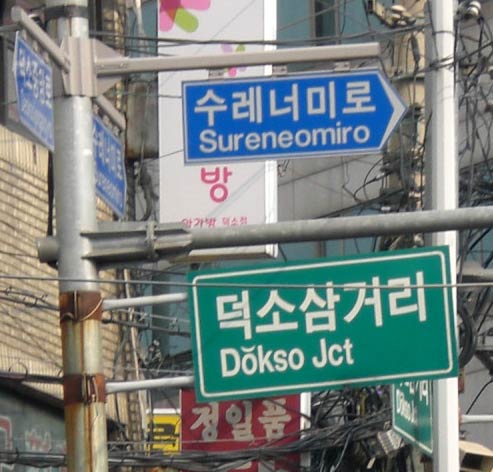
I’ve been doing so much on signage lately that I’ve been neglecting the issue of romanization. (Remember romanization?) Here’s something just in from South Korea, a country that rivals Taiwan in making a national pastime of screwing around with its romanization system.

The Ministry of Culture, Sports and Tourism and the Presidential Council on National Competitiveness on Wednesday discussed plans to make the Korean language more accessible worldwide, including working out a Romanization standard for family names, compiling a new Hangul dictionary with about 1 million entries, and building a Hangul cultural center.

The government will come up with standard Romanization for family names this year that will become mandatory for people when they apply for new passports and for government offices that use both Hangul and English on official documents such as birth records and residence registration cards.

In Taiwan, people can choose among romanization systems for the name on their passport. Employing romanization for Hoklo, Hakka, or a language of one of Taiwan’s official tribes is also permitted.

An earlier Romanization project for family names was suspended in 2000 due to controversy over exceptions. The new standard will cost a huge amount of money as the Romanized names of businesses, schools and individuals as well as road signs will have to be changed.

A new Hangul dictionary is to be compiled by 2012, adding a large number of words to the last official dictionary published in 1999, which has about 500,000 entries, and adding easy sample sentences.

Experts have said that the younger generation have trouble understanding the conventional dictionary, as there are too many difficult Chinese characters in explanations and definitions.

The government also plans to compile a multilingual web dictionary comprising about 20 different foreign language sections — such as Vietnamese-Hangul and Thai-Hangul — to help foreigners and Korean nationals overseas.

A Hangul cultural center, to be built at a cost of W35.2 billion [US$27.5 million] by 2012, is to give visitors hands-on experience of the Korean language.

source: Standard Romanization for Korean Names Planned, Chosun Ilbo, June 25, 2009

Photo of street signs in Namyangju, Gyeonggi-do (Namyangju, Ky?nggi-do) courtesy of Robert Badger.
korean_streetsigns

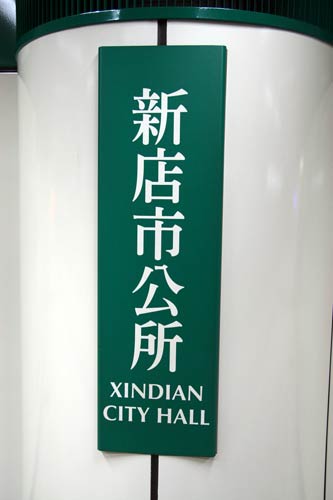
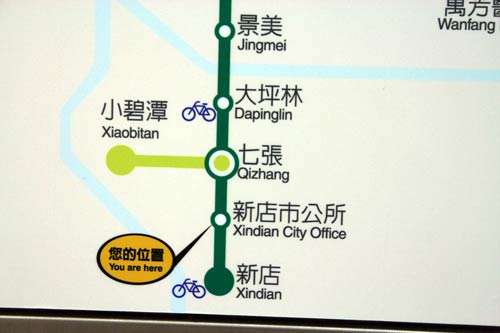
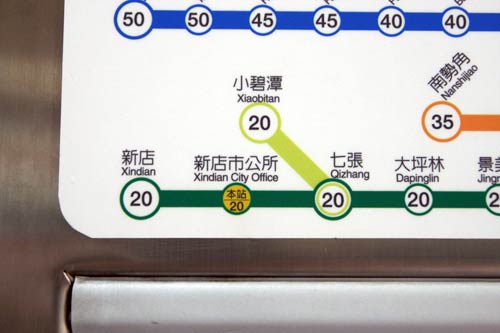
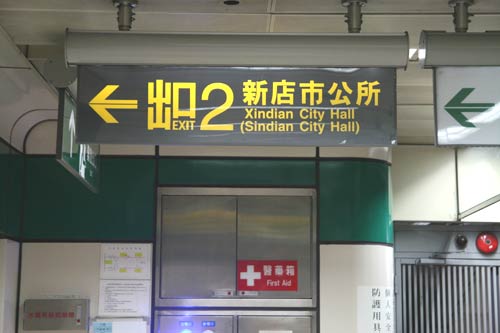
photos of and around Xindian City Hall MRT station

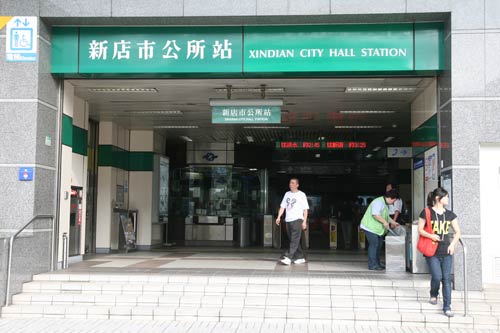
My friend David of David on Formosa kindly sent me lots of photos of the current signage at Xindian City Something-or-other Station. Here they are.

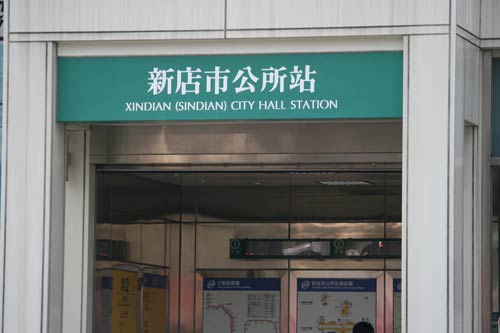
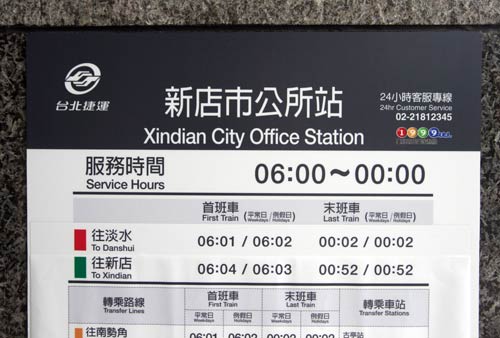
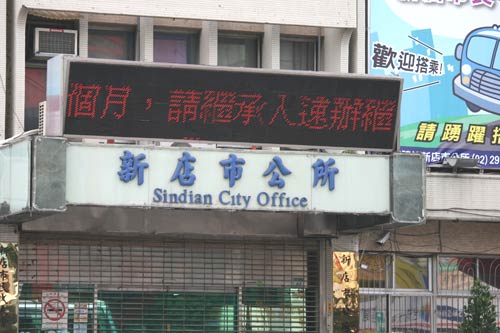
Note that some of the signage at the station itself gives the Tongyong Pinyin form (Sindian) as well as the Hanyu Pinyin form; but other signage does not. And the newest signs give Xindian City Office rather than Xindian City Hall.

MRT station main entrance, marked 'Xindian City Hall Station'

MRT station side entrance, marked 'Xindian (Sindian) City Hall Station'

Sign of things to come?
photo of station operation hours, with station name marked 'Xindian City Office Station'

sign on a pillar on the MRT platform reading 'Xindian City Hall'

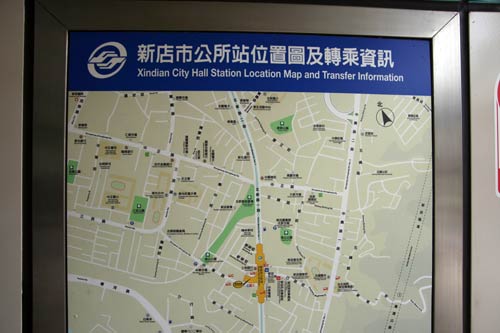
closeup of a new map on a station wall, with the station called 'Xindian City Office'

map_detail

exit2

area_map

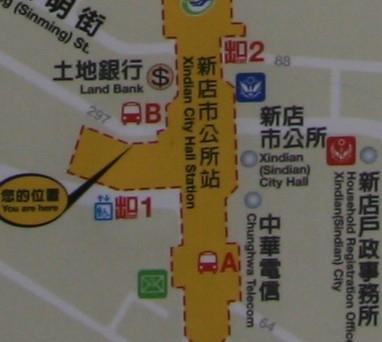
This closeup from the map above reveals that even city hall itself (not the MRT station) is labeled “City Hall.”

closeup from the photo above, as described

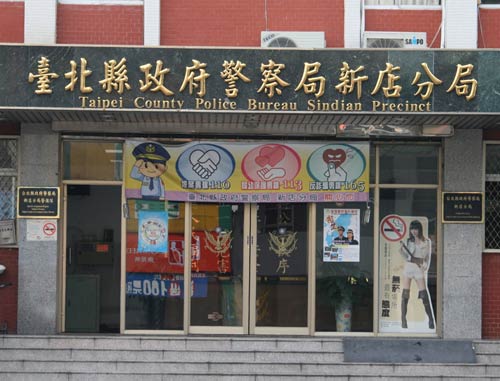
More than three years ago Taipei County Magistrate Zhōu Xīwěi (Chou Hsi-wei / 周錫瑋 / Zhou Xiwei) said that Taipei County should use the same romanization system as the city of Taipei (i.e., Hanyu Pinyin). But nothing has happened yet — not unlike his administration in general. So here we still see the Tongyong Pinyin form of “Sindian” rather than the Hanyu Pinyin form (now official at the national level) of “Xindian.”
photo of Xindian City Hall (the actual building, not the MRT station). It's labeled 'Sindian City Office'

Taipei County Police Bureau Sindian Precinct

common newbie errors in Pinyin: YAN

Today’s post is something for those who are relatively new to Pinyin and Mandarin. It covers something I’ve received more than one query about.

Hanyu Pinyin is quite simple. But it still has a few points — beyond the usual caveats about x, q, c, and zh — that sometimes trip up introductory students of Mandarin. One of the most common of these is the syllable yan.

Lots of Mandarin learners tend to pronounce this as if it were yang — but with an n on the end instead of an ng. But it’s properly pronounced much like the English pronunciation of the name of the Japanese currency: yen. Thus, yen for yan is a common misspelling.

Yet yan is a perfectly regular spelling within the Pinyin system. What’s more: Pinyin doesn’t have anything spelled yen.

Remember that when an i comes at the beginning of a syllable, it is written y (or yi, if there is no vowel immediately following). Thus,

yan = ian

I stress this because relatively few people get any of the following related syllables wrong:

  • bian (as in former Taiwan president Chen Shui-bian)
  • pian (as in pianyi / cheap)
  • mian (as in chaomian / fried noodles)
  • dian (as in dianhua / telephone)
  • tian (as in tianqi / weather)
  • nian (as in nian / year)
  • lian (as in buyao lian / shameless)
  • jian (as in zaijian / good-bye)
  • qian (as in qian / money)
  • xian (as in xiansheng / mister)

Now try reading these:

  • yanjing / eye
  • yanjing / glasses
  • chouyan / smoke (verb)
  • yuyan / language
  • yanse / color
  • keyan / scientific research
  • It’s easy!

    further reading:
    combinations of initials and finals in Hanyu Pinyin/span

    Dungan and Gyami

    The most recent release from the archives of Sino-Platonic Papers is a particular favorite of mine, Two Non-Tetragraphic Northern Sinitic Languages (2.6 MB PDF), by Victor H. Mair. In case that title sounds a little technical, in layman’s terms the title might be A Couple of Languages Closely Related to Mandarin that Are Not Written with Chinese Characters (Which Many People Mistakenly Believe Are Essential for Such Languages), with One of Them Having Been Successfully Written with an Alphabet for Many Decades.

    This issue comprises two studies:

    1. Implications of the Soviet Dungan Script for Chinese Language Reform, which has long been featured here on Pinyin.info, and
    2. Who Were the Gyámi?

    This issue also contains “A Short Supplementary Note on the Name ‘Tibet.'” The subject of the essay probably sounds perfectly innocuous. But it set off a few rounds of polite but pointed dueling among scholars — in the pages of a journal, that is, not with pistols at forty paces or anything of that sort. The exchanges make for interesting reading. See, for example, SPP 35 (“Reviews IV,” pp. 32-37) and SPP 70 (“Reviews VI,” pp. 21, 79-84).

    This was first published in May 1990 as issue no. 18 of Sino-Platonic Papers.

    further reading:

    weiird typos

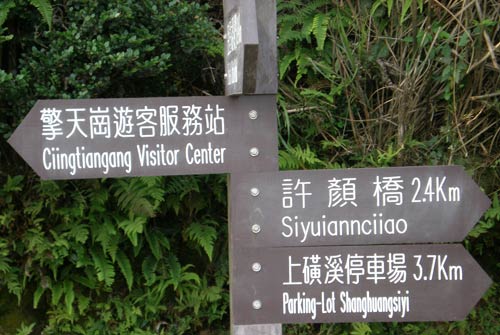
    The Qíngtiāngāng part of Yangming Shan National Park (Yángmíng Shān Guójiā Gōngyuán / 陽明山國家公園), to the north of Taipei, is distinguished by grasslands high in the mountains — the sort of open, natural place that, though not spectacular, might still make someone used to living in crowded northern Taiwan want to do the Julie-Andrews-hills-are-alive twirl. But, as usual, I’m only going to show you some signs. Here goes.

    wooden directional signs reading '擎天崗遊客服務站 Ciingtiangang Visitor Center / 許顏橋 Siyuiannciiao / 上磺溪停車場 Parking-Lot Shanghuangsiyi'

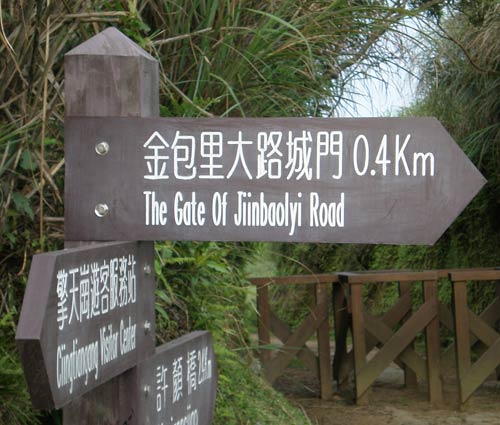
    wooden directional sign reading '金包里大路城門 The Gate Of Jiinbaolyi Road'

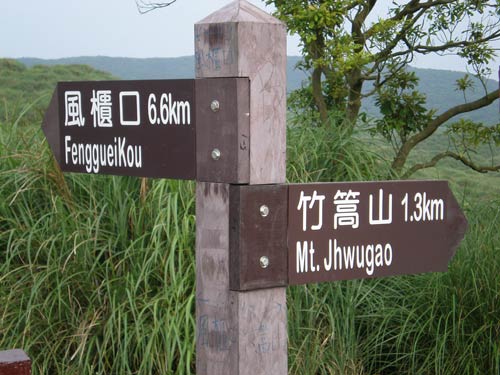
    wooden directional signs reading '風櫃口 FenggueiKou' and '竹篙山 Mt.Jhwugao'

    Ciingtiangang, Siyuiannciiao, Jiinbaolyi. Normally the presence of doubled vowels indicates the use of Gwoyeu Romatzyh (e.g., rice-flour noodles as miifeen rather than Hanyu Pinyin’s mǐfěn). But these signs are most definitely not in Gwoyeu Romatzyh. They’re just really screwed-up Tongyong Pinyin.

    Sign Tongyong Pinyin Hanyu Pinyin Gwoyeu Romatzyh
    Ciingtiangang Cingtiangang Qíngtiāngāng Chyngtiangang
    Siyuiannciiao Syuyan ciao Xǔyán qiáo Sheuyan chyau
    Shanghuangsiyi Shanghuangsi tingchechang Shànghuángxī tíngchēchǎng Shanqhwangshi
    The Gate Of Jiinbaolyi Road Jinbaoli dalu chengmen Jīnbāolǐ dàlù chéngmén Jinbaulii dahluh cherngmen
    FenggueiKou Fongguei Kou Fēngguì kǒu Fengguey koou
    Mt.Jhwugao Jhugao Shan Zhúgāo Shān Jwugau Shan

    Two of Tongyong Pinyin’s most distinctive features are the use of jh– for what in Hanyu Pinyin is zh– and the use of fong rather than the feng found in Hanyu Pinyin, MPS2, Wade-Giles, Yale, and Gwoyeu Romatzyh. But whoever produced these signs couldn’t get even those right, as shown by Jhwugao and FenggueiKou.

    A few misc. notes:

    • FenggueiKou: Die, InTerCaPiTaLiZaTion, die! Or in this case perhaps I should write IntercapitalizaTion.
    • It’s supposed to be “km”, not “Km”.
    • Even the signs that got “km” correct left out the necessary space before it.
    • The Gate Of Jiinbaolyi Road: An initial “The” is almost never needed on such signs; indeed, its presence is counterproductive. And the capitalized “Of” is amateurish.
    • Parking-Lot Shanghuangsiyi: Oh, that’s just too depressing.
    • Ciingtiangang Visitor Center: Leaving out that extra i would help the missing s fit in, as would abbreviating “center” or simply leaving out Qingtiangang altogether. It’s not like there are any other visitors’ centers around there to confuse people. But since the English-speaking world is filled with places marked “visitor center”, it’s probably not worth having mentioned.
    • Siyuiannciiao: I’m puzzled that ciao/qiao wasn’t translated as bridge (and written with a space before it). Is there not actually a bridge there?
    • Mt.Jhwugao: Again, are spaces really all that difficult?
    • I could probably talk about the orthography of a few of the names (e.g., Jinbao Li vs. Jinbaoli, Shanghuang Xi vs. Shanghuangxi, Fenggui Kou vs. Fengguikou); but that’s something well beyond the common awfulness of these signs. And it might also require some research, such as finding the answer to “Is there really a stream [] at Shanghuangxi/Shanghuang Xi?”)

    The government’s list of Pinyin and English terms related to Yangming Shan National Park, Yángmíng Shān Guójiā Gōngyuán xiāngguān míngcí, doesn’t give any of those incorrect forms. (Anyway, the list, which is in Tongyong Pinyin, is now outdated because of the switch — at least on paper — to Hanyu Pinyin.) And I can’t think of any good reason for the doubled i’s, the interposed y’s, or the other errors. Apparently, these signs are just plain-ol’ awful.

    So I don’t have anything particularly interesting to note about the linguistics of this. But I do have a point other than that some typos are weiird weird enough that I can’t help but mention them. Rather, it’s worth noting that just because over the past few years many signs — but not nearly as many people believe — went up in tòng yòng, er, Tōngyòng Pinyin, this doesn’t mean the signs were done properly and wouldn’t require replacement even if Taiwan weren’t switching to Hanyu Pinyin.

    Wiki for collaborative Pinyin projects

    I have long wanted to expand the range of materials available in and about Pinyin. Possibilities for projects include:

    • Hanyu Pinyin subtitles for movies and videos
    • Hanyu Pinyin versions of Mandarin plays (for example, Cháguǎn, by Lǎo Shě)
    • translations into Mandarin (Hanzi and/or Pinyin) of parts of this site

    I can do a lot of the work — in fact, as is my habit, I’ve begun all sorts of such projects but haven’t finished them — but can’t do all of it myself. So I’ve been mulling the idea of setting up a Pinyin-related wiki here on Pinyin.info or perhaps on a spinoff site I set up, which would allow you, o reader, to get involved (a little or a lot, depending on your desire and amount of free time).

    I’m thinking that texts could be worked on with the aid of Wenlin, since even contributors without the full version of that enormously useful program could use its free demo to select disambiguation choices in cases of word-parsing ambiguities or characters with multiple pronunciations.

    For example, if one were using Wenlin to convert the following into Pinyin,

    我在朦胧中,眼前展开一片海边碧绿的沙地来,上面深蓝的天空中挂着一轮金黄的圆月。我想:希望本是无所谓有,无所谓无的。这正如地上的路;其实地上本没有路,走的人多了,也便成了路。

    one would first need to choose between potentially ambiguous word boundaries

    |我 | 在 | 朦胧 | 中,眼前 | 展开 | 一 | 片 | 海边 | 【◎Fix:◎碧绿 | 的;◎碧 | 绿的】 | 沙地 | 来,上面 | 深蓝 | 的 | 【◎Fix:◎天空 | 中;◎天 | 空中】 | 挂着 | 一 | 轮 | 金黄 | 的 | 圆月。我 | 想:希望 | 本 | 是 | 无所谓 | 有,无所谓 | 无 | 的。这 | 正如 | 【◎Fix:◎地上 | 的;◎地 | 上的】 | 路;其实 | 地上 | 本 | 没有 | 路,走 | 的 | 人 | 多 | 了,也 | 便 | 成了 | 路。

    and then take care of items with multiple pronunciations

    Wǒ zài ménglóng 【◎Fix:◎zhōng;◎zhòng】, yǎnqián zhǎnkāi yī 【◎Fix:◎piàn;◎piān】 hǎibiān bìlǜ de shādì lái, shàngmian shēnlán de tiānkōng 【◎Fix:◎zhōng;◎zhòng】 guàzhe yī lún jīnhuáng de yuányuè. Wǒ xiǎng: xīwàng běn shì wúsuǒwèi yǒu, wúsuǒwèi 【◎Fix:◎wú;◎mó】 de. Zhè zhèngrú 【◎Fix:◎dìshang;◎dìshàng】 de lù; qíshí 【◎Fix:◎dìshang;◎dìshàng】 běn méiyǒu lù, zǒu de rén duō 【◎Fix:◎le;◎liǎo;◎liāo;◎liào;◎liáo】, yě 【◎Fix:◎biàn;◎pián】 chéngle lù.

    I’d prefer to keep things generally on the right side of copyright laws but am also hopeful that those may not be too onerous in the case of Pinyin versions and that Taiwan’s laws may put the situation more in our favor than might be the case elsewhere. Information about the legal situation would be greatly appreciated.

    So, is anyone interested in helping out? Have advice? Success/horror stories about wiki projects? Suggestions for additional material?