Spotted on the Taipei MRT on Sunday:
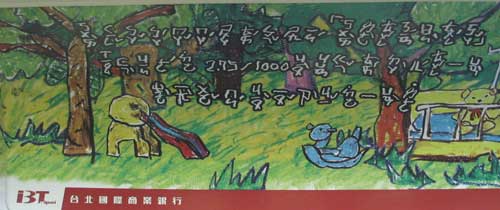
larger version
ad in zhuyin (bopomofo)
Reply

Spotted on the Taipei MRT on Sunday:
larger version
Today’s Taipei Times has the following note:
Citizenship changes proceed
Foreign nationals seeking Taiwanese citizenship will be required to have a basic grasp of Mandarin and an understanding of the rights and responsibilities of being a Taiwanese citizen if an amendment to the Nationality Law (國籍法 guójí fǎ) is passed. The amendment was approved by the legislature’s Home and Nations Committee yesterday and sent for further screening to a legislative plenary session. According to the amendment, the Ministry of the Interior will set the standards regarding basic language ability and knowledge of citizen rights and responsibilities. The ministry will also be responsible for testing applicants. Vice Minister of the Interior Chien Tai-lang (簡太郎) said that the amendment is aimed at bringing naturalization laws in line with those of such English-speaking countries as the US, Canada and New Zealand.
According to an official U.S. government Web site on U.S. citizenship and immigration services, “To be eligible for naturalization, you must be able to read, write, and speak basic English.” (Emphasis mine.)
The few Web pages I’ve scanned about Canadian citizenship are not as specific about the language requirement. I get the impression, though, that being able to read and write French or English is not required as long as speaking ability exists. I didn’t see anything specific about the English-language requirement for New Zealand, either.
Official talk of a language requirement for ROC (Taiwan) citizenship surfaced about a year ago. At the time, I called the Ministry of the Interior to inquire about the situation. If applicants for citizenship are required to be able to read and write Mandarin in Chinese characters, this would be a substantial barrier to naturalization — much more so than being able to read or write a language that is written in an alphabetic script.
I was told that reading and writing Chinese characters would not be required. I hope that is still the intention of the government.
I also inquired whether languages of Taiwan other than Mandarin would be acceptable, and I was told they would be. Thus, someone able to speak Taiwanese (Hokkien, Minnan, Holo…), Hakka, or, rather less likely, one of the languages of Taiwan’s tribes, would be able to meet the language requirement without knowledge of Mandarin. I hope that this, too, is still the intention of the government.
I suspect some of the ambiguity may lie in how Guóyǔ (國語) is translated. Most of the time the word refers to Mandarin. Recently, however, the government has occasionally chosen to translate Guóyǔ not as “national language” (i.e. Mandarin) but “national languages” (i.e. the more than one dozen languages of Taiwan: Mandarin, Taiwanese, Hakka, and the languages of Taiwan’s tribes).
The following is the text of a note I have sent to the U.S. Library of Congress concerning its discussion of its collection of Naxi materials. Much of this beautiful and fascinating collection is available for viewing on line.
The section of your Web site devoted to “Selections from the Naxi Manuscript Collection” makes frequent reference to Naxi as a “pictographic language.” This is a serious error, rooted in a common but mistaken conflation of language and script. No language is pictographic, as even common sense should be sufficient to reveal. (Surely no one believes that Naxi people are unable to speak to one another but must instead draw pictures in order to hold conversations.)
Moreover, the Naxi pictographic texts are not even writing, properly speaking. The following is from The Languages of China, by Robert Ramsey:
In the strictest sense it is wrong to call these pictographs writing, because they do not normally represent the units of a language. They serve, rather, only as mnemonic devices to remind a priest of the details of a story he already knows by heart. … Moreover, many words of the text — especially those representing abstract concepts — are left completely unrepresented by symbols and must be totally supplied from memory. Sometimes a symbol is inserted into a frame only to elucidate the meaning of another symbol and is itself left unread. … The Naxi have never used these pictographs to communicate with each other — they do not exchange letters, write books, or even keep simple accounts and records with them. Anyone can appreciate the graphic beauty of a Naxi text, but only someone well-versed in the mystical lore of Naxi religion can interpret its meaning and translate it into language. It is not enough simply to be able to speak Naxi.The Naxi have a different but less interesting script that can be used for real writing.
I hope you will correct the text of your beautiful and informative site accordingly.
This tendency to conflate language and script is one of the main problems interfering with many people’s understanding of the nature of Chinese characters.
In 馬英九怕被叫馬爺爺 開心唱客家歌, Taipei Mayor Ma Ying-jeou offers a few remarks on Hakka, Taiwanese, and how they may be learned.
Mǎ Yīngjiǔ shuō, Kèyǔ hé Táiyǔ qíshí dōu kěyǐ yòng zhùyīn fúhào, zàijiā shàng jǐ gè yīn lái jiào, xiǎopéngyou kěyǐ yīcì xué sān zhǒng yǔyán, bùyīdìng yào yòng Luómǎ pīnyīn, zēngjiā xuéxí nándù.
馬英九說,客語和台語其實都可以用注音符號,再加上幾個音來教,小朋友可以一次學三種語言,不一定要用羅馬拼音,增加學習難度。
The article isn’t very well written. But Ma seems to have a prejudice against romanization that should be corrected. Nonetheless, it’s hard for this Pinyin advocate to get too worked up about this because Ma is the one who finally brought some order to the signage of Taipei with the thorough implementation of Hanyu Pinyin.
Whatever they might think of other aspects of his politics, many foreigners in Taiwan are deeply appreciative of Ma’s administration for this, despite the awful, awful InTerCaPiTaLiZaTion.
平埔族人 曾用羅馬拼音寫契約
記者溫筆良/枋寮報導 05/10 04:06
中央研究院台灣研究所博士研究員陳秋坤最近發現,平埔族人在清朝乾隆到嘉慶年間,使用羅馬文字拼音書寫契約,閩南話中的「牽手」、「抓狂」等都沿用自平埔族用語,閩南話也可以用羅馬文字拼寫出來。
專門研究台灣近代史的陳秋坤博士最近受高雄縣政府委託,以大崗山地區古契約書為題作專題研究,在高雄、屏東地區蒐集近兩、三百年來的古契文書,找出清朝康熙、乾隆年間到民國初年的各種土地買賣契約。
陳秋坤昨天說,平埔族、漢人買賣土地可推演到荷蘭人佔據台灣時代,當時荷蘭人教導不識字的平埔族人用羅馬拼音書寫買賣契約,買賣雙方用羅馬拼音書寫閩話或漢字,把買賣約定內容寫成白紙黑字。
陳秋坤說,難得發現的羅馬拼音平埔族文字,流傳至今已找不到可以完全解讀的人,不過還好這些羅馬拼音都有漢字對照,互相比對可以完全了解契約內容。有深入研究價值,正帶領研究人員深入研究。
對客家六堆有深入研究的客家公益會理事長李貴文說,用羅馬拼音書寫平埔族、閩南話,在台南、高屏曾發現過,但數量稀少,中央研應引導專家作更入研究,根據古契約文書留下資料,閩南話常用的「牽手」、「抓狂」、「搞丟」都是平埔族用語,平埔族漢化後繼續使用。
An article in Science News on hyperlexia has a discussion of some recent research on reading, the brain, and Chinese characters.
The author of the article is to be commended for managing to summarize more or less accurately an important conclusion of the research: the notion that Chinese characters are ideographic and not tied to sound is, as observant Western analysts have been saying for nearly 200 years, a myth. (Asian analysts of language weren’t originally afflicted with the ideographic myth but acquired it from the West about 100 years ago. For more on this, see the book Ideogram: Chinese Characters and the Myth of Disembodied Meaning.)
Recent investigations of Chinese readers suggest that people everywhere invoke core neural responses in order to read, but other types of brain activity are necessary to attain mastery of alphabetic or non-alphabetic writing systems, psycholinguist Charles A. Perfetti of the University of Pittsburgh explained last February in Washington, D.C., at the annual meeting of the American Association for the Advancement of Science.
Many investigators have assumed that, unlike alphabetic systems, written Chinese employs drawings that symbolize whole words.
Even if that were the case with ancient Chinese pictographic symbols, those characters have transformed into much more abstract shapes that induce sounds of spoken syllables in modern readers’ minds, Perfetti says. Chinese characters thus represent bigger chunks of spoken words than alphabetic letters do.
“All writing systems represent spoken language, but they have different design principles,” Perfetti asserts.
Consider Mandarin Chinese. It currently includes 420 syllables. These syllables correspond to nearly 4,600 written characters, so an average of about 11 characters share a single pronunciation, which can be modified by using any of four tones.
In spoken Chinese, the meaning of the many different words that sound alike becomes apparent only in the context of conversation. People listening to English sometimes discern word meanings in this way—consider the words guise and guys—but need to do so much less often than Chinese listeners do.
Many Mandarin Chinese words consist of only one syllable, Perfetti adds. That has encouraged the false impression, at least among Westerners, that the language’s written characters represent only words, he says.
Actually, only about 2 percent of Mandarin words are monosyllabic. But those that are tend to be used frequently. (But this is also the case in English. For some tangential remarks, see Taipei street names and the monosyllabic myth.) The monosyllabic myth is fed in part by confusion about morphemes and Chinese characters. (For remarks on this, see Chinese Writing.)
Experiments show that Mandarin Chinese characters correspond to spoken Chinese rather than to the idea that the word represents, Perfetti says. For instance, if shown the written character for the word red printed in blue ink, volunteers name the ink color more slowly than if the same character is printed in red ink. Analogous results have been noted among English readers, whose writing system inarguably represents spoken sounds.
Response times for Chinese readers turn almost as sluggish if a different character with the same pronunciation and tone as red, such as the character for flood, appears in blue ink. This effect indicates that written characters correspond to sounds in spoken Chinese, not to specific words. The pronunciation of flood calls to mind red and slows naming of the clashing ink color, Perfetti says. If the characters represented specific words, instead of sounds, this delay would not occur.
A smaller but still notable slowdown occurs when a character with the same pronunciation as red but a different vocal tone, such as the character for boom, appears in blue ink. Again, the common pronunciation calls to mind red, causing readers to take a little longer to identify the different ink color.
A little later is the statement that “Right brain regions involved in vision also contribute to reading Chinese but not to reading English.” This is the sort of thing that causes lots of people to forget everything that came before (such as how Chinese characters are tied to sound) and go back down the path of erroneous preconceptions about Chinese characters being ideographs.
Another paper I’ve come across in my Web surfing: Ideen zur Sprachreform in China ab den ersten phonetischen Transkribtionssystemen unter besonderer Berücksichtigung des Schriftstellers Lu Xun (“Thoughts on language reform in China, starting from the first phonetic transcription and with special consideration of the writer Lu Xun”).
I don’t read German, so I can’t vouch for the correctness of the paper. Actually, from what little I can read, it seems that the author has a few all-too-common notions about “dialects”, etc. But the paper might be worthwhile anyway.
I recently came across W.K. Cheng’s “Enlightenment and Unity: Language Reformism in Late Qing China,” an interesting article from 2001 that covers much of the same ground as Victor Mair’s “Sound and Meaning in the History of Characters: Views of China’s Earliest Script Reformers,” but from a wider, social perspective.
