some grammatical terms &c. in English and Mandarin

I just typed out this list of terms for someone and thought I might as well make it available here in case anyone else would find it useful.

English Pinyin traditional simplified
noun míngcí 名詞 名词
verb dòngcí 動詞 动词
adjective xíngróngcí 形容詞 形容词
adverb fùcí 副詞 副词
numeral shùcí 數詞 数词
measure word liàngcí 量詞 量词
pronoun dàicí 代詞 代词
preposition jiècí 介詞 介词
conjunction liáncí 連詞 连词
particle zhùcí 助詞 助词
interjection tàncí 嘆詞 叹词
onomatopoeia xiàngshēngcí 象聲詞 象声词
prefix qiánzhuì 前綴 前缀
suffix hòuzhuì 後綴 后缀
construction jiégòu 結構 结构

Singapore to allow electronic Chinese dictionaries in exams

Students in Singapore will be able to use certain government-approved handheld electronic Mandarin dictionaries in national exams beginning in 2007. Some printed dictionaries are already allowed for ‘O’ level mother tongue composition exams and, from next year, will also be permitted in PSLE mother tongue composition exams.

The electronic dictionaries will be allowed in the Chinese language composition part of the PSLE and GCE ‘N’, ‘O’ and ‘A’ levels.

I’ve written to the company that makes one of the approved electronic dictionaries, the Hansvision Handheld Dictionary PX2051, for details but have not received a response. The product costs S$24 (about US$14).

The move to allow the electronic devices is in response to a report issued last year by the Chinese Language Review Committee that recommended their use.

Basically, students are finding Chinese characters just too much trouble, so Singapore, wisely, has changed its approach to teaching Mandarin to focus more on speaking and listening. Now if it would just place more emphasis on Pinyin….

source: Electronic Chinese dictionaries to be allowed in national exams, Channel News Asia, October 25, 2005.

Q, W, and Turkish law

Reuters is reporting that a Turkish court has fined 20 people some US$75 each for using the letters Q and W on placards. The signs, displayed last year at a Kurdish new year celebration, were written in Kurdish.

The 1928 Law on the Adoption and Application of Turkish Letters changed the Turkish alphabet from the Arabic script to a modified Latin script and required all signs, advertising, newspapers and official documents to only use Turkish letters.

Kurdish, when written in the Roman alphabet, makes use of several letters not found in the Turkish alphabet, including Q, W, and X.

A ban on Q and X here in Taiwan might go over well with some ideologues. Taiwan’s Ministry of Foreign Affairs already prevents people from using Hanyu Pinyin (which, unlike Wade-Giles and the locally developed Tongyong Pinyin, uses those two letters) on their passports, even though that’s the system the president of the country uses for the romanized version of his own name!

source: 20 fined for using letters W and Q, Reuters, October 25, 2005.

Microsoft, Dzongkha, and “dialects”

Dzongkha, the national language of Bhutan, has been relegated to the status of a dialect of Tibetan in Microsoft products. Rather than being labelled “Dzongkha” or “Bhutan-Dzongkha,” it is identified as “Tibetan – Bhutan” in the recently released beta version of Windows Vista. This is apparently an official Microsoft policy, likely aimed at appeasing China.

Microsoft has barred the use of the Bhutanese government’s official term for the Bhutanese language, Dzongkha, in any of its products, citing that the term had affiliations with the Dalai Lama. In an internal memorandum, Microsoft employees were told not to use the term Dzongkha in any Microsoft software, language lists or promotional materials since “Doing so implies affiliation with the Dalai Lama, which is not acceptable to the government of China. In this instance, replace “Dzongkha” with ‘Tibetan – Bhutan’.”

The Kingdom of Bhutan is situated in the Himalayas between India and Tibet. The state religion is the Drukpa Kagyu school of Tibetan Buddhism and Dzongkha is the official language. Dzongkha has a linguistic relationship to modern Tibetan in a similar way to that between Spanish and Italian.

The use of the word Dzongkha was graded by Microsoft as a ‘ship-stopper’, which means that a product may not be produced in any form until the problem is resolved. Microsoft has four levels of error severity, ship-stopper being the most severe.

Likely uses of the term may have been in Language Lists for Microsoft products, particularly the upcoming release of the next version of the Microsoft Windows operating system, Windows Vista. (Source: Microsoft Sensitive to Chinese Pressure on Bhutan Tibet Link, Tibet News. )

I didn’t know anything about Dzongkha, so I did some searching and found this:

Dzongkha is the modern Bhutanese vernacular language derived from Old Tibetan through many centuries of separate evolution on Bhutanese soil. Modern Dzongkha differs from Classical Tibetan as much as modern French does from Classical Latin. Only a few decades ago, the first attempts were undertaken to write in the vernacular in Bhutan, and the strong liturgical tradition in Bhutan has maintained the use of Classical Tibetan as the literary language to the present day. (source)

If this is accurate, the situation sounds familiar: A literary language (Classical Chinese in China, Classical Tibetan in Bhutan, Latin in Europe) continued to be used long after it was no longer spoken by the masses because over time the language had evolved in different ways in different places, becoming new languages (Mandarin, Cantonese, Hakka, etc., in China; Dzongkha and Tibetan in Bhutan and Tibet; French, Spanish, Italian, etc. in Europe). But because people in different locales primarily used the same literary language rather than writing in their own [modern] languages, their mutually unintelligible languages were mislabeled “dialects.”

But even if everyone in Europe were to switch to writing in Latin or even Italian, that wouldn’t make French, Spanish, Portuguese, etc., “dialects.” Similarly, the use of Modern Standard Mandarin in China as the written language doesn’t mean that Mandarin, Cantonese, Hakka, Taiwanese, etc., aren’t all separate languages.

And, lest I pass over the issue of romanization, Dzongkha is written in the Tibetan script and also has an official romanization system, “Roman Dzongkha,” which makes use of all the letters of the Roman alphabet other than F, V, Q, and X. Its three diacritic marks are the apostrophe, the circumflex accent, and the diaeresis. Bhutan, however, is not expected to replace Bhutanese orthography with Roman Dzongkha.

And for Suzanne, here’s a Dzongkha keyboard.

additional source: Dzongkha: out of Windows?, Kuensel, Monday, September 26, 2005.

‘Seoul’ in Chinese characters

Last year I noted that South Korea had decided to call upon China to use different Chinese characters to refer to “Seoul”. Judging by a Xinhua article, it looks like China has finally agreed. Taiwan had already approved the change.

So 汉城 (“Hànchéng” in Mandarin) is out, and 首尔 (“Shǒu’ěr” in Mandarin) is in. I’ve seen the spelling “Shouer” in several stories. The proper Pinyin spelling, however, is “Shou’er.” The apostrophe is not optional.

In traditional Chinese characters, 汉城 is written 漢城 and 首尔 is written 首爾.

While it is important to keep in mind that the etymologies of words/names and the etymologies of Chinese characters used to write them are not at all the same thing, it can be hard to overlook the characters. Thus, the desire for a different Chinese name isn’t mere caprice on the part of South Korea. The 漢 in 漢城 is used to refer to the Han people (i.e. “Chinese”). This is the same “Han” as in Hanzi (漢字 / Chinese characters) and Hanyu Pinyin (漢語拼音). The 城 means “city” (as in 城市 chéngshì). 城 is also used for “wall,” as in the walls that used to surround most Chinese cities (Xi’an’s wall is almost the only one left), and as in chángchéng (长城 / the Great Wall). (I’m not sure which meaning came first, so I don’t know which way that metonomy flows, as it were.) So using Hancheng for Seoul could be seen as labelling it a Chinese city.

And then there’s the fact that “Hancheng” doesn’t sound a thing like “Seoul.” The Chinese languages take a variety of approaches to rendering foreign place names.

The Xinhua article says “Hancheng” came from the fact that Seoul originated as a walled city on Korea’s Han River. Interestingly, the Chinese “Han” also originally referred to a river (a different one, in China). Later, Han was the name of a dynasty (206 B.C.E. to 220 C.E.). Then it became associated with the most populous ethnic group in China and the language.

source of China’s announcement: Zhōngguó jìnrì jiāng kāishǐ qǐyòng Hànchéng shì Zhōngwén xīn yìmíng “Shǒu’ěr”, Xinhua, October 23, 2005:

Zhōngguó jìnrì jiāng kāishǐ qǐyòng Hànchéng shì Zhōngwén xīn yìmíng “Shǒu’ěr”
Xīnhuá wǎng Běijīng 10 yuè 23 rì diàn (jìzhě tán jīngjīng) jìzhě 23 rì cóng yǒuguān bùmén huòxī, Zhōngguó jìnrì jiāng kāishǐ qǐyòng Hánguó shǒudū Hànchéng shì de Zhōngwén xīn yìmíng “Shǒu’ěr”.
Hànchéng shì jīnnián 1 yuè xuānbù, jiāng gāi shì Zhōngwén yìmíng gǎiwéi “Shǒu’ěr”, Hán fāng xīwàng zài Zhōngguó yě shǐyòng zhè yīxīn yìmíng.
Cǐjiān zhuānjiā rènwéi, Hánguó shǒudū shǐyòng Zhōngwén yìmíng “Shǒu’ěr”, fúhé guójì guànlì, yě fúhé Zhōngguó yǒuguān wàiguó dìmíng fānyì shǐyòng guīdìng.
Shǒu’ěr lìshǐ yōujiǔ, gǔshí yīn wèiyú Hàn Jiāng zhī běi, démíng “Hànyáng”. 14 Shìjìmò Cháoxiǎn wángcháo dìngdū Hànyáng hòu, gǎimíng wéi “Hànchéng”.
Jìndài Cháoxiǎn Bàndǎo shòu Rìběn zhímín tǒngzhì qījiān, Hànchéng gǎichēng “Jīngchéng”.
1945 nián Cháoxiǎn Bàndǎo guāngfù hòu, gēngmíng wéi Cháoxiǎnyǔ gùyǒu cí, Luómǎ zìmǔ biāojì wéi “Seoul”, yǔyì wéi “shǒudū”.

writing Taiwanese: language, script, and myths

I’ve been fortunate to be able to add to this site a major essay on Taiwan’s language situation, etymology, and scripts: “How to Forget Your Mother Tongue and Remember Your National Language,” by Victor H. Mair, a professor of Chinese language and literature at the University of Pennsylvania.

Here is the abstract:

The concept of guoyu (“national language”) is deeply embedded in the consciousness of everyone who has grown up in Taiwan during the past half century. Lately, however, people have begun to speak of their muyu (“mother tongue”) as being worthy of inculcation. Guoyu, of course, refers to Modern Standard Mandarin (MSM), which in China is called putonghua (“common speech”). Mandarin is not native to Taiwan, yet it is the national language of Taiwan’s citizens and is the sole official written language. In contrast, the citizens of Taiwan are discouraged from writing their native languages (viz., Taiwanese, Hakka, and various aboriginal languages) and it is only recently that it has been possible to teach them in the schools. This paper will examine the complicated processes whereby the citizens of Taiwan are transformed from speakers of their mother tongues to speakers and writers of the national language. This transformation does not rely purely on educational activities carried out in the schools, but involves political, social, and cultural factors as well. The transformation of Cantonese and Shanghainese speakers into Mandarin speakers and writers will also be examined for comparative purposes.

This, however, hardly does justice to the scope of the essay.

I strongly recommend reading this. Again, here is the link to the full essay.

emblem books

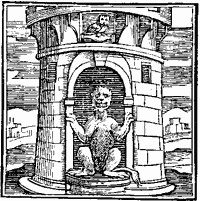
Before Champollion deciphered the Rosetta stone and unlocked the secrets of hieroglyphic writing, many wrongly believed that Egyptian hieroglyphs represented an ideographic form of writing. Indeed, the very word “ideographic” comes to us via Champollion. “It is ironic that the scholar who demonstrated the falsity of the old belief in Egyptian as symbolic and nonphonetic should have helped to popularize terms that powerfully reinforced the popular misconception of both the Egyptian and Chinese systems of writing,” DeFrancis notes in his discussion of the ideographic myth.

During the Renaissance, notions of ideographic writing helped spawn the creation of emblem books, which in their most common form were volumes of allegorical illustrations accompanied by a motto, a short explanatory caption, and often a brief poem, too. (The English department of the Memorial University of Newfoundland has an example of an emblem book online.)

The fact that these images require extensive knowledge particular to certain cultures to read — and even then not with any guarantee of correctness — should have been enough to clue people in that the notion of ideographic reading was bunk. But myths die hard.

The library of the University of Illinois has more than 600 emblem books. A recent article in that school’s campus paper gives some information on emblem books and the ideas behind them:

Interestingly, the impetus for emblem books was a misunderstanding of Egyptian hieroglyphs by Renaissance Italy humanists. “They thought that hieroglyphs were a secret language … that they were ideograms that could more accurately relate hidden mysteries about human life and nature,” Mara Wade, University professor of German, said.

The Renaissance scholars created a form where the full meaning depended on an intricate interplay between text and image, both had to be understood in order to understand the meaning of the emblem. All elements drew on complex academic themes that demanded a high degree of knowledge for their creation. “It’s the key way the Renaissance views itself, in that you can have universal truths within a short exposition of picture and text. … It’s alien to how we gain knowledge these days,” Elizabeth Black, a graduate student who works with emblems, said.

The idea of emblems spread throughout Europe, with publications in every major language, including German, Italian, French, Latin, Spanish, Portuguese, Dutch and English. The emblem books are a hybrid not just of text and image, but also languages, with many containing text in both the vernacular language and Latin.

“It was the first time you could mass-produce images,” Wade said. Even in America, emblem books attained popularity, where Benjamin Franklin printed an emblem book in 1776.

What is interesting about the emblems is that they do not present simple images, repeating what is written in the text, as in an illustrated novel. Rather, they display “a picture of something commonplace in a new or unusual setting,” Wade said. For example, to convey the title “the way of the world” an emblem from 1617 displays a crayfish with a globe on his back. In order to understand the emblem, one must know that crayfish scuttle backwards. In other words, the point of the image is the moral message one step forward, two steps back.

The ambiguous nature of emblems has invited interpretation for centuries. Subsequent editions of emblem books were sometimes accompanied with “reams of commentaries helping to enlighten, expand or completely re-order the emblems,” Black said….

Emblem books waned in popularity around 1800 when the notion of “text-image puzzles,” as Wade characterizes emblems, became no longer attractive. Nonetheless, Wade said he sees a certain connection between emblems and modern marketing logos, such as the Nike swoosh.

“A lot of the earliest emblems were designs for printers’ marks,” Wade said. In the University’s Main Library reference room, the stained glass windows contain printers’ marks that can be interpreted both as types of emblems and types of modern advertising logos.

For more information, see the University of Illinois Library’s Open Emblem Portal.

source: Emblem books: First multimedia experience, Daily Illini, Friday, October 14, 2005.

For more on how people before our time saw such matters, see Peter DuPonceau, very much a man of the Age of Enlightenment, who criticized the ideographic myth.