
Pinyin Info in the news

Nathan Bierma‘s most recent column on linguistics for the Chicago Tribune‘s Tempo section contains excerpts from an e-mail interview with yours truly.

Much of the piece focuses on Professor Victor H. Mair’s explanation, here on Pinyin Info, of how “crisis” is not “danger” plus “opportunity” in Chinese characters .

The French have a saying about incomprehensible communication. Americans say, “It’s Greek to me.” But the French say “C’est du chinois” — meaning, “It’s Chinese.”

Chinese characters are so complex that they make a good metaphor for failure to communicate. But an American copy editor living in Taiwan is trying to demystify Chinese characters and demolish a few myths about how they work.

Mark Swofford runs the Web site www.pinyin.info, a site dedicated to Pinyin, the standard system of writing Chinese words in the Roman alphabet (the alphabet used to write English).

“Most of what most people think they know about Chinese — especially when it comes to Chinese characters — is wrong,” Swofford writes at the site. “This Web site is aimed at contributing to a better understanding of the Chinese languages and how Romanization can be used to write languages traditionally associated with Chinese characters (such as Japanese, Korean and especially Mandarin Chinese).”

The Mandarin Chinese word for “crisis,” for example, is represented with an intricate symbol made with several strokes, but the word’s pronunciation can be spelled in Pinyin as “weiji” (plus a few accent marks).

Using the Pinyin system makes it easier for students to learn to speak Chinese languages, Swofford says, because Chinese characters are so complex and misunderstood — such as the frequently misinterpreted character for “weiji,” a favorite of motivational writers and speakers.

Seeking a better system

Swofford says he started his Web site in part out of frustration with the confusing and inconsistent ways street names were written in the Roman alphabet when he moved to Taiwan.

“As a professional copy editor, I found the plethora of misspellings more than just a nuisance,” Swofford says. “I started compiling lists of street and place names so that I would be able to know the correct spellings.”

Swofford’s Pinyin site features news articles about Chinese writing, original essays about Pinyin, spelling quizzes, song lyrics written in Pinyin and sample chapters of books on Pinyin.

“The Mandarin Chinese language has about 410 distinct syllables, not counting variations based on tones,” Swofford writes by e-mail from Taiwan, where he is a copy editor at Kainan University. “All can be written simply and unambiguously using the Roman alphabet.”

Swofford lists all of the syllables written in Pinyin, alongside the characters they represent, at www.pinyin.info/romanization.

“One needn’t be a student of Mandarin or a scholar to make use of the readings on my site,” Swofford says. “Most of the readings are in English and require no prior knowledge of anything about the Sinitic [Chinese] languages.”

Victor Mair is an avid reader and regular contributor to Pinyin.info. Mair is professor of Chinese language and literature at the University of Pennsylvania, where he teaches a course called “Language, Script and Society in China.”

Mair believes that Western teachers often overemphasize the need to learn and read Chinese characters. By learning Chinese with a Romanized alphabet instead of characters, he says, students are able to start speaking the language more quickly.

`Crisis’ clarified

Chinese characters themselves are often misunderstood, Mair says. Many students and scholars fail to realize there is a difference between Chinese characters and Chinese languages, he says, which can lead to problems because the meaning of the characters depends on the language and culture where they are used.

This confusion is partly to blame for the common claim of self-help books that the Chinese character for the word “crisis” means both “danger” and “opportunity.”

“A whole industry of pundits and therapists has grown up around this one grossly inaccurate formulation,” Mair writes at Pinyin.info. “The explication of the Chinese word for `crisis’ as made up of two components signifying `danger’ and `opportunity’ is due partly to wishful thinking, but mainly to a fundamental misunderstanding about how terms are formed in Mandarin and other Sinitic languages.”

According to the myth, to write the Chinese character for “crisis,” you combine the character for “danger” and the character for “opportunity.”

That’s based on a partial truth: the word pronounced “weiji” is made up of two characters, pronounced “wei” and “ji.” But while “wei” means danger, “ji” doesn’t mean “opportunity.”

“The `ji’ of `weiji,’ in fact, means something like `incipient moment; crucial point (when something begins or changes),'” Mair writes. “Thus, a `weiji’ is indeed a genuine crisis, a dangerous moment. . . . A `weiji’ in Chinese is every bit as fearsome as a crisis in English.”

The word “ji” only means “opportunity” in some cases, such as when it combines with the word “hui” (“occasion”) to make the word “jihui,” for “opportunity.” Its meaning changes depending on what other word it’s blending with. The crisis-means-opportunity myth, Mair says, is founded on a faulty understanding of the way languages work.

“There will always be some degree of misinterpretation about other peoples and their languages,” Mair writes by e-mail, “but I’m hoping to reduce misunderstanding through critical thinking and clear education.”

Here’s the article: Debunking misconceptions about Chinese characters. (Reading the piece, however, requires jumping through some registration hoops. Perhaps Bierma will later add it to his archive of some of his work, which contains much of interest.) It was published in the Chicago Tribune on November 9, 2005.

Hanyu Pinyin address plates in Taizhong

Today’s Taipei Times has a photo displaying a sample of a new address plate for buildings. The new-style plates are larger and feature romanization. The choice of Hanyu Pinyin, however, might change if the KMT fails to hold the mayorship of Taizhong (usually spelled Taichung, following bastardized Wade-Giles), as the choice of romanization systems has become partisanized, to the dismay even of many within the DPP who would prefer a more practical approach to the issue.

Note, too, the logo in the upper left corner. Although the logo is fine in the case of the address plates, many of the newer street signs in Taizhong are less legible because of the logo’s placement. I’ll supply examples later.

source: Sign of the times, Taipei Times, November 9, 2005.

Chinese man forbidden to use letter ‘D’ for son’s name

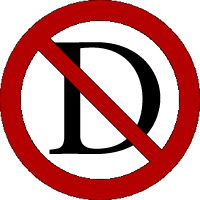
no sign with the letter 'D'[Updated version.] A Mr. Hu (胡) in Dengfeng, China, wants to give his son the name “胡D”. In case anyone’s not clear on this, yes, that’s a letter from the alphabet, not a Chinese character that happens to look like the letter D. (The name would have been the same had the baby been a girl, he said.) But this is being blocked.
The hospital where the baby was born refused to issue a birth certificate under that name. The doctor in charge of the hospital was quoted as saying that he had consulted the local public security authorities responsible for newborn registrations. “We think it is better to name newborns with simplied Chinese characters instead of rare and strange characters,” he explained.

So for the time being, the baby’s parents have had to assign a name written with a Chinese character: . By most practical measures, though, 镝 would fall under the heading of rare characters. The majority of literate Chinese would not recognize this character. Indeed, the majority of college-educated Chinese would not recognize the character, which is used to indicate the element dysprosium. On the other hand, almost everyone would recognize the letter D.

Thus, this isn’t a case of a name being rejected because it’s “rare and strange,” because in China the letter D is not rare but common and the character 镝 is certainly quite rare. (Whether 镝 is also strange I’ll leave to others.) And in China perhaps not even one in ten thousand would know how to write that character by hand.

In Mandarin, 镝 is pronounced essentially the same as the English letter D. Half the letters of the English alphabet have names that sound at least fairly close to Mandarin syllables, and thus they could be represented by Chinese characters. These are A, B, D, E, G, I, K, O, P, R, T, U, and Y. This, however, is seldom seen.

I wonder what would have happened if he had chosen a letter that doesn’t correspond to a Mandarin syllable. In support of his desired name for his son, Mr. Hu cited the example of Lu Xun’s “The True Story of Ah Q,” one of the most famous short stories in Chinese literature. Even in the Mandarin original, the character is referred to with the letter Q, as “阿Q.” (Lu Xun, by the way, was a strong supporter of romanization for Mandarin, as shown in essays such as “An Outsider’s Chats about Written Language.”)

The reverse situation — of using English letters to represent Mandarin morphemes — is fairly common among young Internet users.

The Hu family, however, has not given up. “When I find out laws and regulations to support the original name, I will apply to have it revised,” Mr. Hu said.

source: Child named with English letter, causing controversy, Xinhua, November 5, 2005.

earlier story (in Mandarin): “胡D” míngzi nán jiànlì, zhǐhǎo jiào “胡镝” [Hú Dī], Hénán bàoyè wǎng, October 26, 2005.

See also this earlier Pinyin News story: 911 Restaurant?!.

Pictures that sing?

Oh, good grief!

I’m going to give the speaker — who has lectured at Yale, Columbia, New York University, the Smithsonian, and the United Nations — the benefit of the doubt and assume he doesn’t really believe any of this nonsense, that he has created these thoughts to serve as mnemonic devices only.

These sorts of stories, as represented in the article selection below, are fairly common when people talk about Chinese characters. And, if carefully constructed, they may very well be useful in helping people remember tones or how to write characters, because characters are indeed difficult. But what I want to know is, Just when are people told that these are merely fairly tales and that the truth is very different? When are they given the facts?

When I was young, someone tried to teach me to tie my shoes by telling me a story about a fox and a rabbit, with the rabbit running around a tree and down a hole (or something like that). But everybody knew it was just a story. I didn’t grow up thinking that rabbits were somehow intimately connected with the very essence of topology. And when I was learning to read music and was taught to remember “Every Good Boy Deserves Fudge,” neither I nor my classmates assumed there was some sort of mystical connection between music and chocolate products. And never did any teacher lead me to believe that learning “King Philip called out for good soup” to remind me of “kingdom, phylum, class, order, family, genus, species” somehow let me in on a secret: that the natural world really was ruled by a soup-loving king.

So why is it that when it comes to Chinese characters the myths are all that most people are told? And thus they know no better than to believe them — after all, such stories are found in lots of books, even ones by people with impressive-sounding credentials.

“When I was a child, I spake as a child, I understood as a child, I thought as a child: but when I became a man, I put away childish things.” How long before Mandarin teaching grows up?

OK, enough of that. In the first paragraph I spoke of nonsense. Here it is:

Alumnus Ben Wang delivered a lecture on the art of the Chinese language specific to Beijing as part of Seton Hall University’s 150th anniversary….

Throughout the lecture, “Pictures that Sing,” Wang made the point that in the Chinese language, music and language are intertwined. Unlike other languages, each character symbolizes what is being said. To go along with the picture is a distinct tone or musical note. When someone speaks, notes are being sung, which are the Chinese characters.

One of the examples Wang used was sky, which comes from the root, human. The character, sky, looks like a human stick figure with a line a little above the head.

According to Wang, when pronouncing the word sky, the tip of the tongue must touch the palette of the mouth to symbolize something high. The tone used in pronouncing the word must also be high because sky is masculine and the sky is high.

Wang also compared western languages to Chinese, saying Chinese is like a string of pearls, and western languages are like embroideries.

“Every syllable is like a pearl,” he said.

He explained that, in embroidery, the beauty cannot be seen until all the threads are sewn together. Each pearl is beautiful because of the written character and the musical tone that goes with it.

Wang used the phrase “I am coming home,” to demonstrate the dissection of a sentence.

In Chinese culture, the individual is something of minimal importance so the tone going along with the character, I, is drawn out.

Wang said returning is a wonderful thing in Chinese culture because it always refers to returning home, and home, in Chinese culture, is paradise, so there is a rising tone that goes along with it.

Finally, he said, since home is paradise, the tone is also high but still sounds different from the tone of returning.

Even though it’s understood that returning is always referring to home, he said, returning and home are still two different characters and have two different tones.

source: Lecturer compares language, music

another article on Chinese forgetting how to write characters

Just another reminder that computerization hasn’t “saved” Chinese characters but is hastening the erosion of people’s ability to write them.

“Wǒ dōu kuài bù huì xiězì le! Hěn duō yuán yǐwéi hěn shúxī de zì, náqǐ bǐ lái, jiùshì bù jìde zěnme xiě, lǎoshi xiǎng xiě pīnyīn.” 11 Yuè 2 rì, zài Shāndōng wēi hǎi mǒu jīguān gōngzuò de cóng xiānsheng, pōwéi kǔnǎo de duì jìzhě shuō. Bùguāng shì cóng xiānsheng, jìzhě shēnbiān xǔduō péngyou dōu xiàng jìzhě fā guo lèisì de “gǎnkǎi”. “Diànzǐ shídài” de fùchǎnpǐn——”shūxiě zhàng’ài”, yǐ qiǎorán láidào wǒmen shēnbiān.

Qíshí, zhè bìngbù qíguài. Yǎnxià, suízhe diànnǎo jí wǎngluò de pǔjí, bàngōng jīběn shíxiàn le wú zhǐ huà, shàngwǎng liáotiān chéngwéi rénmen xīn de gōutōng fāngshì; ér shǒujī yǐ bùzài shì shēchǐpǐn, zīfèi yě jìnyībù xiàjiàng, diànhuà jiāoliú, shǒujī duǎnxìn dàitì le chuántǒng de shūxìn jiāoliú. Rénmen yòng bǐ xiězì de jīhuì yuèláiyuè shǎo. Jìzhě zài Shāndōng wēi hǎi mǒu jīguān de hòuqín chù liǎojiě dào, jìnniánlái, bǐjìběn, yuánzhūbǐ de shǐyòng liàng zhúnián xiàjiàng, ér dǎyìn zhǐ hé mòhé děng diànnǎo hào cái de shǐyòng liàng zé dàfúdù zēngzhǎng.

Shūxìn, yǐwǎng yīzhí shì dàxuéshēng yǔ fùmǔ hé wàidì tóngxué jiāoliú de zhǔyào fāngshì, ér jìzhě zài Shāndōng wēi hǎi liǎng suǒ gāoxiào cǎifǎng shí què liǎojiě dào zhèyàng de xìnxī: 90% yǐshàng de tóngxué jīhū cónglái méi xiě guo xìn. Hā-Gōng-Dà wēi hǎi xiào qū de yī wèi xìng Liú de dàyī tóngxué gàosu jìzhě, bān lǐ 80% yǐshàng de tóngxué yòngshàng le shǒujī, sùshè lǐ hái zhuāngyǒu diànhuà, yǔ fùmǔ hé wàidì tóngxué jiāoliú zhǔyào shì dǎ diànhuà hé fā duǎnxìn, cónglái méi xiǎngdào guo yào xiěxìn. Xiě yīshǒu hǎozì, yuánběn zài dàxuéshēng qiúzhí shí, kěyǐ zuòwéi yī ge zhòngyào de fǎmǎ; ér xiànzài, dàxuéshēng qiúzhí shí, suǒxū cáiliào dōu shì dǎyìn de, jīběn bùyòng xiězì. Xǔduō dàxuéshēng rènwéi, zì xiě de zěnmeyàng, duì jīnhòu de gōngzuò méi shénme yǐngxiǎng: “liàn xiězì hái bùrú liàn liàn diànnǎo dǎzì, fǎnzheng yǐhòu zhǔyào shì yòng diànnǎo.”

Yóuyú pīnyīn dǎzì jiǎndān [róng]yì xué, yīncǐ, chúle zhuānmén de dǎzìyuán wài, xǔduō rén dōu xuǎnzé pīnyīn dǎzì fǎ, zhèyàng yīlái, gèng jiāzhòng le rénmen duì Hànzì shūxiě de “mòshēng gǎn”, tíbǐ wàng zì de qíngxing shíyǒu fāshēng. Gèngwéi yánzhòng de shì, yóuyú diànnǎo pǔjí de jiākuài, zhōng-xiǎo xuésheng jiēchù diànnǎo de jīhuì yuèláiyuè duō, hěn duō xuésheng shènzhì shì jiāzhǎng dōu hūshì le “liànzì” de zhòngyàoxìng. Zài huán cuì qū yī suǒ zhōngxué gōngzuò de Sòng lǎoshī shēn yǒugǎn chùdì shuō: “xiànzài de xuésheng zì xiě de yuèláiyuè chà. Chúle fāzhǎn xìngqù àihào wài, hěn shǎoyǒu tóngxué yǒu yìshi de liàn yīxià zì. Xiāngfǎn, tāmen yòng qǐ diànnǎo, dǎqǐ zì lái què déxīnyìngshǒu, bǐ chéngniánrén hái shúliàn. ”

Zhēnduì zhèizhǒng xiànxiàng, yǒuguān zhuānjiā rènwéi, xiězì shì yī gèrén zhōngshēng de běnlǐng, liàn hǎo xiězì duì yī gèrén yóuqíshì qīng-shàonián de xīnlǐ, shēnglǐ yǐjí sīwéi hé xiétiáo nénglì děng fāngmiàn de péiyǎng, shì diànnǎo suǒ wúfǎ qǔdài de. Yīncǐ, píngshí yǒu yìshi de duō tíbǐ liàn liàn xiězì, fēicháng bìyào.

电子时代写字难 山东专家:写字本领不可丢

“我都快不会写字了!很多原以为很熟悉的字,拿起笔来,就是不记得怎么写,老是想写拼音。”11月2日,在山东威海某机关工作的丛先生,颇为苦恼地对记者说。不光是丛先生,记者身边许多朋友都向记者发过类似的“感慨”。“电子时代”的副产品——“书写障碍”,已悄然来到我们身边。

其实,这并不奇怪。眼下,随着电脑及网络的普及,办公基本实现了无纸化,上网聊天成为人们新的沟通方式;而手机已不再是奢侈品,资费也进一步下降,电话交流、手机短信代替了传统的书信交流。人们用笔写字的机会越来越少。记者在山东威海某机关的后勤处了解到,近年来,笔记本、圆珠笔的使用量逐年下降,而打印纸和墨盒等电脑耗材的使用量则大幅度增长。

书信,以往一直是大学生与父母和外地同学交流的主要方式,而记者在山东威海两所高校采访时却了解到这样的信息:90%以上的同学几乎从来没写过信。哈工大威海校区的一位姓刘的大一同学告诉记者,班里80%以上的同学用上了手机,宿舍里还装有电话,与父母和外地同学交流主要是打电话和发短信,从来没想到过要写信。写一手好字,原本在大学生求职时,可以作为一个重要的砝码;而现在,大学生求职时,所需材料都是打印的,基本不用写字。许多大学生认为,字写得怎么样,对今后的工作没什么影响:“练写字还不如练练电脑打字,反正以后主要是用电脑。”

由于拼音打字简单易学,因此,除了专门的打字员外,许多人都选择拼音打字法,这样一来,更加重了人们对汉字书写的“陌生感”,提笔忘字的情形时有发生。更为严重的是,由于电脑普及的加快,中小学生接触电脑的机会越来越多,很多学生甚至是家长都忽视了“练字”的重要性。在环翠区一所中学工作的宋老师深有感触地说:“现在的学生字写得越来越差。除了发展兴趣爱好外,很少有同学有意识地练一下字。相反,他们用起电脑、打起字来却得心应手,比成年人还熟练。”

针对这种现象,有关专家认为,写字是一个人终生的本领,练好写字对一个人尤其是青少年的心理、生理以及思维和协调能力等方面的培养,是电脑所无法取代的。因此,平时有意识地多提笔练练写字,非常必要。

source: Diànzǐ shídài xiězì nán Shāndōng zhuānjiā: xiězì běnlǐng bùkě diū, Dàzhòng Rìbào, November 4, 2005.

Taiwan to introduce Mandarin test for prospective foreign students

Beginning next June, Taiwan will require that foreign students and overseas Taiwanese-Chinese applying to study in universities take a newly developed Mandarin proficiency text, according to the Taipei Times. Those who do not pass will be required to take Mandarin lessons to supplement their studies.

Here are the proficiency test levels:

  • Elementary
    Level 1
    can understand simple instructions and basic dialogues
    Level 2
    can understand the main points of topic and read ads, posters, etc.
  • Intermediate
    Level 3
    can understand general conversation and short texts
    Level 4
    can pick up the main points of a discussion and understand longer texts
  • Advanced
    Level 5
    can discuss specialist subjects and understand simple classical Chinese texts and proverbs
    Level 6
    can expound upon and discuss topics and understand news reports at native speed
    Level 7
    native speaker fluency

source: Foreign students face Mandarin test, Taipei Times, Thursday, Nov. 3, 2005.

‘Written Taiwanese’ — new book

Harrassowitz has released a new book by Henning Klöter, Written Taiwanese (ISBN 3447050934).

Here’s the publisher’s blurb:

Written Taiwanese provides the first comprehensive account of the different ways in which Taiwanese (i.e., the Southern Min language of Taiwan) has been represented in written sources. The scope of the study ranges from early popular writings in closely related dialects to present-day forms of written Taiwanese. The study treats written Taiwanese both as a linguistic and as a socio-political phenomenon. The linguistic description focuses on the interrelation between written units and Taiwanese speech and covers various linguistic sub. elds, such as Taiwanese lexicography, phonology, and morphosyntax. The socio-political analysis explores the historical backgrounds which have led to different conventions in writing Taiwanese.

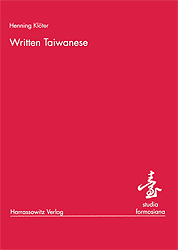
cover of book 'Written Taiwanese'
Here are some related links:

Look for a review of this book in a forthcoming issue of the Journal of Chinese Linguistics.

signage with tone marks

This morning I spotted something rare: official, government signage with tone marks. As a matter of fact, I can’t recall ever seeing this before in Taiwan. (It’s not so rare in China.)

There were three signs together, posted horizontally above the southeastern-bound lanes of a highway running through Zhonghe, near Taipei.

They read as follows:

新店
Sindiàn
秀朗橋
Siòulǎng Bridge
景平路
Jǐngpíng Rd.

Please note several points:

  • These are in Tongyong Pinyin rather than Hanyu Pinyin (in which they would be written Xiùlǎng Qiáo, Xīndiàn, and Jǐngpíng Lù, respectively.
  • They are written in a mix of romanization and English, which is typical in Taiwan. Although I don’t favor this style, it is so pervasive here that changing it is a relatively low priority compared with other romanization problems.
  • The use of tone marks differs in Tongyong Pinyin and Hanyu Pinyin, with first tone not being marked in Tongyong.

I suspect these signs are one-offs, not, um, signs of things to come. But I’ll keep my eyes open.

The tone marks on the signs were done poorly, with the marks being too small and placed far above the relevent vowels. The letter i, for example, should lose its dot when it takes a tone mark.


(I’ve adjusted the second image to move the signs closer together.)

I apologize for the poor quality of the photos. They were taken through the dirty windshield of a speeding bus.