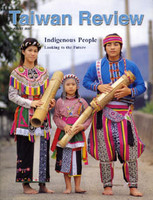
 The most recent issue of Taiwan Review has a number of articles about Taiwan’s aborigines. I found two of them particularly interesting: Giving Indigenous People a Voice, which discusses Taiwan Indigenous TV, a television station established in July 2005 for Taiwan’s aboriginal population, and Whither Aboriginal Education?, which consists of excerpts from a panel discussion.
From “Giving Indigenous People a Voice”:
[T]he station is struggling with how to broadcast to people from 13 tribes, each of which speak a different language and have widely different customs.
“It’s very difficult to be fair,” says station director Masao, himself from the Atayal tribe. “Out of 13 tribes, which tribe’s language do you choose to broadcast in? So we have no choice but to use Mandarin” (the language of the majority Han Chinese population). “Some Atayal viewers complain there’s too little Atayal news. Of course it would be best if every tribe had its own channel, but that’s impossible.”
Another problem the station faces is finding skilled aboriginal staff, especially reporters and technicians, and those who can speak their own tribal language, even if not fluently….
Kolas, who grew up in the city with no aboriginal friends, recalls realizing the importance of being able to speak her own language when she first switched from being a mainstream reporter to being a reporter covering aboriginal issues for TITV.
“I realized that, just because I was an aborigine, it didn’t mean I could get interviews with aborigines. Without speaking their language, it was very hard for me to win their trust and interview them,” she says. She is now studying the Amis language.
Less than 5 percent of aboriginal children can speak their own language, Masao estimates, but like many things concerning aborigines, no solid statistics are available. To encourage the learning of one’s own language, the station has now made it an employment requirement….
The desuetude of aboriginal languages is such a problem that the TV station is trying to devote more airtime to tribal language broadcasting. Throughout the day, tribal folk tales are told in tribal languages, although the programs are generally short, resembling commercial breaks. Once a week, there are news programs in a select number of tribal tongues. The main programs, however, including news and cooking shows, are mostly broadcast in Mandarin, unlike another Taiwanese minority channel, Hakka TV, which broadcasts almost entirely in the Hakka language.
From “Whither Aboriginal Education?”:
Sun Ta-chuan: The truth is that many of the tribes have been integrated into modern society and traditional skills such as building a slate house or building a canoe no longer exist. Children of indigenous families that have moved to the cities no longer speak their mother tongues and nor do many of those who still live in the tribal areas. The thing is that we cannot force aboriginal children to shoulder the responsibility of keeping their cultures alive. The question is, should all aboriginal children receive education about the indigenous peoples from preschool to college, or are a couple of hours a week enough? I think the way to go is a “limited two-track” system, where students are free to change track between a complete aboriginal education and regular education.
Teachers are another problem. When the College of Indigenous Studies was set up, we were hoping that it could be equipped with aboriginal faculty members but in reality most of them are not. The standard for recruiting faculty members was the same as any other university [i.e., Ph.D.s are required for most faculty positions]. But where can you find someone with a doctorate to teach an indigenous language? We complained, but to no avail. In fact, we did not know what to teach the students, because there were no textbooks about aboriginal cultures and we had to compile our own teaching materials. Currently in tribal primary and high schools, people who have completed regular normal education and receive some hours of extra courses can teach indigenous culture. That is way too easy to qualify a teacher.
The problem is that we have been making a lot of effort in education for indigenous people, but there has been little done in the way of education about them. If we are determined to work on the latter, we need to invest a lot more. The government has actually invested a lot in local education, but it is mostly about Taiwanese and Hakka cultures. From my point of view, aboriginal languages and cultures are in much greater danger than these two, but are not receiving the same level of investment. There are millions who speak Taiwanese and Hakka, but each and every one of Taiwan’s indigenous languages is in immediate danger of disappearing. Take my people, the Pinuyumayans, there are only 10,000 of us and fewer than 2,000 speak our mother tongue.
Take the preservation of languages. The government has spent considerable time and money on this. Normally, you need to have a romanization system for the languages to be able to compile the teaching materials and then you establish the tribal language certification system. But the government started to issue certificates before the romanization system came out in 2006. The same goes for the teaching materials. The fundamental reason for this waste of money and time is the lack of a policy goal, and consequently that of a blueprint and efficient process for its execution. Facing these problems, I think we had better slow down and rethink carefully our goals and priorities.
Wang Ming-huey: The key problem, I think, is that the education provided for aborigines diverges from the work of cultural transmission. Though the Indigenous Peoples Basic Act and the Education Act for Indigenous Peoples are made to promote indigenous ethnic cultures, neither the goal nor the nature of the education to be given the indigenous peoples is clearly stated therein. We hope to change the past experience of being assimilated into the rulers’ cultures–first the Japanese and then the Kuomintang, but we find no way.
Establishing a university for ethnic communities is indicative of what the new law attempts to achieve. But the curriculum taught at the College of Indigenous Studies covers such subjects as anthropology, sociology, ethnology, or political science, and Mandarin is still the language used to teach, which is no different from teaching at regular colleges. Intrinsically, we are still implementing the assimilation policy. The indigenous people have to master Mandarin, in order to learn about their tribes, whereas the knowledge still alive in the tribe is ignored.
source: Taiwan Review, Vol. 57 No. 8, August 2007
additional resources:

 A movie currently doing well at the box office in both the United States and Taiwan is I Now Pronounce You Chuck and Larry. In Taiwan, the film has been given the linguistically interesting title
  Getting back to the Taiwanese title, “