
ABC Etymological Dictionary of Old Chinese — just released!

image of the cover of the 'ABC Etymological Dictionary of Old Chinese'The University of Hawai`i Press has just released another title in its excellent ABC Chinese Dictionary Series: the ABC Etymological Dictionary of Old Chinese, by Axel Schuessler.

Here is the publisher’s blurb:

This is the first genuine etymological dictionary of Old Chinese written in any language. As such, it constitutes a milestone in research on the evolution of the Sinitic language group. Whereas previous studies have emphasized the structure of the Chinese characters, this pathbreaking dictionary places primary emphasis on the sounds and meanings of Sinitic roots. Based on more than three decades of intensive investigation in primary and secondary sources, this completely new dictionary places Old Chinese squarely within the Sino-Tibetan language family (including close consideration of numerous Tiberto-Burman languages), while paying due regard to other language families such as Austroasiatic, Miao-Yao (Hmong-Mien), and Kam-Tai.

Designed for use by nonspecialists and specialists alike, the dictionary is highly accessible, being arranged in alphabetical order and possessed of numerous innovative lexicographical features. Each entry offers one or more possible etymologies as well as reconstructed pronunciations and other relevant data. Words that are morphologically related are grouped together into “word families” that attempt to make explicit the derivational or other etymological processes that relate them. The dictionary is preceded by a substantive and significant introduction that outlines the author’s views on the linguistic position of Chinese within Asia and details the phonological and morphological properties, to the degree they are known, of the earliest stages of the Chinese language and its ancestor. This introduction, because it both summarizes and synthesizes earlier work and makes several original contributions, functions as a useful reference work all on its own.

The work is 678 pages long and retails for US$62.
ISBN: 978-0-8248-2975-9
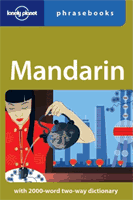
Lonely Planet switches back to Hanyu Pinyin for Mandarin phrasebook

cover of the 6th edition of the Lonely Planet Mandarin phrasebookFor the latest (sixth) edition of its Mandarin phrasebook, Lonely Planet has abandoned its disastrous experiment with its own irregular and downright awful romanization system for Mandarin and switched back to full and exclusive use of Hanyu Pinyin.

No one should even think about buying the fifth edition, which is the one with the weird romanization. Another caveat: The covers for the Pinyin-less fifth edition and the Pinyin-using sixth edition have the exact same illustration; the only difference is in the background color. The fifth edition has a red background, while the sixth (shown here) has a greenish background.

Here’s a more or less random example of the romanization in the fifth edition. The book gives “jèr shìr shér·mer jùn” for what should be written “Zhè shì shénme zhàn?” (“What station is this?”) in Hanyu Pinyin. So in addition to having weird romanization, the fifth edition fails to put a capital letter at the beginning of a sentence and fails to include punctuation at the end. I see this sort of thing a lot and am puzzled by the practice. Capital letters at the beginning of a sentence and punctuation at the end — that’s not too much to ask, is it?

Moreover, sometimes the romanization does not match the Chinese characters! In the example above, for instance, the sentence in Chinese characters should read “这是什么站?” But instead it is written “这是哪个站?”, which would be “Zhè shì nǎge zhàn?” in Hanyu Pinyin. In this case, the two sentences mean basically the same thing. But on the very next page (p. 58) for the question “Do I need to change?” it gives “sēw·yào líng·chyén ma” (Pinyin: Xūyào língqián ma?).

This is a real howler. Somehow those responsible for writing the book managed to mix up two of the meanings of “change” in English. So the phrasebook will have unwary travelers asking not “Do I need to change trains to reach my destination?” but “Do I need coins?” A Chinese person hearing this would probably just answer “no” and ponder how very strange foreigners are to think they might specifically need coins on a train. So woe to the trusting Lonely Planet customer who needs to change trains! Admittedly, foreigners ending up in the wrong part of China as a result of such sloppiness may not have happened too often, since the given romanization is so weird that foreigners could probably not make themselves understood with it and had to point to the Chinese characters. At least the characters manage to give the correct question, Xūyào dǎochē ma? (需要倒车吗?), instead of Xūyào língqián ma? (需要零钱吗?). But that’s hardly enough to make up for such errors.

There are many more errors in the fifth edition. I certainly hope they have been corrected in the sixth; but I didn’t have time the other day in the bookstore to check for sure. If any readers of Pinyin News have a copy of the sixth edition, please let me know; I’d like to check if the Lonely Planet’s hovercraft is still full of eels.

Now that at least the weird romanization has been banished in favor of Hanyu Pinyin (would that Taiwan take that lesson to heart!), it would be good if Lonely Planet could get some other things right, like correcting the misinformation about Mandarin not being a real language but a “dialect.” Some of the word parsing is also incorrect. And the Mandarin-English dictionary should be available in alphabetical order, too, not just stroke order.

Zhejiang orders Pinyin, numerals removed from business names

Xinhua is reporting that beginning in March 2007 the names of businesses in China’s Zhejiang Province must use no Hanyu Pinyin or numerals (Arabic numerals, most likely) and must have at least two Chinese characters.

This is reportedly the first time a local Chinese government has made this regulation. (But see also 911 restaurant?!.) Since this is a new regulation, it seems likely that it was created to counter an emerging practice. I expect we’ll hear soon of a crackdown against English in names, too.

Míngnián 3 yuè qǐ, fánshì zài Zhèjiāng de qǐyè jiù bùnéng zài shǐyòng yóu Hànyǔ Pīnyīn Zìmǔ huò shùzì zǔchéng de shānghào le, ér bìxū gǎiyòng yóu liǎng ge yǐshàng Hànzì zǔchéng de shānghào míngchēng.

Jù liǎojiě, zhè shì guónèi shǒu bù guānyú qǐyè shānghào guǎnlǐ hé bǎohù de dìfāngxìng fǎguī.

source: Shānghào yòng Hànzì bù shǎoyú liǎng ge (商号用汉字不少于两个), Xinhua, via Héběi qīngnián bào (河北青年报), December 2, 2006

related reading: Chinese man forbidden to use letter ‘D’ for son’s name, Pinyin News, November 5, 2005

Gaoxiong (Kaohsiung) MRT

Looking through Hao’s photos (linked to in his comment on yesterday’s post) reminded me that the MRT system in Gaoxiong is at least partially open. Since Gaoxiong is in Tongyong land, and since the signage there mixes romanization and English, and since no tone marks are given, I thought I’d share with everyone these Hanyu Pinyin guides I just made.

Here are the stations of the Gaoxiong subway system as given in Hanyu Pinyin (with tone marks), Hanyu Pinyin and English, Chinese characters, and Tongyong Pinyin and English:

See also Hao’s photos of the KMRT.

I don’t know Gaoxiong well, having been there only once, so if I got the word parsing for any of the stations wrong, please let me know.

Taiwan’s “more amiable English services”

logo to promote Taiwan's English-language environment; an image of the island of Taiwan appears with a smile and a large A+, with a globe in the backgroundWith the end of the year approaching, it is once again time for Taiwan to tout the quality of the island’s English environment by putting together a “carnival” and tossing online a website in awkward English.

Perhaps word got back to the powers that be that the English in last year’s site was bad beyond belief, because this year’s site to promote English has largely left out use of that particular language! Much of the English that is there, while not so howlingly inept as that in last year’s site, is still awkward, clichéd bullshit. Here’s an example:

The Logo features close affiliation between the globe and the smiling Taiwan, symbolizing Taiwan’s linkage to the world. The expression of “English-friendly Environment” that circles the globe and the sign of “A+” on Taiwan fully convey the ideas of creating a quality and friendly internationalized environment, as well as broadening the scope of social participation. To advance Taiwan’s connection with the world, and provide better services to foreign friends who visit Taiwan, the Research, Development and Evaluation Commission of the Executive Yuan is going to use the Logo as the basis to design a emblem that identifies a quality English-friendly environment, which will be advertised and promoted through a certificating mechanism, in order to increase the number of popular locations that offer quality English services, so that foreign friends can not only easily identify those locations but also get access to more amiable English services.

One of the few parts of the site with any useful information is the page of “Important Achievements of Creating an English Living Environment.” Some of the things listed there even are important achievements. Nonetheless, Taiwan has many fundamental problems with its approach to English — and to romanization, too. One of the biggest of these problems is that English and romanization are treated as last-minute details of little importance.

I could go on and on about this; but it’s all too depressing.

source: 2006 English Carnival

And the language used for the PRC side is …

Mark Liberman of Language Log has just added another to the series of Victor H. Mair’s guest posts on English in China. This one features an interesting news photo from the ceremony for the signing of an agreement between China and Cambodia.

photo of banner for a signing ceremony between Cambodia and China, with the text for China given in English, not Mandarin; click for larger image

And I wonder what language the agreement is in.

As Mair, who is also an occasional contributer to Pinyin Info, wrote in his initial post:

Judging from all that I have seen and heard during the last couple of years, however, it is apparent that the role of English in China will continue to grow at an exponential rate. The implications of this massive expansion of English in China will inevitably have a corresponding impact upon local language usage. In fact, the profound effects of the current surge in English usage upon Mandarin and other Chinese languages is already obvious in many respects.

sources:

Guangzhou subway to switch from Pinyin to English-Pinyin mix

Guangzhou’s Metro will be reportedly be changing from Hanyu Pinyin to a mix of English and Pinyin in the naming of its stations. Thus, for example, “Guangzhou Huochezhan” will become “Guangzhou Train Station” (or something like that) and Tiyu Xilu will become Tiyu West Road.

If the official website of the Guangzhou Metro is anything to go by, the Pinyin presently used there is terrible. The official website is infected with the Pinyin-crippling diseases of InTerCaPiTaLiZaTion and FailUreToSePaRateWords. 体育西路, for example, is given not as Tǐyù Xīlù but as TiYuXiLu. Horrible! And, of course, there are some typos too, which make matters even worse, such as TiYuZhongZin for what should be Tǐyù Zhōngxīn.

The last time I was in Guangzhou the subway didn’t exist, so I haven’t seen this signage for myself. Can anyone supply photos of station signage in Guangzhou? I’d also appreciate receiving photos of official Pinyin signage from elsewhere in China. (Photos can be sent to the address on my contact info page.)

And, of course, there’s no word on supplying what ought to be a basic: additional signage in romanized Cantonese.

I have written the authorities there seeking details about the conversion but have not received a reply.

source and resources:

typo of the day

Ain’t it the truth.

sign in Guangzhou Province with 'ticketing hell' rather than 'ticketing hall'

Jìzhě zuórì (5 rì) qiánwǎng Dōngguǎn shìqū mǒu qìchē zǒngzhàn bànshì, zài zhàn qián guǎngchǎng xià le gōngjiāochē biàn xúnzhǎo shòupiàotīng wèizhi. Zǒuláng shàng xuángguà zhe yīkuài jùdà de zhǐshì pái, zhǐmíng chángtú shòupiàotīng de wèizhi, dàn Hànzì xiàmian pèishàng de Yīngwén ràngrén dàchī-yījīng, hèrán xiě zhe: Ticketing Hell (Zhōngwén zhíyì wéi “shòupiào dìyù”). Yuánlái shì dàtīng de Yīngwén “Hall” bèi wùxiě wéi “Hell” (dìyù).

Zhè kuài zhǐshì pái de bèimiàn xiě zhe bùtóng de nèiróng, Zhōngwén shì “xíngrén tōngdào”, Yīngwén xiězuò “Pedestrain chenneling”. Zhuānyè rénshì gàosu jìzhě, “chenneling” bùzhī hé yì, shì zìjǐ shēngzào de cíhuì, kěnéng shì xiǎng xiě “channeling” ér chūxiàn le pīnxiě cuòwù, dàn “channeling” shì “gōuqú” de yìsi, “tōngdào” yībān xiězuò “channels”.

Zài guǎngchǎng de lìngyī cè, gōngjiāo zhàn de zhǐshì pái shàng bùzài xiě Yīngwén, érshì gǎiyòng Pīnyīn, dànshì xiězuò “gongjiaozan”, “zhàn” zì de pīnyīn yěshì cuòwù de.

Yǒu chéngkè gàosu jìzhě, zhèxiē zhǐshì pái yǐjing guà le hǎojǐ nián le, yīzhí méiyǒu huàn xiàlái. Rúguǒ wàibīn kànjian, bùzhī zuò hé gǎnxiǎng.

source: Yīngwén pīnxiě cuòwù: yīzìzhīchā shòupiàotīng biàn “dìyù” (英文拼写错误 一字之差售票厅变“地狱”), Guǎngzhōu Rìbào, November 4, 2006