reviews of books related to China and linguistics

Sino-Platonic Papers has just released online its first compilation of book reviews. Here is a list of the books discussed. (Note: The links below do not lead to the reviews but to other material.)

Invited Reviews

  • J. Marshall Unger, The Fifth Generation Fallacy. Reviewed by Wm. C. Hannas
  • Rejoinder by J. Marshall Unger
  • Hashimoto Mantaro, Suzuki Takao, and Yamada Hisao. A Decision for the Chinese NationsToward the Future of Kanji (Kanji minzoku no ketsudanKanji no mirai ni mukete). Reviewed by Wm. C. Hannas
  • S. Robert Ramsey. The Languages of China. Reviewed by Wm. C. Hannas
  • James H. Cole, Shaohsing. Reviewed by Mark A. Allee
  • Henry Hung-Yeh Tiee, A Reference Grammar of Chinese Sentences. Reviewed by Jerome L. Packard

Reviews by the Editor

  • David Pollack, The Fracture of Meaning
  • Jerry Norman, Chinese
  • N. H. Leon, Character Indexes of Modern Chinese
  • Shiu-ying Hu, comp., An Enumeration of Chinese Materia Medico
  • Donald M. Ayers, English Words from Latin and Greek Elements
  • Chen Gang, comp., A Dictionary of Peking Colloquialisms (Beijing Fangyan Cidian)
  • Dominic Cheung, ed. and tr., The Isle Full of Noises
  • Jonathan Chaves, ed. and tr., The Columbia Book of Later Chinese Poetry
  • Philip R. Bilancia, Dictionary of Chinese Law and Government
  • Charles O. Hucker, A Dictionary of Official Titles in Imperial China
  • Robert K. Logan, The Alphabet Effect
  • Liu Zhengtan, Gao Mingkai, et al., comp., A Dictionary of Loan Words and Hybrid Words in Chinese (Hanyu Wailai Cidian)
  • The Mandarin Daily Dictionary of Loan Words (Guoyu Ribao Wailaiyu Cidian)
  • Shao Xiantu, Zhou Dingguo, et al., comp., A Dictionary of the Origins of Foreign Place Names (Waiguo Diming Yuyuan Cidian)
  • Tsung-tung Chang, Metaphysik, Erkenntnis und Praktische Philosophie um Chuang-Tzu
  • Irene Bloom, trans, ed., and intro., Knowledge Painfully Acquired: The K’un-chih chi of Lo Ch’in-shun
  • Research Institute for Language Pedagogy of the Peking College of Languages, comp., Frequency Dictionary of Words in Modern Chinese (Xiandai Hanyu Pinlyu Cidian)
  • Liu Yuan, chief compiler, Word List of Modern Mandarin (Xianhi Hanyu Cibiao)
  • The Editing Group of A New English-Chinese Dictionary, comp., A New English-Chinese Dictionary
  • BBC External Business and Development Group, Everyday Mandarin

This is SPP no. 8, from February 1988. The entire text is now online as a 4.2 MB PDF.

Banqiao signage SNAFU

Here’s an example of the mixing of romanization systems and addition of errors that used to be common in Taipei before the city switched to Hanyu Pinyin. These signs are on a corner in Banqiao, Taipei County, not far from Banqiao City Hall.

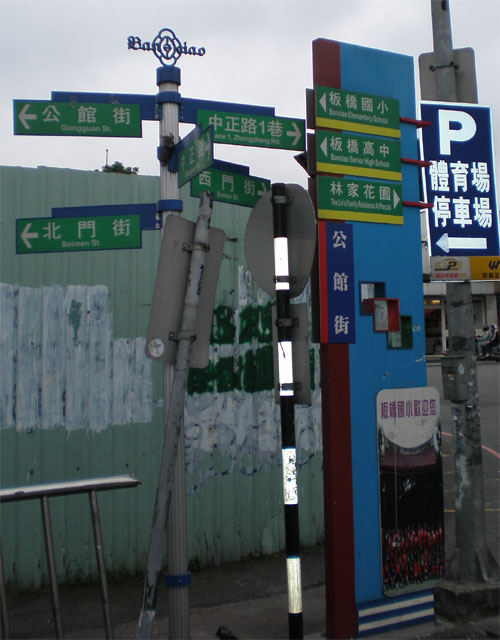
First, let’s set the scene. We have two types of signs, both with a mix of romanization and English. One set of signs gives street names; the other points toward places of possible interest.
establishing shot of signage (at one corner) discussed in this post

The blue-panel signage on the right represents something introduced during the term of the previous mayor, a member of the Democratic Progressive Party. And since the DPP backs Tongyong Pinyin for Mandarin, that’s the romanization system used most of the time on such signs. A number of the photos on these signs feature the previous mayor, who had relatively little recognition among the public since he had succeeded someone else’s term rather than being elected to his own. He put his photo on all sorts of things. But he failed to be elected to the city’s top spot. His challenger, the current mayor of Banqiao, spreads her name recognition by having her recycling speech broadcast from the city’s trash trucks.

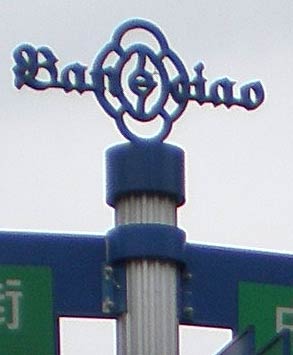
photo of the top piece on a streetsign pole in Banqiao. It reads OK, now note the cap on the signpost. It reads “Ban ciao” in black letter. Although I spotted several of these today, I’d never seen any before, which would mean it’s very likely that a KMT-led city administration under a KMT-led county government is putting up new signs in Tongyong Pinyin, a romanization system the Kuomintang (Guomindang) opposes. (The KMT used to oppose Hanyu Pinyin as well, which is how Taiwan ended up with MPS2, the Tongyong Pinyin of the 1980s.) Similarly, Banqiao has relatively new signs in prominent places around the city that read (in a particularly clumsy script face) “Bravo Banciao.” (What exactly about Banqiao is worthy of such a cheer is not stated.) Even though the city administration is under the mistaken impression that it must use Tongyong (and it does suffer from this idea), that doesn’t mean it has to go around putting up new signage in this.

To get back to the cap, the likely story is that the transportation department had some leftover money in its budget which had to be spent lest the following year’s budget be cut; but rather than spend it on fixing errors, which would involve study and actual work, people decided to make something that the boss thinks would look cool.

I wonder, though, how many Taiwanese would even recognize this reads “Banciao” unless they had it specifically pointed out to them. A few months ago I spotted an innocent-looking teenager shopping with her mother. The girl was wearing a shirt with the following text:

'f uck you' written in black letter

Although it’s almost certain she would know both English words and understand their meaning together, I think it extremely unlikely she knew what words were on her shirt.

OK, let’s have a closer look at the signs themselves.
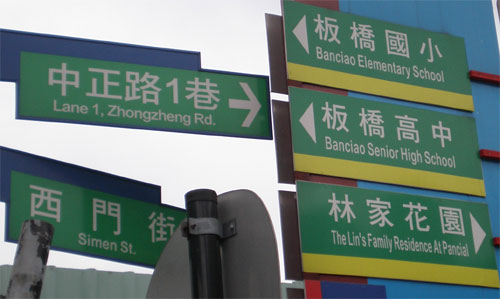
detail of signs discussed in this post

Here we have

  • “Zhongzheng” (Hanyu Pinyin)
  • “Simen” and “Banciao” (Tongyong Pinyin for what would be “Ximen” and “Banqiao” in Hanyu Pinyin)
  • “Panchial” (bastardized Wade-Giles of “Panchiao” plus a typo, for what would be “Banqiao” in Hanyu Pinyin)

And then there’s the matter of “The Lin’s Family Residence At Panchail,” which would be much better written simply “Lin Family Residence” or by the most commonly used English name “Lin Family Gardens.”

So that’s three romanization systems, a typo, and clumsy English on official signage at just one corner — to say nothing of how relatively small the alphabetic text is. And there’s no solution in sight.

Mandarin’s ‘four languages’

Another back issue of Sino-Platonic Papers has been released: The Four Languages of “Mandarin”, by Robert M. Sanders of the University of Hawaii.

Here’s how it begins:

Many hours have been spent at scholarly meetings and many pages of academic writing have been expended discussing what is to be considered acceptable Mandarin. Very often these discussions degenerate into simplistic and narrow-minded statements such as “That’s not the way we say it in …!” or “We had better ask someone from Peking.” Objectively speaking, these disagreements on style reflect a less-than-rigorous definition of which type of Mandarin each party is referring to. Because there has been a failure by all concerned to define fully the linguistic and socio-linguistic parameters of their assumed language(s), Mandarin oranges are often unwittingly being compared with Mandarin apples. This paper is a preliminary attempt to articulate the fundamental differences distinguishing four major language types subsumed under the single English heading ‘Mandarin’. Though the Chinese terms putonghua/guoyu, guanhua, and difanghua help to accentuate the conceptual distinctions distinguishing our four types of Mandarin, it is arguable that even Chinese scholars are not immune from confusing one language with another.

Sanders goes on to indentify and discuss what he calls

  1. Idealized Mandarin
  2. Imperial Mandarin
  3. Geographical Mandarin
  4. Local Mandarin

The entire text is now online for free in both HTML and PDF (875 KB) formats.

Professor Sanders is also one of the associate editors of the excellent ABC Chinese-English Comprehensive Dictionary.

‘dialect’ and ‘Chinese’ from a linguistic point of view

Another back issue of Sino-Platonic Papers has been released, this one of particular relevance to the themes of this site: What Is a Chinese “Dialect/Topolect”? Reflections on Some Key Sino-English Linguistic Terms (1991), by Professor Victor H. Mair of the University of Pennsylvania’s Department of East Asian Languages and Civilizations.

Here is the abstract:

Words like fangyan, putonghua, Hanyu, Guoyu, and Zhongwen have been the source of considerable perplexity and dissension among students of Chinese language(s) in recent years. The controversies they engender are compounded enormously when attempts are made to render these terms into English and other Western languages. Unfortunate arguments have erupted, for example, over whether Taiwanese is a Chinese language or a Chinese dialect. In an attempt to bring some degree of clarity and harmony to the demonstrably international fields of Sino-Tibetan and Chinese linguistics, this article examines these and related terms from both historical and semantic perspectives. By being careful to understand precisely what these words have meant to whom and during which period of time, needlessly explosive situations may be defused and, an added benefit, perhaps the beginnings of a new classification scheme for Chinese language(s) may be achieved. As an initial step in the right direction, the author proposes the adoption of “topolect” as an exact, neutral translation of fangyan.

The entire text is now online as a 2.2 MB PDF: What Is a Chinese “Dialect/Topolect”? Reflections on Some Key Sino-English Linguistic Terms.

Strongly recommended.

Holy hippos, Batman! — Taiwan expands its list of English words for students

Taiwan’s Ministry of Education has dipped into pop culture for some of its additions to the list of English words that elementary and junior high students are expected to learn. Among the new additions are “Batman” and “Spiderman.”

Yes, students will be tested on these — but not until 2011.

Three professors and three junior high English teachers compiled the new list of two hundred basic words; this will be added to the existing list of one thousand words.

Here are some of the other new additions:

  • bat
  • bug (computer)
  • Easter
  • French fries
  • gate (airport)
  • guy
  • Halloween
  • hippo
  • kangaroo
  • koala
  • marker
  • MRT (the mass rapid transit systems of Taipei and Gaoxiong)
  • PIN (personal identification number)
  • scooter
  • slim
  • spider
  • surf
  • temple
  • T-shirt
  • yummy
  • zebra

sources:

some character-input methods ‘Westernizing’ Chinese culture and making it ‘degenerate’: PRC official

Many of the stories I come across in my searches for news about Pinyin are related to input methods for Chinese characters. But I seldom find anything of interest in these. They tend to follow the same template: someone is touting a great new character-input method that is just so much better than Pinyin and everything else. It’s going to save Chinese characters and thus Chinese civilization and all that is good in the universe, etc. Blah, blah, blah. I just get bored.

But I recently came across one widely reprinted article that’s a bit more interesting and amusing/alarming/absurd. It has the additional advantage of being about the claims of a member of the PRC’s Chinese People’s Political Consultative Conference. Here’s the key paragraph:

Chén Duó wěiyuán shuō: “Shǒujī Hànzì shūrù jìshù yīlài wàiguó gōngsī zhìshǎo zàochéng sān dà wèntí. Shǒuxiān, wàiguó gōngsī de Hànzì shūrùfǎ pòhuài le wǒmen shǐyòng Hànyǔ Hànzì de chuántǒng sīwéi xíguàn, dǎozhì Hànwén huà yánghuà, yìhuà, tuìhuà; qícì, wàiguó gōngsī bù zhíxíng wǒguó 27,484 gè zì de qiángzhìxìng biāozhǔn, biānmǎ zì liáng zhǐyǒu 6,763 gè zì, zàochéng Hànzì shǐyòng hùnluàn, Hànzì wénběn xìnxī shīzhēn, yǐngxiǎng guójiā xìnxī ānquán; hái yǒu, Zhōngguó měinián huā jǐ yì yuán gòumǎi wàiguó gōngsī de Hànzì shūrù ruǎnjiàn, yèjiè liǎnmiàn hézài? Hànzì wénhuà de zūnyán, quánwēi bèi zhìyú hédì?”

Committee member Chen Duo said: “The reliance of mobile phones on foreign corporations’ Chinese character input technology creates at least three major problems. First, foreign corporation’s Chinese character input methods are destroying the traditional patterns for thinking about using Chinese characters and are Westernizing Chinese culture, [causing it to be] alienated and degenerate. Next, foreign corporations are not complying with our country’s compulsory standard of 27,484 characters, using instead only 6,763 characters, which wreaks chaos in the use of Chinese characters, distorts Chinese character text messages, and affects national information security. Also, China spends hundreds of millions of yuan every year on Chinese character input software. Where is the self respect of the [domestic] industry? The dignity and prestige of the culture of Chinese characters — where have they been put?

About a week later Liu Naiqiang (刘廼强), another member of the Chinese People’s Political Consultative Conference, was touting the “fool” (shǎguā) character-input method, whatever that is, and warning against Pinyin.

Here is the whole article about Chen Duo:

“Wǒguó yǒu chāoguò 4.6 yì shǒujī yònghù, jū quánqiú dìyī, dàn yǒu jiǔchéng yònghù shūrù Hànzì shí, shǐyòng de shì wàiguó jìshù!” láizì xīnwén chūbǎnjiè de quánguó Zhèngxié wěiyuán Chén Duó zài quánguó Zhèngxié shí jiè wǔ cì huìyì gānggang kāishǐ shí, biàn tíjiāo le yī fèn zhǔnbèi hěn jiǔ de tí’àn, jiànyì jǐnkuài shíshī shùzì jiànpán Hànzì shūrù guójiā biāozhǔn, niǔzhuǎn wǒguó shǒujī Hànzì shūrù jìshù shòukòng yú wàiguó gōngsī de júmiàn.

Chén Duó wěiyuán shuō: “shǒujī Hànzì shūrù jìshù yīlài wàiguó gōngsī zhìshǎo zàochéng sān dà wèntí. Shǒuxiān, wàiguó gōngsī de Hànzì shūrùfǎ pòhuài le wǒmen shǐyòng Hànyǔ Hànzì de chuántǒng sīwéi xíguàn, dǎozhì Hànwén huà yánghuà, yìhuà, tuìhuà; qícì, wàiguó gōngsī bù zhíxíng wǒguó 27,484 gè zì de qiángzhìxìng biāozhǔn, biānmǎ zì liáng zhǐyǒu 6,763 gè zì, zàochéng Hànzì shǐyòng hùnluàn, Hànzì wénběn xìnxī shīzhēn, yǐngxiǎng guójiā xìnxī ‘ānquán; hái yǒu, Zhōngguó měinián huā jǐ yì yuán gòumǎi wàiguó gōngsī de Hànzì shūrù ruǎnjiàn, yèjiè liǎnmiàn hézài? Hànzì wénhuà de zūnyán, quánwēi bèi zhìyú hédì?”

Chén Duó jīngguò diàoyán huòxī, yóu Zhōngguórén zìzhǔ kāifā de guó bǐ shūrù jìshù zì liáng 27,484 gè, pīnyīn shūrù sùdù Bǐguó wài shūrùfǎ kuàijiāng jìn sì chéng, bǐhuà shūrù Bǐguó wài shūrùfǎ kuài yībàn, yīn xíng zǔhé shūrù Bǐguó wài pīnyīn shūrùfǎ kuài jìn qīchéng. Tā rènwéi, “guó bǐ cǎijí jìsuàn le shù bǎiyì zì de Zhōngguó bǎixìng xíguàn yòngyǔ yòng cí, yōngyǒu gèxìng huà de zhìnéng tiáopín wénzì shūrù fāng’àn, yínghé le Zhōngguó bǎixìng shǐyòng Hànyǔ Hànzì de chuántǒng sīwéi guànxìng, shǐ wénzì shūrù gèng liúchàng, fāngbiàn, shíyòng. “2006 nián 10 yuè, xìnxī chǎnyè bù zhàokāi le yǐ guó bǐ shūrùfǎ wéizhǔ dǎo de guójiā biāozhǔn 《xìnxī jìshù shùzì jiànpán Hànzì shūrù tōngyòng yāoqiú》 zhēngqiú yìjiàn huì, chàngyì quánguó gè dàshǒu jī shèjì shāng, zhìzàoshāng děng cǎiyòng wǒguó zìzhǔ chuàngxīn de Hànzì shūrùfǎ.

Chén Duó wěiyuán shuō, jǐnguǎn guó bǐ shūrù jìshù yǐ qiànrù le kāng jiā, jīn lì, yǔ lóng, TCL děng zhōngduān chǎnpǐn, dǎkāi le shìchǎng de quēkǒu, dàn yóuyú shūrù jìshù shìyǐ qiànrù jìshù de fāngshì jìnrù shìchǎng, zhǔnrù ménkǎn gāo, zhōuqī cháng; zhàn wǒguó 60% yǐshàng shǒujī shìchǎng de jǐ dàguó wài pǐnpái shāng, cúnzài cǎigòu wàiguó gōngsī ruǎnjiàn de guànxìng, yǒude guónèi shǒujī chǎngshāng yě mángmù chóngbài guówài chǎnpǐn; jiāshàng shuǐhuò shǒujī jí shǎo fùfèi děng yuányīn, guónèi de Hànzì shūrù jìshù yào yǔguó wài yǐjing xíngchéng lǒngduàn de gōngsī jìngzhēng, nándù fēicháng dà; jiāzhī zhè xiàng jìshù de ménkǎn jiàogāo, jíshǐ qiāndìng le hézuò xiéyì, cóngxīn shǒujī yánfā dào chéngshú de chǎnpǐn chūchǎng zhìshǎo xūyào 9 ge yuè de shíjiān, zhège guòchéng rúguǒ méiyǒu hěn hǎode jìshù bǎozhàng hédà liáng zījīn zhīchí, hěn nán wéichí xiaqu.

Wèicǐ, Chén Duó jiànyì guójiā yǒuguān bùmén cǎiqǔ qièshí cuòshī tuīdòng shùzì jiànpán Hànzì shūrù guójiā biāozhǔn de shíshī, jiāndū hé yǐndǎo yǒuguān shēngchǎn shāng zhíxíng guójiā biāozhǔn, tuījìn guóchǎn shǒujī Hànzì shūrù jìshù chǎnyèhuà, bìng cóng fúzhí zìzhǔ chuàngxīn de jiǎodù chūfā, duì qí jǐyǔ zhèngcèxìng zhīchí.

sources:

“只有顺着中文书写逻辑,以字形和笔顺为基础,不用学、不用记,人人都很快上手的‘傻瓜输入法’才能成为全球通用的中文输入法。国家应尽快将‘傻瓜输入法’开发出来。”全国政协委员刘廼强说。

现在社会上的中文输入法很多,像目前最流行的繁体“仓颉”、“简易”,简体的“五笔”等,但刘廼强认为它们是为要求速度的专业人员设计的,不适合现在人人都要自己输入,速度不是最重要要求的现实状况。

至于“拼音”输入法,刘廼强则认为,虽然繁简皆宜,更无须特别学和记,只要统一拼音标准,按道理是不错的全球通用的输入方法。“问题是中文不是语音语言,老用拼音输入法,很容易就会执笔忘字。实践证明,彻底拼音化决不是中文发展的正确方向,因而也不是中文输入应发展的方向,因为这样下去,中文便会萎缩灭亡。”

indicator of character frequency: a suggestion for programmers

It occurred to me the other day that many people, especially language learners, might find it useful to have a tool that would take text written in Chinese characters and mark it up according to the frequency of use of the individual characters within.

Here’s a sentence from a recent CCP rant news item that can serve as an example:

非驴非马的“网语”不再满足于偏安网络一隅,正迅速向着其它媒体渗透,因而加剧了报纸电视等文字语言的混乱,玷污了汉语言文化的纯洁。
(Fēilǘfēimǎ de “wǎng yǔ” bùzài mǎnzú yú piān’ān wǎngluò yīyú, zhèng xùnsù xiàngzhe qítā méitǐ shèntòu, yīn’ér jiājù le bàozhǐ diànshì děng wénzì yǔyán de hùnluàn, diànwū le Hànyǔ yán wénhuà de chúnjié.)

Predictably, many of the characters here are extremely common. Others, however, would not even be covered under China’s definition of literacy. I’ve separated these characters into different classes, based on their frequencies of usage and applied different colors to each class:

  • character frequency: 1-100 (class i-c)
  • character frequency: 101-500 (class c-d)
  • character frequency: 501-1000 (class d-m)
  • character frequency: 1001-1500 (class m-md)
  • character frequency: 1501-2000 (class md-mm)
  • character frequency: beyond 2000 (class mmplus)

So the sample sentence would look like this:

的“语”电视

(Those of you reading this through RSS may need to visit the site to see what I’m talking about.)

The coding I used looks like this, though other approaches are possible:

<span class=”c-d” title=”101-500″>非</span><span class=”mmplus” title=”2001+”>驴</span>….

I added titles to make this more accessible.

Perhaps adding a summary would be useful:

1-100              24.6%
101-500           42.1%
501-1000          8.8%
1001-1500         14.0%
1501-2000          1.8%
2001+              8.8%

This approach could also be used for Japanese — for example, to highlight all kanji not included in the Jōyō kanji, or to highlight different sets of the Kyōiku kanji. For that matter, it could also be applied to written words in English or other languages that use alphabets, though conjugutions, plurals, and the like would complicate matters.

So, would anyone like to try coming up with one of these? Or has it been done already?

one possible resource:

Orientalism and Chinese characters: the case of ‘busyness’

Professor Victor H. Mair has sent me another piece along the lines of his popular essay danger + opportunity ≠ crisis.

The new piece discusses a misinterpretation of the nature of the Chinese character for máng (”busy”).

Since the entire essay is just a few paragraphs long, I won’t excerpt from it here but simply encourage everyone to read the whole thing: busyness ≠ heart + killing.

For related examples of this fanciful approach to etymology that Mair exposes, see misunderstandings of biblical proportions. And for a detailed explanation of how Chinese characters really do function, see Chinese.