Latin
Archived Posts from this Category
news and discussions related to romanization
Archived Posts from this Category
Posted by site admin on 14 Feb 2008 | Tagged as: Chinese, Hanyu, Japanese, Latin, Mandarin, languages, teach Chinese
2007 was the first year that the U.S. College Board offered an Advanced Placement (AP) exam for “Chinese Language and Culture.” It was also the first year students could take an AP exam in “Japanese Language and Culture.”
Data for the results as a whole have just been released. The figures for Mandarin are remarkably lopsided.
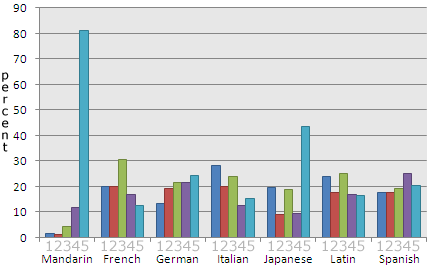
A total of 81.1 percent of those taking the exam for Mandarin and Chinese culture achieved the top score of 5, a much higher percentage than with any other test. The subject with the second highest percentage of 5’s was Japanese (43.4 percent), followed by Electricity and Magnetism (33.8 percent), Mechanics (26.1 percent), and German (24.4 percent). In most other subjects a score of 5 was achieved by only about 10 percent to 20 percent of test takers.
Let’s look at those who achieved only the lowest score (1). Here, too, Mandarin stands out, with by far the lowest percentage of test takers with this score (1.5 percent). Next are Drawing, 2-D Design, and 3-D Design (5.8 percent); English Language and Composition (10.9 percent); and Calculus BC (13.5 percent). Most subjects have “1″ rates in the 20s.
Comparison of Scores Across Language Exams

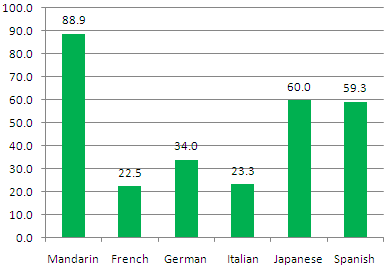
Comparison of Lowest Scores Across Language Exams

So, does this indicate Mandarin isn’t damn hard for students after all or that the perfect pedagogy for this subject has been reached? Of course not.
Only 11.1 percent of the 3,260 people taking the Mandarin exam did not indicate on their test that they “regularly speak or hear the foreign language of the examination at home, or that they have lived for one month or more in a country where the language is spoken.”
Percent of test takers who “regularly speak or hear the foreign language of the examination at home” or “have lived for one month or more in a country where the language is spoken”

Thus, it’s no surprise to see that 89.4 percent of those taking the Mandarin exam identified themselves as “Asian, Asian American, or Pacific Islander.” Of all those across the entire United States who took the Mandarin exam last year, only 363 people did not identify themselves as falling within that category. This certainly does not match the hype about Mandarin as the foreign language being studied.
While I congratulate those who scored well on the exam (Chinese characters can certainly be a pain to learn regardless of your background), the test — and perhaps the curriculum, too — evidently needs considerable revision, which isn’t too surprising considering this was its first appearance. I’m a bit saddened, though, to see that more students from a wider variety of backgrounds aren’t taking up the challenge of Mandarin.
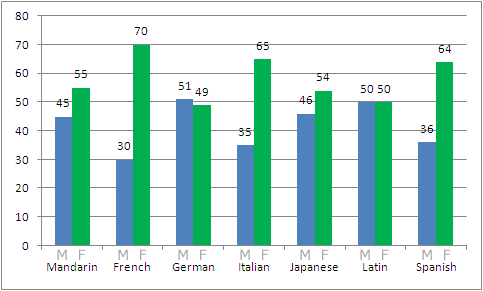
There doesn’t appear to be much of a gender imbalance, however, in AP Mandarin classes.
Percentages of students in AP language exams, by sex

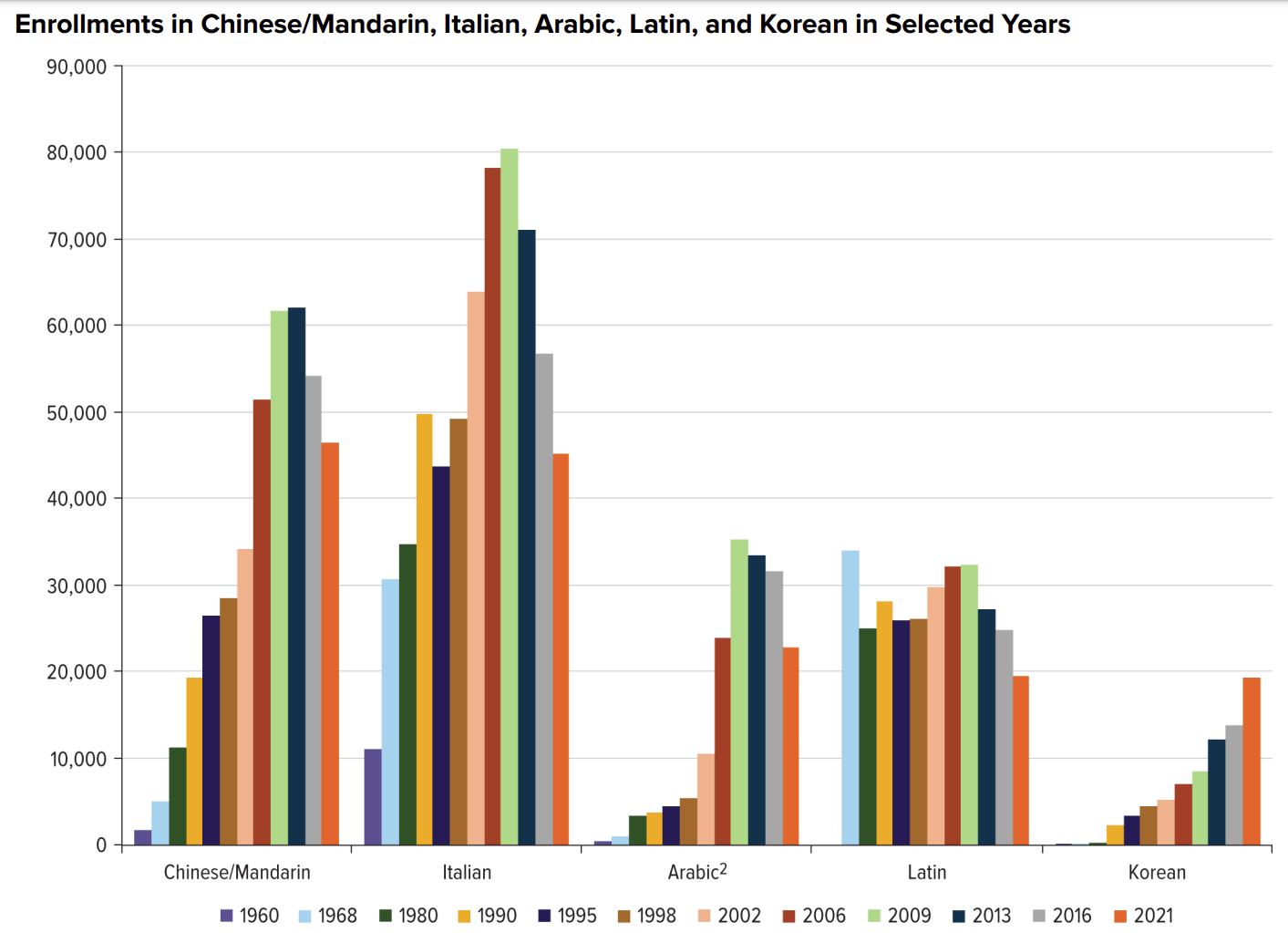
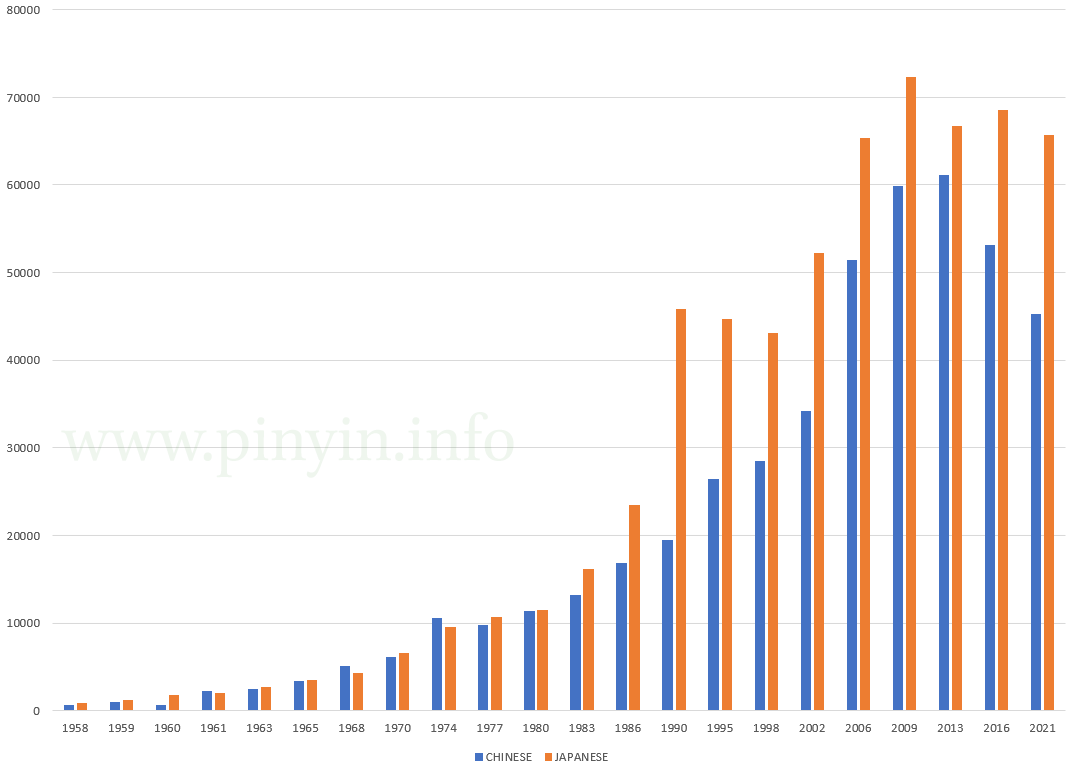
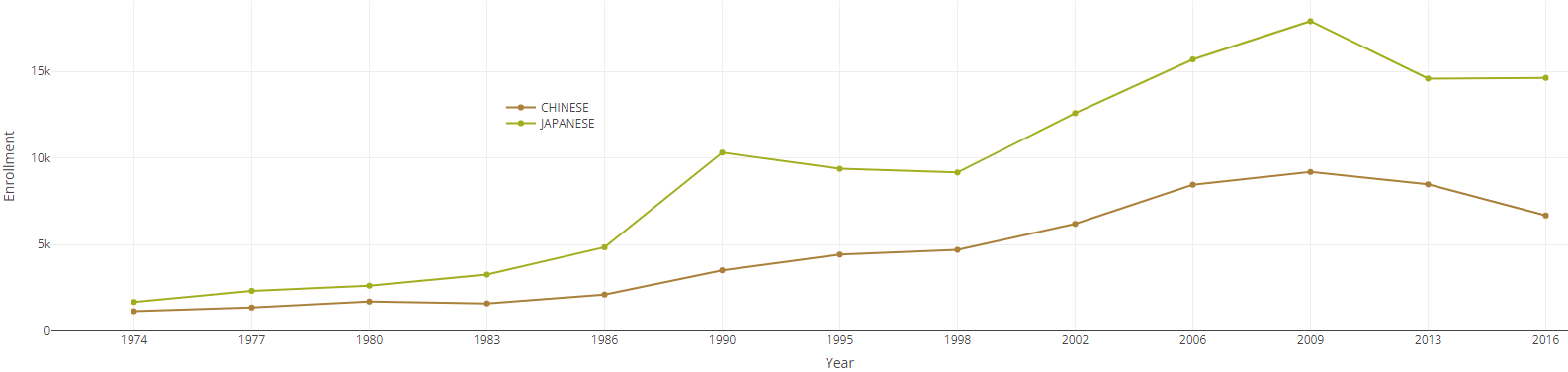
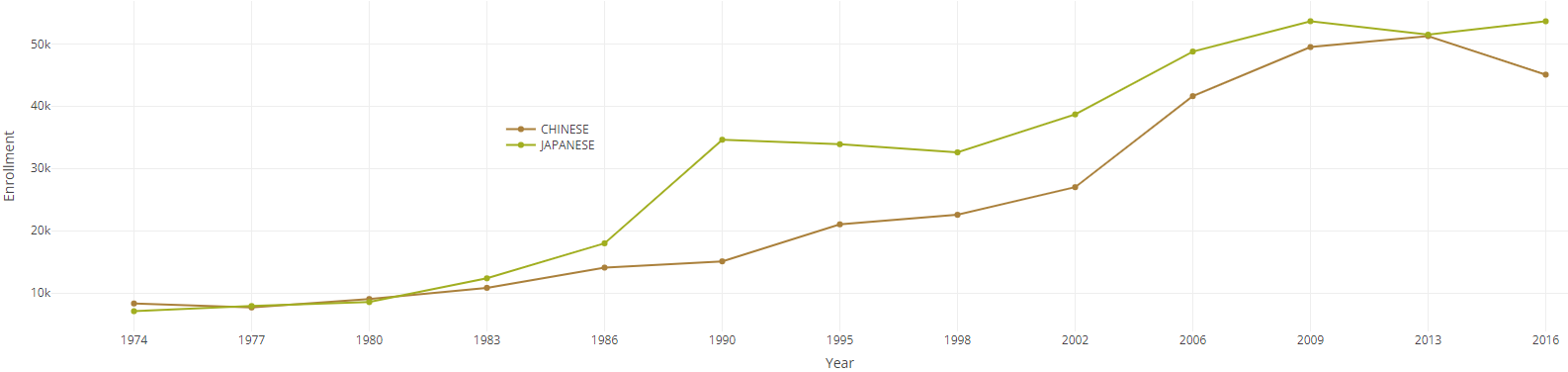
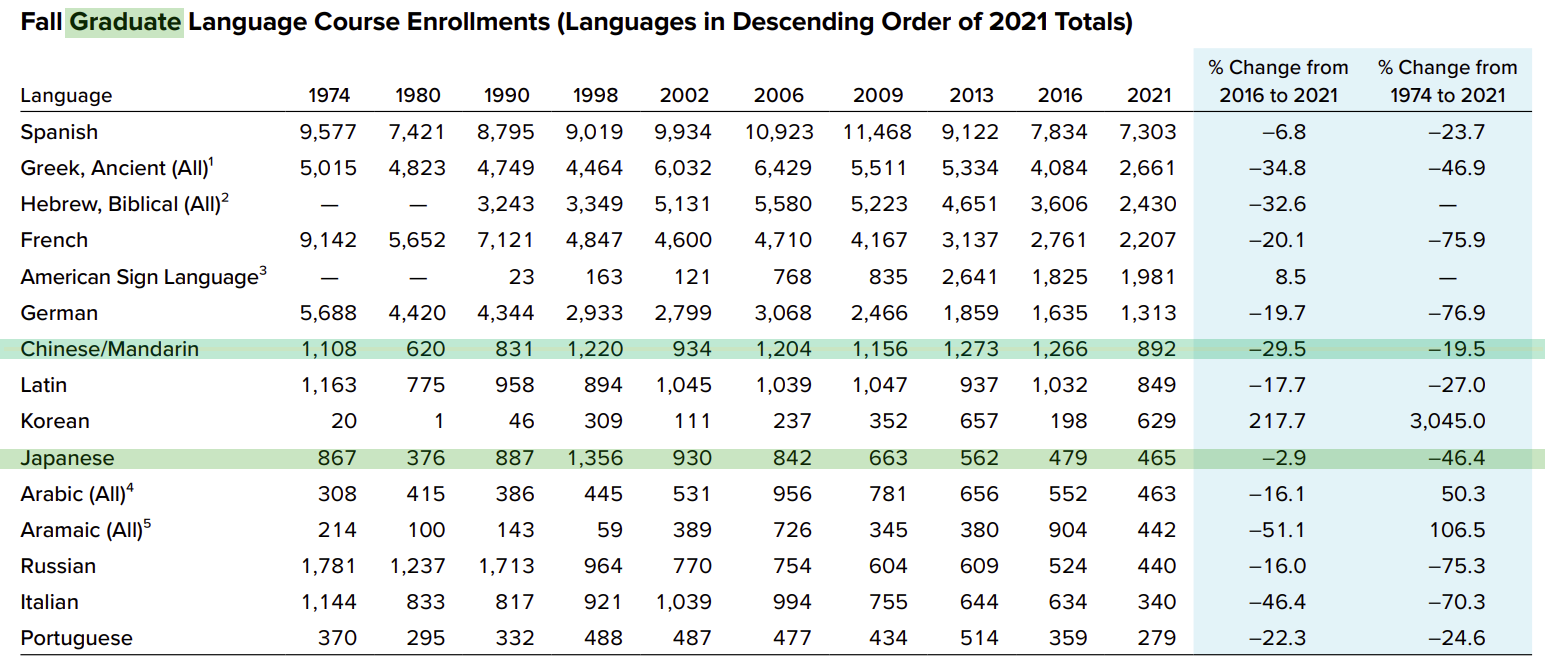
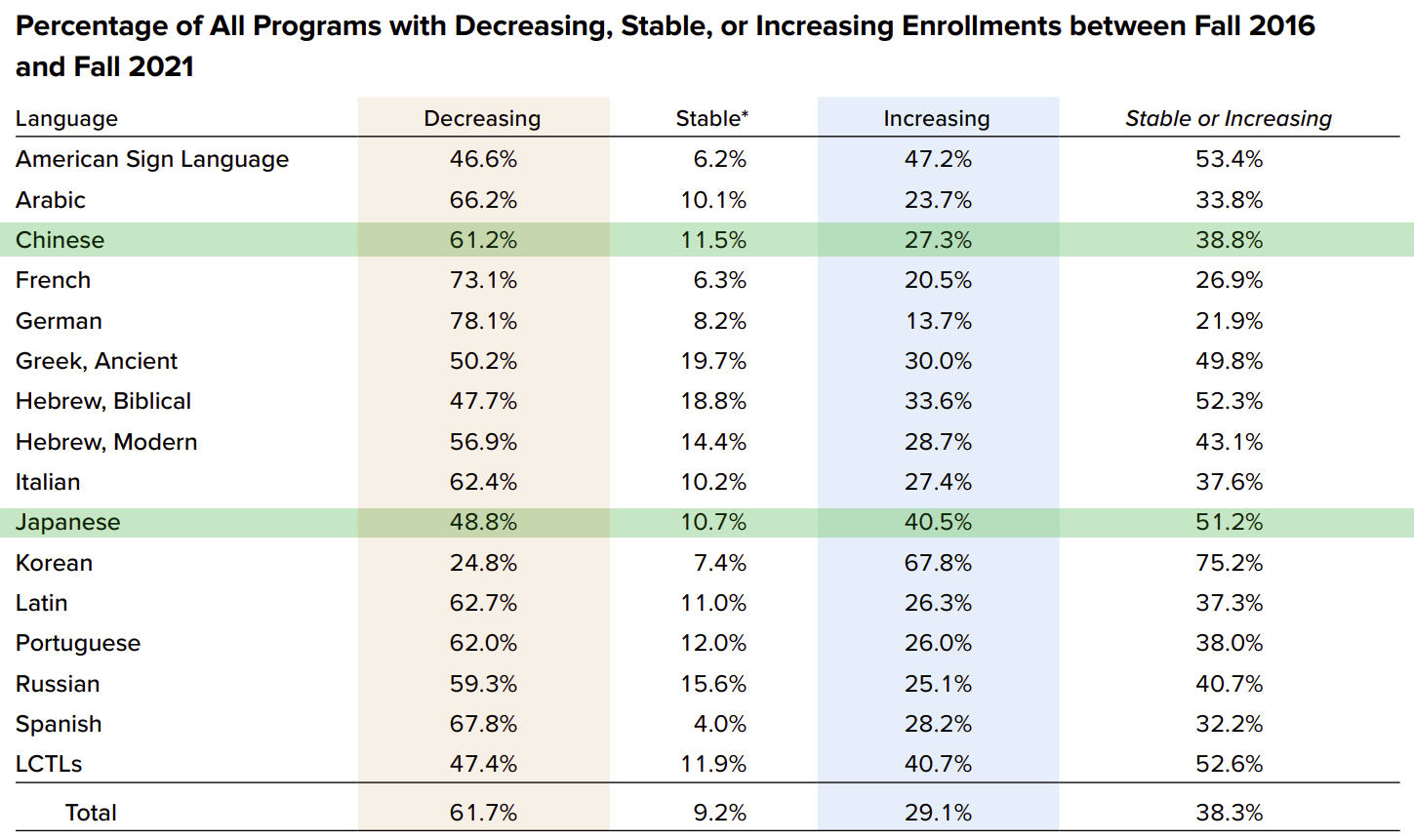
Within a week or two I’ll be posting some interesting figures about U.S. post-secondary enrollments in Mandarin and other languages.
source: The 4th Annual AP Report to the Nation, College Board, February 13, 2008
Posted by site admin on 02 May 2007 | Tagged as: Beijing, China, Chinese, Chinese characters, Classical Chinese, English, Greek, Hanyu, Japan, Japanese, Korea, Latin, Mandarin, Sino-Platonic Papers, Taiwan, Victor H. Mair, alphabet, dialect, dictionary, languages, linguistics, romanization, writing systems
Sino-Platonic Papers has just released online its first compilation of book reviews. Here is a list of the books discussed. (Note: The links below do not lead to the reviews but to other material.)
Invited Reviews
- J. Marshall Unger, The Fifth Generation Fallacy. Reviewed by Wm. C. Hannas
- Rejoinder by J. Marshall Unger
- Hashimoto Mantaro, Suzuki Takao, and Yamada Hisao. A Decision for the Chinese Nations — Toward the Future of Kanji (Kanji minzoku no ketsudan — Kanji no mirai ni mukete). Reviewed by Wm. C. Hannas
- S. Robert Ramsey. The Languages of China. Reviewed by Wm. C. Hannas
- James H. Cole, Shaohsing. Reviewed by Mark A. Allee
- Henry Hung-Yeh Tiee, A Reference Grammar of Chinese Sentences. Reviewed by Jerome L. Packard
Reviews by the Editor
- David Pollack, The Fracture of Meaning
- Jerry Norman, Chinese
- N. H. Leon, Character Indexes of Modern Chinese
- Shiu-ying Hu, comp., An Enumeration of Chinese Materia Medico
- Donald M. Ayers, English Words from Latin and Greek Elements
- Chen Gang, comp., A Dictionary of Peking Colloquialisms (Beijing Fangyan Cidian)
- Dominic Cheung, ed. and tr., The Isle Full of Noises
- Jonathan Chaves, ed. and tr., The Columbia Book of Later Chinese Poetry
- Philip R. Bilancia, Dictionary of Chinese Law and Government
- Charles O. Hucker, A Dictionary of Official Titles in Imperial China
- Robert K. Logan, The Alphabet Effect
- Liu Zhengtan, Gao Mingkai, et al., comp., A Dictionary of Loan Words and Hybrid Words in Chinese (Hanyu Wailai Cidian)
- The Mandarin Daily Dictionary of Loan Words (Guoyu Ribao Wailaiyu Cidian)
- Shao Xiantu, Zhou Dingguo, et al., comp., A Dictionary of the Origins of Foreign Place Names (Waiguo Diming Yuyuan Cidian)
- Tsung-tung Chang, Metaphysik, Erkenntnis und Praktische Philosophie um Chuang-Tzu
- Irene Bloom, trans, ed., and intro., Knowledge Painfully Acquired: The K’un-chih chi of Lo Ch’in-shun
- Research Institute for Language Pedagogy of the Peking College of Languages, comp., Frequency Dictionary of Words in Modern Chinese (Xiandai Hanyu Pinlyu Cidian)
- Liu Yuan, chief compiler, Word List of Modern Mandarin (Xianhi Hanyu Cibiao)
- The Editing Group of A New English-Chinese Dictionary, comp., A New English-Chinese Dictionary
- BBC External Business and Development Group, Everyday Mandarin
This is SPP no. 8, from February 1988. The entire text is now online as a 4.2 MB PDF.
Posted by site admin on 02 May 2006 | Tagged as: Latin, languages
Sorry for my lack of posts recently. My Internet connection at home has been out for more than a week. I’m writing this from work during my lunch break.
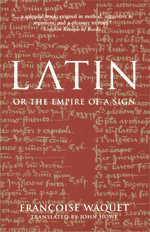
While reading Latin or the Empire of a Sign (title in the original French: Le Latin ou l’empire d’un signe XVIe-XXe Siècle), by Françoise Waquet, I came across mention of several proposals from the seventeenth century and later for the creation of “Latin towns.”

The originators of these projects started from a double observation: on the one hand the weakness of Latin after a long and difficult learning process; on the other, the speed with which a child suddenly immersed in a foreign environment learns to speak its language. In 1621 Antoine de Laval suggested that the King of France “create a Latin colony for Monseigneur the Dauphin his son and for all the princes, great lords, nobles and other children of good houses”: the exclusive use of Latin and the “pleasant” methods of instruction that would be adopted would guarantee rapid and perfect mastery of spoken Latin. Along similar lines, but more modest, was Jean Cécile Frey’s proposal for a Latin college which children would enter at the age of two; there, along with their masters and servants, they would use nothing but the Latin language in conversation and play. Thus at the age of five they would speak “more Latin, and in a more Attic fashion” than children who had spent ten painful years at school. Daniel Georg Morhof believed that it would take about twenty years to establish a Latin town where even the artisans would speak Latin; to get started all that would be needed were six or seven good Latinists, who would teach Latin to poor children of both sexes; these would then learn a profession; they in their turn would then teach Latin to their apprentices, and in this way a Latin society would take shape
Of course, nothing came of these proposals for Latin — or any of the others to follow for that language. The concept of language villages for English, though — that’s another story.
Another anecdote:
Gasparo Gozzi noted that at Padua, in the unanimous judgement of the professors, hardly a tenth of the students — perhaps thirty out of 300 — “had a middling understanding of the Latin language”. How could they follow lectures in an unintelligible language? “It is true,” Gozzi added, “that after such lectures, the students go to hear the explanation at a private school.”
I stumbled across this book while browsing in a bookstore and been having a lot of fun reading it, and not just because of the parallels between the situation with Latin and those of Literary Sinitic (Classical Chinese) and Chinese characters. Highly recommended.
Posted by site admin on 03 Jan 2006 | Tagged as: Classical Chinese, Greek, Latin, languages
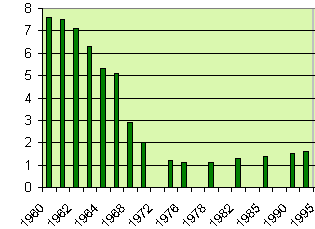
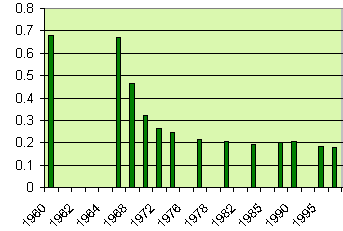
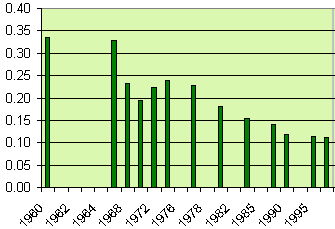
Mark Liberman at Language Log mentions the role Latin and Greek used to play in education (Old school), which is as good an excuse as any to post some graphs I made a few weeks ago from data (not current, alas) on Latin and Greek Enrollments in America’s Schools and Colleges. (I’m trying to post my backlog before Chinese New Year. And maybe then I can finally answer all the mail and comments that have been piling up.)
Note that these are not to scale with each other.
Latin as a Percentage of Enrollments, Grades 9-12

Latin, as a Percentage of College Enrollments

Greek, as a Percentage of College Enrollments

The numbers appear different in another paper from the same source: Foreign Language Enrollments in United States Institutions of Higher Education, Fall 2002 (PDF). This also gives data for many other languages.
I was going to have this lead into a discussion on the role of Classical Chinese in education in Taiwan, but I’m too far behind. So this makes two entries in a row without a direct tie-in to this site’s theme. Sorry about that.