April 2008
Monthly Archive
news and discussions related to romanization
Monthly Archive
Posted by site admin on 30 Apr 2008 | Tagged as: Aborigine languages, Taiwan, Yami, aborigines, languages, linguistics
Language Documentation & Conservation, a refereed, open-access journal sponsored by the National Foreign Language Resource Center and published online by the University of Hawai‘i Press, has released its first online book: Documenting and Revitalizing Austronesian Languages, edited by D. Victoria Rau and Margaret Florey.
Half of the chapters in the new book (ISBN 978-0-8248-3309-1) focus specifically on Austronesian languages of Taiwan. I have indicated those with bold text below.
Contents:
Introduction: documenting and revitalizing Austronesian languages
I. International capacity building initiatives
- The language documentation and conservation initiative at the University of Hawai’i at Manoa
- Training for language documentation: Experiences at the School of Oriental and African Studies
- SIL International and endangered Austronesian languages
II. Documentation and revitalization activities
- Local autonomy, local capacity building and support for minority languages: Field experiences from Indonesia
- Documenting and revitalizing Kavalan
- E-learning in endangered language documentation and revitalization
- Indigenous language-informed participatory policy in Taiwan: A socio-political perspective
- Teaching and learning an endangered Austronesian language in Taiwan
III. Computational methods and tools for language documentation
- WeSay, a tool for engaging communities in dictionary building
- On designing the Formosan multimedia word dictionaries by a participatory process
- Annotating texts for language documentation with Discourse Profiler’s metatagging system
There have also been two issues of the journal issued to date, though neither of these has anything specific about languages spoken in Taiwan.
This is indeed a promising beginning. I look forward to more such titles from the journal.
Posted by site admin on 29 Apr 2008 | Tagged as: Taiwan, Tongyong, pinyin, psycholinguistics, romanization
Dr. Ovid Tzeng (Zēng Zhìlǎng / 曾志朗 ) will be returning to government as a minister without portfolio in the Cabinet of the incoming administration of Ma Ying-jeou.
Tzeng has done important work in psycholinguistics and is known to support Taiwan’s adoption of Hanyu Pinyin. Indeed, this support was one of the reasons he was pushed out of office the last time he was in government service, as minister of education at the beginning of President Chen Shui-bian’s first term.
Tasked with choosing a romanization system for Taiwan, Tzeng recommended Hanyu Pinyin. He was promptly replaced by someone who backed the adoption of the newly minted Tongyong Pinyin.
Tzeng’s name is often misspelled “”Ovid Tseng” in news reports.
Posted by site admin on 28 Apr 2008 | Tagged as: China, English, Sino-Platonic Papers, languages, linguistics
The new work I promised on Li Yang and his Crazy English method has finally been published and is available for free on the Web: A Survey of Li Yang Crazy English (2.6 MB PDF), by Amber R. Woodward.
For a little more on this, see Victor Mair’s recent post on Language Log: Crazy English again.
This paper, which is some 70 pages long, includes photos and even videos.
Here’s the table of contents:
- Preface
- Abstract
- Li Yang: The Man
- Li Yang’s Background
- The Establishment of Li Yang Crazy English
- Crazy English: The Method
- Precursors to Crazy English
- Crazy English Pedagogical Method
- Crazy English Psychological Method
- The Potential for Success of the Crazy English Method
- Li Yang Crazy English Politics: The Madness
- Li Yang’s Personal Ideology
- Zhang Yuan’s 1999 Documentary, Crazy English
- Crazy English Publicity
- Government Response to Li Yang
- Connection between the Method and the Madness
- Appendix
- Survey on Li Yang and Crazy English
- Transcript of Time Asia Interview
- Transcript of Li’s Responses to Criticism
- Pictures of Li Yang Crazy English
- Bibliography
This is issue no. 180 of Sino-Platonic Papers.
Further reading:
Posted by site admin on 25 Apr 2008 | Tagged as: China, English, Sino-Platonic Papers, languages
A couple of days ago I promised a “long, critical study of Crazy English” will be released soon. It’s still in preparation. But you can now read a study from a couple of years ago by Amber Woodward, the same author who wrote the forthcoming piece. The 2006 study is Learning English, Losing Face, and Taking Over: The Method (or Madness) of Li Yang and His Crazy English.
The article prominently quotes a comment added to a post here on Pinyin News. So comment away, everyone, cuz you just might end up in an international journal.
This is issue no. 170 of Sino-Platonic Papers.
further reading:
Posted by site admin on 23 Apr 2008 | Tagged as: Chinese characters, Hokkien, Hoklo, Minnan, Taiwan, Taiwanese, languages, linguistics, literacy, romanization, writing systems
If the Chen Shui-bian administration had bothered to do much of anything really useful to promote Taiwanese, especially as a written language, then we probably wouldn’t be faced with crap like this.
President-elect Ma Ying-jeou met last week with Chen Fang-ming (陳芳明), the chairman of the Graduate Institute of Taiwanese Literature at National Chengchi University (Zhèng-Dà). Although Professor Chen is a former DPP official and supported Frank Hsieh in the recent election, the two reportedly found much to agree on, such as that the idea that Chinese characters are all that are needed for literature in Taiwanese; romanization and other such phonetic spellings, they agreed, aren’t necessary.
Zǒngtǒng dāngxuǎnrén Mǎ Yīngjiǔ jīntiān bàihuì Zhèng-Dà Táiwān wénxué yánjiūsuǒ suǒzhǎng Chén Fāngmíng, tā biǎoshì liǎng rén jīntiān tándào běntǔhuà, zhuǎnxíng zhèngyì, běntǔ wénxué, dàxué píng jiàn děng yìtí, lìng tā yǒu “kōnggǔzúyīn” zhī gǎn, liǎng rén hěn duō kànfǎ dōu bùmóu’érhé, lìrú Chén Fāngmíng rènwéi zhǐyòng Zhōngwén xiě, Héluòhuà niàn, jiùshì Táiyǔ wénxué, bùyīdìng kèyì yào yòng Luómǎzì, yīn lái pīn.
This is certainly discouraging though not unexpected news for romanization supporters — and for those whose idea of Taiwanese lit isn’t stuck in the Qing dynasty or even earlier. But there’s always hope that this is another of those times in which Ma is simply persuaded by or agreeing with whatever is in front of him; and he may change his mind later. Regardless, though, it doesn’t augur well for a modern Taiwanese literature or for government work on — much less promotion of — romanization over the next four years.
source and further reading:
Posted by site admin on 23 Apr 2008 | Tagged as: general
The latest issue (April 28, 2008) of the New Yorker has an article on the China’s Crazy English (Fēngkuáng Yīngyǔ / 疯狂英语) method: Crazy English: The national scramble to learn a new language before the Olympics, by Evan Osnos.
Li Yang Crazy English (as it is properly known, after Li Yang, the company’s founder, chief spokesman, and head cheerleader) uses untraditional and emphatic but not always proven methods, including shouting and vowel-associated gesticulations, to help students overcome their fear of using English and remember the sounds of their vocabulary words.
Chinese nationalism is also a big part of its approach.
From the article:
A long red-carpeted catwalk sliced through the center of the crowd. After a series of preppy warmup teachers, firecrackers rent the air and Li bounded onstage. He carried a cordless microphone, and paced back and forth on the catwalk, shoulder height to the seated crowd staring up at him.
“One-sixth of the world’s population speaks Chinese. Why are we studying English?” he asked. He turned and gestured to a row of foreign teachers seated behind him and said, “Because we pity them for not being able to speak Chinese!” The crowd roared.
Li professes little love for the West. His populist image benefits from the fact that he didn’t learn his skills as a rich student overseas; this makes him a more plausible model for ordinary citizens. In his writings and his speeches, Li often invokes the West as a cautionary tale of a superpower gone awry. “America, England, Japan—they don’t want China to be big and powerful!” a passage on the Crazy English home page declares. “What they want most is for China’s youth to have long hair, wear bizarre clothes, drink soda, listen to Western music, have no fighting spirit, love pleasure and comfort! The more China’s youth degenerates, the happier they are!” Recently, he used a language lesson on his blog to describe American eating habits and highlighted a new vocabulary term: “morbid obesity.”
Li’s real power, though, derives from a genuinely inspiring axiom, one that he embodies: the gap between the English-speaking world and the non-English-speaking world is so profound that any act of hard work or sacrifice is worth the effort. He pleads with students “to love losing face.” In a video for middle- and high-school students, he said, “You have to make a lot of mistakes. You have to be laughed at by a lot of people. But that doesn’t matter, because your future is totally different from other people’s futures.”
Very soon Sino-Platonic Papers will be issuing a long, critical study of Crazy English. Look for the announcement of that here in Pinyin News.
further reading:
Posted by site admin on 16 Apr 2008 | Tagged as: China, Sino-Platonic Papers, Zhejiang
This week’s rerelease from Sino-Platonic Papers is Tattooed Faces And Stilt Houses: Who Were The Ancient Yue? (1.6 MB PDF), by Heather Peters.
Here’s the introduction:
Recent archeological evidence excavated at Hemudu, a site in northern Zhejiang Province south of Shanghai (Zhejiang Provincial Museum 1978), suggests that were we to step back in time to the 5th millennium B.C. in southern China, we would find people cultivating wet rice, raising water buffalo and living in houses perched high on stilt posts. Culturally, these people differed radically from the millet growing pit dwellers found in the Yellow River Valley region; their discovery has raised new and important questions regarding the development of culture and civilization in southern China.
At long last Chinese archeologists have begun to reinterpret the developments of early civilization in southern China. In so doing they have emphasized the emergence of a southern cultural complex which they call “Yue” (越). The Yue culture, as defined by Chinese archeologists, spans both the Neolithic and early state period.
As more and more archeological data are retrieved from southern China, Chinese archeologists are asking the question, who were the people who created this Yue culture? Were they ethnically different from the people who lived in northern China? What language(s) did they speak? One favorite theory at the moment is that the Yue people were ancestral to the various Tai speaking populations, i.e. the Tai Lue, Tai Neu, Tong, Shui, Bu Yi and the Zhuang, living today primarily in southwestern China.
This was originally published in April 1990 as issue no. 17 of Sino-Platonic Papers.
Posted by site admin on 08 Apr 2008 | Tagged as: Chinese, Chinese characters, Mandarin, computers, software
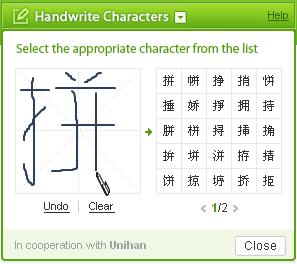
Nciku, a Web site that bills itself as “more than a dictionary,” has a nifty feature that allows users to find Chinese characters by drawing them with a mouse.
As you draw, possible character matches will appear in the box to the right of your drawing, with the results refined as your drawing progresses. You don’t need to know the canonical stroke order to get this to work, nor do your calligraphy skills need to be perfect, as this example shows.

Once you see the correct character offered as a choice, click on it and it will be entered into the search box for the site’s online dictionary. This dictionary feature can handle multiple-character input and will even prompt you with likely choices to fill out your search.
via Keywords