S.P.: Surf’s uP

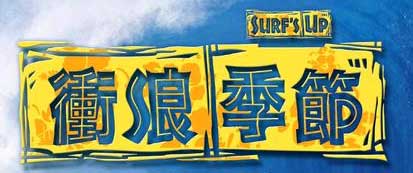
Here’s an image from the Taiwanese poster for the forthcoming movie Surf’s Up. Surfing penguins — I’m in no hurry to see this.

But I do very much like the lettering (in all senses), which incorporates two of the letters of the original title in the Chinese characters for the Mandarin name (Chōnglàng jìjié, 衝浪季節). (The title might end up translated differently in China.)

衝浪季節 -- with an S taking the place of the 'water' bushou in the 2nd character and a P taking the place of the '卩' in the final character

In the second character an S takes the place of the “water” bushou 氵 (”radical” is a misleading translation, so it’s best to avoid that word). And in the final character a P takes the place of the “卩”.

衝浪季節

See also JOHNNY DePP AND CHINeSe CHARACTeRS.

results of Hong Kong tests in Mandarin and English

The government of Hong Kong has released the results of February’s proficiency exams for prospective teachers of English and of Mandarin. A total of 1,836 candidates took the English exam, while 2,209 candidates were tested in Mandarin.

Here are the percentages of candidates attaining level 3, the basic proficiency requirement for language teachers, in 2007:

  • English
    • 78.8% in reading
    • 38.3% in writing
    • 80.4% in listening
    • 47.7% in speaking
    • 92.7% in classroom-language assessment
  • Mandarin
    • 39.6% in listening and recognition
    • 56.5% in Pinyin
    • 35.6% in speaking
    • 83.4% in classroom-language assessment

Percentages of candidates attaining level 3, the basic proficiency requirement for language teachers, in 2006:

  • English
    • 85.5% in reading
    • 45.9% in writing
    • 74.3% in listening
    • 37.0% in speaking
    • 92.7% in classroom-language assessment (exactly the same as in 2007 — strange)
  • Mandarin
    • 54% in listening and recognition
    • 50% in Pinyin
    • 38% in speaking
    • 85% in classroom-language assessment

sources and further reading:

reviews of books related to China and linguistics (2)

Sino-Platonic Papers has just released online its second compilation of book reviews. Here are the books discussed. (Note: The links below do not lead to the reviews but to other material. Use the link above.)

Invited Reviews

  • William A. Boltz, “The Typological Analysis of the Chinese Script.” A review article of John DeFrancis, Visible Speech, the Diverse Oneness of Writing Systems.
  • Paul Varley and Kumakura Isao, eds., Tea in Japan: Essays on the History of Chanoyu. Reviewed by William R. LaFleur .
  • Vladimir N. Basilov, ed., Nomads of Eurasia. Reviewed by David A. Utz.

Reviews by the Editor

  • “Philosophy and Language.” A review article of Françcois Jullien, Procès ou Création: Une introduction a la pensée des lettrés chinois.

Language and Linguistics

  • W. South Coblin, A Handbook of Eastern Han Sound Glosses.
  • Weldon South Coblin. A Sinologist’s Handlist of Sino-Tibetan Lexical Comparisons.
  • ZHOU Zhenhe and YOU Rujie. Fangyan yu Zhongguo Wenhua [Topolects and Chinese Culture].
  • CHOU Fa-kao. Papers in Chinese Linguistics and Epigraphy.
  • ZENG Zifan. Guangzhouhua Putonghua Duibi Qutan [Interesting Parallels between Cantonese and Mandarin].
  • Luciana Bressan. La Determinazione delle Norme Ortografiche del Pinyin.
  • JIANG Shaoyu and XU Changhua, tr. Zhongguoyu Lishi Wenfa [A Historical Grammar of Modern Chinese] by OTA Tatsuo.
  • McMahon, et al. Expository Writing in Chinese.
  • P. C. T’ung and D. E. Pollard. Colloquial Chinese.
  • Li Sijing, Hanyu “er” Yin Shih Yanjiu [Studies on the History of the “er” Sound in Sinitic].
  • Maurice Coyaud, Les langues dans le monde chinois.
  • Patricia Herbert and Anthony Milner, eds., South-East Asia: Languages and Literatures; A Select Guide.
  • Andrew Large, The Artificial Language Movement.
  • Wilhelm von Humboldt, On Language: The Diversity of Hunan Language-Structure and Its Influence on the Mental Development of Mankind.
  • Vitaly Shevoroshkin, ed., Reconstructing Languages and Cultures.
  • Jan Wind, et al., eds., Studies in Language Origins.

Short Notices

  • A. Kondratov, Sounds and Signs.
  • Jeremy Campbell, Grammatical Man: Information, Entropy, Language, and Life.
  • Pitfalls of the Tetragraphic Script.

Lexicography and Lexicology

  • MIN Jiaji, et al., comp., Hanyu Xinci Cidian [A Dictionary of New Sinitic Terms]
  • LYU Caizhen, et al., comp., Xiandai Hanyu Nanci Cidian [A Dictionary of Difficult Terms in Modern Sinitic].
  • Tom McArthur, Worlds of Reference: Lexicography, learning and language from the clay tablet to the computer.

A Bouquet of Pekingese Lexicons

  • JIN Shoushen, comp., Beijinghua Yuhui [Pekingese Vocabulary].
  • SONG Xiaocai and MA Xinhua, comp., Beijinghua Ciyu Lishi [Pekingese Expressions with Examples and Explanations] .
  • SONG Xiaocai and MA Xinhua, comp., Beijinghua Yuci Huishi [Pekingese Words and Phrases with Explanations] .
  • FU Min and GAO Aijun, comp., Beijinghua Ciyu (Dialectical Words and Phrases in Beijing).

A Bibliographical Trilogy

  • Paul Fu-mien Yang, comp., Chinese Linguistics: A Selected and Classified Bibliography.
  • Paul Fu-mien Yang, comp., Chinese Dialectology: A Selected and Classified Bibliography.
  • Paul Fu-mien Yang, comp., Chinese Lexicology and Lexicography: A Selected and Classified Bibliography.

Orality and Literacy

  • Jack Goody. The interface between the written and the oral.
  • Jack Goody. The logic of writing and the organization of society.
  • Deborah Tannen, ed., Spoken and Written Language: Exploring Orality and Literacy.

Society and Culture

  • Scott Simmie and Bob Nixon, Tiananmen Square.
  • Thomas H. C. Lee, Government Education and Examinations in Sung China.
  • ZHANG Zhishan, tr. and ed., Zhongguo zhi Xing [Record of a Journey to China].
  • LIN Wushu, Monijiao ji Qi Dongjian [Manichaeism and Its Eastward Expansion].
  • E. N. Anderson, The Food of China.
  • K. C. Chang, ed., Food in Chinese Culture: Anthropological and Historical Perspectives.
  • Jacques Gemet, China and the Christian Impact: A Conflict of Cultures.
  • D. E. Mungello, Curious Land: Jesuit Accommodation and the Origins of Sinology.

Short Notice

  • Roben Jastrow, The Enchanted Loom: Mind in the Universe.

In Memoriam
Chang-chen HSU
August 6, 1957 – June 27, 1989

  • Hsu Chang-chen, ed., and tr., Yin-tu hsien-tai hsiao-shuo hsüan [A Selection of Contemporary Indian Fiction].
  • Hsu Chang-chen, T’o-fu tzu-huiyen-chiu (Mastering TOEFL Vocabulary).
  • Hsu Chang-chen, Tsui-chung-yao-te i pai ke Ying-wen tzu-shou tzu-ken (100 English Prefixes and Word Roots).
  • Hsu Chang-chen, Fa-wen tzu-hui chieh-koufen-hsi — tzu-shou yü tzu-ken (Les préfixes et les racines de la langue française).
  • Hsu Chang-chen, comp. and tr., Hsi-yü yü Fo-chiao wen-shih lun-chi (Collection of Articles on Studies of Central Asia, India, and Buddhism).

This is SPP no. 14, from December 1989. The entire text is now online as a 7.3 MB PDF.

See my earlier post for the contents of the first SPP volume of reviews and a link to the full volume.

Banqiao’s orificial signage

David, who for just a little while longer lives in the same Banqiao neighborhood as I, sent me a photo of a street sign in our highly populated but little-discussed city.
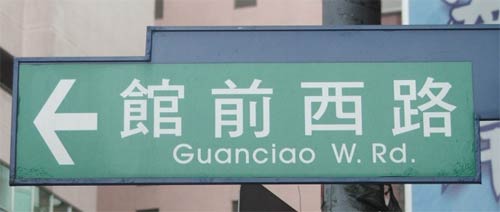
'Guanciao W. Rd.': streetsign in Banqiao, Taiwan, labeled in misspelled Tongyong Pinyin and English

The sign tells us this is “Guanciao” West Road. In Hanyu Pinyin this would be “Guanqiao.” Guanqiao? The only word in my biggest Mandarin-English dictionary under that spelling is guānqiào (關竅/关窍), which is defined as “orifices on the human body.” Hmm. Taiwan might have the questionable taste of having many a road still named after a dead dictator, but orifices?

This oddity is explained by the fact that Banqiao is simply continuing its tradition of typos — even on relatively new signs. (The style of the sign and the choice of Tongyong Pinyin both indicate this went up within the past few years.)

Guanciao (Guanqiao) should be Guancian. (In Hanyu Pinyin, 館前西路 is written Guǎnqián Xīlù.) It’s worth noting this is not a tiny lane but a road in a well-traveled part of town.

As long as I’m putting up yet another post with photos and doing further damage to my reputation of having one of the Taiwan blogosphere’s fastest-loading, least Turtonesque sites*, I might as well go ahead and add one more so I can mention something else about this sign.

Let’s look at the relative size of the Chinese characters and the alphabetic text. The majority of the letters are but one quarter of the height of the Chinese characters.
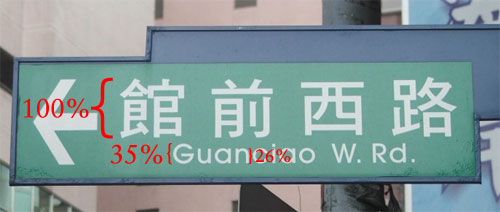
sign showing the relative percentages of the height of the letters/Hanzi on the sign

Although in this particular case the lettering might not be too small, this style often leads to nearly illegible romanization, especially on signs posted high above streets.

* Just in terms of the average number photos per post, that is. (But that’s in part because I’m a lousy photographer.) Congratulations, Michael, on reaching two thousand posts!

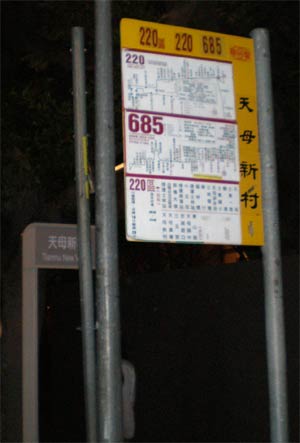
Taipei’s new busstop signs

white on gray busstop sign reading 'Tianmu New Village', with Chinese charactersThe Taipei City Government has begun to replace busstop signs throughout the city.
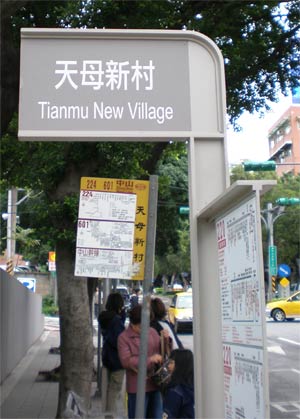
The color scheme of the new signs, however, is a poor choice because white letters against a gray background offer little contrast, especially at night.

Here, for example, is are daytime and nighttime shots of the same stop, taken from different angles.

shot of the busstop signs during the day nighttime shot of the busstop sign, showing the low level of contrast at night

The stop is not lit well, so the nighttime photo had to be taken with a flash. So this photo, though the focus came out a little fuzzy, represents an improvement over what people would normally see at night.

Two weeks ago I wrote the Taipei City Government’s Department of Transportation for clarification about the policies associated with this signage but have not received an answer. Everyone I have spoken with in that office has been friendly; but the system is unfortunately still stuck in its ways.

At least InTerCaPiTaLiZaTion doesn’t seem to be in effect. And the new style for displaying bus routes does provide more information to those who cannot read Chinese characters.

List of busstops for the Taipei 220 bus, as given on the new style (spring 2007) of busstop signage. Click for larger image.
(click for larger image)

reviews of books related to China and linguistics

Sino-Platonic Papers has just released online its first compilation of book reviews. Here is a list of the books discussed. (Note: The links below do not lead to the reviews but to other material.)

Invited Reviews

  • J. Marshall Unger, The Fifth Generation Fallacy. Reviewed by Wm. C. Hannas
  • Rejoinder by J. Marshall Unger
  • Hashimoto Mantaro, Suzuki Takao, and Yamada Hisao. A Decision for the Chinese NationsToward the Future of Kanji (Kanji minzoku no ketsudanKanji no mirai ni mukete). Reviewed by Wm. C. Hannas
  • S. Robert Ramsey. The Languages of China. Reviewed by Wm. C. Hannas
  • James H. Cole, Shaohsing. Reviewed by Mark A. Allee
  • Henry Hung-Yeh Tiee, A Reference Grammar of Chinese Sentences. Reviewed by Jerome L. Packard

Reviews by the Editor

  • David Pollack, The Fracture of Meaning
  • Jerry Norman, Chinese
  • N. H. Leon, Character Indexes of Modern Chinese
  • Shiu-ying Hu, comp., An Enumeration of Chinese Materia Medico
  • Donald M. Ayers, English Words from Latin and Greek Elements
  • Chen Gang, comp., A Dictionary of Peking Colloquialisms (Beijing Fangyan Cidian)
  • Dominic Cheung, ed. and tr., The Isle Full of Noises
  • Jonathan Chaves, ed. and tr., The Columbia Book of Later Chinese Poetry
  • Philip R. Bilancia, Dictionary of Chinese Law and Government
  • Charles O. Hucker, A Dictionary of Official Titles in Imperial China
  • Robert K. Logan, The Alphabet Effect
  • Liu Zhengtan, Gao Mingkai, et al., comp., A Dictionary of Loan Words and Hybrid Words in Chinese (Hanyu Wailai Cidian)
  • The Mandarin Daily Dictionary of Loan Words (Guoyu Ribao Wailaiyu Cidian)
  • Shao Xiantu, Zhou Dingguo, et al., comp., A Dictionary of the Origins of Foreign Place Names (Waiguo Diming Yuyuan Cidian)
  • Tsung-tung Chang, Metaphysik, Erkenntnis und Praktische Philosophie um Chuang-Tzu
  • Irene Bloom, trans, ed., and intro., Knowledge Painfully Acquired: The K’un-chih chi of Lo Ch’in-shun
  • Research Institute for Language Pedagogy of the Peking College of Languages, comp., Frequency Dictionary of Words in Modern Chinese (Xiandai Hanyu Pinlyu Cidian)
  • Liu Yuan, chief compiler, Word List of Modern Mandarin (Xianhi Hanyu Cibiao)
  • The Editing Group of A New English-Chinese Dictionary, comp., A New English-Chinese Dictionary
  • BBC External Business and Development Group, Everyday Mandarin

This is SPP no. 8, from February 1988. The entire text is now online as a 4.2 MB PDF.