
Reply
Taiwan to abandon use of ‘4’ on license plates
 Superstitious dread of the number four is so widespread in Taiwan that the officials in charge of the issuing of license plates for vehicles have decided to abandon use of that number altogether for personal cars and motorscooters.
I’m not making this up.
Beginning next year, new license plates for cars will have two alphabetic letters and four digits, and scooters plates will have three alphabetic letters and three digits — and neither of them will have any fours. The reason behind this is that in Mandarin the word for “four” (sì) sounds similar but not identical to the word for “die/death” (sǐ). In Taiwanese the situation is the same: the words are similar but not identical.
It turns out that this is more an expansion of an existing policy than something completely new. The Ministry of Transportation and Communications has long had a policy that kept 4 from being used as the final digit in a license number. And ten years ago this was expanded to cover the second-from-the-last digit as well.
Although I was aware of the superstition involving the number four, I’d never heard of this license policy before. So on the way home last night from the movies I paid careful attention to license plates and, much to my surprise, saw no fours as the final or penultimate digits — except on one bus (not covered by the policy) and one car that looked like it was more than 10 years old (and thus would have a plate number that had been grandfathered in).
But even this allowed for too many fours for many motorists. More than 30 percent of vehicle owners pay some NT$3,000 (US$90) each to be able to choose their own plate numbers — which doesn’t provide anywhere near the same freedom as, say, U.S. drivers can have with their vanity plates.
Especially dreaded by some was the combination “45” (sì and wǔ), which sounds vaguely similar but certainly not identical to sǐ wǒ. This might be translated “death me” (??). If that sounds not quite right, that’s because sǐ wǒ is not grammatically correct Mandarin or Taiwanese.
Given the nature of my Web site, I’d like to note a few things here other than that superstitions are stupid. First, note that Taiwan uses the Roman alphabet and Arabic numerals, just as Western countries do. Although Chinese characters are used to identify the area of the vehicle’s registration, they have nothing to do with the identification of the car itself. Numbers are not given in the form 一, 二, 三, 四, 五, 六,七, 八, 九, 十 but 1, 2, 3, etc.
Furthermore, this situation with the license plates contains a lesson on the ideographic myth. Superstitious motorists aren’t seeing the Arabic numeral “4” as an, ahem, ideograph; it is still very much being tied to sound. That the superstitious seize upon the association despite the fact that the sound is not identical to that of the dreaded word for “death” is, I believe, reflective of how readers of Chinese characters must be flexible in how they interpret characters’ phonetic clues. The phonetic elements of Chinese characters have over the course of millennia become so out of synch with the modern language that many, many characters at best only hint at rather than express their pronunciation. Thus, readers must allow for changes in tone, in initials, and in finals. (And often that’s not enough, forcing people to fall back on tedious rote memorization.) Chinese characters are quite simply not a good match for modern Mandarin.
Many thanks to Jens at my favorite ice cream store for alerting me to this story.
Guórén jìhuì「4」, qìjīchē páizhào huàn fā ruò pèngdào Ālābó shùzì 4, cháng yīn mínzhòng bù yuàn lǐng pái ér lācháng páizhào fāfàng zuòyè shíjiān. Jiāotōngbù kǎoliáng mínzhòng de xīntài, juédìng míngnián quánmiàn huàn fā de qìjīchē xīn páizhào, qǔxiāo suǒyǒu hán Ālābó shùzì 4 de hàomǎ.
Jiāotōngbù gōnglù zǒngjú zǎoqī jí yǐ qǔxiāo zuì yòubian de 4 zìmǎ, 10 nián qián yòu qǔxiāo chēpái hàomǎ yòubian dì-èr mǎ de 4, wàichuán 4444 chēpái shì gěi bìnzàng yè shǐyòng, bìngbù zhèngquè. Xiànxíng chēliàng páizhào jǐn yòubian dì-sān wèishù jí dì-sì wèishù yǒu 4 zìmǎ, dàn mínzhòng réngyǒu jìhuì, lìrú 45XX, xiéyīn jiùshì「sǐ wǒXX」.
Jiāotōngbù gōnglù zǒngjú Táiběi qū jiānlǐ suǒzhǎng Wáng Zhēn-shèng biǎoshì, měi ge yuèdǐ huò niándǐ dōu shì jiāo chē lǐng pái jiānfēng shíduàn, dàn ruò pèngdào yǒu 4 de chēpái, chē shāng huò mínzhòng cháng xuǎnzé zìfèi xuǎnhào, huò gāncuì guò jǐ tiān zài lǐng pái, yǐzhì jiānlǐ suǒ zhàn huàn fā hán 4 de hàopái shí, suǒxū zuòyè shíjiān yuē wèi huàn fā yībān hàopái de liǎng bèi.
Jiāotōngbù gōnglù zǒngjú jiānlǐ zǔzhǎng Xiè Jiè-tián zhǐchū, guórén qìchē shǐyòng niánxiàn píngjūn 10 nián, wèile qǔdé hǎo zhàotou, sān chéng yǐshàng chēzhǔ nìngyuàn huā liǎng, sānqiān yuán xuǎn chēpái hàomǎ;jíshǐ bù huāqián xuǎnhào, yě dōu jìnliàng bìmiǎn lǐngdào hàomǎ zhōng yǒu 4 de chēpái.
Xiè Jiè-tián biǎoshì, qìjīchē xīn páizhào xíngshì yǔ xiànxíng chēpái jīhū xiāngtóng, qìchē cǎi liǎng ge Yīngwén zìmǔ jiāshàng sì ge Ālābó shùzì, jǐn jiāng mùqián hàopái shàngfāng Táiwān Shěng, Táiběi Shì jí Gāoxióng Shì děng zhíxiáshì fēnlèi gǎiwéi Yīngwén zìmǔ. Rúcǐyīlái, chēpái hàomǎ róngliàng zēngjiā èrshíwǔ bèi, dádào yīyì sānqiān sānbǎi wàn ge, zú gōng 30 nián páizhào jiǎoxiāo jí huàn fā suǒxū.
Xiè Jiè-tián zhǐchū, chēliàng hàopái róngliàng chōngzú, wèilái hàopái bù huì zàifāshēng Yīngwén zìmǔ yǔ Ālābó shùzì hùnzá shǐyòng de qíngkuàng, qìchē chēpái gùdìng wèi liǎng ge Yīngwén zìmǔ jiē sì ge Ālābó shùzì, jīchē wèi sān ge Yīngwén zìmǔ jiē sān ge Ālābó shùzì.
source: Qìjīchē huànxīn páizhào méi 4 le, Taibei Baodao, November 13, 2005
candidate numbers and literacy
As I mentioned in the previous entry of Pinyin News, it’s election season in Taiwan. That means the streets are lined with political banners and roving trucks have been blaring candidates’ pleas for votes. This culminated last night in an orgy of loud campaign rallies. Today all is silent, as campaigning is not allowed on election day itself.
One of the rituals marking a milestone in the campaign season is the drawing of lots to determine the order in which candidates’ names are listed on the ballot. Candidates draw the numbers themselves at local election bureaus. Sometimes they even dress in costume for the occasion.
These numbers, however, are given a prominence that reveals their significance is far greater than just determining name order. Indeed, even if just one person is running for an office, by law (article 38 of the Enforcement Rules of Public Service Election And Recall Law) that candidate is still assigned a number (1, of course). The numbers go alongside candidates’ names on the ballots and appear prominently on essentially all campaign material, whether that be in the form of a banner, a poster, a flyer, or a package of tissue (a popular choice here). The numbers are almost always printed in red against a white background that is itself circled in red. These two campaign banners demonstrate the style:
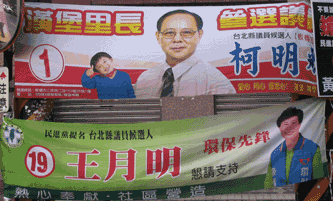
Including the numbers is not mandated by law, but they’re always there (except in the few cases where someone overlooked writing in the number on individual signs printed before the drawing of lots). Furthermore, this style of writing the numbers is not required, but it’s seldom altered. Sometimes the color is altered to match the color scheme of the banner. But I’ve never seen a number in a square, a triangle, or a diamond — always a circle. And I’ve never seen the numbers written in Chinese characters (一, 二, 三, 四, 五, 六, 七, 八, 九,十, etc., or the more formal forms 壹, 貳, 叄, 肆, 伍, 陸, 柒, 捌, 玖, 拾, etc.) rather than 1, 2, 3, etc.
 Here’s what the Public Officials Election and Recall Law states about what information appears on ballots:
The ballot shall bear the serial numbers [i.e., the numbers I’ve been discussing], names and photographs of all candidates. However, in an election of central public officials, the ballots shall also bear the candidates’ party affiliation from which the candidates were recommended (article 60 ).
So the numbers also appear on the ballots themselves, which is, of course, the whole reason for them appearing in campaign literature. Note that ballots for local-level elections omit mention of political parties. Thus, not only the photo of the candidate but also the candidate’s number is regarded as more important than party affiliation.
I think the attention given to numbers should prompt questions on the true state of literacy in Taiwan.
I asked an official at the Central Election Commission about why party affiliation was left off. But neither he nor anyone else in his office at that time knew the explanation. And when I asked about the prominence of numbers, the official admitted that literacy did play a role in this.
For what it’s worth, party affiliation on ballots for national-level posts is indicated by the printed name of the party, not with a party logo. A change to logos is being discussed for the next legislative election.
There’s a lot more to be said about this topic. Perhaps I’ll come back to it later.

Further reading:
- Taiwan’s election laws (in English)
- an entry earlier this year about a special election that, unusually, did not have numbers for the ballot choices
deerly contested elections
Yeah, yeah, I know: For that pun I should be locked up. But, believe me, it’s in the spirit of Taiwan’s current electoral season. 
Here, for example, is an image from the campaign literature for Zhāng Hóng-lù (張宏陸). Zhang has chosen a deer as his mascot because the final syllable of his name sounds like the Mandarin word for deer, lù (鹿). (Yes, that’s supposed to be a deer, not the result of some unholy experiment involving Rudolph the red-nosed reindeer and an inflatable Bambi.)
Note the quasi romanization, on both the collar and headphones, of @ for “a,” which is a prefix for personal names. Thus, “@-lu” stands for “A-lu,” which is a meant as a friendly nickname for Zhang.
The A prefix might be familiar to Westerners through Lu Xun’s “The True Story of Ah-Q” (阿Q正傳). (Lu Xun, by the way, was an important advocate of romanization.) The association in the campaign literature, however, is definitely intended to be with Taiwan’s president, Chen Shui-bian, whose nickname of “A-bian” was written in romanization on much of Chen’s campaign merchandise.  Chen even refers to himself in the third person as “A-bian.” (For some reason most people in Taiwan don’t seem to find this affectation by Chen as disconcerting as Americans found Bob Dole’s odd habit of referring to himself as “Bob Dole.”)
Zhang is of course from the same political party as Chen.
As for the use of @ for “a,” this might be copied from Chen-related merchandise, though the only images I found in a quick search had “a-bian” rather than “@-bian.” The “a,” however, is often found within a circle, which may have led subsequent designers to the @ usage. There is, however, a small chain of soup-noodle stores named “@-Bian.” 
The @ is of course a vague allusion to the Internet, with the intent of looking “modern.” The @ usage was copied (perhaps incorrectly) from some of Chen’s merchandise, affectations of modernity being pointless when it comes to otherwise unpretentious noodle stores.
The headphones on the deer, however, are a mystery to me. Then there’s the fact that they aren’t on the deer’s ears. Perhaps they’re a vague attempt to appeal to the youth vote.
Bei-Bei jing-jing wel-wel comes-comes you-you
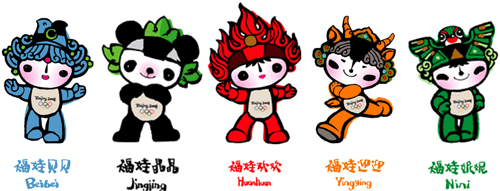
 Beijing has unveiled its five mascots for the 2008 Olympics, the Friendlies Fuwa. They are dubbed Beibei, Jingjing, Huanhuan, Yingying, and Nini. Here’s Jingjing, the friendly PRC panda, with his gun. In case you’re wondering, yes, that’s an official image.
OK, back to language-related matters. These aren’t just saccharine names for cutesy figures: there’s a pattern. Note how each name is a doubled syllable, which is a common way to form affectionate nicknames in Mandarin. (My wife, for example, is named Hsin-chun, but many in her family refer to her as Hsin-hsin.)
Taking the first syllable of each of the mascot names yields “bei jing huan ying ni,” or, more properly, “Beijing huanying ni,” which is “Beijing welcomes you” in Mandarin. If tones are indicated this would be written Běijīng huānyíng nǐ; but tone indications are completely unnecessary here for easy comprehension of the meaning. Although Mandarin is a tonal language, most clearly written texts do not need to have all or even most tones indicated for comprehension by fluent speakers.
Let’s look at the sentence “Beijing huanying ni” when written in characters. It’s “北京欢迎你” in simplified Chinese characters. In traditional characters it would be written “北京歡迎你.” But the names of the mascots aren’t all written with these same characters. For that matter, not even all the tones are the same:
| Beijing welcomes you | mascot names | ||
|---|---|---|---|
| character | tone | character | tone |
| 北 | běi | 贝 | bèi |
| 京 | jīng | 晶 | jīng |
| 欢 | huān | 欢 | huān |
| 迎 | yíng | 迎 | yíng |
| 你 | nǐ | 妮 | nī |
北北 (lit. “North-north”) just doesn’t make for a catchy mascot name. But, basically, the only way to use Chinese characters to indicate the third-tone bei sound of “Beijing” is with the 北 character. So the mascot namers went with a different character — and consequently a different tone, too. They opted for bèi.
By the way, readers of Chinese characters have no choice but be accustomed to characters being pronounced with a variety of tones. Some 80 percent of Chinese characters that have more than one pronunciation — and these are quite common — are associated with at least two tones.
Chinese does have a word pronounced bèibèi. It is written in characters thusly: 孛孛. The meaning is “radiant,” which sounds nice enough for a mascot name. But almost no one knows this old word. For that matter, most people don’t even know the obscure 孛 character and thus wouldn’t know it’s supposed to be pronounced bei. (Note how a character doesn’t have to have a large number of strokes to be obscure.)
Thus, 孛孛 obviously wouldn’t work. So the designers used a bèi that is rather more precious. When 贝 is doubled, the association is with baobei (treasure), as in something a mother might call her child (just as an Italian woman might sometimes fondly refer to her child as “tesoro”). Thus, an English translation of “Beibei” would be something like “Precious.” (Normally I’m opposed to translating names. But in this case some translation is appropriate, as these names are most certainly designed to be cute as a button and so should be revealed as such.)
Let’s move on to Jingjing. Using, say, the “proper” character for Beijing’s jing would yield 京京, which means “intense (of sorrow).”
念我独兮、忧心京京。
哀我小心、癙忧以痒。I think how I stand alone,
And the sorrow of my heart grows intense. (tr. James Legge)
Even though that’s such an ancient term that almost no one would know it now, it’s probably still not the sort of thing Beijing’s Olympic planners would want as a mascot name. So 晶, which has the same pronunciation (including tone) as Beijing’s jing was selected. An English translation of “Jingjing” would be something like Crystal, or perhaps Sparkles.
Huan and ying are used unchanged. Indeed, Huanhuan is found as a personal name; an English version of this name would be “Joy.” But “Yingying” doesn’t translate well; “Welcome” is about the best I can think of at the moment.
With Nini, again we have a different character and a different tone. (Then there’s the selection of ni rather than the more polite form of nin. This might make an interesting entry by itself.)
Mandarin does have a word pronounced “nǐnǐ.” It means “luxuriant; exuberant; flourishing” — perhaps not entirely out of line for a name. But then comes the matter of the character; this word is written 苨苨. But 苨 is used only in 苨苨. Although in this case the phonetic part of the character (as opposed to the “radical”) is relatively clear, 尼, the character is nonetheless not nearly common enough for people to know whether it is pronounced (probably, that is — because Chinese characters are not unlike a spelling system that’s two thousand years out of date) nī, ní, nǐ, or nì. And at any rate, even if people did know the correct pronunciation, they still wouldn’t know the meaning of 苨苨. In short, 苨苨 is also a bad choice.
There’s a more common “nini,” which has different tones: níní (泥泥). This has two meanings: (1) damp (from dew), and (2) luxuriant; thick (of vegetation). The 泥 character, unlike 苨, is not uncommon. Nonetheless, the word níní (泥泥) is obscure, which would lead most people to guess at the meaning, and most of them would probably guess something like “muddy.” So this choice wouldn’t be a good one either.
The marketing managers decided to use 妮 (nī), which is used in nīr (妮儿/妮兒), a word for “girl.” This yields the decidedly twee “Nīnī,” which might be translated as “Girly.” (Note that the phonetic is the same as in the above: 尼.)
Here are Precious, Crystal, Joy, Welcome, and Girly:
sign language in Taiwan
A group of scholars at National Chung Cheng University (Guólì Zhōngzhèng Dàxué) have compiled a large reference book on Taiwan Sign Language and created a related Web site, according to the Taiwan News. The newspaper labeled the work “the world’s most comprehensive sign language reference book.” Although I’m not sure I’m ready to believe that without more details, the work does sound important. Here are some excerpts from the article:
[Professor] Tai [Hau-yi] explained that sign language is more than hand gestures – it is a multi-sensory communication tool with its own set of grammar and syntax rules. Moreover, it is the native tongue of many hearing-impaired people as well as of hearing children born into non-hearing families, he added.
Many people have the misconception that there is a universal sign language, [Professor Jane] Tsai said.
“But because languages are culturally-based, each country has its own sign system and within each system, there are various “accents” among the regions of the country.” Tsai explained.
She said that to accommodate all the variations in TSL, the reference book and online dictionary provide video clips for signs from northern and southern Taiwan….
“It is important to demonstrate how to make the signs because sign language is more than speaking with your hands. It involves facial expressions and body movements such as raising of the eyebrows and lip-mouth motions to convey the speaker’s intent,” said Tai….
Tai said in Taiwan, most parents of hearing-impaired children prefer to lip-read than to sign. By robbing these children the rights to speak their natural language, the parents are doing them a disservice, he said.
“We understand why the parents want their children to learn how to lip read, but since Chinese is a tonal language, it is very difficult for kids to perfect lip-reading skills,” Tai explained….
According to the latest 2005 statistics from the Ministry of the Interior, there are 98,206 hearing-impaired people in Taiwan.
source: Academics launch most comprehensive sign-language book, Taiwan News, November 25, 2005
mobile phone with hiragana menus
NTT Do Co Mo is releasing a mobile phone aimed at the children’s market. One of the phone’s features is that users will be able to switch its screen-menu system from kanji to hiragana.
子どもが簡単に操作できるよう、メニューやガイドの難しい漢字をひらがなで表示することができます。
I wonder if similar features can be found on other electronic items in Japan. (Matt, any ideas?)
The phone is model SA800i.
sad state of ‘native-language education’ in Taiwan
Today’s Taipei Times has an interesting article on the state of teaching Taiwan’s “native languages.” (This means Taiwanese (a.k.a. Hokkien, Minnan, etc.), Hakka, and the languages of Taiwan’s tribes, but not Mandarin.) From the look of things, the government has basically botched the situation, despite having thrown twice as much money toward these languages as is being spent on English.
Although some of the problems and expenses are to be expected, given how new this is and how much resistance there has been from conservative forces, I’d say that things are still far from acceptable. A large part of the problem is that the government can’t even decide on a script for these languages: sometimes romanization (various systems), sometimes Chinese characters, sometimes zhuyin. It’s a mess.
No progress in native-language education has been made in schools despite the central government promising to encourage local culture and language education three years ago, native-language teachers said yesterday.
Liu Feng-chi (???), director of the Taiwan Association of Mother Language Teachers and a teacher of Hoklo (also known as Taiwanese), said he felt cheated that the government had “not taken in any of our suggestions to improve native-language education in school” over the past three years.
Liu said the Ministry of Education had not put much effort into reform nor native-language education. Classes in schools were not being planned carefully and lack continuity, he said.
“Classes [for native languages] should continue after elementary school so that students can keep learning the languages in junior high,” Liu said.
Association executive director Huang Hsiu-jen (???) said teachers of Hoklo are being “reselected” every year and must undergo a “disrespectful” selection process.
Huang said the selection committee was sometimes composed of teachers who did not speak Hoklo themselves.
“The selection team tends to choose young Hoklo teachers who can sing and dance in class, while older teachers like us end up with no job,” Huang said.
Liu also said that the salary for teachers was based on the number of hours worked in a week and that the hourly wage was a mere NT$320.
Furthermore, native language teachers are called “assistant teachers,” and schools do not provide them with health insurance, Liu added.
The association also expressed concern that many schools were using the time reserved for language classes to teach other subjects, and that many language teachers were required to teach mathematics or science as well.
Meanwhile, Perng Fuh-yuan (???), section chief at the ministry’s Department of Elementary Education, said there are more than 300,000 children learning native languages in the country.
Perng said the selection process applied not only to language teachers but to teachers in general, and that former language teachers were added to the selection committee to provide specialist advice.
“It is hard for students to continue native-language classes in junior high school under all of the exam pressure,” he said. “However, schools have tried to incorporate these languages into extracurricular activities connected to the school, such as Hoklo language clubs.”
The ministry spends NT$400 million (US$11.9 million) annually on native-language courses, while English classes have NT$200 million per year in funding. Elementary school students are required to take at least one period of native-tongue classes per week.
Taiwan’s native tongues include Hoklo, Hakka and a variety of Aboriginal languages.
source: Native-language teachers lash ‘disrespectful’ ministry, Taipei Times, November 18, 2005.