US students abroad

The Institute of International Education has released its 2005 “Open Doors” report on U.S. students studying abroad.

The top twenty destinations for study abroad by U.S. students during the 2003-04 school year were, in declining order, Britain, Italy, Spain, France, Australia, Mexico, Germany, Ireland, China, Costa Rica, Japan, Austria, New Zealand, Cuba, Chile, Greece, the Czech Republic, South Africa, Russia, and the Netherlands.

Britain was by far the leader, with 32,237 U.S. students. China was ninth, with 4,737.

Fear of SARS resulted in numbers for parts of East Asia dropping off for the spring and summer of 2003, so the 90 percent increase for China is not so much a dramatic increase as a return to pre-crisis levels.

In 2003/04, overall U.S. study abroad in Asia (13,213) increased by 36%, with American student numbers in China exceeding pre-SARS levels (4,737, up 90%), and increases in students going to Japan, (3,707, up 7%), Korea (879, up 19%), Hong Kong (487, up 6%), and Taiwan (195, up 32%). However, even with all of these increases, only 7% of all Americans studying abroad selected Asia for their overseas academic experience.

I don’t know how those numbers are reached. Taiwan certainly has more than 192 Americans studying here. Perhaps the figures are related to official university-level study-abroad programs.

Nonetheless, the figures do represent an increase, especially for places such as China, where many are studying Mandarin. Indeed, being in an environment where the target language is spoken is especially important, given how many Mandarin-learning programs (in both the West and Asia) are badly imbalanced toward memorizing Chinese characters rather than learning the language itself. So environment is especially important for those wishing to learn Mandarin.

For what it’s worth, I’ve lived in both China and Taiwan, and I recommend Taiwan.

calligraphy in decline

“Many people are saying that Chinese characters and Chinese calligraphic art is in a life-or-death crisis,” begins an article on the state of calligraphy in contemporary China.

One factor contributing to the decline of the popularity of calligraphy is the fact that fewer and fewer Chinese characters are being written by hand. And without regular practice writing characters, people are forgetting how to write many of them as they now have computerization to help with character input.

In an academic seminar held last week at the National Art Museum of China in Beijing, many Chinese experts and artists expressed their concerns about the future of the millennia-old Chinese characters and Chinese calligraphic art….

Wu Zhenfeng, a researcher with the Shaanxi Provincial Art Museum, said that many Chinese calligraphers today are not as knowledgeable in the arts as previous generations of calligraphers, for instance in classical Chinese literature.

Although the “kids these days just aren’t as knowledgeable as they used to be” line is a cliche, in this case it’s almost certainly true.

It is true that the practical functions of calligraphy are decreasing and calligraphy is getting far away from the daily lives of ordinary people. However, “calligraphy, as a vital part of art education, should be strengthened rather than weakened in China’s primary education and at the university level,” said Li Yi, a researcher with the National Research Institute of Chinese Arts.

This is roughly the Chinese equivalent of people in Britain saying, “Bring back compulsory Latin.” The trouble is there are only so many hours even Chinese children can study. And keep in mind that they already have to spend more time in what might be called basic language classes than their counterparts in the West because Chinese characters are a tremendously more difficult script than the Roman alphabet. So what exactly is going to get dropped?

After the Cultural Revolution, interest in calligraphy revived, and about 100 magazines and newspapers devoted to the art sprung up. But today, the number of calligraphy-related publications “has dwindled sharply as fewer people care about the art form,” the article notes.

Most graduates of a doctoral program in calligraphy opened in 1993 at Capital Normal University in Beijing are unable to make a living as professional calligraphers, unlike calligraphers of two decades ago, according to Ye Peigui, an art researcher and one of the first graduates of the program.

Chen Lusheng, a researcher with the National Art Museum of China, said that Chinese calligraphy is the very essence of Chinese culture and philosophy.

“The question of the sustainability of Chinese calligraphy is actually the question of the sustainability of Chinese culture,” he said.

If that’s so, Chinese culture is in real trouble.

He criticized the excessive use of Chinese calligraphy art as a resource in recent years by some “vanguard” Chinese artists. This practice caused misunderstanding and distorted perceptions among average viewers about Chinese calligraphy.

Those darn kids, trying to make something new again.

source: Calligraphic art faces predicament, China Daily, November 10, 2005.

Zhuang writing

An article from Xinhua discusses writing in Zhuang. The Zhuang, China’s largest “national minority” group, live mainly in Guangxi. Their language is written with the Roman alphabet.

The first paragraph discusses a prize for literature in Zhuang. One of the winners was a folk song, the other a novella. While I have nothing against folk songs, I find the novella potentially far more interesting as it wouldn’t necessarily fit within the framework of what multiculturalism has come to be in today’s China: “We love minorities as long as they wear colorful costumes, have some songs and dances, bring in tourists, and don’t spout other than the Party line.” (It wasn’t always so. In the period just after the 1949 revolution, the Communist authorities initially worked to give real support to minority groups — to the extent of registering many people as Zhuang who insisted that, no, they were Han!)

The novella, though, has a rather folksy title, Shorty A-he, so it may be just more in the colorful, old-fashioned-countryside-folk mode. Although there’s nothing necessarily wrong with that, I hope there’s more to Zhuang literature than this. Otherwise, it’s going to end up a museum piece.

我国首届壮文文学奖日前揭晓,李从式的山歌《深情重如山》和陆登的中篇小说《短脚阿和》等5篇以壮文创作的作品获奖。众多语言学专家认为,文学艺术给壮文普及插上一对翅膀,对传承壮族文化起着重要作用。”民族语言文字在传播、培育民族文化中发挥着重要作用,以艺术形式推广不仅有利于普及壮文,还能更加鲜明地体现出壮族文化的内涵。”广西少数民族语言文字研究处主任杜宰经说。

壮族是我国人口最多的少数民族,11月29日是壮文诞辰48年纪念日。壮族文化源远流长,壮文早在隋唐时期就有了雏形,但过去一直没有形成统一使用的民族语言文字,直到1957年国务院才经过语言文字专家仔细研究,通过了以拉丁字母为基础的拼音壮文方案。据统计,我国壮语人口已经超过1700万人。作为中国学者和壮文研究者集体智慧的结晶,壮文已经在广西、云南文山等一些地方得到普及和应用。现行的标准壮语是以广西武鸣音为标准音、以壮族北部方言为基础方言的壮民族共同语。

广西贝贝特文化传播有限公司副总经理李庭华说:”过去壮文普及仅仅依托教育模式,通过设立壮汉双语教学学校,培养了数以十万计的壮文教育人才,但是文学艺术才是一个民族文化特色的本质所在,通过艺术表现力才能更好地展现一个民族的魅力。”

“今年广西在第五届壮族文学奖里增设了壮文文学奖,以文学艺术竞赛模式促进了壮文文学创作队伍的扩大,有益于建立独特的壮文文学读者群,从而推动壮语普及和壮族文化发展。”李庭华说。

为了普及壮文,广西之前还举办过农民学壮文学科技等一系列颇具特色的壮文培训班,将壮文扫盲与脱贫致富相结合。”过去学壮文学科技致富脱贫,现在学壮文学艺术陶冶情操。”李庭华笑着说。

source: Shǒujiè Zhuàngwén wénxué jiǎng jiēxiǎo Zhuàngyǔ pǔjí dāchéng yìshù kuàichē, (首届壮文文学奖揭晓 壮语普及搭乘艺术快车), Xinhua, November 4, 2005.

Pinyin Info in the news

Nathan Bierma‘s most recent column on linguistics for the Chicago Tribune‘s Tempo section contains excerpts from an e-mail interview with yours truly.

Much of the piece focuses on Professor Victor H. Mair’s explanation, here on Pinyin Info, of how “crisis” is not “danger” plus “opportunity” in Chinese characters .

The French have a saying about incomprehensible communication. Americans say, “It’s Greek to me.” But the French say “C’est du chinois” — meaning, “It’s Chinese.”

Chinese characters are so complex that they make a good metaphor for failure to communicate. But an American copy editor living in Taiwan is trying to demystify Chinese characters and demolish a few myths about how they work.

Mark Swofford runs the Web site www.pinyin.info, a site dedicated to Pinyin, the standard system of writing Chinese words in the Roman alphabet (the alphabet used to write English).

“Most of what most people think they know about Chinese — especially when it comes to Chinese characters — is wrong,” Swofford writes at the site. “This Web site is aimed at contributing to a better understanding of the Chinese languages and how Romanization can be used to write languages traditionally associated with Chinese characters (such as Japanese, Korean and especially Mandarin Chinese).”

The Mandarin Chinese word for “crisis,” for example, is represented with an intricate symbol made with several strokes, but the word’s pronunciation can be spelled in Pinyin as “weiji” (plus a few accent marks).

Using the Pinyin system makes it easier for students to learn to speak Chinese languages, Swofford says, because Chinese characters are so complex and misunderstood — such as the frequently misinterpreted character for “weiji,” a favorite of motivational writers and speakers.

Seeking a better system

Swofford says he started his Web site in part out of frustration with the confusing and inconsistent ways street names were written in the Roman alphabet when he moved to Taiwan.

“As a professional copy editor, I found the plethora of misspellings more than just a nuisance,” Swofford says. “I started compiling lists of street and place names so that I would be able to know the correct spellings.”

Swofford’s Pinyin site features news articles about Chinese writing, original essays about Pinyin, spelling quizzes, song lyrics written in Pinyin and sample chapters of books on Pinyin.

“The Mandarin Chinese language has about 410 distinct syllables, not counting variations based on tones,” Swofford writes by e-mail from Taiwan, where he is a copy editor at Kainan University. “All can be written simply and unambiguously using the Roman alphabet.”

Swofford lists all of the syllables written in Pinyin, alongside the characters they represent, at www.pinyin.info/romanization.

“One needn’t be a student of Mandarin or a scholar to make use of the readings on my site,” Swofford says. “Most of the readings are in English and require no prior knowledge of anything about the Sinitic [Chinese] languages.”

Victor Mair is an avid reader and regular contributor to Pinyin.info. Mair is professor of Chinese language and literature at the University of Pennsylvania, where he teaches a course called “Language, Script and Society in China.”

Mair believes that Western teachers often overemphasize the need to learn and read Chinese characters. By learning Chinese with a Romanized alphabet instead of characters, he says, students are able to start speaking the language more quickly.

`Crisis’ clarified

Chinese characters themselves are often misunderstood, Mair says. Many students and scholars fail to realize there is a difference between Chinese characters and Chinese languages, he says, which can lead to problems because the meaning of the characters depends on the language and culture where they are used.

This confusion is partly to blame for the common claim of self-help books that the Chinese character for the word “crisis” means both “danger” and “opportunity.”

“A whole industry of pundits and therapists has grown up around this one grossly inaccurate formulation,” Mair writes at Pinyin.info. “The explication of the Chinese word for `crisis’ as made up of two components signifying `danger’ and `opportunity’ is due partly to wishful thinking, but mainly to a fundamental misunderstanding about how terms are formed in Mandarin and other Sinitic languages.”

According to the myth, to write the Chinese character for “crisis,” you combine the character for “danger” and the character for “opportunity.”

That’s based on a partial truth: the word pronounced “weiji” is made up of two characters, pronounced “wei” and “ji.” But while “wei” means danger, “ji” doesn’t mean “opportunity.”

“The `ji’ of `weiji,’ in fact, means something like `incipient moment; crucial point (when something begins or changes),'” Mair writes. “Thus, a `weiji’ is indeed a genuine crisis, a dangerous moment. . . . A `weiji’ in Chinese is every bit as fearsome as a crisis in English.”

The word “ji” only means “opportunity” in some cases, such as when it combines with the word “hui” (“occasion”) to make the word “jihui,” for “opportunity.” Its meaning changes depending on what other word it’s blending with. The crisis-means-opportunity myth, Mair says, is founded on a faulty understanding of the way languages work.

“There will always be some degree of misinterpretation about other peoples and their languages,” Mair writes by e-mail, “but I’m hoping to reduce misunderstanding through critical thinking and clear education.”

Here’s the article: Debunking misconceptions about Chinese characters. (Reading the piece, however, requires jumping through some registration hoops. Perhaps Bierma will later add it to his archive of some of his work, which contains much of interest.) It was published in the Chicago Tribune on November 9, 2005.

Hanyu Pinyin address plates in Taizhong

Today’s Taipei Times has a photo displaying a sample of a new address plate for buildings. The new-style plates are larger and feature romanization. The choice of Hanyu Pinyin, however, might change if the KMT fails to hold the mayorship of Taizhong (usually spelled Taichung, following bastardized Wade-Giles), as the choice of romanization systems has become partisanized, to the dismay even of many within the DPP who would prefer a more practical approach to the issue.

Note, too, the logo in the upper left corner. Although the logo is fine in the case of the address plates, many of the newer street signs in Taizhong are less legible because of the logo’s placement. I’ll supply examples later.

source: Sign of the times, Taipei Times, November 9, 2005.

English edging out Japanese in science — even in Japan

A recent article in a Japanese newspaper discusses the dominance of English in the world of science, specifically in Japan. It contains this telling anecdote:

Earlier this year, the Japan Society for Bioscience, Biotechnology and Agrochemistry revised the rules governing submission of papers to its Japanese-language journal, Kagaku to Seibutsu (Chemistry and Biology), as follows: “Papers should be those whose contents cannot be explained properly in languages other than Japanese, or those that are of particular interest to Japanese readers.”

Akinori Ota, 57, a professor at the University of Tokyo’s Graduate School of Agricultural and Life Sciences who participated in making the revision, says papers likely to draw attention from around the world should be submitted to its English journal, Bioscience, Biotechnology and Biochemistry.

“It isn’t that we don’t encourage researchers to write papers in Japanese. However, papers written in Japanese are not widely read overseas,” Ota says. The society has already returned some papers to their authors together with advice to write them in English. No papers that would be appropriate for publication in Japanese have been received.

(Emphasis added.)

source: Japanese scientists use English or get the silent treatment, Asahi Shimbun, November 5, 2005.

Chinese man forbidden to use letter ‘D’ for son’s name

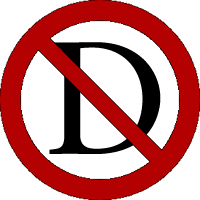
no sign with the letter 'D'[Updated version.] A Mr. Hu (胡) in Dengfeng, China, wants to give his son the name “胡D”. In case anyone’s not clear on this, yes, that’s a letter from the alphabet, not a Chinese character that happens to look like the letter D. (The name would have been the same had the baby been a girl, he said.) But this is being blocked.

The hospital where the baby was born refused to issue a birth certificate under that name. The doctor in charge of the hospital was quoted as saying that he had consulted the local public security authorities responsible for newborn registrations. “We think it is better to name newborns with simplied Chinese characters instead of rare and strange characters,” he explained.

So for the time being, the baby’s parents have had to assign a name written with a Chinese character: . By most practical measures, though, 镝 would fall under the heading of rare characters. The majority of literate Chinese would not recognize this character. Indeed, the majority of college-educated Chinese would not recognize the character, which is used to indicate the element dysprosium. On the other hand, almost everyone would recognize the letter D.

Thus, this isn’t a case of a name being rejected because it’s “rare and strange,” because in China the letter D is not rare but common and the character 镝 is certainly quite rare. (Whether 镝 is also strange I’ll leave to others.) And in China perhaps not even one in ten thousand would know how to write that character by hand.

In Mandarin, 镝 is pronounced essentially the same as the English letter D. Half the letters of the English alphabet have names that sound at least fairly close to Mandarin syllables, and thus they could be represented by Chinese characters. These are A, B, D, E, G, I, K, O, P, R, T, U, and Y. This, however, is seldom seen.

I wonder what would have happened if he had chosen a letter that doesn’t correspond to a Mandarin syllable. In support of his desired name for his son, Mr. Hu cited the example of Lu Xun’s “The True Story of Ah Q,” one of the most famous short stories in Chinese literature. Even in the Mandarin original, the character is referred to with the letter Q, as “阿Q.” (Lu Xun, by the way, was a strong supporter of romanization for Mandarin, as shown in essays such as “An Outsider’s Chats about Written Language.”)

The reverse situation — of using English letters to represent Mandarin morphemes — is fairly common among young Internet users.

The Hu family, however, has not given up. “When I find out laws and regulations to support the original name, I will apply to have it revised,” Mr. Hu said.

source: Child named with English letter, causing controversy, Xinhua, November 5, 2005.

earlier story (in Mandarin): “胡D” míngzi nán jiànlì, zhǐhǎo jiào “胡镝” [Hú Dī], Hénán bàoyè wǎng, October 26, 2005.

See also this earlier Pinyin News story: 911 Restaurant?!.

Pictures that sing?

Oh, good grief!

I’m going to give the speaker — who has lectured at Yale, Columbia, New York University, the Smithsonian, and the United Nations — the benefit of the doubt and assume he doesn’t really believe any of this nonsense, that he has created these thoughts to serve as mnemonic devices only.

These sorts of stories, as represented in the article selection below, are fairly common when people talk about Chinese characters. And, if carefully constructed, they may very well be useful in helping people remember tones or how to write characters, because characters are indeed difficult. But what I want to know is, Just when are people told that these are merely fairly tales and that the truth is very different? When are they given the facts?

When I was young, someone tried to teach me to tie my shoes by telling me a story about a fox and a rabbit, with the rabbit running around a tree and down a hole (or something like that). But everybody knew it was just a story. I didn’t grow up thinking that rabbits were somehow intimately connected with the very essence of topology. And when I was learning to read music and was taught to remember “Every Good Boy Deserves Fudge,” neither I nor my classmates assumed there was some sort of mystical connection between music and chocolate products. And never did any teacher lead me to believe that learning “King Philip called out for good soup” to remind me of “kingdom, phylum, class, order, family, genus, species” somehow let me in on a secret: that the natural world really was ruled by a soup-loving king.

So why is it that when it comes to Chinese characters the myths are all that most people are told? And thus they know no better than to believe them — after all, such stories are found in lots of books, even ones by people with impressive-sounding credentials.

“When I was a child, I spake as a child, I understood as a child, I thought as a child: but when I became a man, I put away childish things.” How long before Mandarin teaching grows up?

OK, enough of that. In the first paragraph I spoke of nonsense. Here it is:

Alumnus Ben Wang delivered a lecture on the art of the Chinese language specific to Beijing as part of Seton Hall University’s 150th anniversary….

Throughout the lecture, “Pictures that Sing,” Wang made the point that in the Chinese language, music and language are intertwined. Unlike other languages, each character symbolizes what is being said. To go along with the picture is a distinct tone or musical note. When someone speaks, notes are being sung, which are the Chinese characters.

One of the examples Wang used was sky, which comes from the root, human. The character, sky, looks like a human stick figure with a line a little above the head.

According to Wang, when pronouncing the word sky, the tip of the tongue must touch the palette of the mouth to symbolize something high. The tone used in pronouncing the word must also be high because sky is masculine and the sky is high.

Wang also compared western languages to Chinese, saying Chinese is like a string of pearls, and western languages are like embroideries.

“Every syllable is like a pearl,” he said.

He explained that, in embroidery, the beauty cannot be seen until all the threads are sewn together. Each pearl is beautiful because of the written character and the musical tone that goes with it.

Wang used the phrase “I am coming home,” to demonstrate the dissection of a sentence.

In Chinese culture, the individual is something of minimal importance so the tone going along with the character, I, is drawn out.

Wang said returning is a wonderful thing in Chinese culture because it always refers to returning home, and home, in Chinese culture, is paradise, so there is a rising tone that goes along with it.

Finally, he said, since home is paradise, the tone is also high but still sounds different from the tone of returning.

Even though it’s understood that returning is always referring to home, he said, returning and home are still two different characters and have two different tones.

source: Lecturer compares language, music