
candidate numbers and literacy

As I mentioned in the previous entry of Pinyin News, it’s election season in Taiwan. That means the streets are lined with political banners and roving trucks have been blaring candidates’ pleas for votes. This culminated last night in an orgy of loud campaign rallies. Today all is silent, as campaigning is not allowed on election day itself.

One of the rituals marking a milestone in the campaign season is the drawing of lots to determine the order in which candidates’ names are listed on the ballot. Candidates draw the numbers themselves at local election bureaus. Sometimes they even dress in costume for the occasion.

These numbers, however, are given a prominence that reveals their significance is far greater than just determining name order. Indeed, even if just one person is running for an office, by law (article 38 of the Enforcement Rules of Public Service Election And Recall Law) that candidate is still assigned a number (1, of course). The numbers go alongside candidates’ names on the ballots and appear prominently on essentially all campaign material, whether that be in the form of a banner, a poster, a flyer, or a package of tissue (a popular choice here). The numbers are almost always printed in red against a white background that is itself circled in red. These two campaign banners demonstrate the style:
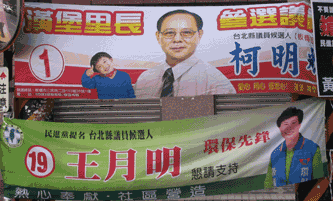
Including the numbers is not mandated by law, but they’re always there (except in the few cases where someone overlooked writing in the number on individual signs printed before the drawing of lots). Furthermore, this style of writing the numbers is not required, but it’s seldom altered. Sometimes the color is altered to match the color scheme of the banner. But I’ve never seen a number in a square, a triangle, or a diamond — always a circle. And I’ve never seen the numbers written in Chinese characters (一, 二, 三, 四, 五, 六, 七, 八, 九,十, etc., or the more formal forms 壹, 貳, 叄, 肆, 伍, 陸, 柒, 捌, 玖, 拾, etc.) rather than 1, 2, 3, etc.

Here’s what the Public Officials Election and Recall Law states about what information appears on ballots:

The ballot shall bear the serial numbers [i.e., the numbers I’ve been discussing], names and photographs of all candidates. However, in an election of central public officials, the ballots shall also bear the candidates’ party affiliation from which the candidates were recommended (article 60 ).

So the numbers also appear on the ballots themselves, which is, of course, the whole reason for them appearing in campaign literature. Note that ballots for local-level elections omit mention of political parties. Thus, not only the photo of the candidate but also the candidate’s number is regarded as more important than party affiliation.

I think the attention given to numbers should prompt questions on the true state of literacy in Taiwan.

I asked an official at the Central Election Commission about why party affiliation was left off. But neither he nor anyone else in his office at that time knew the explanation. And when I asked about the prominence of numbers, the official admitted that literacy did play a role in this.

For what it’s worth, party affiliation on ballots for national-level posts is indicated by the printed name of the party, not with a party logo. A change to logos is being discussed for the next legislative election.

There’s a lot more to be said about this topic. Perhaps I’ll come back to it later.

The UN says:

In countries with high rates of illiteracy, election management bodies should design ballots that include party emblems or photographs of candidates in order to facilitate voting. If there are minority languages in a country, it is good practice to print ballots and voter education material in all the languages commonly used.

In Afghanistan, where literacy is low, ballots have not only the names of candidates but also their photos and an assigned icon. Here’s a small sampling of these icons:
Here’s the full list to be used on ballots in Afghan elections.)

What’s the situation in other developed countries?

A story in the Miami Herald from 2004 states that in Florida
http://www.libertypost.org/cgi-bin/readart.cgi?ArtNum=54875
“using numbers has a long history here [in Miami-Dade County, Florida], where illiteracy is not uncommon.”

“Miami, FL, Jun. 23,[ 2004] (UPI) — Miami-Dade County, Fla., is suing the state for refusing to allow placing numbers next to ballot questions and candidates to help illiterate voters…. Miami-Dade County Commissioners say the numbers next to candidates’ names and ballot proposals help the illiterate because it makes it easier for them to identify the candidate they want by number.”
http://washingtontimes.com/upi-breaking/20040623-115105-2336r.htm

Taipei Times story of candidate using other people’s photos (without permission or attribution) on his campaign lit:
http://www.taipeitimes.com/News/taiwan/archives/2005/11/30/2003282303/print

Also talk about arty b&w images of Mayor Ma on people’s posters.

Further reading:

deerly contested elections

Yeah, yeah, I know: For that pun I should be locked up. But, believe me, it’s in the spirit of Taiwan’s current electoral season.

Here, for example, is an image from the campaign literature for Zhāng Hóng-lù (張宏陸). Zhang has chosen a deer as his mascot because the final syllable of his name sounds like the Mandarin word for deer, lù (鹿). (Yes, that’s supposed to be a deer, not the result of some unholy experiment involving Rudolph the red-nosed reindeer and an inflatable Bambi.)

Note the quasi romanization, on both the collar and headphones, of @ for “a,” which is a prefix for personal names. Thus, “@-lu” stands for “A-lu,” which is a meant as a friendly nickname for Zhang.

The A prefix might be familiar to Westerners through Lu Xun’s “The True Story of Ah-Q” (阿Q正傳). (Lu Xun, by the way, was an important advocate of romanization.) The association in the campaign literature, however, is definitely intended to be with Taiwan’s president, Chen Shui-bian, whose nickname of “A-bian” was written in romanization on much of Chen’s campaign merchandise. Chen even refers to himself in the third person as “A-bian.” (For some reason most people in Taiwan don’t seem to find this affectation by Chen as disconcerting as Americans found Bob Dole’s odd habit of referring to himself as “Bob Dole.”)

Zhang is of course from the same political party as Chen.

As for the use of @ for “a,” this might be copied from Chen-related merchandise, though the only images I found in a quick search had “a-bian” rather than “@-bian.” The “a,” however, is often found within a circle, which may have led subsequent designers to the @ usage. There is, however, a small chain of soup-noodle stores named “@-Bian.”

The @ is of course a vague allusion to the Internet, with the intent of looking “modern.” The @ usage was copied (perhaps incorrectly) from some of Chen’s merchandise, affectations of modernity being pointless when it comes to otherwise unpretentious noodle stores.

The headphones on the deer, however, are a mystery to me. Then there’s the fact that they aren’t on the deer’s ears. Perhaps they’re a vague attempt to appeal to the youth vote.

Bei-Bei jing-jing wel-wel comes-comes you-you

Beijing has unveiled its five mascots for the 2008 Olympics, the Friendlies Fuwa. They are dubbed Beibei, Jingjing, Huanhuan, Yingying, and Nini. Here’s Jingjing, the friendly PRC panda, with his gun. In case you’re wondering, yes, that’s an official image.
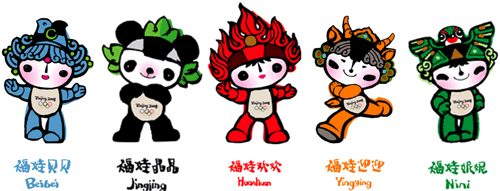
OK, back to language-related matters. These aren’t just saccharine names for cutesy figures: there’s a pattern. Note how each name is a doubled syllable, which is a common way to form affectionate nicknames in Mandarin. (My wife, for example, is named Hsin-chun, but many in her family refer to her as Hsin-hsin.)

Taking the first syllable of each of the mascot names yields “bei jing huan ying ni,” or, more properly, “Beijing huanying ni,” which is “Beijing welcomes you” in Mandarin. If tones are indicated this would be written Běijīng huānyíng nǐ; but tone indications are completely unnecessary here for easy comprehension of the meaning. Although Mandarin is a tonal language, most clearly written texts do not need to have all or even most tones indicated for comprehension by fluent speakers.

Let’s look at the sentence “Beijing huanying ni” when written in characters. It’s “北京欢迎你” in simplified Chinese characters. In traditional characters it would be written “北京歡迎你.” But the names of the mascots aren’t all written with these same characters. For that matter, not even all the tones are the same:

Beijing welcomes you mascot names
character tone character tone
běi bèi
jīng jīng
huān huān
yíng yíng

北北 (lit. “North-north”) just doesn’t make for a catchy mascot name. But, basically, the only way to use Chinese characters to indicate the third-tone bei sound of “Beijing” is with the 北 character. So the mascot namers went with a different character — and consequently a different tone, too. They opted for bèi.

By the way, readers of Chinese characters have no choice but be accustomed to characters being pronounced with a variety of tones. Some 80 percent of Chinese characters that have more than one pronunciation — and these are quite common — are associated with at least two tones.

Chinese does have a word pronounced bèibèi. It is written in characters thusly: 孛孛. The meaning is “radiant,” which sounds nice enough for a mascot name. But almost no one knows this old word. For that matter, most people don’t even know the obscure 孛 character and thus wouldn’t know it’s supposed to be pronounced bei. (Note how a character doesn’t have to have a large number of strokes to be obscure.)

Thus, 孛孛 obviously wouldn’t work. So the designers used a bèi that is rather more precious. When 贝 is doubled, the association is with baobei (treasure), as in something a mother might call her child (just as an Italian woman might sometimes fondly refer to her child as “tesoro”). Thus, an English translation of “Beibei” would be something like “Precious.” (Normally I’m opposed to translating names. But in this case some translation is appropriate, as these names are most certainly designed to be cute as a button and so should be revealed as such.)

Let’s move on to Jingjing. Using, say, the “proper” character for Beijing’s jing would yield 京京, which means “intense (of sorrow).”

念我独兮、忧心京京。
哀我小心、癙忧以痒。

I think how I stand alone,
And the sorrow of my heart grows intense. (tr. James Legge)

Even though that’s such an ancient term that almost no one would know it now, it’s probably still not the sort of thing Beijing’s Olympic planners would want as a mascot name. So 晶, which has the same pronunciation (including tone) as Beijing’s jing was selected. An English translation of “Jingjing” would be something like Crystal, or perhaps Sparkles.

Huan and ying are used unchanged. Indeed, Huanhuan is found as a personal name; an English version of this name would be “Joy.” But “Yingying” doesn’t translate well; “Welcome” is about the best I can think of at the moment.

With Nini, again we have a different character and a different tone. (Then there’s the selection of ni rather than the more polite form of nin. This might make an interesting entry by itself.)

Mandarin does have a word pronounced “nǐnǐ.” It means “luxuriant; exuberant; flourishing” — perhaps not entirely out of line for a name. But then comes the matter of the character; this word is written 苨苨. But 苨 is used only in 苨苨. Although in this case the phonetic part of the character (as opposed to the “radical”) is relatively clear, 尼, the character is nonetheless not nearly common enough for people to know whether it is pronounced (probably, that is — because Chinese characters are not unlike a spelling system that’s two thousand years out of date) , , , or . And at any rate, even if people did know the correct pronunciation, they still wouldn’t know the meaning of 苨苨. In short, 苨苨 is also a bad choice.

There’s a more common “nini,” which has different tones: níní (泥泥). This has two meanings: (1) damp (from dew), and (2) luxuriant; thick (of vegetation). The 泥 character, unlike 苨, is not uncommon. Nonetheless, the word níní (泥泥) is obscure, which would lead most people to guess at the meaning, and most of them would probably guess something like “muddy.” So this choice wouldn’t be a good one either.

The marketing managers decided to use 妮 (), which is used in nīr (妮儿/妮兒), a word for “girl.” This yields the decidedly twee “Nīnī,” which might be translated as “Girly.” (Note that the phonetic is the same as in the above: 尼.)

Here are Precious, Crystal, Joy, Welcome, and Girly:
Olympic mascots

sign language in Taiwan

A group of scholars at National Chung Cheng University (Guólì Zhōngzhèng Dàxué) have compiled a large reference book on Taiwan Sign Language and created a related Web site, according to the Taiwan News. The newspaper labeled the work “the world’s most comprehensive sign language reference book.” Although I’m not sure I’m ready to believe that without more details, the work does sound important. Here are some excerpts from the article:

[Professor] Tai [Hau-yi] explained that sign language is more than hand gestures – it is a multi-sensory communication tool with its own set of grammar and syntax rules. Moreover, it is the native tongue of many hearing-impaired people as well as of hearing children born into non-hearing families, he added.

Many people have the misconception that there is a universal sign language, [Professor Jane] Tsai said.

“But because languages are culturally-based, each country has its own sign system and within each system, there are various “accents” among the regions of the country.” Tsai explained.

She said that to accommodate all the variations in TSL, the reference book and online dictionary provide video clips for signs from northern and southern Taiwan….

“It is important to demonstrate how to make the signs because sign language is more than speaking with your hands. It involves facial expressions and body movements such as raising of the eyebrows and lip-mouth motions to convey the speaker’s intent,” said Tai….

Tai said in Taiwan, most parents of hearing-impaired children prefer to lip-read than to sign. By robbing these children the rights to speak their natural language, the parents are doing them a disservice, he said.

“We understand why the parents want their children to learn how to lip read, but since Chinese is a tonal language, it is very difficult for kids to perfect lip-reading skills,” Tai explained….

According to the latest 2005 statistics from the Ministry of the Interior, there are 98,206 hearing-impaired people in Taiwan.

source: Academics launch most comprehensive sign-language book, Taiwan News, November 25, 2005

alternate source

mobile phone with hiragana menus

NTT Do Co Mo is releasing a mobile phone aimed at the children’s market. One of the phone’s features is that users will be able to switch its screen-menu system from kanji to hiragana.

子どもが簡単に操作できるよう、メニューやガイドの難しい漢字をひらがなで表示することができます。

I wonder if similar features can be found on other electronic items in Japan. (Matt, any ideas?)

The phone is model SA800i.

sad state of ‘native-language education’ in Taiwan

Today’s Taipei Times has an interesting article on the state of teaching Taiwan’s “native languages.” (This means Taiwanese (a.k.a. Hokkien, Minnan, etc.), Hakka, and the languages of Taiwan’s tribes, but not Mandarin.) From the look of things, the government has basically botched the situation, despite having thrown twice as much money toward these languages as is being spent on English.

Although some of the problems and expenses are to be expected, given how new this is and how much resistance there has been from conservative forces, I’d say that things are still far from acceptable. A large part of the problem is that the government can’t even decide on a script for these languages: sometimes romanization (various systems), sometimes Chinese characters, sometimes zhuyin. It’s a mess.

No progress in native-language education has been made in schools despite the central government promising to encourage local culture and language education three years ago, native-language teachers said yesterday.

Liu Feng-chi (???), director of the Taiwan Association of Mother Language Teachers and a teacher of Hoklo (also known as Taiwanese), said he felt cheated that the government had “not taken in any of our suggestions to improve native-language education in school” over the past three years.

Liu said the Ministry of Education had not put much effort into reform nor native-language education. Classes in schools were not being planned carefully and lack continuity, he said.

“Classes [for native languages] should continue after elementary school so that students can keep learning the languages in junior high,” Liu said.

Association executive director Huang Hsiu-jen (???) said teachers of Hoklo are being “reselected” every year and must undergo a “disrespectful” selection process.

Huang said the selection committee was sometimes composed of teachers who did not speak Hoklo themselves.

“The selection team tends to choose young Hoklo teachers who can sing and dance in class, while older teachers like us end up with no job,” Huang said.

Liu also said that the salary for teachers was based on the number of hours worked in a week and that the hourly wage was a mere NT$320.

Furthermore, native language teachers are called “assistant teachers,” and schools do not provide them with health insurance, Liu added.

The association also expressed concern that many schools were using the time reserved for language classes to teach other subjects, and that many language teachers were required to teach mathematics or science as well.

Meanwhile, Perng Fuh-yuan (???), section chief at the ministry’s Department of Elementary Education, said there are more than 300,000 children learning native languages in the country.

Perng said the selection process applied not only to language teachers but to teachers in general, and that former language teachers were added to the selection committee to provide specialist advice.

“It is hard for students to continue native-language classes in junior high school under all of the exam pressure,” he said. “However, schools have tried to incorporate these languages into extracurricular activities connected to the school, such as Hoklo language clubs.”

The ministry spends NT$400 million (US$11.9 million) annually on native-language courses, while English classes have NT$200 million per year in funding. Elementary school students are required to take at least one period of native-tongue classes per week.

Taiwan’s native tongues include Hoklo, Hakka and a variety of Aboriginal languages.

source: Native-language teachers lash ‘disrespectful’ ministry, Taipei Times, November 18, 2005.

Fujian gov’t proposes rules against local languages, certain uses of Pinyin

The government of China’s Fujian Province is calling for official suppression of the use of languages other than Mandarin, though Mandarin is not native to that region, and for Chinese characters to be seen as more important than Pinyin and foreign languages.

The scope of this is about as broad as I’ve ever seen. The basics are roughly these:

  • Thou shalt not write in Sinitic languages other than Mandarin and in other than officially standard characters.
  • Thou shalt not even speak thy mother tongue, if it be not Mandarin, at work in the broadly defined public sphere other than in a few limited contexts.
  • Thou shalt have no other script lest thou also employ Chinese characters, which must be made larger than all others.

Wǒ shěng lìfǎ guīfàn yǔyán wénzì, xiāngguān bànfǎ cǎo’àn tíjiāo shěng Rén-Dà chángwěihuì shěnyì

《Fújiàn shěng shíshī 《Zhōnghuá Rénmín Gònghéguó tōngyòng yǔyán wénzì fǎ》 bànfǎ》 (cǎo’àn) zuórì tíjiāo shěng 10 jiè Rén-Dà chángwěihuì dì 20 cì huìyì shěnyì. Zhè bù dìfāngxìng fǎguī (cǎo’àn) míngquè guīdìng, guójiā jīguān gōngzuò rényuán zài bàngōng, huìyì, miànduì shèhuì gōngkāi jiǎnghuà děng gōngwù huódòng shí yīngdāng shǐyòng Pǔtōnghuà.

Bànfǎ (cǎo’àn) lièchū le tuīguǎng Pǔtōnghuà hé tuīxíng guīfàn Hànzì de 4 dà zhòngdiǎn lǐngyù:
(yī) guójiā jīguān gōngwù yòngyǔ yòngzì;
(èr) jiàoyù jīgòu de jiàoyù jiàoxué yòngyǔ yòngzì;
(sān) dàzhòng méitǐ, Hànyǔ wén chūbǎnwù, xìnxī jìshù chǎnpǐn de yòngyǔ yòngzì;
(sì) gōnggòng fúwù hángyè, gōnggòng chǎngsuǒ de yòngyǔ yòngzì.

Bànfǎ (cǎo’àn) guīdìng, xuéxiào jí qítā jiàoyù jīgòu yǐ Pǔtōnghuà wèi jīběn de jiàoyù jiàoxué yòngyǔ. Guǎngbō diàntái, diànshìtái de bōyīn, zhǔchí hé cǎifǎng, yǐng-shì, Hànyǔ wén yīnxiàng diànzǐ chūbǎnwù yīngdāng shǐyòng Pǔtōnghuà. Shāngyè, jīnróng, lǚyóu, wénhuà, tǐyù, yīliáo wèishēng, tiělù, mínháng, chéngshì jiāotōng, yóuzhèng, diànxìn, bǎoxiǎn děng gōnggòng fúwù hángyè, yǐjí gèlèi huìyì, zhǎnlǎn, dàxíng huódòng de fāyánrén, jiěshuōyuán yīngdāng yǐ Pǔtōnghuà wèi jīběn gōngzuò yòngyǔ. Tóngshí guīdìng, zài zhíxíng gōngwù shí yùdào wúfǎ yòng Pǔtōnghuà jìnxíng jiāoliú de duìxiàng shí, jīng pīzhǔn shǐyòng fāngyán bōyīn de shěng nèi guǎngbō, diànshìtái de yǒuguān jiémù yòngyǔ, kěyǐ bù shǐyòng Pǔtōnghuà. Duì Xiāng Gǎng, Àomén, Táiwān tóngbāo yǐjí Qiáobāo de liánluò hé jiēdài, yǔ Xiāng Gǎng, Àomén tèbié xíngzhèngqū hé Táiwān dìqū jīngjì, wénhuà, jiàoyù, kējì, tǐyù, wèishēng děng lǐngyù de jiāoliú huódòng, gēnjù xūyào kě[yǐ] shǐyòng xiāngguān fāngyán. Dìfang xìqǔ, fāngyán gēqǔ děng shǔyú mínzú mínjiān chuántǒng wénhuà bǎohù de huódòng yǐjí fāngyán yánjiū kě[yǐ] shǐyòng fāngyán.

Zài guīfàn yòngzì fāngmiàn, bànfǎ (cǎo’àn) guīdìng, guójiā jīguān de gōngwù yòngzì, yǐng-shì píngmù yòngzì, gōnggòng fúwù hángyè yòngzì, Hànyǔ wén chūbǎnwù, dìmíng, jiànzhùwù biāozhì děng yòngzì yīngdāng shǐyòng guīfàn Hànzì. Rénmíng yòngzì yīngdāng fúhé guójiā Hànzì rénmíng guīfàn hé gōng’ān jīguān yǒuguān guīdìng.

Zài gōnggòng chǎngsuǒ de yòngzì bùdé dāndú shǐyòng wàiguó wénzì huò Hànyǔ Pīnyīn. Xūyào pèihé shǐyòng wàiguó wénzì huò Hànyǔ Pīnyīn de, yīngdāng cǎiyòng yǐ guīfàn Hànzì wéizhǔ, wàiguó wénzì huò Hànyǔ Pīnyīn wèi fǔ de xíngshì, guīfàn Hànzì de zìtǐ yīng dàyú wàiguó wénzì huò Hànyǔ Pīnyīn; wàiguó wénzì jí yìwén huò Hànyǔ Pīnyīn yào zuòdào guīfàn hé biāozhǔn.

我省立法规范语言文字,相关办法草案提交省人大常委会审议

本报福州讯 (记者 田家鹏)《福建省实施《中华人民共和国通用语言文字法》办法》(草案)昨日提交省十届人大常委会第二十次会议审议。这部地方性法规(草案)明确规定,国家机关工作人员在办公、会议、面对社会公开讲话等公务活动时应当使用普通话。

办法(草案)列出了推广普通话和推行规范汉字的四大重点领域:
(一)国家机关公务用语用字;
(二)教育机构的教育教学用语用字;
(三)大众媒体、汉语文出版物、信息技术产品的用语用字;
(四)公共服务行业、公共场所的用语用字。

办法(草案)规定,学校及其他教育机构以普通话为基本的教育教学用语。广播电台、电视台的播音、主持和采访,影视,汉语文音像电子出版物应当使用普通话。商业、金融、旅游、文化、体育、医疗卫生、铁路、民航、城市交通、邮政、电信、保险等公共服务行业,以及各类会议、展览、大型活动的发言人、解说员应当以普通话为基本工作用语。同时规定,在执行公务时遇到无法用普通话进行交流的对象时,经批准使用方言播音的省内广播、电视台的有关节目用语,可以不使用普通话。对香港、澳门、台湾同胞以及侨胞的联络和接待,与香港、澳门特别行政区和台湾地区经济、文化、教育、科技、体育、卫生等领域的交流活动,根据需要可使用相关方言。地方戏曲、方言歌曲等属于民族民间传统文化保护的活动以及方言研究可使用方言。

在规范用字方面,办法(草案)规定,国家机关的公务用字、影视屏幕用字、公共服务行业用字、汉语文出版物、地名、建筑物标志等用字应当使用规范汉字。人名用字应当符合国家汉字人名规范和公安机关有关规定。

在公共场所的用字不得单独使用外国文字或汉语拼音。需要配合使用外国文字或汉语拼音的,应当采用以规范汉字为主、外国文字或汉语拼音为辅的形式,规范汉字的字体应大于外国文字或汉语拼音;外国文字及译文或汉语拼音要做到规范和标准。

source: Gōngwùyuán bàngōng kāihuì yàoshuō Pǔtōnghuà (公务员办公开会要说普通话), Xiàmén Rìbào, November 16, 2005. I first spotted this at What’s On Xiamen.

Beijing to mix Pinyin, English on signage

This is a real disappointment: Beijing is going to drop full Pinyin on its street signs and replace it with a mixture of Mandarin (in Pinyin) and English. By this I mean that it will have not “Zhongshan Lu” but “Zhongshan Rd.” Thus, it will be following the model of Taiwan, though I doubt anybody there put it that way. Why this is necessary is beyond me. After all, foreigners get by just fine in France with “rue” on street signs instead of “street.” Beijing, however, has decided that “hutong” can stay.

This is being done in the name of the 2008 Beijing Olympics, of course.

I’m glad there’s a move to correct bad and incorrect signage, but this is the wrong way to do it. Bad move, Beijing!

Běijīng yīxiē shèwài fàndiàn, lǚyóu jǐngdiǎn, jiāotōng gànxiàn děng chù de Yīngwén biāozhì cuòwùbǎichū, yǒudeshì fānyì yǔfǎ yǒu cuò, yǒudeshì Yīngwén hé Hànyǔ Pīnyīn hùn yòng, yǒudeshì yìwén zǒuyàng, yǐzhìyú chūxiàn Zhōngguórén kànbudǒng, wàiguórén kànbumíngbai de gāngà júmiàn.

Bùguò, jìzhě jīntiān cóng quánwēi bùmén huòxī, zhè yī gāngà hùnluàn de júmiàn yǒuwàng zài 2008 nián Àoyùnhuì zhīqián zhōngjié.

Běijīng shìmín jiǎng wàiyǔ huódòng zǔwěihuì rénshì tòulù, jīngguò zhēngqiú 30 yú wèi zhuānjiā de; yìjian, 《Běijīng shì dàolù jiāotōng biāozhì Yīngwén yì fǎ yuánzé》jíjiāng chūtái, jiāng jiē, dào, lù míngchēng tǒngyī guīfàn, rú: Běijīng de “jiē” guànyǐ Yīngwén suōxiě “St”, “lù” yì wéi “Rd”, xiǎo jiē, tiáo, xiàng hé jiādào shǐyòng “Alley”. Ér tǐxiàn lǎo Běijīng wénhuà sècǎi de “hútòng” yī cí, jiāng cǎiyòng Hànyǔ Pīnyīn yǔyǐ bǎoliú, yīnwèi tā yǐjing pǔbiàn bèi wàiguórén jiēshòu.

Suízhe guīfàn Yīngwén biāozhì de hūshēng yuèláiyuè gāo, jīnnián Běijīng shì jiāo guǎn bùmén yǐ náchū jǐ qiānwàn zhuānxiàng jīngfèi, yòngyú gēngxīn sān huánlù yǐnèi de jiāotōng shuāngyǔ biāozhì. Jùxī, sān huánlù yǐnèi suǒyǒu yìwén bù tǒngyī, bù guīfàn de dàolù jiāotōng shuāngyǔ biāozhì jiāng yú míngnián Liùyuè qián gēnghuàn wánbì, sān huánlù yǐwài de bù guīfàn Yīngwén jiāotōng biāozhì yě jiāng zài 2007 niándǐ quánbù huànxīn.

北京一些涉外饭店、旅游景点、交通干线等处的英文标识错误百出,有的是翻译语法有错,有的是英文和汉语拼音混用,有的是译文走样,以至于出现中国人看不懂、外国人看不明白的尴尬局面。

不过,记者今天从权威部门获悉,这一尴尬混乱的局面有望在二00八年奥运会之前终结。

北京市民讲外语活动组委会人士透露,经过征求三十余位专家的意见,《北京市道路交通标志英文译法原则》即将出台,将街、道、路名称统一规范,如:北京的“街”冠以英文缩写“St”,“路”译为“Rd”,小街、条、巷和夹道使用“Alley”。而体现老北京文化色彩的“胡同”一词,将采用汉语拼音予以保留,因为它已经普遍被外国人接受。

随着规范英文标志的呼声越来越高,今年北京市交管部门已拿出几千万专项经费,用于更新三环路以内的交通双语标识。据悉,三环路以内所有译文不统一、不规范的道路交通双语标识将于明年六月前更换完毕,三环路以外的不规范英文交通标志也将在二00七年底全部换新。

(Aside: Note the double zeros crammed into one graph: 二00七 and 二00八, for 2007 and 2008.)

source: Běijīng Jiāotōng Bùmén yù chìzī shù qiānwàn yuán xiāomiè cuòwù Yīngyǔ biāozhì (北京交通部门欲斥资数千万元消灭错误英语标识), Zhōngguó Xīnwénshè (China News Agency), November 15, 2005.