
What Chinese characters can’t do-be-do-be-do

It don’t mean a thing if it ain’t got that “shuing”!

David Moser uses the question of how would someone scat sing in Mandarin Chinese to start off an exploration of what Chinese characters can’t do well (and what Pinyin can).

Here’s an excerpt:

English has numerous conventions for representing casual oral speech: “Are you kiddin’ me?” “Whaddya wanna do tonight, Marty?” “I’m gettin’ outta here!” “Gimme that.” And so on. Such spelling conventions have been employed in the literature of most alphabetic traditions for hundreds of years, and are often an invaluable link to the vernaculars of the past. English-language writers from Mark Twain to James Joyce have used the flexibility of the alphabet to vividly re-created various speech worlds in their works. It is, in fact, hard to imagine how much of the literature of the West could have been produced without recourse to such devices.

Chinese characters, by contrast, cannot reproduce the equivalent elisions and blends of colloquial Chinese, except in rare cases, and only at the level of the syllable…. The result is that China effectively has no tradition of realistically notating vernacular speech. Wenyanwen ???, classical Chinese, exerted a virtual stranglehold on written literature up until the early twentieth century, and even then, most writers did not attempt to accurately represent common speech, despite the appearance of an occasional Lao She or Ba Jin. But even if such writers had so desired, working within the Chinese system of writing, they could never have notated the sounds of the language around them with the same kind of vivid verisimilitude of the following examples in English….

Read the whole article, here on Pinyin Info: Some Things Chinese Characters Can’t Do-Be-Do-Be-Do.

And if you haven’t seen it already, be sure to check out another work by Moser: Why Chinese Is So Damn Hard, which is one of Pinyin Info’s most popular readings.
Can the Taiwanese language survive?

In the latest issue of Sino-Platonic Papers Deborah Beaser examines the chances for the survival of Taiwanese (a.k.a. Hoklo, Minnan, Southern Min, etc.).

The introduction to her paper, The Outlook for Taiwanese Language Preservation (432 KB PDF), is a good summary of the whole work:

In this paper I will discuss the history of the Taiwanese language on the island of Taiwan, and explore its potential to continue into the future. I predict that over the next 50 years Taiwanese, as a language, will become increasingly marginalized, and that the recent increase in desire to promote Taiwanese is purely the short-term reaction of the generation of Taiwanese who went through periods of linguistic and cultural suppression. This is not to say that I believe it will completely disappear. To the contrary, I believe the Taiwanese language will remain as part of a cultural legacy, but how large that legacy will be depends on whether or not today’s Taiwanese people are able to standardize a script and computer inputting system that will preserve it in a written form and open up its domain of usage.

toneless whispers and tonal languages

John at Sinosplice discusses how speakers of Sinitic languages, which are tonal, can understand whispered speech, which is not tonal.

It turns out that when people whisper a tonal language such as Chinese, they naturally compensate for the lack of tones. How? According to one study:

  1. the laryngeal sphincter mechanism is found to be a principal contributing physiological maneuver in the production of whisper, emphasizing the vertical rather than the horizontal component of the laryngeal source;
  2. two special behavioral maneuvers are also used in whisper: male speakers tend to lengthen vocalic duration and female speakers tend to exaggerate the amplitude contours of Tone 3 and Tone 4;
  3. these two special behavioral maneuvers and two temporal envelope parameters contribute to tone recognition in whisper, but the phonetic context is shown to be a distraction;
  4. the environments of the target tones cause perceptual differneces, and the ranking of these environments in order of increasing degree of difficulty is: isolation, sentence-final, sentence-medial and sentence-final;
  5. the ranking of the four tones in isolation, in order of increasing degree of perceptual difficulty is: Tone 3, Tone 4, Tone 1 and Tone 2.

further reading:

Gee, the things found in dictionaries

Another interesting story mentioned on Danwei is a tale of a dictionary, prostitutes, and chickens:

A scandal has erupted in Shenzhen after a primary school dictionary was found to have included the slang definition of the Chinese word for chicken, which means prostitute. What a scandal! Living in the wholesome boomtown of Shenzhen, no one would ever guess that there are such things as prostitutes.

The Shanghaiist links to an English-language article on this (Book clucks and quacks with sex talk). Here’s an excerpt:

An online survey conducted on the People’s Daily Website found that nearly 64 percent of the respondents considered the dictionary harmful to children, and more than half said the editors should be punished.

The others didn’t think the second definition was a big deal.

The Chinese word for “prostitute” is “jinu.” Its first syllable is pronounced the same as “ji,” making it a widely used slang reference for a female sex worker.

The book introduces itself as a modern dictionary especially designed for students.

An editor surnamed Zhang at Nanfang Press, however, told the Beijing Youth Daily that only one edition of the dictionary was published and any future editions will drop the sexual references.

The dictionary is now difficult to find in Chinese’s bookstores and online shops. But collectors who do locate a copy also might want to check out the reference for “duck.”

The dictionary goes on to define “ya” as a male prostitute.

Here’s j?:
鸡 / 雞

Zhuang ms found, resembles Naxi documents

An ethnic culture research worker in Funing County, Yunnan Province, China, has come across an old Zhuang book of songs. What makes this manuscript particularly interesting is that the songs are written down not in a regular script but rather in something similar to Naxi pictographs, i.e. pictures that serve as mnemonic references to the text rather than as real pictographs or real writing.

The article I read on this is a little vague, so I’m hoping someone can come up with some images of the manuscript or a more scholarly source.

source: Yúnnán fāxiàn Zhuàngzú gǔlǎo xíngtài túhuà wénzì — kān pìměi Dōngbā wénhuà (云南发现壮族古老形态图画文字 堪媲美东巴文化), CCTV.com, August 16, 2006

Opera’s translation widget

The latest version of Opera, my favorite Web browser, now has a feature called “widgets.” These are basically the same as Firefox’s extensions. (Many of the features Firefox gets credit for were taken from Opera, so turnabout is fair play.)

Of particular interest to readers of this site is the GTranslation widget, which ties in with Google’s and BabelFish’s translation engines. This will allow you to input text and even Web pages in [Mandarin] Chinese and view them in English. Well, sort-of English. But at least it’s free!

Thus, this widget is Opera’s equivalent of Firefox’s translation extensions.

GTranslation was written by Shoust.

I know that many of my readers are still tied to Microsoft’s Internet Explorer. I strongly recommend trying Opera or Firefox, which are faster, more secure, and generally better in most every way.

typing in Pinyin on a Windows 2000/XP system

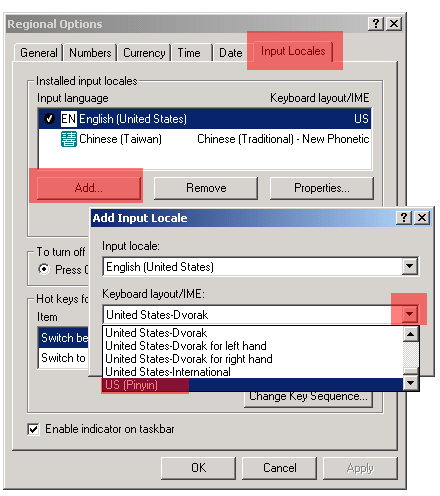
Jason Frazier has used the free Microsoft keyboard layout creator to devise a keyboard method for entering Pinyin texts with tone marks. This will work on Windows 2000 and XP systems.

Basically, to type a vowel with a tone mark, first press the key corresponding to the tone you want and then the vowel (or “v” for ü). Many may find this method preferable to using an online tool that converts Pinyin tone numbers to tone marks (my own online converter being desperately in need of an update) or a separate program such as Wenlin (or its free but tremendously useful demo version).

To download and install this Pinyin-entry tool, follow the directions on Jason’s Web page. I’ve added a screenshot below to help clarify part of the installation process.

screenshot of method to add pinyin keyboard layout