Sherbrooke is a free Pinyin-friendly font by Eyad Al-Samman.


Sherbrooke is a free Pinyin-friendly font by Eyad Al-Samman.
Today I’m continuing my look at the U.S. high school Advanced Placement foreign language exams, focusing especially on the AP exam in Chinese Language and Culture. (See also AP exams: using highest and lowest scores to look at the case of Chinese.)In the graphs below, “Chinese” is the first column on the left.
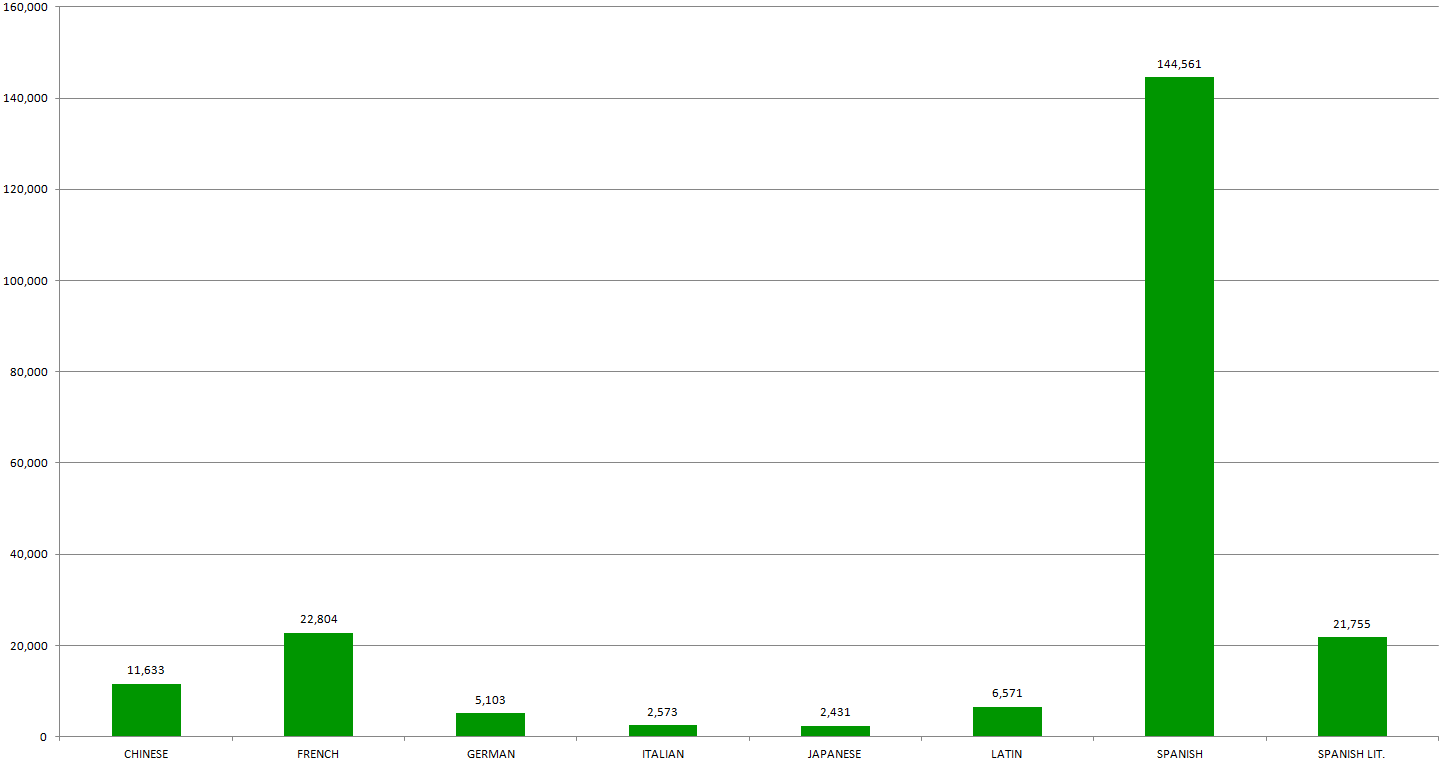
The first and obvious point from graphing the numbers of high school students from the class of 2015 who took an AP foreign language exam is the dominance of Spanish. Combined, the exams for Spanish Language and Spanish Literature outnumber all of the other language exams put together … times three.
Now let’s look at the figures above broken down into the grade during which people took the exam. As you can see, there’s something different about when people take the Chinese exam. For all other foreign languages, most people take the exam their senior year. But the Chinese Language and Culture exam is most often taken by juniors.
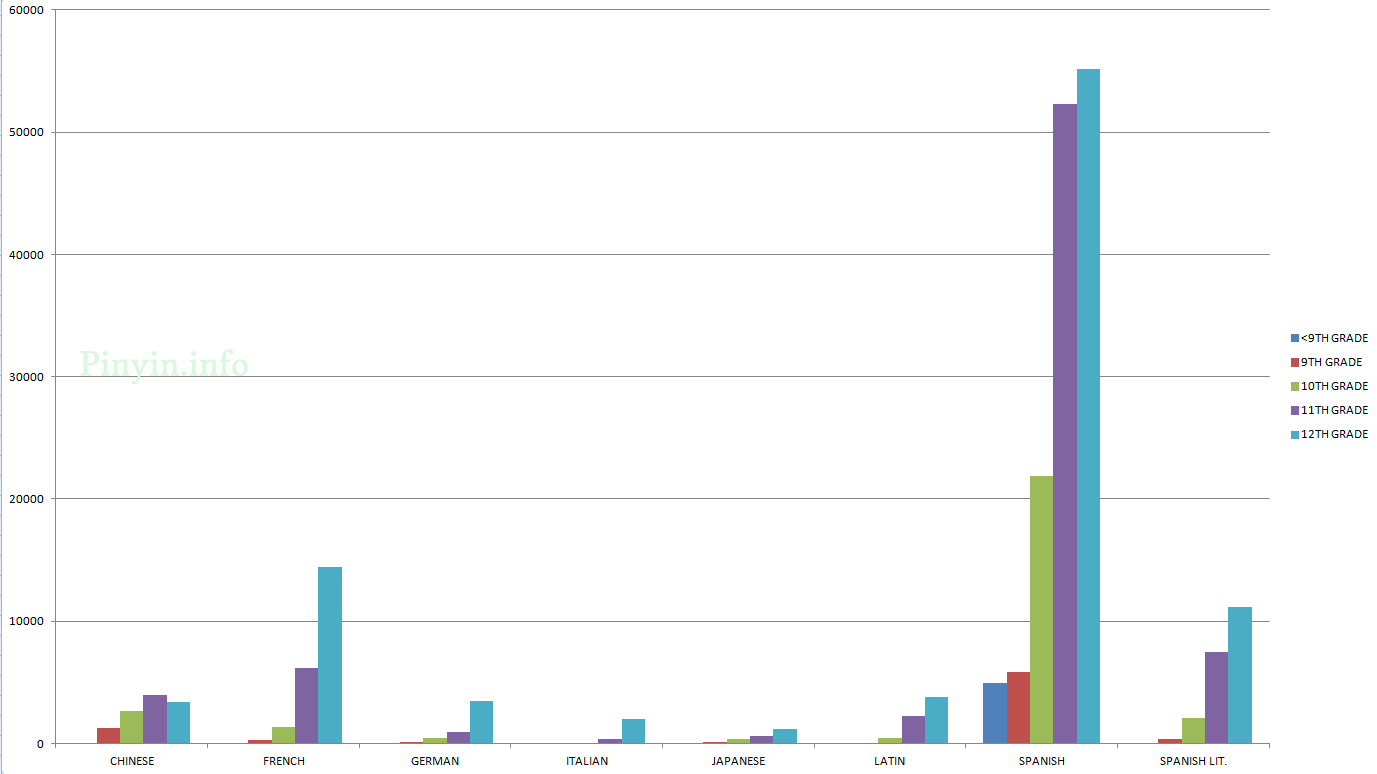
That’s a little lopsided. So let’s take Spanish and Spanish Lit. out of the mix so we can compare the other languages more easily.
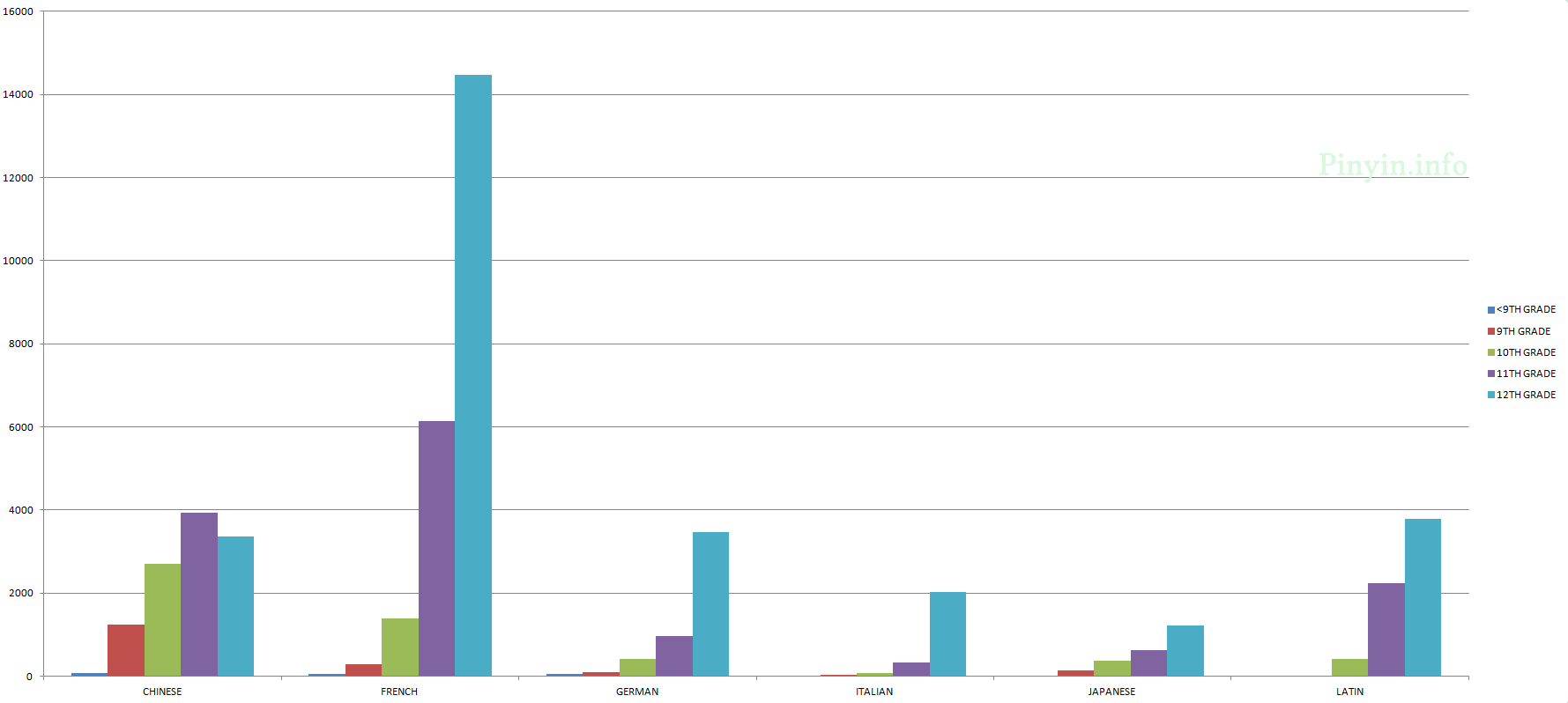
In just a few years Chinese has grown to be the third-most popular AP foreign language exam, behind Spanish and French. OK: way, way behind Spanish and about half of the number that French has. And Chinese comes in fourth if you count Spanish Literature. Still, Chinese now has more test takers than German. And it has more than Latin, Italian, and Japanese put together. But — you knew there’d be a but — the numbers for the AP Chinese Language and Culture exam are relatively large because most of the people who take it already know the language and didn’t learn it in an AP class. That is reflected in the charts above showing when people took the exam. (Note that Spanish also has a relatively high number of juniors taking the exam.)
The closest measure we have for native speakers and others with a much higher level of exposure to the language in question than other students is what students indicate themselves to the College Board on their answer sheets. Here’s how the College Board defines a “standard” student: They “generally receive most of their foreign language training in U.S. schools. They did not indicate on their answer sheet that they regularly speak or hear the foreign language of the exam, or that they have lived for one month or more in a country where the language is spoken.”
Here are the numbers for “standard” students in 2015 across various languages.
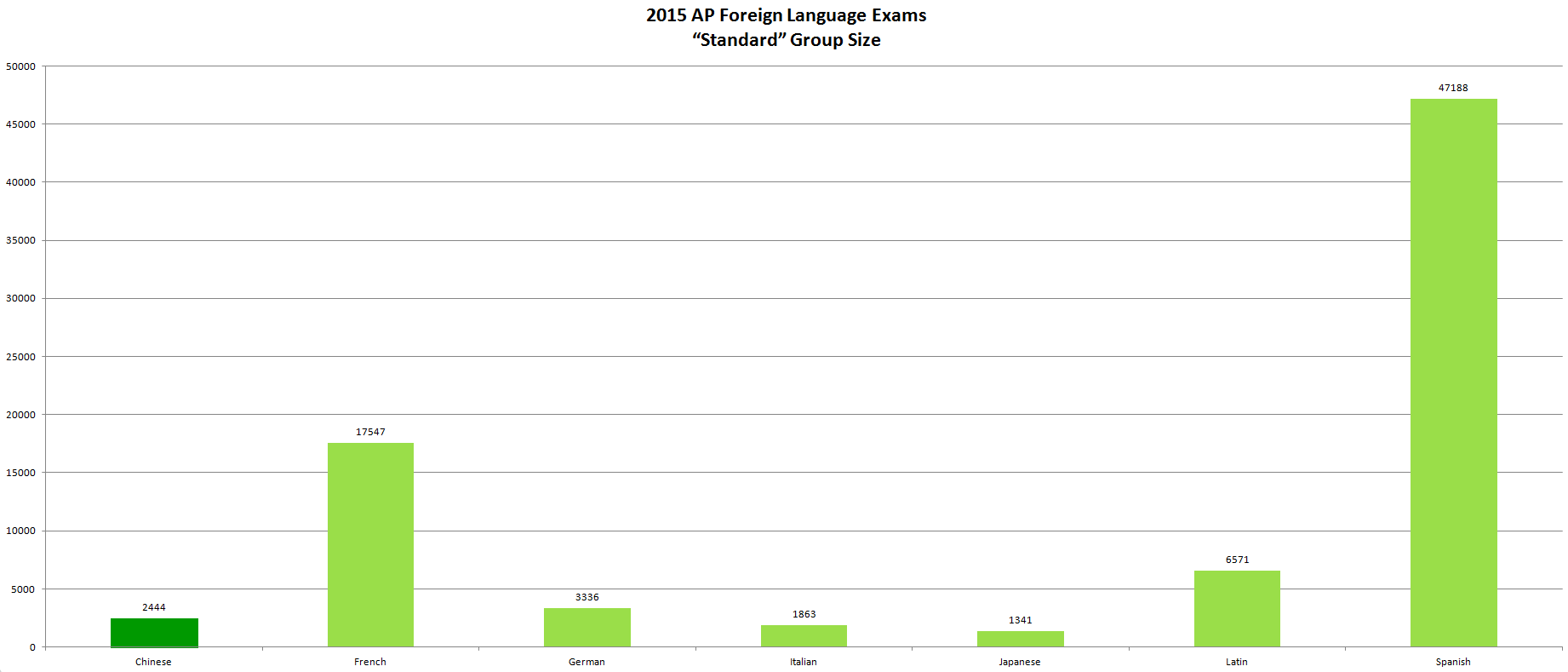
In this, Chinese drops from third place to fifth, behind Spanish, French, Latin (which is without a question on the standard group), and German, but still ahead of Italian and Japanese. When all test-takers are considered, AP exams in French outnumber those in Chinese by a little less than 2:1, which sounds very impressive (and, to some degree, it is). But when only the standard groups are considered, AP exams in French outnumber those in Chinese by more than 7:1.
Later in this series, we’ll look further at both the standard group and those not in it.
Today’s Pinyin-friendly fonts are Fortunata, which doesn’t quite close the counters of some letters (e.g., a, o, e, p, d), and the somewhat more recent Fortunatus, which does.
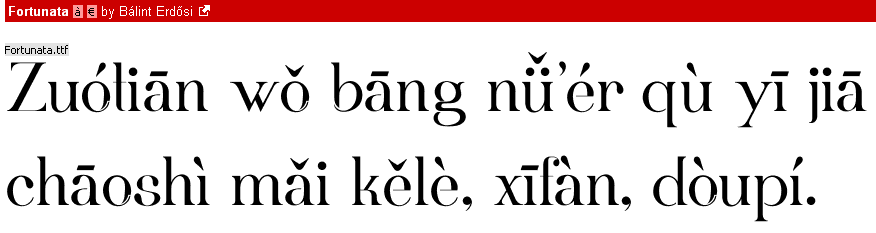
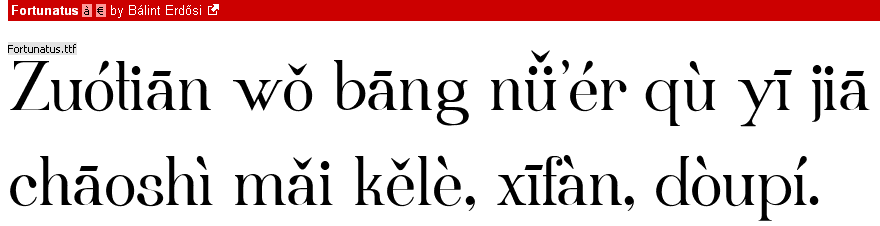
Balint Erdosi (I’m sorry to omit the diacritics for now) of Hungary created both of these, which are available as donationware.
A couple of days ago the New York Times ran a small piece, “How Emojis Find Their Way to Phones.” It contains the sort of nonsense about Chinese characters and language that often sets me off.
Fortunately, Victor Mair quickly posted something on this. J. Marshall Unger (Ideogram: Chinese Characters and the Myth of Disembodied Meaning, The Fifth Generation Fallacy, and Literacy and Script Reform in Occupation Japan) and S. Robert Ramsey (The Languages of China) quickly followed. But since those are in the comments to a Language Log post and thus may not be seen as much as they should be, I thought I’d link to them here.
The Language Log post itself is on Emoji Dick, which is billed as a translation of Moby Dick into emoji. As long as I’m writing, I might as well offer up a sample for you. See if you can determine the original English.

Did you try “Call me Ishmael”? Sorry. That’s not it. But if you guessed that I would choose the passage from Moby Dick that mentions Taiwan, give yourself bonus points.
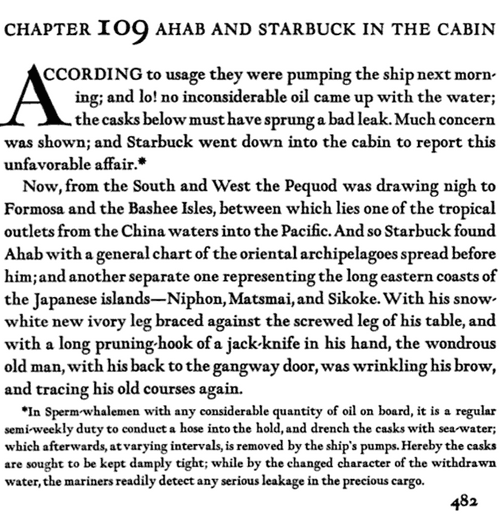
Here’s what the above emoji supposedly translate:
Hereby the casks are sought to be kept damply tight; while by the changed character of the withdrawn water, the mariners readily detect any serious leakage in the precious cargo.
Now, from the South and West the Pequod was drawing nigh to Formosa and the Bashee Isles, between which lies one of the tropical outlets from the China waters into the Pacific.
Ah, of course. It’s all so clear now.
The next time you hear someone use “pictorial language,” “ideographs,” or the like in all seriousness, perhaps ask them for their own English translation of the above string of images.
Actually, Emoji Dick screwed this up some, as part belongs to the main text and part to a footnote.
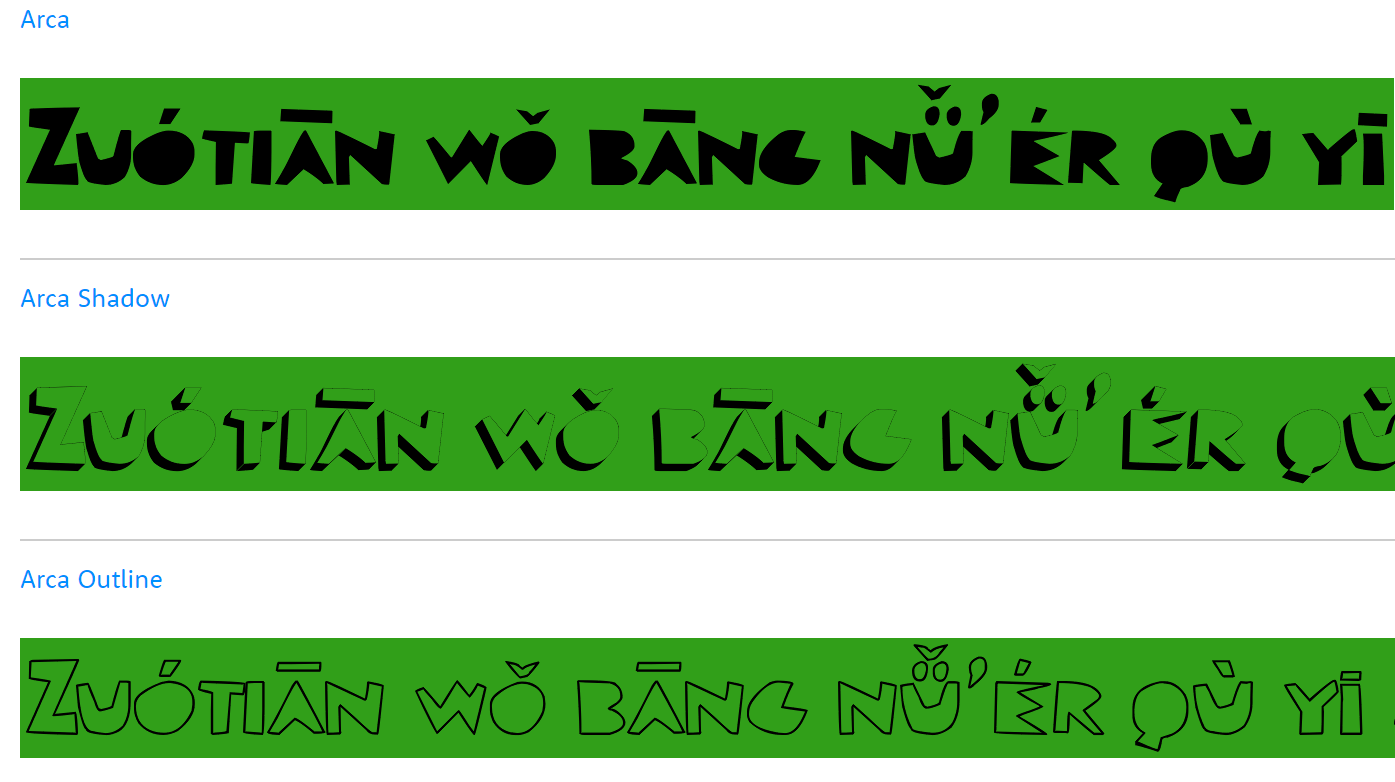
Today’s Pinyin-friendly font is another display face: Arca Dashed, by Ricardo Marcin and Erica Jung. It has a papercut style.

The other members of the Arca family, which users may find a bit more serviceable, are commercial.
The results of the Advanced Placement exams from the College Board can give us an idea of what’s going on with the teaching of Mandarin Chinese in U.S. high schools.
As the charts below demonstrate, there’s something very different about the scores for the AP exam in Chinese Language and Culture compared with the scores for just about everything else.
The tests are graded on a five-point scale, with a 5 being the top score. Generally, a 3 is considered a pass, though some universities choose to give or deny credit based on different scores.
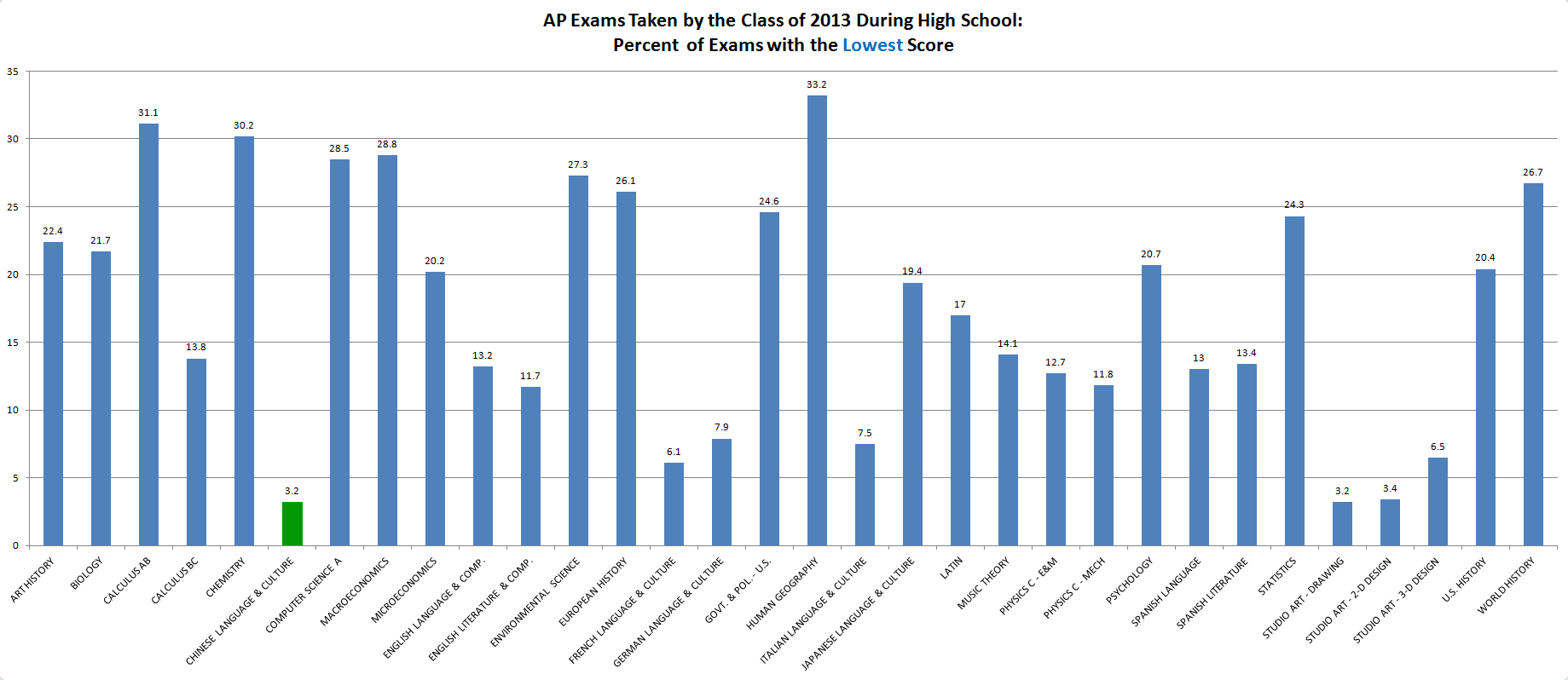
The first chart shows the percentage of of test takers who received a score of just 1 (lowest) on their respective AP exams. The median of the figures below for the percentage of test takers who received the lowest score is 18.2. The figure for Chinese (in green, at 3.2) is just 0.18 times that. Studio Art Drawing and Studio Art 2-D Design are at about the same level here as Chinese Language and Culture. But everything else is at least twice that — in most cases many times that.
AP Exams Taken by the Class of 2013 During High School: Percent of Exams with the Lowest Score
(click any chart to enlarge it)
So, relatively speaking, almost no one received the lowest score on the AP Chinese Language and Culture exam.
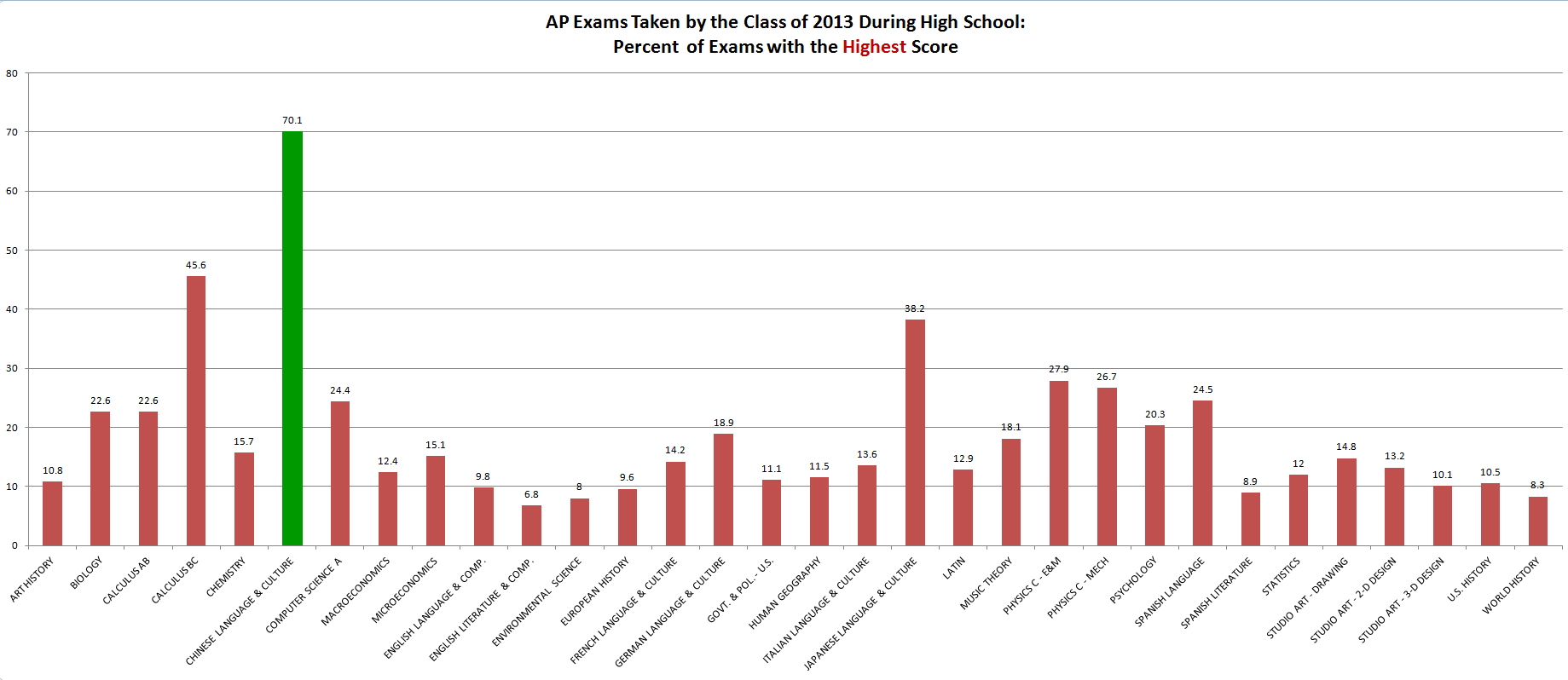
What about the highest score? The median of the figures below for the percentage of test takers who received the highest score (of 5) on their respective AP exams is 13.9. The figure for Chinese is 5.0 times that.
AP Exams Taken by the Class of 2013 During High School: Percent of Exams with the Highest Score
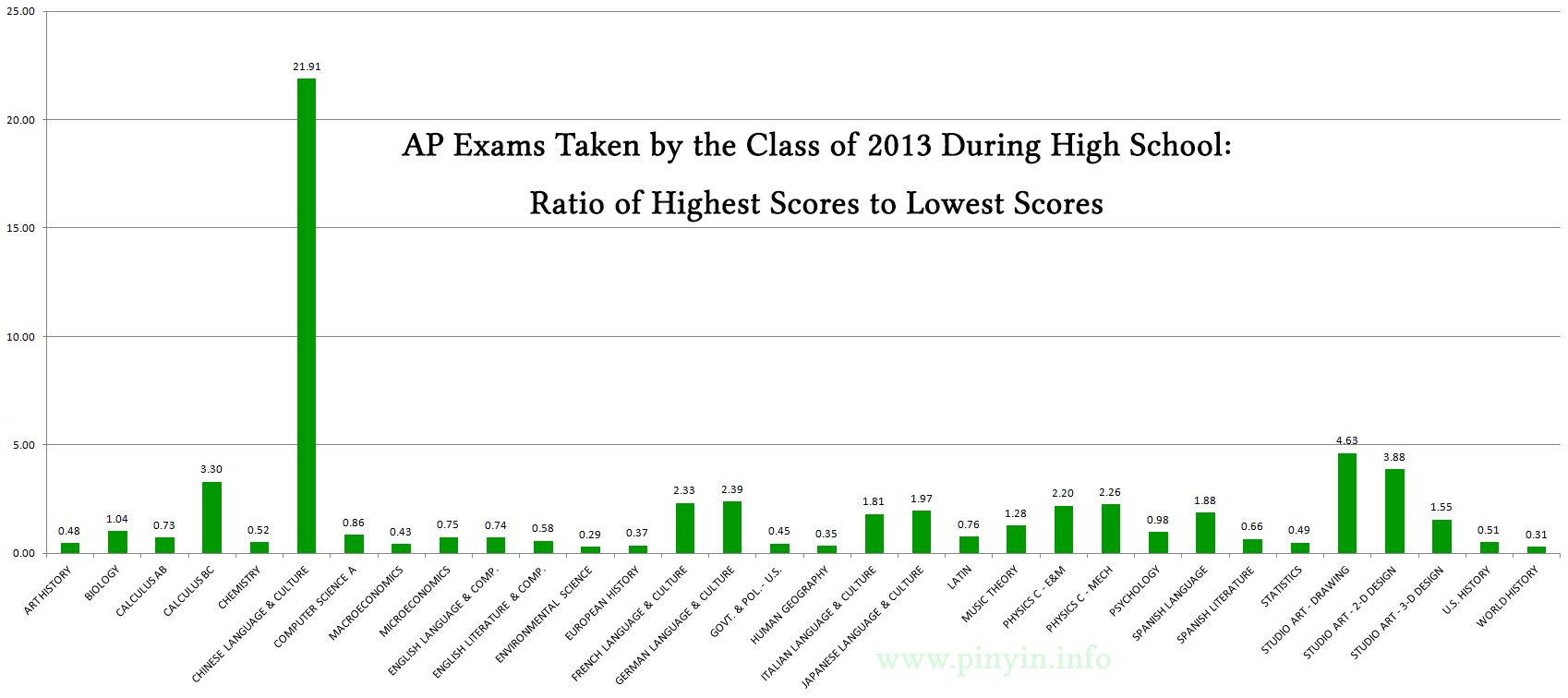
Finally, below is a chart putting the differences into greater perspective. It shows the ratio of highest scores to lowest scores on various AP exams.
The median of the figures below for the ratio of highest scores to lowest scores on the AP exams is 0.8. The figure for Chinese is 27.1 times that.
As is obvious from the image below, nothing else is even close.
AP Exams Taken by the Class of 2013 During High School: Ratio of Highest Scores to Lowest Scores
The reason for this massive difference is that the Advanced Placement exam for Chinese Language and Culture is taken mainly by native speakers and others who generally have not had to learn most of their Mandarin in their high school AP classes. This doesn’t bode well for newcomers to the language who want to learn. But as lopsided as the situation is, things are improving. More on that in later posts.
source: The 10th Annual AP Report to the Nation, February 11, 2014
See also Results of US AP exams: first year for Mandarin, Japanese, Pinyin News, February 14, 2008.
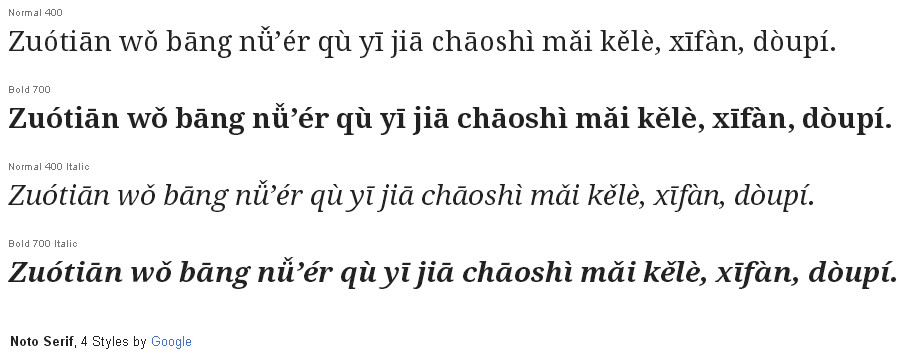
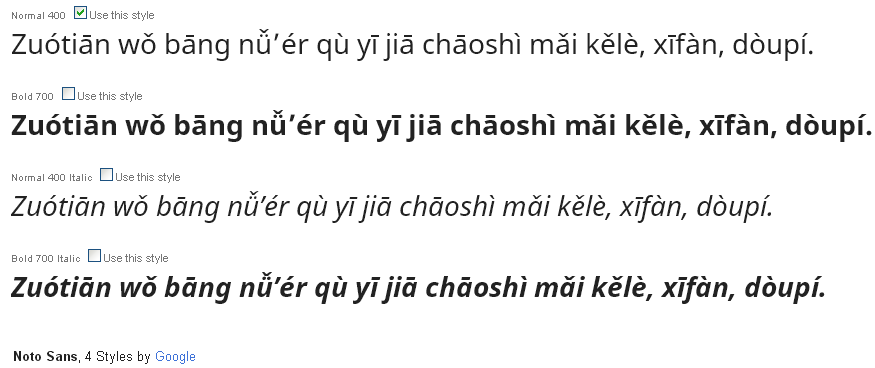
I shouldn’t go too long without mentioning Google’s ambitious Noto project, which offers both serif and sans-serif versions: Noto Serif and Noto Sans.
When text is rendered by a computer, sometimes there will be characters in the text that can not be displayed, because no font that supports them is available to the computer. When this occurs, small boxes are shown to represent the characters. We call those small boxes “tofu,” and we want to remove tofu from the Web. This is how the Noto font families got their name.
Noto helps to make the web more beautiful across platforms for all languages. Currently, Noto covers over 30 scripts, and will cover all of Unicode in the future. This is the Sans Latin, Greek and Cyrillic family. It has Regular, Bold, Italic and Bold Italic styles and is hinted. It is derived from Droid, and like Droid it has a serif sister family, Noto Serif.
Noto fonts for many other languages are available as web fonts from the Google Web Fonts Early Access page.
Noto fonts are intended to be visually harmonious across multiple languages, with compatible heights and stroke thicknesses.
(Emphasis added.)
And it’s free, of course.
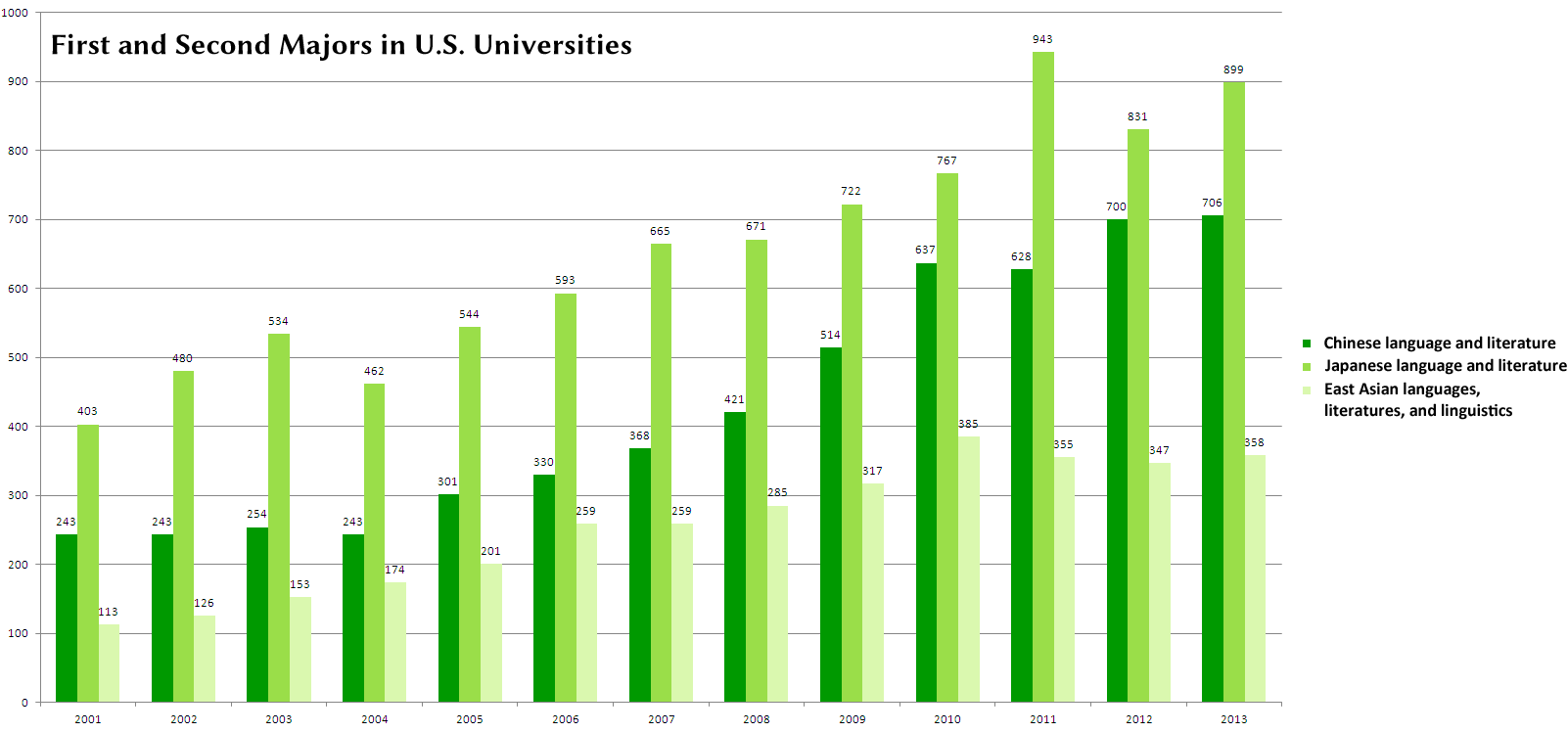
In 2013, a total of 706 U.S. students majoring in Chinese graduated, a gain of just 6 students over the previous year. In addition, Japanese as a major continues to attract significantly more students than Mandarin.
By way of contrast, in 2013 a total of 12,703 U.S. students graduated with degrees in Spanish.
Despite the strong growth of interest in Mandarin over the past two decades or so, only 2.34% of all students in U.S. universities majoring in a foreign language are majoring in Chinese, so the percentage of Mandarin majors among students overall is tiny indeed.
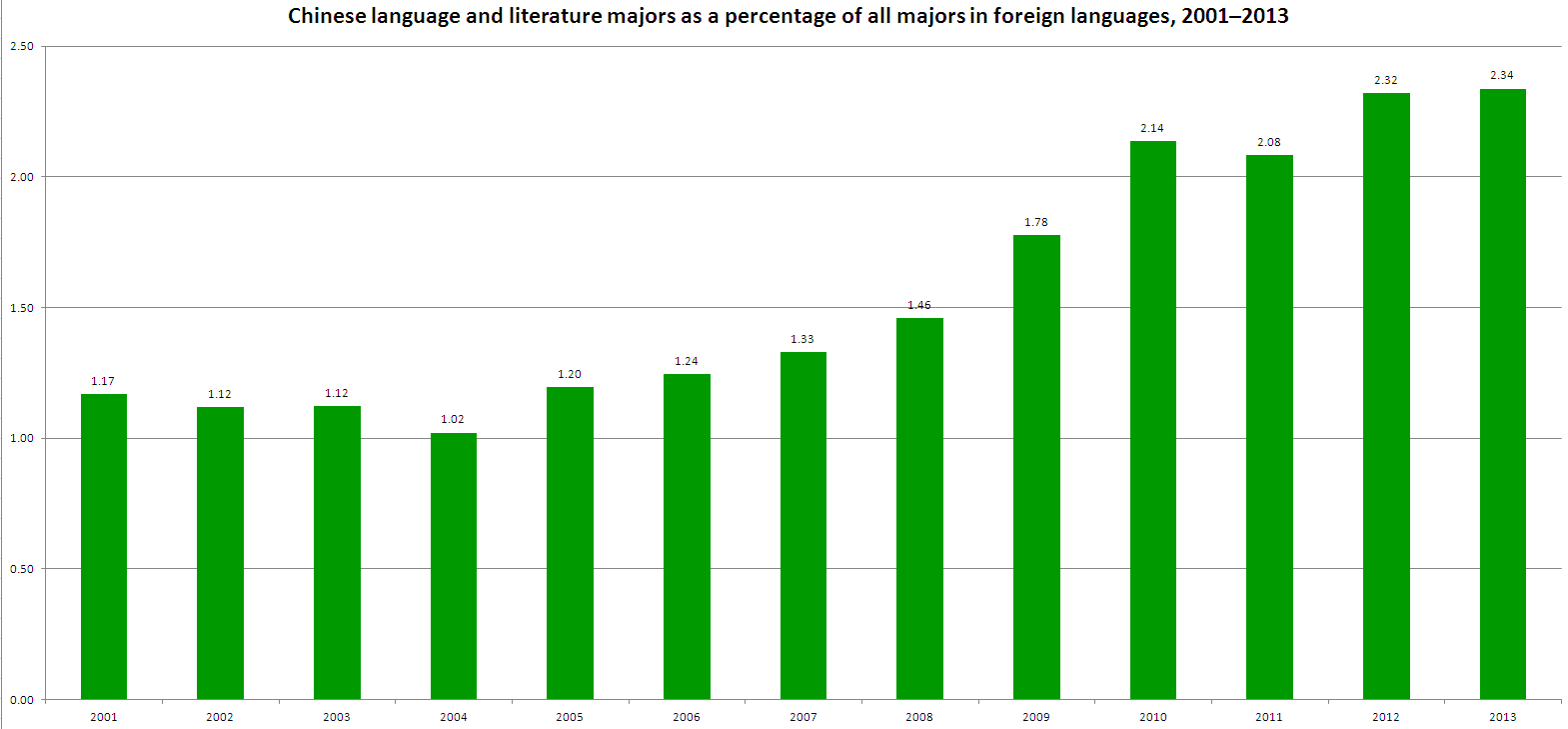
The numbers are for graduating seniors in those years.
Source: Data on Second Majors in Language and Literature, 2001–13, MLA Office of Research, Web publication, February 2015