
Zhou Youguang on 50th anniversary of simplified characters, etc.

Here’s the text of a speech by Zhou Youguang on the fiftieth anniversaries (but not to the day) of the scheme for “simplifying” Chinese characters and of the national directive on the popularization of Mandarin. I don’t share his enthusiasm for these. But, given his vital and clear-sighted work on Hanyu Pinyin, I’d be happy to publicize his views on just about anything.

And the fact that he’s still giving speeches at the age of 101 is nothing short of phenomenal.

Gèwèi lǐngdǎo, nǚshìmen, xiānshengmen:
Jīntiān wǒmen qìngzhù Guówùyuàn gōngbù 《Hànzì Jiǎnhuà Fāng’àn》 hé 《guānyú tuīguǎng Pǔtōnghuà de zhǐshì》50 zhōunián. 1956 nián Guówùyuàn gōngbù 《Hànzì Jiǎnhuà Fāng’àn》 hé 《guānyú tuīguǎng Pǔtōnghuà de zhǐshì》, dào xiànzài yǐ 50 nián le. Zhè 50 nián, shì wǒguó “yǔwén shēnghuó xiàndàihuà” fāzhǎn zuì kuài de shíqī, Hànzì de guīfànhuà hé Pǔtōnghuà de tuīguǎng qǔdé le qiánsuǒwèiyǒu de jìnzhǎn. 2000 nián gōngbù 《guójiā tōngyòng yǔyán wénzì fǎ》, zǒngjié guòqù, kāizhǎn wèilái, shǐ wǒguó yǔwén shēnghuó màixiàng xìnxī huà shídài.
Guīfàn Hànzì, bāokuò jiǎnhuàzì hé chuánchéng zì, zài wǒguó dàlù yǐjing tōngxíng, xiǎoxué jiàoshī shuō, jiǎnhuàzì hǎo jiāo, xiǎoxuéshēng róngyì rèn, róngyì xiě. Zài diànnǎo píngmù shàng jiǎnhuàzì yuèdú qīngxī, Liánhéguó de Zhōngwén wénjiàn zhǔnbèi yīlǜ yòng dàlù de guīfàn jiǎn Hànzì. Xǔduō zhǒng gǔdài shūji yǐjing fānyì chéng báihuàwén. Gǎi yìn guīfàn Hànzì. Jiǎnhuà bù fáng’ài shūfǎ yìshù, shūshèng Wáng Xīzhī jīngcháng xiě jiǎnhuàzì, shū-huà yìshù fēn shíyòng shūfǎ hé chún guānshǎng shūfǎ, shíyòng shūfǎ lìrú zhāopai yāoqiú dàzhòng néng kàndǒng, yíyú yòng guīfàn Hànzì. Yínháng jìlù de diànnǎohuà, fāshēng xìngmíng shēngpì zì bùbiàn shūrù diànnǎo hé zhuǎnzhàng, jīnhòu xìngmíng yòngzì yīngdāng yǐ tōngyòng Hànzì wéixiàn. Yī ge 13 yì rénkǒu de dàguó, guòqù duōshù rénmín dōu shì wénmáng, jīntiān dàduōshù rénmín zhèngzài jiēshòu jīchǔ jiàoyù, zhè shì wǒguó wénhuà lìshǐ de jùdà biànhuà.
Pǔtōnghuà shì Hàn mínzú de gòngtóngyǔ hé Zhōngguó de guójiā gòngtóngyǔ, tuīguǎng guójiā gòngtóngyǔ shì gōngyèhuà hé xìnxī huà de xūyào, chángqīyǐlái, tuīguǎng gōngzuò chíchí bù qián. Xiànzài, chuánshēng jìshù tūfēiměngjìn, guǎngbō, diànshì, yídòng diànhuà děngdeng, bāngzhù tuī-pǔ gōngzuò kuàisù fāzhǎn. Quánguó xuéxiào yuèláiyuè duō yǐ Pǔtōnghuà wéi xiàoyuán yǔyán. Gōngzhòng huódòng yuèláiyuè duō yǐ Pǔtōnghuà wéi gòngtóng méijiè. Rén-Dà, Zhèng-Xié yǐ Pǔtōnghuà zuòwéi huìyì yǔyán, gěi quánguó shùlì bǎngyàng. Xǔduō dà chéngshì rénkǒu měngzēng, wǔfāngzáchǔ, zhèngzài fāshēng “dàdūhuì huà” de yǎnbiàn, dàdūhuì xūyào yǐ Pǔtōnghuà wéi rìcháng yòngyǔ.
“Yányǔ yì shēng, wénzì yìxíng” de shídài jíjiāng guòqù, “shūtóngwén, yǔ tóngyīn” de shídài chū xiànzài wǒmen de miànqián, zài quánqiúhuà de 21 shìjì, Zhōngguó jiāng yǐ yī ge xiàndài wénmíng de dàguó yìlì yú shìjiè. Xièxie.

The source also has several nice photos of Zhou.

source: 组图:百岁语言文字学家周有光谈汉字, March 22, 2006
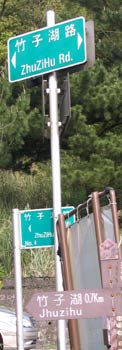
the Zhuzihu spelling blues

road and trail signs giving different spellings for the same placeLess than 10 years ago the romanization on Taipei’s street signs was a complete mess. The “standard,” such as it was, was the inherently bad bastardized Wade-Giles; but misspellings were abundant, so much so that even some individual intersections had signs with several different spellings. It was the sort of thing foreigners in Taiwan loved to point out. Since almost all of those signs are now gone — and good riddance! — I offer up this lesser sample, taken about ten days ago when my wife and I went walking on Yangming Shan to see the sakura and calla lilies.

The sign on the top, reading “ZhuZiHu Rd.”, is in a mix of Hanyu Pinyin and English (Rd.), though, like other Hanyu Pinyin signs in Taipei, it uses InTerCaPiTaLiZaTion for individual syllables, which is wrong, wrong, wrong. (It should be Zhuzihu or Zhuzi Hu, not ZhuZiHu.) The trail marker at the bottom marked “Jhuzihu” is in misspelled Tongyong Pinyin; in Tongyong it should be written “Jhuzihhu”.

misspelled and poorly made Tongyong road signs in TaipeiThe reason for the different spellings here is almost certainly that the road, being within Taipei, is labeled in Hanyu Pinyin, whereas the trail marker, for a trail within Yangming Shan National Park, was put up by the central government and is thus in Tongyong Pinyin — well, almost. The misspelled Tongyong in the sign isn’t just a one-off, either. All of the Tongyong-ish signs I saw in the area are misspelled in the same way. See, for example, the sign at right. (The arrows, by the way, are both correct: The road is a loop.)

Note, also, how the “i” in the second example below is printed incorrectly, with the top of the dot lining up with the tops of the other lowercase letters. I’ve been seeing increasing instances of this particular typographical monstrosity, which puzzles me because it seems like the sort of error that someone has to go out of their way to make.

Those familiar with Taipei may have noticed something odd about the name Zhuzihu: It is not bisyllabic. Indeed, it is the only road name of Sinitic origin within Taipei to have more than two syllables. (The only other two such names are loans from English (Roosevelt) and a language of one of Taiwan’s tribes (Ketagelan). See Taipei street names and the monosyllabic myth.)

calla liliesCloser examination, however, reveals that Zhuzihu is based upon a bisyllabic name after all. Zhuzi Hu means “Bamboo Lake” (Zhúzi Hú / 竹子湖). The only particular reason for writing it solid (Zhuzihu) rather than as “Zhuzi Hu” is that there’s no actual hu (lake) there anymore. (It was more like a marsh, anyway.) Come to think of it, I don’t remember seeing any bamboo there, either. A case could be made for writing it either way: Zhuzi Hu or Zhuzihu
By the way, I wrote the Taipei City Government to have it correct its Web site on the calla lilies. The problem was that the Tongyong Pinyin spelling, Jhuzihhu, was used rather than the Hanyu Pinyin spelling, Zhuzihu. More than a week passed without any changes. Today, however, I noticed that some (but not all or even most) of the spellings had been changed — to another wrong spelling! Now some of the time the Web site gives the Tongyong Pinyin version, Jhuzihhu, and some of the time it gives Zhuzihhu, that latter having one h too many for correct Hanyu Pinyin. No one has yet responded to my message.

if people keep using Pinyin input, China will die, says Wubi-input inventor

Wang Yongmin (Wáng Yǒngmín, 王永民), the developer of the much hyped “Wubi” input method for Chinese characters, seems to get a bit more shrill each time he has a chance to make it into the papers. The Wubi Chinese character input method works by assembling characters based on the shapes of elements within characters.

Here’s something from a recent rant:

近日,五笔字型的发明者——王永民教授在中国科学院研究生院演讲时发表了这样的观点。

王永民认为,汉字的形是“身”,汉字的音是“衣”;“弃形留音”等于“舍身取衣”。拼音输入离开了对汉字造字元素的直接思考和运用,汉字必然将因此而形神俱灭,汉字本身所固有的文化遗传基因,将因此而丧失殆尽。

王永民认为,从文化意义上说,中华民族的伟大复兴也是汉字文化的伟大复兴,没有汉字,就没有中华民族。他指出,汉字和汉语拼音的主辅关系是早有定论的。

source: Wáng Yǒngmín: Pīnyīn shūrù shì Hànzì wénhuà de jué [fen]mù jī[qi] (王永民:拼音输入是汉字文化的掘墓机), Science Web, March 17, 2006

preliminary meeting on writing Taiwanese

The Ministry of Education sponsored a gathering on Saturday to conduct preliminary discussions on how to write Taiwanese. The hope is that a decision can be reached soon on an orthography.

I would hope that by now there’s sufficient worry about the future of Taiwanese that scholars will stop arguing among themselves about which system to use. Maybe soon they’ll finally come together. But I suspect that instead they’re going to continue to bicker as the clock runs out on Chen Shui-bian’s second term.

I haven’t seen any reports on how Saturday’s gathering went.

Jiàoyùbù jīntiān xiàwǔ zhàokāi “Mǐnnán yǔyán yīnbiāo” zuòtánhuì, yāoqǐng xiāngguān lǐngyù xuézhě zhuānjiā, Táiyǔ wén zuòjiā, mínjiān tuántǐ dàibiǎo yánshāng tǎolùn. Jiàoyù Bùzhǎng Dù Zhèng-shèng zhǐchū, jǐnguǎn huìyì méiyǒu gòngshí, tuīdòng tǒngyī de Mǐnnányǔ yīnbiāo xìtǒng hái zài tǎolùn jiēduàn, Jiàoyùbù jiāng zūnzhòng zhuānjiā yìjian, qīdài jǐnkuài gěi shèhuì yī ge dá’àn.

Dù Zhèng-shèng zhǐchū, zhìdìng tǒngyī de Mǐnnányǔ yīnbiāo xìtǒng, zàixué lǐ shàng yǒu kùnnan, ér gè bùtóng pàibié yěyǒu bùtóng jiānchí, Jiàoyùbù qīdài xuézhě néng chōngfèn gōutōng, tǎolùn chū gòngshí, Jiàoyùbù yě huì zūnzhòng zhuānyè, jiànlì yī tào shìhé shèhuì xūyào de Mǐnnányǔ yīnbiāo xìtǒng.

Jiàoyùbù Guóyǔ tuīxíng wěiyuánhuì zhǐchū, mùqián shǐyònglǜ bǐjiào gāo de Mǐnnányǔ pīnyīn xìtǒng bāokuò jiàohuì luómǎzì pīnyīn, Táiwān Mǐnnányǔ pīnyīn xìtǒng yǔ Tōngyòng Pīnyīn, lìngwài hái yǒu TLPA Mǐnnányǔ jí gǎiliáng shì TLAP děng xìtǒng, yóuyú quēfá tǒngyī de zhěnghé bǎnběn, shǐ xuéxiào tuīxíng xiāngtǔ yǔyán kèchéng shí, yě zāoyù bùzhī shǐyòng hézhǒng bǎnběn de kùnnan.

Jiàoyùbù Guóyǔ Huì biǎoshì, jīntiān de huìyì zhǐshì zhèngshì huìyì de “huì qián huì,” mùdì shì zài gè pài xuézhě zhuānjiā jiāoliú yìjian, chōngfèn gōutōng, qīdài wèilái tòuguò hézuò jiāoliú, zhěnghé chū yī tào fúhé mínzhòng qīdài yǔ xūqiú de pīnyīn xìtǒng.

source: Mǐnnányǔ yīnbiāo xìtǒng Dù Zhèng-shèng: zūnzhòng zhuānjiā yìjian (閩南語音標系統 杜正勝:尊重專家意見), CNA, March 18, 2006

China to enact rules on characters in personal names: PRC official

China plans to impose limits on the Chinese characters that may be used in personal names, according to Bao Suixian, deputy director of the Public Security Management Bureau under the PRC Ministry of Public Security. I regard this as a step in the right direction.

[Bao] said the aim is to standardize names of Chinese citizens, and especially “reduce the incidence of rarely-used characters.”

But how big the database will be or when the draft will be completed was not disclosed. (China Daily)

A June 2005 article in a Taiwan magazine reports, “In [the] future, names in mainland China will be restricted to a choice of 12,000 characters.” If that’s at all reliable, I suspect the number would be derived from China’s now-outdated GB 2312-1980 character set (7,445 characters, 6,763 of which are Hanzi) plus the 4,600 “supplemental characters” being added. A project at Peking University compiled the latter list of obscure characters from names throughout the country.

Bào Suìxiàn biǎoshì, jìn 3 niánlái, Běi-Dà fāngzhèng zìkù yǐ cóng quánguó gèdì sōují dào 4,600 ge lěngpì zì, mùqián, quánguó gè zhì zhèng zhōngxīn zhèng ānzhuāng lěngpì zì ruǎnjiàn, ruǎnjiàn kāigōng hòu, yuánlái yīn lěngpì zì méiyǒu lǐngdào shēnfen zhèngjiàn de gōngmín, duǎnqī nèi kěyǐ lǐngdào xīn zhèng. (Beijing News)

But even with 4,600 more characters — a list more than two-thirds the size of the original — the list isn’t big enough. Beijing officials have already run up against 231 characters that still aren’t covered by the new system. There are sure to be even more.

I should probably note that learning 12,000 characters would require someone to have a phenomenal memory — not to mention a lot of spare time and extraordinary dedication. Almost no one in all of China knows that many characters. The percentage of those who know even half that amount would be in the low single digits. Literacy, for the majority of the population, is defined as knowing as few as 1,500 characters; but the figures for those who know even that relatively low number are greatly exaggerated.

Chinese parents usually choose the second and/or third characters for their babies, but “strong,” “smart,” and “wise” for boys; and “pretty,” “quiet,” and “lovely” for girls are popular, so overlapping names are common.

I’ll let those with feminist blogs handle that one.

Figures from nationwide household registration departments show that about 100,000 Chinese share the name “Wang Tao.”

The popularity of assigning single-syllable given names is a real problem.

To avoid such situations, some parents choose names from the gigantic Kang Hsi Dictionary that lists 50,000 characters while the largest standard computer database contains only 27,000.

Such names, which are unrecognizable by computers, have caused inconvenience to about 60 million Chinese in their daily lives, especially when they travel, register in hotels or open bank accounts, the ministry said.

Names with rarely-used characters also hinder a nationwide programme to replace the first-generation identity cards with intelligent, computer-read cards, Bao said.

At least 40,000 Beijing residents whose names cannot be recognized by computers have not got new ID cards since the replacement exercise started in 2004, according to the city’s public security bureau.

The updated ID cards, with advanced anti-forgery and printing features, include an electronic chip to store personal information from computers. “So we cannot handwrite rarely-used characters on the cards like we did before,” Bao said.

(emphasis added)

Below is an anecdote from Taiwan. It refers to a man who changed his name to one having particularly obscure characters. This was to improve his luck and his parents’ health.

Having a name that can’t be entered into a computer because the characters are not in the standard character set has also caused him considerable headaches. His most vivid memory is of getting sick in the middle of the night and going to an emergency ward, where unfortunately the nurse on duty had never seen the two strange characters before and was unable to enter his name into the computer as he rolled on the floor in pain. In the end he had to plead with her to give him an injection for the pain and then discuss the name problem later.

Lucky name. Heh.

respect characters pavilions

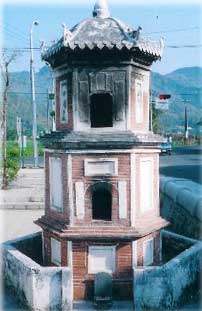
photo of 'pavilion' used for burning paper with writing on it
Meinong (美濃鎮), a township in Taiwan’s Gaoxiong County, holds a ceremony on the ninth day of each year according to the traditional luni-solar calendar to mark respect for the written word and ask the gods to bless the area, especially its farms. Meinong is traditionally a Hakka region.

In the ceremony, items such as old books that might normally be thrown away are instead burned in special structures known as jing zi ting (敬字亭 / [zūn]jìng [Hàn]zì tíng[zi] / “respect characters pavilions”), also known as xizi ting (xīzì tíng[zi] / “treat written paper with respect pavilions”). These structures, which are officially recognized as important cultural relics, date back to the latter half of the eighteenth century. The ashes are combined with the ashes of other written-word items burned over the previous year in the jing zi ting and, after various fanfare, ceremonially dumped in the local river.

This is related to the notion of jìngxī zìzhǐ (敬惜字紙/敬惜字纸 — “cherish paper with writing on it”).

This year, related activities included a contest to see which children would be the fastest to find certain characters in the dictionary. Such contests are not uncommon in Taiwan, where looking up something in a dictionary can be a real chore.

sources:

And here are some genizah (גניזה)-related links for lagniappe:

Taiwan’s first written language — in romanization

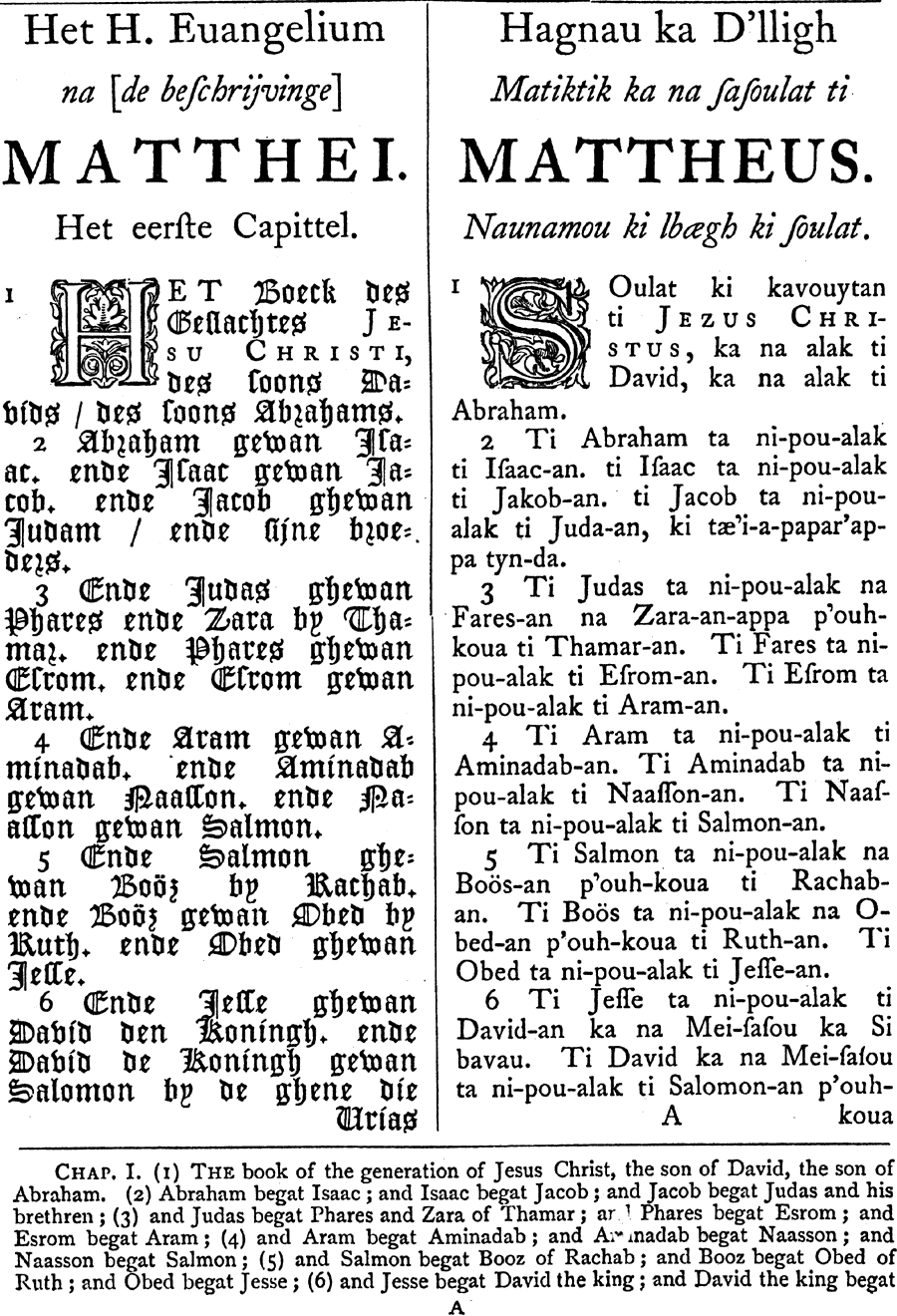
About 80 percent of the “Sinkang Manuscripts” (新港文書) have been deciphered in the ongoing collaboration project between Academia Sinica‘s Institute of Taiwan History and Institute of History and Philology. These documents, in the language of the Siraya people, were written in a romanization system devised by the Dutch colonists in Taiwan in the seventeenth century. Although the Dutch were forced out of Taiwan in the 1660s, writing in this system continued for at least 150 years.

The name Siraya, however, has been applied to the people of that group only since the period of Japanese rule (1895-1945). It was derived from the group’s pronunciation of the word for “I.” The documents get their name from Sinkang Sia, the largest Siraya settlement near the Dutch stronghold Fort Zeelandia.

click for an image of the first page of the Book of Matthew in SirayaMost of the documents are records of land contracts and business transactions. Some are bilingual: in Siraya and Dutch, or Siraya and Chinese. One long bilingual document is a translation by the Dutch of the Book of Matthew.

One of the articles cited below states, “The orthography of the Sinkang Manuscripts also embodies a vestige of 17th-century Europe where the italic style of lettering was still unknown in Dutch and Germanic writings.” This sample, however, makes me wonder. Any paleographers or font specialists out there?

The manuscripts also show that some words were borrowed from Hoklo, the Sinitic language now often referred to as Taiwanese

a transcript of a Siraya document: transcript of bilingual Siraya, Chinese document

sources:

one woman’s writing in ‘symbolic code’

A 70-year-old woman in Tainan, Taiwan, who can read relatively few Chinese characters has reportedly come up with her own “symbolic code” for writing the words to songs. I’d love to see it. Unfortunately, however, she is “afraid others might laugh” and so covers all her writing with white-out once she has memorized the song.

Tainan great-grandmother Lin Li Yuda, 70, wanted to learn some songs, but unfortunately she could not read. But she was determined to do so anyway, and now, eight years later, she has memorized over 100 songs and can flawlessly recall the words to even the longest of folk songs, which can run to 1700 words or more.

Lin worked as a laborer in the construction industry before retiring, carrying bricks and cement. Even this tough labor could not bow her. Eight years ago, she began to weaken, and decided to retire. She now works as a volunteer at the Nanhua Community. Lin heard that singing was good for exercising the abdomen and had other health benefits, so she began to learn songs from other elderly people.

Lin was illiterate, however, and the songbooks her teachers passed out were incomprehensible to her. She could only follow the sounds the others made. But Lin was not ready to give up. She thought long and hard, and came up with an idea: she would learn to write the songs down.

After she began, the whole world was Lin’s singing teacher. Now, whenever she has a moment, she grabs her songbook and asks people to recite the words to her one by one. At her age, her memory is not as good as it used to be, and sometimes she has to ask about a word several times. Lin says that at the beginning, she felt embarrassed about her shortcomings, but everyone was very patient with her, and willingly repeated the lyrics again and again until she learned them.

By relying only on learning from others, however, Lin was unable to remember the songs. So Lin took to making notes beside the words using her own “symbolic code.” Quite often, a song sheet of Lin’s will be a forest of red symbols. When she has learned the song, Lin quickly covers her notes with white-out, because, she says shamefacedly, she is “afraid others might laugh.”

Over the past eight years, Lin has memorized over 100 songs, and knows each one practically word for word….

The most difficult thing for Lin is songs with foreign words in them. One song, “The Butterfly Maid of Nagasaki,” has the Japanese phrase “chocho san” in it, and this nearly tripped Lin up. She says that the person who taught her the song had to repeat it many times before she mastered it. In fact, even Lin’s great-grandson, who is now in primary school, can act as her teacher. When she meets a character she doesn’t know, she rushes to ask someone so that she can make a note….

source: Illiterate great-grandmother memorizes songs using unique symbols, Taiwan Headlines translation of a story from United Daily News, February 23, 2006