Beijing Olympics to use icons modeled after seal script

Danwei notes that Beijing’s Olympics committee has come up with its version of the icons for the sports of the games. These graphics are modeled after seal script, a style of writing that came to prominence about two thousand years ago.

images of icons for the 2008 Olympics in Beijing, China
Above are the icons for baseball, shooting, sailing, softball, cycling, and golf hockey.

Here’s part of how the committee describes the items:

Named “the beauty of seal characters” and with strokes of seal characters as their basic form, the Pictograms of the Beijing 2008 Olympic Games integrate pictographic charm of inscriptions on bones and bronze objects in ancient China with simplified embodiment of modern graphics, making them recognizable, rememberable and easy to use.

Although seal script can still be seen on name chops (seals) and some calligraphy, few people can read it well if at all.

additional resources:

source: New Olympic Icons, Danwei, August 7, 2006

Courage… Cabnap… Grunplitk: zhuyin and the movie Fearless

Many Westerners are so attracted by Chinese characters, which tend to be absurdly exoticized as symbols [sic] or ideograms [sic] of deep meaning, that they place them here and there as if they were some sort of pixie dust that bestows coolness upon any object (or body). Often when they do so, they write these characters incorrectly or are mistaken about their meaning, as Tian of Hanzi Smatter continues to note. But you’d think that at least those who make trailers for Chinese movies would be a little better informed.

Fearless (Mandarin title: Huò Yuánji? / ???), which is billed as Jet Li’s final martial-arts movie, has been out in Asia since January but won’t reach the States until later this year. (I have no plans to see this movie, which appears from the trailer to be a string of the usual clichés. And, anyway, I have yet to forgive Jet Li for appearing in Hero, which is probably the biggest cinematic valentine to totalitarianism since Triumph of the Will.) One of the trailers for Fearless features a number of Chinese characters. They’re even written correctly. But, oddly enough, interspersed with the Chinese characters are zhuyin fuhao, also known as bopo mofo, a semi-syllabic script used in Taiwan mainly to help teach children to read. Odder still, the zhuyin make absolutely no sense.

Here’s how Taiwanonymous, on whose site I found this story, puts it:

Intercut with scenes from the movie was a burnt-yellow background, suggesting aged parchment, with Chinese characters flying past. Along with the Chinese characters were some Mandarin phonetic symbols (zhuyin fuhao ????). It’s bad enough that they included phonetic symbols (which are mainly used in Children’s books) in the flying sea of what wanted to be an ancient Chinese text, but the symbols flew past in strings of gibberish! Imagine the following text dramatically moving across the screen, “Integrity… Peace… Courage… Cabnap… Grunplitk… Uwsugls.” Gives you chills just thinking about it.

Here’s a screenshot from the trailer:
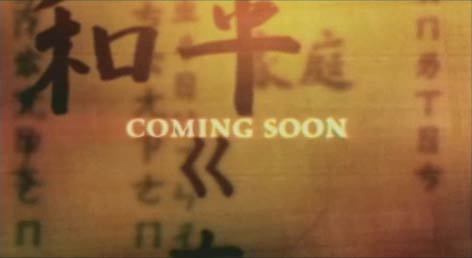
gibberish zhuyin in the background

Just below COMING SOON is a giant ?. For something written in English this would be the equivalent of putting a large letter G on the screen.

Along the right side of the screen is the following, in zhuyin fuhao: ?????. This, in Hanyu Pinyin, would be “maixrici,” which is complete gibberish. The other vertical lines of text are also nonsense in zhuyin fuhao.

Again, there’s nothing wrong with how these are written. It’s just that they’re no more meaningful than a random string of letters.

Here’s one more shot:
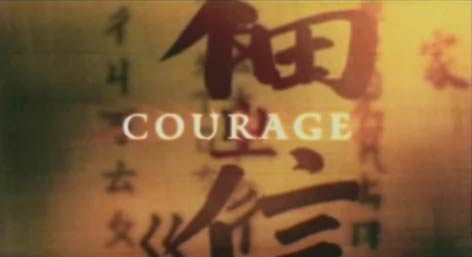
gibberish zhuyin in the background
The zhuyin fuhao on the left read, from top to bottom, ?????, which would be “chjktp” in Hanyu Pinyin. As I think should be obvious even to those who don’t know Mandarin or any other Sinitic language, this is simply nonsense.

sources:

bopomofo: the band

I suppose it was inevitable: a Taiwan band named after bopomofo (a.k.a. zhuyin fuhao), the semi-syllabic script still used in Taiwan schools in place of a romanization system. I need to remember to ask Poagao or Sandy of David Chen and the Muddy Basin Ramblers if the band is any good.

So, does anyone know if anyone in China or elsewhere has named a band after Pinyin? So-and-so and the Hanyu Pinyins might work for a doo-wop group; but I’m guessing that particular musical style has never really taken off in China. So there’s probably not much hope either for “Y.R. Chao and the Gwoyeu Romatzyhs.” But maybe a punk or metal band could name itself Tongyong.

via The Real Taiwan blog

kanji conversions cause crash

This is a weird one: Sharp Corp. has acknowledged that more than 10 million of its cell phones have a “software glitch that disables the handsets when certain hiragana phrases are converted into kanji when writing e-mail.”

The phrases known to freeze the phones are: “mirare makuccha,” which roughly means “people’s eyes were fixed on me,” and “kazega naori kaketa,” meaning, “I was recovering from a cold,” according to Nikkei Net, a Web-based business and information technology news site.

I’m not sure I could come up with a proper comment on this even if I didn’t have a bad case of jet lag.

sources:

oracle bones site makes World Heritage list

The PRC has been trying for several years to get Yin Xu (the Ruins of Yin) in Xiaotun, site of important finds of oracle bones, included on the United Nation’s list of World Heritage Sites. Oracle bones are pieces of turtle shell or animal bone on which were inscribed early forms of what eventually came to be Chinese characters.

This year Yin Xu was finally voted in.

This year’s new additions also include giant-panda sanctuaries and the Tequila-producing area of Mexico.

sources:

learn kanji through noh?

Studying kanji while taking in a Japanese noh drama — what could more exciting? Heh.

A common problem for those new to Japanese traditional performing arts is that–even for native Japanese speakers–it is hard to understand the story and old-fashioned language used in noh recitation or gidayu, a form of narrative chanting that accompanies bunraku performances. With a view to solving this problem, there has been a marked increase in productions using Japanese subtitles at the National Theatre in Tokyo and National Bunraku Theatre in Osaka. The National Noh Theatre in Tokyo also plans to make greater use of subtitles on screens it will introduce in autumn.

The new computer-controlled system to be introduced at the National Noh Theatre in Tokyo, where prior improvements to seats and other theater facilities are scheduled for completion in August and September, will allow Japanese subtitles to be displayed on flat-panel screens installed in seat backs.

“We will provide Japanese and English subtitles for the time being, although the system will allow us to use four channels in total,” said an official at the noh theater. Noh recitation will be displayed as it is in Japanese, while the plot of the play and a briefing on scenes will be provided in English along with a translation of the recitation….

Some bunraku performers at first questioned why Japanese subtitles were necessary since most audience members are Japanese.

“But they don’t voice such objections any more. Some even say the subtitles are useful in learning kanji…,” said Takemoto Sumitayu, a bunraku narrator and a living national treasure.

The National Bunraku Theatre hopes that the service “will help overcome the image of traditional performing arts as hard to understand.”

I suppose as long as the chairback is below the stage, the text would still be subtitling. But I can’t help but wonder if there’s a more precise term. It’s not likely to be real captioning. And what’s the word for texts that are presented on the sides of stages?

source: Does Japanese theater need Japanese subtitles?, Daily Yomiuri, July 8, 2006

Kaohsiung to revise English signage

According to a CNA story in the Taipei Times, the Gaoxiong/Kaohsiung City Government has decided to “correct and update all English translations of signage at 132 scenic spots” in preparation for the city’s hosting of the World Games in 2009.

A “group of specialists” from an ESL magazine are the chief advisers to the city government, which I suppose is better than just one randomly selected foreigner. Still, I wonder what these “specialists” know about signage — or romanization, for that matter. And will anyone check to ensure the signs are made correctly?

Here’s what is probably going to happen: Gaoxiong will replace some old signs with poor English and worse romanization with signs in tiny, unreadable English (probably still with mistakes) and sloppy romanization in a system that most foreigners actively dislike.

Deputy Mayor Cheng Wen-lung (鄭文隆), who is convener of a city committee formed to develop Kaohsiung’s English living environment, said yesterday that in addition to the changes, the committee was considering standardizing the English translations of food names in the area as a way to help foreign athletes — as well as the large number of foreign visitors who are expected at the upcoming World Games — recognize Chinese and local cuisines.

The city plans to update English translations on all of the city’s key signage within one month.

source: Kaohsiung looks to improve its English signage for games, CNA, June 28, 2006

prospects for Chinese writing reform: important new work

John DeFrancis — whose name should be familiar to most readers of this site, especially for his essential work The Chinese Language: Fact and Fantasy, which contains his refutation of the ideographic myth — has just published a new article: “The Prospects for Chinese Writing Reform.”

This article is the first in the new, electronic-format releases of Sino-Platonic Papers. Moreover, these new issues will be available free of charge.

I strongly recommend reading this.
