Shanxi / Shaanxi

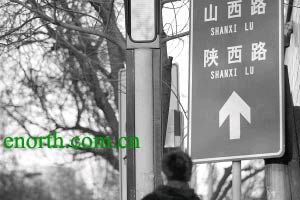
road sign that gives SHANXI LU for 山西路 and SHANXI LU for 陕西路
A sign in Tianjin, China, points toward two roads, which, although they have different names, are both labeled “SHANXI LU”.

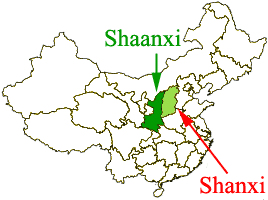
The two roads are named after adjacent Chinese provinces: Shānxī (山西), whose largest city is Taiyuan, and Shǎnxī ( 陝西 / 陕西), which contains Xi’an. So “Shanxi” would appear to be appropriate for both if tone marks are omitted, which is, obviously, sometimes definitely a bad idea.

But because these names are both often used and leaving off the tone mark in their romanized forms could lead to confusion, the PRC authorities long ago decided to alter the romanization of Shǎnxī by borrowing a trick from Y.R. Chao’s tonal spelling system; in this exceptional case, a doubled a is used to represent the third-tone a in Shǎnxī, rendering the province’s name as “Shaanxi”. (This is not intended to change the pronunciation in the slightest, which is still Shǎnxī in modern standard Mandarin. Pronouncing “Shaanxi” with a drawn-out a — Shaaaaaaaaaaaaaaaaaaanxi — is incorrect.)

In Gwoyeu Romatzyh, a first-tone a is spelled simply a, so “Shanxi” could be said to use this as well. And in the old postal system romanizations that predated Hanyu Pinyin for the names, the provinces were “Shensi” and “Shansi”.

So the signs in the photo should read “SHANXI LU” for 山西路 (Shānxī Lù) and “SHAANXI LU” for 陕西路 (Shǎnxī Lù). The local authorities, however, say they can’t do anything to change this:

Tiānjīn Shì Dìmíng Bàngōngshì de gōngzuò rényuán biǎoshì, ànzhào “Tiānjīn Shì dìmíng guǎnlǐ tiáolì” de guīdìng, dìmíng de Hànyǔ Pīnyīn Fāng’àn yào yǐ Hànyǔ Pīnyīn hé pīnxiě guīzé wéi biāozhǔn, bùdé shǐyòng wàiwén pīnxiě. Tóngyàng, Tiānjīn Shì yǔyán wénzì péixùn cèshì zhōngxīn de gōngzuò rényuán yě biǎoshì, xiàng Shānxī Lù hé Shǎnxī Lù de Hànyǔ Pīnyīn pīnxiě fāngshì quèshí wúfǎ gēnggǎi.

(天津市地名办的工作人员表示,按照《天津市地名管理条例》的规定,地名的汉语拼音方案要以汉语拼音和拼写规则为标准,不得使用外文拼写。同样,天津市语言文字培训测试中心的工作人员也表示,像山西路和陕西路的汉语拼音拼写方式确实无法更改。)

This is absurd. “Shaanxi” is not a “foreign-language spelling” (wàiwén pīnxiě). The name is in Mandarin, China’s official language, and Shaanxi is China’s own spelling for this, as should be no mystery to anyone who has access to a map of China published in the last few decades. Also, Hanyu Pinyin’s rules — which are based on words, not syllables, and most definitely not on Chinese characters taken in isolation — take this exception into account. Using “Shaanxi” to refer to 陕西 Province is perfectly acceptable in Hanyu Pinyin.

map of China, showing the locations of Shaanxi and Shanxi

source: ‘SHANXI LU’: Nín cāi shì nǎ tiáo lù? (SHANXI LU 您猜是哪条路?), Měirì xīn bào (每日新报), December 29, 2006

Beijing subway signage — some photos

Sonarchic sent in photos of some signs in the Beijing subway system.

The typography for English and Pinyin is generally poor, as is common in China.

There are several things in general I’d like to draw attention to:

  • Everything is in a boring sans-serif.
  • The letters are often set too close together and occasionally too far apart.
  • EVERYTHING IS IN CAPITAL LETTERS.
  • The size of the English/romanization relative to the Chinese characters varies, with the English text often too small. (The latter is increasingly a problem in Taiwan.)

OK, now to the photos.

column-mounted list of station names along one particular Beijing subway line
Above:

  • very tight tracking between most of the Roman letters, except around the letter I
  • enormous (and incorrect) space after the apostrophes in “Tian’anmen” (which is, correctly, written with an apostrophe, BTW) and “Yong’anli” (which should perhaps be written “Yong’an Li”)
  • yet the apostrophes in the time-to-station markings are not followed by enormous spaces
  • failure to parse many words correctly, e.g., “Lù” (“Road” / ?) should be written apart from the name of the road: G?chéng Lù (???), not GUCHENGLU, etc.

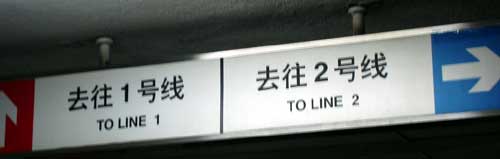
sign hanging from the ceiling of a Beijing subway station, with arrows showing which way to different lines
Above:

  • note different word spacing between “TO” and “LINE” than between “LINE” and the number

click for larger image
Above:

  • This should almost certainly be “Changchun Jie” (jie means “street”), not “CHANGCHUNJIE”.

click for larger image
Above:

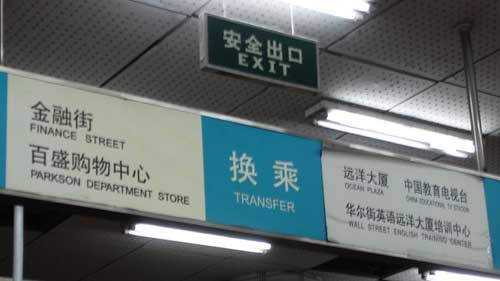
  • only Chinese characters identify this as the northeast exit (??? D?ngb?i k?u)
  • uneven left margin for the English/romanization
  • very small English in relation to the Chinese characters
  • clumsy letterspacing around capital I’s
  • too much space after the period in JRJ.COM
  • uneven spacing, as can be seen in the two uses of the word “insurance” comparison of the sizes of the word 'insurance' on the same sign

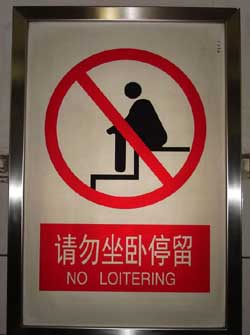
stylized image of a person sitting on a stair, with the caption 'no loitering' in English and Mandarin

further reading:

Chinese Characters as a High-Maintenance Script and the Consequences Thereof

The following is a guest post by Prof. Victor H. Mair of the University of Pennsylvania.

——————

Anyone who has taken it upon him/herself to become literate in Chinese characters realizes what a tremendous commitment is required to master the thousands of different graphs that are necessary for reading and writing. Great as the initial expenditure of time and energy is, one must continue to practice reading and writing the characters on an almost daily basis if one is to maintain a workable degree of proficiency. Furthermore, since character production is a skill that requires a high level of neuro-muscular coordination, failure to practice them regularly inevitably results in a rapid deterioration of the ability to write with facility.

In the world of the 21st century, however, there are countless distractions that compete with the Chinese script for the attention of its users: TV, movies, computers, cell phones, video games, iPods, sports, music, dance, and so forth. Every minute or hour devoted to such devices and diversions means less time for practicing the demanding script. In addition, many of these competitors directly or indirectly displace or obviate the script itself. For example, the vast majority of Sinitic language inputting for computers is done via pinyin (Romanization), and the same is true for short text messaging on cell phones which is so ubiquitous in East Asia. Countless studies and endless testimonies from individual users have shown that reliance on computers and other electronic devices to produce written character texts dramatically reduces the ability of users of the Chinese script to form the characters accurately and, to a lesser extent, even diminishes a reader’s ability to distinguish characters.

Some of this was pointed out already in Jennifer 8. Lee’s lengthy and well-researched article entitled “Where the PC Is Mightier Than the Pen: In China, Computer Use Erodes Traditional Handwriting, Stirring a Cultural Debate,” which appeared in the Technology News section of the New York Times on February 1, 2001. Here’s an abstract of Ms. Lee’s article, which was illustrated with photographs:

Use of computers for word processing appears to be taking a toll on Chinese speakers’ ability to write characters by hand; many Chinese fear that computer could undermine written language, which has great cultural significance for Chinese people, but others say the point of language is communication and nothing more; erosion of traditional handwriting skills arises from forcing complexities of Chinese language to conform to standard Roman-alphabet keyboard.

William Hannas, an expert on East Asian writing systems, has perceptively and persuasively pointed out that character production and recognition are intimately linked:

Educators speak too facilely of the distinction between character “recognition skills” and the skills needed to produce them by hand, as if the two were completely independent. In fact, there is much experimental and anecdotal evidence to support a connection between the two types of skills. As one’s ability physically to write Chinese characters, stroke by stroke, improves, so it seems does one’s ability to recognize them and distinguish one from the other. Conversely, as writing skills deteriorate from lack of practice, so does recognition. Primitive motor skills seem to play a part in reinforcing memory here as in other areas. {Original note: Kaiho Hiroyuki summarizes the results of experiments that demonstrate that character recognition is affected by users’ ability to draw them and that users’ appraisal of a character’s complexity depends more on stroke count than on the number of lines actually present in the character. “Nihongo no hyôki kôdô no ninchi shinrigakuteki bunseki,” Nihongogaku, 6 (1987), 65-71.}

If this phenomenon were related to handwriting specifically, literacy would have been lost in the West entirely by now, for most Westerners do their “writing” today on keyboards. But the fact is, typing has reinforced Westerners’ “hands on” awareness of the language by virtue of the direct one-to-one correspondence between discrete hand motions and the letters that make up the words. Character coding schemes, as we have seen, have little or no direct physical connection with the structure of the character — certainly none that bears any relationship to the specific motor skills that are exercised in forming characters. Although it seems unlikely, for all of the reasons given above, that nonphonetic coding will emerge as the primary means of processing Chinese characters for a significant part of the character-literate East Asian population, if this were to happen, the technique could lead eventually to a deterioration of users’ ability to deal with the characters generally. In other words, the same machines that were supposed to give the characters a new lease on life may contain the seeds of the characters’ destruction. {Asia’s Orthographic Dilemma (Honolulu: University of Hawaii Press, 1997), pp. 271-271, 314. 322.}

This is all the more true of phonetic inputting schemes for characters, which — though extremely easy to learn and use — are completely divorced from the shapes of the characters.

The diminution of the ability to produce and recognize characters resulting from electronic interventions has already reached a significant stage. As the number of distractions and displacements increases, which is a virtual certainty considering the rapid pace of invention and the growing impact of such devices, the level of dysfunctionality in character production and recognition is bound to advance from significant to serious.

Such competitors (computers, BlackBerries, and so on) pose far less of a threat to alphabetic scripts than to the characters for the following reasons:

  1. Alphabetic scripts require a far smaller initial investment and a fraction of the effort for maintenance.
  2. Many of the electronic devices mentioned above actually reinforce or improve writing in alphabetical scripts (spell checkers, grammar checkers, and so on [e-mail style, of course, is another matter altogether] — there are no comparable tools for Chinese).
  3. When one forgets how to write a character, one is usually stymied for that particular morpheme, whereas misspelling a word generally presents no obstacle to expression or understanding.

The implications of electronic information processing devices for the Chinese script are only beginning to be felt. As they increase in scope and availability, the adverse effects for character production and recognition will grow exponentially till they reach a genuine crisis.

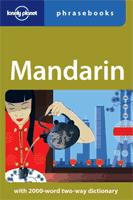
Lonely Planet switches back to Hanyu Pinyin for Mandarin phrasebook

cover of the 6th edition of the Lonely Planet Mandarin phrasebookFor the latest (sixth) edition of its Mandarin phrasebook, Lonely Planet has abandoned its disastrous experiment with its own irregular and downright awful romanization system for Mandarin and switched back to full and exclusive use of Hanyu Pinyin.

No one should even think about buying the fifth edition, which is the one with the weird romanization. Another caveat: The covers for the Pinyin-less fifth edition and the Pinyin-using sixth edition have the exact same illustration; the only difference is in the background color. The fifth edition has a red background, while the sixth (shown here) has a greenish background.

Here’s a more or less random example of the romanization in the fifth edition. The book gives “jèr shìr shér·mer jùn” for what should be written “Zhè shì shénme zhàn?” (“What station is this?”) in Hanyu Pinyin. So in addition to having weird romanization, the fifth edition fails to put a capital letter at the beginning of a sentence and fails to include punctuation at the end. I see this sort of thing a lot and am puzzled by the practice. Capital letters at the beginning of a sentence and punctuation at the end — that’s not too much to ask, is it?

Moreover, sometimes the romanization does not match the Chinese characters! In the example above, for instance, the sentence in Chinese characters should read “这是什么站?” But instead it is written “这是哪个站?”, which would be “Zhè shì nǎge zhàn?” in Hanyu Pinyin. In this case, the two sentences mean basically the same thing. But on the very next page (p. 58) for the question “Do I need to change?” it gives “sēw·yào líng·chyén ma” (Pinyin: Xūyào língqián ma?).

This is a real howler. Somehow those responsible for writing the book managed to mix up two of the meanings of “change” in English. So the phrasebook will have unwary travelers asking not “Do I need to change trains to reach my destination?” but “Do I need coins?” A Chinese person hearing this would probably just answer “no” and ponder how very strange foreigners are to think they might specifically need coins on a train. So woe to the trusting Lonely Planet customer who needs to change trains! Admittedly, foreigners ending up in the wrong part of China as a result of such sloppiness may not have happened too often, since the given romanization is so weird that foreigners could probably not make themselves understood with it and had to point to the Chinese characters. At least the characters manage to give the correct question, Xūyào dǎochē ma? (需要倒车吗?), instead of Xūyào língqián ma? (需要零钱吗?). But that’s hardly enough to make up for such errors.

There are many more errors in the fifth edition. I certainly hope they have been corrected in the sixth; but I didn’t have time the other day in the bookstore to check for sure. If any readers of Pinyin News have a copy of the sixth edition, please let me know; I’d like to check if the Lonely Planet’s hovercraft is still full of eels.

Now that at least the weird romanization has been banished in favor of Hanyu Pinyin (would that Taiwan take that lesson to heart!), it would be good if Lonely Planet could get some other things right, like correcting the misinformation about Mandarin not being a real language but a “dialect.” Some of the word parsing is also incorrect. And the Mandarin-English dictionary should be available in alphabetical order, too, not just stroke order.

Hanyu Pinyin crossword puzzle

The theme of this puzzle is fairly specialized: Taiwan politics. So those not familiar with Taiwan are probably going to find much of this one difficult. But if enough people are interested in other such puzzles on more general themes, please let me know and I’ll create some additional crosswords. Also, please let me know what you think of this one. (Too hard? Too easy? Some questions are too obscure? Interesting? Boring?)

Here are a few guidelines:

  • tones are ignored
  • u is used for both u and ü
  • apostrophes are omitted
  • words can be run together, just as in other crossword puzzles

Have fun!

crossword puzzle in Hanyu Pinyin

Across
4. fight club?
5. one aspect of 12 across
7. KMT
11. min_______, one of the Sanminzhuyi
12. dirty-money politics
13. min _______, one of the Sanminzhuyi
16. Taiwan’s capital prior to Taipei
18. Isla Formosa
19. 1st pers. sing., to Chen Shui-bian
20. pan-green

Down
1. one of 20 across, Minzhu _______
2. start of the guoge
3. Annette _______
6. min_______, one of the Sanminzhuyi
8. “the mainland”
9. _______ Guomindang
10. PFP
14. former ruling nation of Taiwan
15. pan-blue
17. month no. for Taipei mayoral election

This one’s for Gus, who got me started thinking of this.

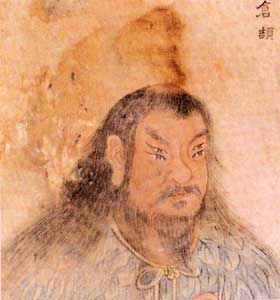
venerating old four-eyes

traditional image of Cang Jie, depicting him with four eyes

Taipei Mayor Ma Ying-jeou spent part of his final day in office at a ceremony in honor of Cang Jie (Cāng Jié / 倉頡 / 仓颉), the mythical inventor of Chinese characters. According to Ma, this was the first time in history that such a formal ceremony has been held for Cang Jie.

The ceremony was part of a plan to promote the use of traditional Chinese characters (something that doesn’t need promoting in Taiwan itself) and to make Taipei the world’s “capital of traditional Chinese characters.” Perhaps Hong Kong, which is a much larger city, will be disqualified by the World Capital Police for now having too many simplified characters here and there.

Taipei officials also appear to view traditional Chinese characters as a potential tourist draw. (They could be a draw for foreigners wanting to learn Mandarin — if only the government would clarify its rules and make it easier for people to study here.) Officials, however, seem to be thinking more of potential tourists from China, always a good group to keep in mind. Nevertheless, Taipei wants the tourists on its own terms and is prepared to dole out some tough love. The city, according to Ma — who, as someone in the final hours of his time in office, wouldn’t seem to have much authority on this — will “continue to use traditional Chinese characters in the tourism pamphlets and maps that it publishes so that the Chinese tourists will have an opportunity to learn about the characters and appreciate their beauty.”

Doesn’t Taipei think PRC tourists would get more than enough opportunities here in Taiwan to see traditional Chinese characters without making it harder for them to read tourist maps and tourist brochures? After all, even the DPP-run central government, which can hardly be accused of being friendly to China, has allowed government brochures and Web sites in simplified characters.

sources:

China’s script-reform officials remark on ‘Internet language’

A few weeks ago the Guangming Daily asked several authorities their ideas on “Internet language” (wǎngluò yǔyán / 网络语言), the mix of abbreviated English and Pinyin along with slang that characterizes much of what is written on Internet chat services and the like.

Since three of those interviewed — Su Peicheng (Sū Péichéng / 苏培成), president of the PRC-government-sponsored Society for the Modernization of the Chinese Language (Zhōngguó Yǔwén Xiàndàihuà Xuéhuì); Qian Yuzhi (Qián Yùzhǐ / 钱玉趾), a member of the same group as Su; and Feng Zhiwei (Féng Zhìwěi / 冯志伟), a research fellow with the PRC Ministry of Education’s Institute of Applied Linguistics’s computational linguistics department — are in important positions related to script reform in China, their thoughts are worth noting. Not surprisingly, they aren’t particularly supportive of it. Su particularly stresses the need to instruct young people in the “harm” of using Internet language.

The fourth member of the group is Wu Zhiwei (Wǔ Zhìwěi / 武志伟), who works at the CCTV website.

source: Rúhé kàndài “Wǎngluò yǔyán” (如何看待“网络语言”), Guangming Ribao, December 7, 2006