Japan likely to regulate pronunciations of personal names

“No, no, no. It’s spelled ‘Raymond Luxury Yacht,’ but it’s pronounced ‘Throatwobbler Mangrove.’” — Monty Python’s Flying Circus

On February 17, Japan’s Legislative Council presented the country’s justice minister with an outline that would mandate that any kanji in names of newborns entered in official family registers include phonetic readings in kana. It would also restrict some readings.

Readings would also be added to names already in registers.

The changes would likely be enforced starting in the 2024 fiscal year (April 1, 2024, to March 31, 2025).

From a news article:

Currently, family registers do not have a field to indicate phonetic readings. After the law revision, family registers will include phonetic readings of kanji in kana characters.

According to the outlines, certain restrictions will be set on “colorful names” whose phonetic readings in kana characters deviate from the original meanings of the kanji characters.

Not only will newborn babies have pronunciations of their names entered in their family registers, but children and adults whose names already appear in family registers will be allowed to add phonetic readings.

Such people will be allowed to register different readings from ones already in their resident registers — records that are distinct from family registers — but the Justice Ministry calls for careful consideration when registering name readings in family registers.

The government plans to submit the revision bill during the current ordinary Diet session, aiming for it to be enforced in fiscal 2024.

The outlines say that “phonetic readings generally accepted as names” will be allowed in family registers.

A supplementary document to the outlines also calls for flexible management of the new system, given the historical and cultural reality that there have been some phonetic readings that are used only for names.

However, the government plans not to accept phonetic readings of names “that would confuse society.”

Examples of this restriction include readings with a meaning opposite to the kanji’s meaning, those that are difficult to distinguish from misreadings or misspellings, and those with no relation to the meaning of the kanji….

Discriminatory and obscene phonetic readings of names will not be accepted. Nor will names of characters from comics, anime and other fictitious works that would cause discomfort if used as the names of real people.

As current family registers do not have a section to indicate phonetic readings of names, people listed in Japanese family registers do not officially have phonetic reading of names under the Family Register Law.

In contrast, phonetic readings are written on resident registers. However, according to the ministry, those phonetics readings are not legally official but exist for administrative convenience. Currently, phonetic readings on birth registrations are used for resident registration purposes, but not for family registers.

After the law revision goes into force, kana characters for phonetic readings in birth registrations of newborns will also be used in family registers. Those who already have family registers can submit phonetic reading of their names to municipalities within one year after the revised law goes into force.

In particular, people with concerns such as the frequent mispronunciation of their names by others may find it necessary to have their resident registers revised to include the desired phonetic readings of their names. However, as changing the submitted names will require permission from a family court, the ministry urges careful consideration in deciding the name readings to be submitted.

For those who do not submit phonetic readings of names within one year after the enforcement of the revision, the official phonetic reading will be decided based on readings indicated in resident registers after municipal mayors send notifications to their respective residents.

I’m still wondering about the “cause discomfort” part. Discomfort to whom? How?

Japan to add romanization to names on My Number cards

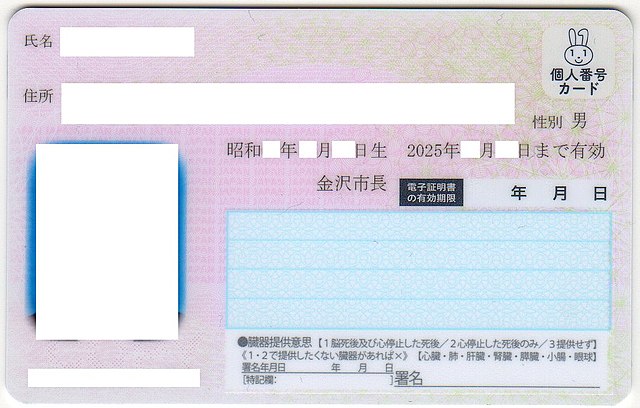
The Japanese government has reportedly decided to add romanization for names on My Number cards, starting next year (2024). My Number cards — also known as Individual Number cards (or kojin bangō kādo / 個人番号カード) are a form of national ID.

Here’s basically what they look like now (without a space for romanization):
blank My Number card

But I haven’t been able to find any more specific information yet.

I wrote the authorities with My Number cards for clarification. I wanted to know what romanization system My Number Cards will use: Hepburn, Kunrei-shiki, or something else? Or will people be able to choose any system they want or to choose from a list of government-approved systems?

I also requested links to any articles/announcements about this in English or Japanese.

Unfortunately, the person who politely responded did not have any information about this beyond what I submitted.

Source: one small mention at the end of this article: Pronunciation of Japanese Personal Names to be Regulated by Planned Law Revision, Japan News (from the Yomiuri Shimbun), February 18, 2023.

Tone marks on Taiwan store sign’s Pinyin

An observant reader sent in this relatively rare example in Taiwan of the use of Hanyu Pinyin with tone marks on signage

sign above the 'Di jia Esthetic Nail Salon'

The Pinyin and especially the tone marks are a little thin, so I’ll give a closeup view:

The sign, here in aesthetic Banqiao, of course, reads:

Dǐ jiā
㭽佳心靈美學館
Esthetic Nail Salon

(Dǐ jiā xīnlíng měixué guǎn)

The Pinyin is not just “esthetic,” because most people probably don’t know the character ‘㭽’. Although they could probably take an educated guess that 㭽 is pronounced dǐ because of the 氐, that’s not the same thing as knowing for sure. So the Pinyin comes in handy even for most literate Taiwanese — if they can see it.

What’s especially surprising is that the people at the store went with Pinyin instead of zhuyin fuhao: ㄉㄧ ㄐㄧㄚ.

Majority supports adding English requirement for applicants for Singapore citizenship: poll

The opposition leader of Singapore, Pritam Singh, said in late February that he supported adding an English test to the requirements for applications for citizenship or permanent residency in Singapore. A recent poll of five hundred Singapore-born citizens found strong popular support for that position.

Proportionately, most of those opposing an English-language requirement were of Chinese descent. But even among that group, supporters of the requirement outnumbered those opposed by roughly 3:1.

Graph showing 400 people of various ethnicities support an English requirement for Singapore citizenship, with 100 opposed -- with most of those in opposition being Chinese.'

Only 7 percent of all respondents, however, said applicants should be able to speak, read, or write fluently in English.

Based on data from the Singapore Census 2020, 72.3 per cent of Singapore residents born outside Singapore are literate in English.

Focusing on the top three countries of origin (India, Malaysia and China), the English literacy level among those from China was the lowest at 61.8 per cent, Asst Prof [Shannon] Ang [of Nanyang Technological University] said.

“Because a large proportion (62.3 per cent) of the overall resident population is Chinese-literate, Chinese immigrants may feel little need to learn another language. But this means that members from the minority races may not be able to communicate with them,” he added.

Further reading:

Large Mongolian-Korean dictionary released

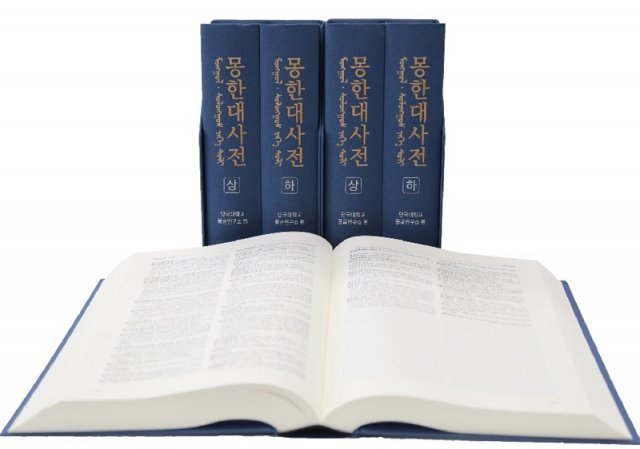
Photo of the Mongolian-Korean dictionary

Dankook University’s Mongolian Research Institute has released what is being called the world’s largest Mongolian dictionary (actually a Mongolian–Korean dictionary), the 몽한대사전.

The two-volume work, which was more than ten years in the making, has some 85,000 headwords and more than 3,000 pages.

Source:
단국대, 15년만에 세계 최대 몽골어 사전 ‘몽한대사전’ 편찬, Donga Ilbo, April 5, 2023.

Chunghwa, Chunghua, Zhonghua

My previous post on postage stamps with Bopomofo (Zhuyin fuhao) mentioned Taiwan’s postal service, Chunghwa Post, which is terrifically efficient at delivering mail but which made an odd choice in romanization in its English name however many years ago . The Mandarin is Zhōnghuá Yóuzhèng in Hanyu Pinyin. But the post office spells its name

Chunghwa

logo for Chunghwa Post Co., Ltd

Chung is clearly Wade-Giles. (It probably would be bastardized Wade-Giles; but in this case chung rather than ch’ung is correct – so, luck of the draw.) Yet hwa does not exist in Wade-Giles, which uses hua. So where is that hwa coming from? The only system that uses hwa and has been official in Taiwan is Gwoyeu Romatzyh.

The Yale system, devised by George Kennedy, also uses hwa; but despite occasional confusion by reporters and others, Taiwan has never used the Yale system. Instead, what many people mistakenly believe is Yale is instead MPS2.

I’m afraid, though, that I don’t have a definitive answer for how Taiwan ended up with the portmanteau spelling of Chunghwa. I suspect that what happened is that the initial intention was to go with the country’s official romanization system, which, way back when, was Gwoyeu Romatzyh (“GR” for short), even if you wouldn’t know that from signage or maps or just about anything but long-distance buses. But using GR would have yielded Jonghwa, which would likely struck people accustomed to seeing 中 romanized as chung as “looking weird” (even though chung is hardly an intuitive spelling for native speakers of English for what is zhong in Hanyu Pinyin). So they kept the chung but then went ahead with hwa, which is not so different than Wade-Giles’s hua. At least that’s my guess, based on having followed romanization in Taiwan for decades.

The odd choice of Chunghwa is not limited to just the postal system. The main telephone system uses it as well: Chunghwa Telecom.

logo for Chunghwa Telecom

If Taiwan ever gets a broader rectification of names under which the Republic of China (Zhōnghuá Mínguó) — not to be confused with the People’s Republic of China (Zhōnghuá Rénmín Gònghéguó) — is simply called “Taiwan,” that would likely remove the issue. The spelling of Taiwan is certainly standard and the same across most romanization systems – with the notable exception of Gwoyeu Romatzyh, which would give us Tairuan. (GR’s fuunny sperlinqs strike again!)

Taiwan issues bopomofo postage stamps

On Monday, March 20, Taiwan’s Chunghwa Post (Zhōnghuá Yóuzhèng / 中華郵政) issued new stamps commemorating Zhuyin Fuhao (aka bopomofo, bopo mofo, or bpmf).

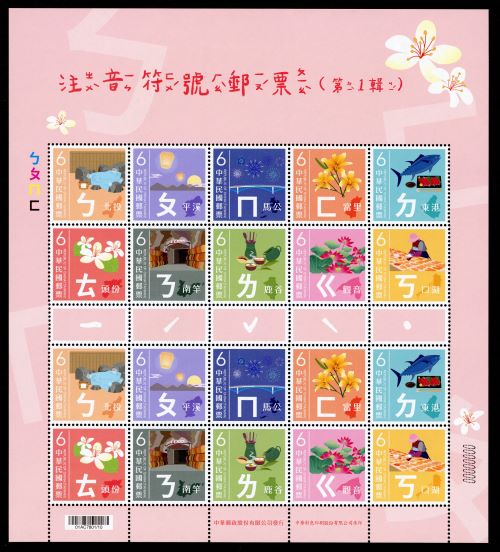
This week’s release of NT$6 (about US$0.20) stamps covers the first ten letters of bopomofo: 「ㄅ、ㄆ、ㄇ、ㄈ、ㄉ、ㄊ、ㄋ、ㄌ、ㄍ、ㄎ」.

Zhuyin Fuhao Hanyu Pinyin
ㄅ b
ㄆ p
ㄇ m
ㄈ f
ㄉ d
ㄊ t
ㄋ n
ㄌ l
ㄍ g
ㄎ k

On the stamps, each letter/symbol is paired with a place (e.g., ㄇ (M) is for 馬公 (Magong, the capital of Penghu).

I bought a nice sheet of the stamps earlier. Get ’em while they’re hot!

Full sheet of two blocks of "5 by 2 block s of  postage stamps of various colors, each highlighting a different zhuyin fuhao/bopomofo letter/symbol. Extra material on the sheet describes the stamps and gives tone marks.

5 by 2 block of  postage stamps of various colors, each highlighting a different zhuyin fuhao/bopomofo letter/symbol.

Sources:

OMG, another rabbit pun!

photo detailing ad described in the post, with cartoon rabbits and other cutesy animals outside a school

Another pun for the Year of the Rabbit

Back to Schoo!! [sic]
兔然開學
OMG

This is notable mainly for writing the word “tūrán” (“suddenly”) as “兔然” rather than properly as “突然”.

The key is that “兔” is the character used in writing “tùzi” (rabbit), as in the Year of the Rabbit. (I took the photo last month.) Thus, here we have a Mandarin-Mandarin pun rather than a Mandarin-English one like the one I posted earlier.

So the ad is basically saying, “Oh my god! A new year / school semester is suddenly upon us [so we’d better update our computers and get Microsoft 365].”

I wish they’d bothered to get “school” correct, though.