
China shifting its position on traditional Chinese characters?

Many Web sites in China are running the story that Chinese, Japanese, Korean, and Taiwanese scholars have reached an agreement on unification of Chinese characters — and that this involves using many traditional characters.

If any “agreement” has indeed been reached, it probably won’t mean much, if anything at all — certainly not to the government of China. But the number of sites running this story and the prominence of some of the members of the PRC delegation make me wonder if this might just be a little more than much ado about nothing.

Zhōng xīn wǎng 11 yuè 5 rì diàn jù hǎiwài méitǐ pīlù, shǔyú Hànzì wénhuà quān de Zhōngguó, Rìběn, Hánguó Sānguó hé Zhōngguó Táiwān dìqū de xuézhě juédìng zhìzuò tǒngyī zìxíng (wénzì de xíngzhuàng) de 5000-6000 ge chángyòng Hànzì biāozhǔn zì.

Hánguó “Cháoxiǎn rìbào” kānzǎi wénzì jí shìpín bàodào chēng, dì-bā jiè “guójì Hànzì yántǎohuì” shàngzhōu zài Zhōngguó Běijīng chuánméi dàxué lóngzhòng zhàokāi, huìyì yóu Zhōngguó Jiàoyùbù yǔyán wénzì yìngyòng yánjiūsuǒ hé guójiā Hànyǔ guójì tuīguǎng lǐngdǎo xiǎozǔ bàngōngshì zhǔbàn. Huìyì jìhuà jiāng Yuènán, Mǎláixīyà, Xīnjiāpō, Xiāng Gǎng, Àomén xīshōu wéi xīn huìyuán, kuòdà Hànzì shǐyòng guójiā huò dìqū de cānyù fànwéi. Huìyì juédìng zhìzuò gè guójiā dìqū Hànzì “bǐjiào yánjiū cídiǎn”, zhújiàn tǒngyī gèguó shǐyòng de zìxíng. Huìyì hái jiù míngnián zài shǒu ěr jǔxíng dì jiǔ jiè yántǎohuì, gèguó fēnbié shèzhì 3 míng liánluòyuán (yánjiū fùzérén) dáchéng le xiéyì.

Jù bàodào, “guójì Hànzì yántǎohuì” yú 1991 nián fāqǐ. Qí mùdìzàiyú, yùfáng Dōngyà guójiā yīnwèi shǐyòng Zhōngguó Táiwān de fántǐzì, Zhōngguó de jiǎntǐzì, Rìběn de lüèzì děng bùtóng xíngzhuàng de Hànzì chǎnshēng hùnluàn, quèdìng chángyòng Hànzì de zìshù, tuījìn zìxíng biāozhǔnhuà (tǒngyī).

Běnjiè huìyì yǔ 2003 nián zài Rìběn Dōngjīng jǔxíng de dì-qī jiè yántǎohuì xiānggé 4 nián. Jù bàodào, běn cì huìyì tíyì, 5000 duō ge chángyòng biāozhǔn zì jiāng yǐ “fántǐzì” wéizhǔ jìnxíng tǒngyī, rúguǒ gèbié Hànzì yǒu jiǎntǐzì, jiù jìxù bǎoliú.

Chūxí cǐcì huìyì de Zhōngfāng dàibiǎo yǒu Wáng Tiěkūn (Jiàoyùbù yǔyán wénzì xìnxī guǎnlǐ sī fù sīzhǎng, Zhōngguó Wénzì Xuéhuì fùhuìzhǎng jiān mìshūzhǎng), Huáng Dékuān (Ānhuī Dàxué xiàozhǎng, Zhōngguó Wénzì Xuéhuì huìzhǎng), Sū Péichéng (Běijīng Dàxué jiàoshòu), Lǐ Dàsuì (Běijīng Dàxué jiàoshòu); Hánguó fāng dàibiǎo yǒu Lǐ Dàchún (Guójì Hànzì Zhènxīng Xiéhuì huìzhǎng), Lǐ Yīngbǎi (Shǒu’ěr Dàxué míngyù jiàoshòu), Jiāng Xìnhàng (Chéngjūnguǎn Dàxué míngyù jiàoshòu), Chén Tàixià (Rénjǐ Dàxué shǒuxí jiàoshòu), Jīn Yànzhōng (Gāolí Dàxué jiàoshòu); Rìběn fāng dàibiǎo yǒu Zuǒténg Gòngyuè (Zhùbō Dàxué jiàoshòu), Qīngyuán Chúnpíng (qīnshàn bù huìzhǎng); Zhōngguó Táiwān dìqū [sic] dàibiǎo yǒu Xǔ Xuérén (“Zhōngguó Wénzì Xiéhuì” lǐshìzhǎng).

source: Zhōngguo, Rìběn, Hánguó yǔ Zhōngguó Táiwān dìqū xuéjiè jiù “tǒngyī Hànzì” dáchéng xiéyì (中日韩与中国台湾地区学界就“统一汉字”达成协议), November 5, 2007
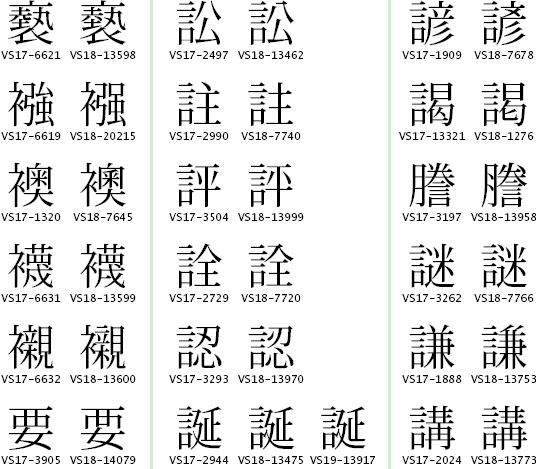
variant Chinese characters and Unicode

A submission to the Unicode Consortium’s Ideographic [sic] Variation Database for the “Combined registration of the Adobe-Japan1 collection and of sequences in that collection” is available for review through November 25. This submission, PRI 108, is a revision of PRI 98.

This set “enumerates 23,058 glyphs” and contains 14,664 tetragraphs (Chinese characters / kanji). About three quarters of Unicode pertains to Chinese characters.

Two sets of charts are available: the complete one (4.4 MB PDF), which shows all the submitted sequences, and the partial one (776 KB PDF), which shows “only the characters for which multiple sequences are submitted.”

Below is a more or less random sample of some of the tetragraphs.

Initially I was going to combine this announcement with a rant against Unicode’s continued misuse of the term “ideographic.” But I’ve decided to save that for a separate post.

sample image of some of the kanji variants in the proposal

MOI and Tongyong Pinyin: update

I have spent many hours over the past few days trying to find out exactly what is behind the recent news story about the Ministry of Education and moves to expand Tongyong Pinyin by the end of the year.

I have sent out no fewer than five e-mail messages to various government officials but have received no responses. I have also made more than a dozen phone calls to various ministries and government-information lines. But nobody I spoke with knows what is going on. My wife helped by making some calls on her own. She was eventually able to get through to someone at the Ministry of the Interior who does have a clue about all this.

Here is basically what is happening.

On October 30, Taiwan’s Ministry of the Interior promulgated the government’s guidelines for writing place names (including not just town names but physical features, such as rivers, mountains, temples, bridges, etc.) in English and romanization: Yùgào dìngdìng “biāozhǔn dìmíng yì xiě zhǔnzé” (預告訂定「標準地名譯寫準則」) (MS Word document).

Most of the pages of this document are simply a list of townships and districts throughout Taiwan, as given in Tongyong Pinyin. But it also contains a few pages of general guidelines. Local governments and interested individuals (yes, that could include you, o reader) who wish to comment on these guidelines may do so before the deadline of Thursday, November 8. The question of Tongyong Pinyin vs. Hanyu Pinyin, however, is supposedly off the table, as the Ministry of the Interior must follow the administration in this — though I encourage anyone who writes the ministry to bring up the issue anyway. I will post contact information as soon as I get it.

To return to the matter of the promulgated document, these are the guidelines that Taiwan’s local governments are ordered to use, with local governments’ offices of land administration compiling lists of place names to be standardized within their jurisdictions and submitting these lists to the MOI’s Department of Land Administration (dìzhèng sī fāngyù kē / 地政司方域科).

If local governments reject Tongyong Pinyin and use a different romanization system, the MOI does not have the authority to compel them to switch to Tongyong. But the central government can and and almost certainly will exert pressure on them to toe the line.

Making matters worse for advocates of Hanyu Pinyin, the international standard romanization system for Mandarin, is the fact that many local officials — even in “blue” regions — do not believe they have autonomy in this matter, as I know from having spoken with several of them about precisely this topic. Nor, unsurprisingly, do they take the word of a foreigner over what they “know” to be “correct”: that they must use Tongyong whether they like it or not. As an example, the city of Jilong (”Keelung”), which is controlled by the anti-Tongyong “blues,” instituted a plan to standardize street names there with Tongyong Pinyin. Nor will most officials bother to look up the rule they are supposedly following — and which, BTW, I can’t show them because it doesn’t exist.

The recently promulgated proposal has extremely limited guidelines. These are most certainly inferior to the fuller guidelines for Hanyu Pinyin — to say nothing of the book-length supplementary guidelines for Hanyu Pinyin (Chinese Romanization: Pronunciation and Orthography and the Xinhua Pinxie Cidian) and carefully produced dictionaries in Hanyu Pinyin.

Probably the best thing I could say about the guidelines is a negative: At least they didn’t adopt Taipei’s StuPid, StuPid PolICy Of InTerCapITaLiZaTion.

The problem that is likely to affect more names than other deficiencies — other than the fundamental matter of Tongyong Pinyin, that is — is the recommended use of the hyphen. Basically, the guidelines call for a hyphen where Hanyu Pinyin would use an apostrophe: before any syllable that begins with a, e, or o, unless that syllable comes at the beginning of a word or immediately follows a hyphen or other dash.

The reason that is a big problem, beyond the failure to follow the standard of Hanyu Pinyin, is that hyphens cannot then be put to the good use they have in Hanyu Pinyin. Hyphens are often needed in signage because they are used in short forms of proper nouns, for example the correct short form of Taiwan Daxue (National Taiwan University) is “Tai-Da.”

Hyphens can thus help clarify names a great deal becuase they often indicate an abbreviation. Mandarin’s tendency toward Consider bridge names, in which the hyphen helps indicates the reason for the name:

  • not Huazhong but Hua-Zhong (for [Wan]hua to Zhong[he])
  • not Huajiang but Hua-Jiang (for [Wan]hua to Jiang[zicui])

Or the case given in the guidelines of 嘉南大圳. The recommendation there is for “Jianan dazun.” But giving “Jia-Nan” instead of “Jianan” would help clarify that this is something in Jiayi and Tainan counties.

The government guidelines’ failure to employ the hyphen in the same manner as Hanyu Pinyin is a major deficiency.

Taiwan should have Tongyong Pinyin’s orthography follow the well-established guidelines for Hanyu Pinyin. But the administration’s petty difference-for-the-sake-of-difference policy will likely rule out that course.

Malaysia exams not to be restricted to English yet

Plans to have primary and secondary students in Malaysia use only English in their exams for science and mathmatics have been put on hold. Instead, the government’s current policy of allowing students to answer in English, Bahasa Malaysia, or the language of their school (such as “Chinese” or Tamil) will remain in force for at least a few more years, Malaysian Education Minister Datuk Seri Hishammuddin Tun Hussein announced earlier this week.

The teaching of science and math in English has been phased in over several years.

Hishammuddin said secondary students would also continue to have the dual-language option although many of them have a “decent command” of English.

He said the weak students were mostly from the rural areas.

“I will not do things on an ad hoc and piecemeal basis. I want to do it (using English) as a whole.

“I want the foundation to be solid (at the primary level) before we look at the secondary schools,” he said.

He added, however, that many secondary students chose to do the papers in English.

Citing matriculation students, he said 95% of them did their papers in English.

sources:

see also teaching in English in Malaysia, Pinyin News, February 3, 2006

more on Taiwan’s new Tongyong move

This morning all three of Taiwan’s English-language newspapers ran the AP story on the Ministry of the Interior’s plan to expand the use of Tongyong Pinyin. (Bonus points to the copy editor at the Taipei Times who changed the original article’s sloppy “Taiwan will standardize the English transliterations of its Chinese Mandarin place names by the end of the year” to “The Romanization of Mandarin place names will be standardized by the end of this year.”)

I have made a few calls about this, but to little effect so far. Unfortunately, I haven’t had the time today to track down someone at the Ministry of the Interior who can give some definitive information about this.

Meanwhile, here’s another article. It gives a little more information: no intercapping (good), hyphens instead of apostrophes (bad), some screwed-up word parsing (bad).

But all of this sounds like old news. How this will be any different in implementation is still unclear.

Wàijí rénshì lái Táiwān gōngzuò huò lǚyóu, zǒng bèi Táiwān de dìmíng yì xiě gǎo de “wù shàsha,” jiéjú cháng yǐ mílù shōuchǎng. Nèizhèngbù 30 rì gōng bù “biāozhǔn dìmíng yì xiě zhǔnzé” cǎo’àn, míng dìng dìmíng yì xiě yǐ “yīnyì” wèi yuánzé, bìng cǎi “Tōngyòng Pīnyīn” wèi jīzhǔn, ruò dìmíng yǒu lìshǐ, yǔyán, guójì guànyòng, shùzì děng tèxìng, zé yǐ dìmíng xìngzhì fānyì, rú Rìyuè Tán yì wéi “Sun Moon Lake;” 306 gāodì yì wéi “Highland 306.”

Gāi cǎo’àn shì yījù “guótǔ cèhuì fǎ” dìngdìng, bìng nàrù Jiàoyùbù zhìdìng de “Zhōngwén yìyīn shǐyòng yuánzé” zuòwéi yì xiě biāozhǔn, dìmíng yì xiě fāngshì yóu dìmíng zhǔguǎn jīguān zìxíng juédìng.

Cǎo’àn zhǐchū, wèi bìmiǎn yì xiě zhě duì wényì rènzhī bùtóng, chǎnshēng yì xiě chāyì, tǒngyī xíngzhèng qūyù de biāozhǔn yì xiě fāngshì, shěng “Province,” shì “City,” xiàn “County,” xiāng-zhèn “Township,” qū “District,” cūnli “Village.” Jiēdào míngchēng yě tǒngyī yì xiě, dàdào “Boulevard,” lù “Road,” jiē “Street,” xiàng “lane,” nòng “Alley.” Lìrú Kǎidágélán Dàdào wéi “Kaidagelan Boulevard.”

Cǎo’àn míng dìng, biāozhǔn dìmíng de yì xiě cǎi tōngyòng pīnyīn, dàn dìmíng hányǒu “shǔxìng míngchēng” shí, yǐ shǔxìng míngchēng yìyì fāngshì yì xiě, rú Dōng Fēng zhíyì wéi “East Peak.”

Ruò shǔxìng míngchēng yǔ biāozhǔn dìmíng zhěngtǐ shìwéi yī ge zhuānyǒu míngchēng shí, bù lìng yǐ yìyì fāngshì fēnkāi yì xiě, rú “Jiā-Nán dà zùn [zhèn?]” yì wéi “Jianan dazun;” Yángmíng Shān yì wéi “Yangmingshan;” Zhúzi Hú yì wéi “Jhuzihhu.”

Lìngwài dìmíng yǒu dāngdì lìshǐ, yǔyán, fēngsúxíguàn, zōngjiào xìnyǎng, guójì guànyòng huò qítā tèshū yuányīn, jīng zhǔguǎn jīguān bào zhōngyāng zhǔguǎn jīguān hédìng hòu, bù shòu “shǔxìng míngchēng” xiànzhì, rú Yù Shān zhíyì wéi Jade Mountain; zhōngyāng shānmài yì wéi “Central Mountains.”

Cǎo’àn guīdìng, biāozhǔn dìmíng yì xiě shūxiě fāngshì, dì-yī ge zìmǔ dàxiě, qíyú zìmǔ xiǎoxiě, rú bǎnqiáo yì wéi “Banciao,” ér fēi “Ban Ciao” huò “Ban-ciao.” Dàn dìmíng de dì-yī ge zì yǐhòu de pīnyīn zìmǔ, chūxiàn a, o, e shí, yǔ qián dānzì jiān yǐ duǎnxiàn liánjiē, rú Qīlǐ’àn yì wéi “Cili-an,” Rén’ài Xiāng wéi “Ren-ai Township.”

Cǐwài, cǎo’àn yě tǒngyī zìrán dìlǐ shítǐ shǔxìng míngchēng, rú píngyuán, péndì, dǎoyǔ, qúndǎo, liè yǔ, jiāo, tān, shāzhōu, jiǎjiǎo, shān, shānmài, fēng, hé xī, hú, tán děng shíwǔ zhǒng yì xiě fāngshì. Lìrú, Dōngshā Qúndǎo yì wéi “Dongsha Islands;” Diàoyútái liè yǔ “Diaoyutai Archipelago;” Běiwèi Tān “Beiwei Bank;” “Ālǐ Shān shānmài” yì wéi “Alishan Mountains;” zhǔfēng yì wéi “Main Peak;” Shānhútán zhíyì wéi “Shanhu Pond.”

source: Yīngyì yǒu “zhǔn” — lǎowài zhǎo lù bùzài wù shàsha (英譯有「準」 老外找路不再霧煞煞), China Times, October 31, 2007