Sorry not to have been posting more lately. My wife and I have just returned from a three-week visit to the United States. I’m starting to dig my way through a mountain of e-mail and suggestions for entries and will answer everyone as soon as I can.
Yearly Archives: 2006
oracle bones site makes World Heritage list
The PRC has been trying for several years to get Yin Xu (the Ruins of Yin) in Xiaotun, site of important finds of oracle bones, included on the United Nation’s list of World Heritage Sites. Oracle bones are pieces of turtle shell or animal bone on which were inscribed early forms of what eventually came to be Chinese characters.
This year Yin Xu was finally voted in.
This year’s new additions also include giant-panda sanctuaries and the Tequila-producing area of Mexico.
sources:
- U.N. adds 18 sites to heritage list, but not Everest, Reuters, July 13, 2006
- Home of China’s earliest writing shoots for world heritage listing, Xinhua, July 12, 2006
- Advisory Body Evaluation (PDF in English and French)
learn kanji through noh?
Studying kanji while taking in a Japanese noh drama — what could more exciting? Heh.
A common problem for those new to Japanese traditional performing arts is that–even for native Japanese speakers–it is hard to understand the story and old-fashioned language used in noh recitation or gidayu, a form of narrative chanting that accompanies bunraku performances. With a view to solving this problem, there has been a marked increase in productions using Japanese subtitles at the National Theatre in Tokyo and National Bunraku Theatre in Osaka. The National Noh Theatre in Tokyo also plans to make greater use of subtitles on screens it will introduce in autumn.
The new computer-controlled system to be introduced at the National Noh Theatre in Tokyo, where prior improvements to seats and other theater facilities are scheduled for completion in August and September, will allow Japanese subtitles to be displayed on flat-panel screens installed in seat backs.
“We will provide Japanese and English subtitles for the time being, although the system will allow us to use four channels in total,” said an official at the noh theater. Noh recitation will be displayed as it is in Japanese, while the plot of the play and a briefing on scenes will be provided in English along with a translation of the recitation….
Some bunraku performers at first questioned why Japanese subtitles were necessary since most audience members are Japanese.
“But they don’t voice such objections any more. Some even say the subtitles are useful in learning kanji…,” said Takemoto Sumitayu, a bunraku narrator and a living national treasure.
The National Bunraku Theatre hopes that the service “will help overcome the image of traditional performing arts as hard to understand.”
I suppose as long as the chairback is below the stage, the text would still be subtitling. But I can’t help but wonder if there’s a more precise term. It’s not likely to be real captioning. And what’s the word for texts that are presented on the sides of stages?
source: Does Japanese theater need Japanese subtitles?, Daily Yomiuri, July 8, 2006
Lysistrata in Taiwanese
Too cool. Oh, I hope this comes to Taipei.
From the troupe’s English-language introduction:
In order to make theatre more accessible to the Tainanese, the troupe has utilised various dramatic forms to explore different local issues that may concern our audiences in their daily life. We even ask our actors to speak good Min-nan-yu, or Taiwanese (as opposed to Mandarin, the official language of Taiwan), in many of our productions, so that the local audiences can easily identify themselves with the characters and feel less intimidated by the language barrier.
Good. This is a basic point but one all too seldom ignored or dismissed: Until relatively recently Mandarin was a foreign language in Taiwan. The native language for most in Taiwan has been Taiwanese/Hokkien/Hoklo.
As an aside, I note that the ticket outlet translates Táinánrén jùtuán (台南人劇團) as the “Tainaner Ensemble”. Tainaner? Is that really what gets used in English for people from Tainan?
via Lomaji
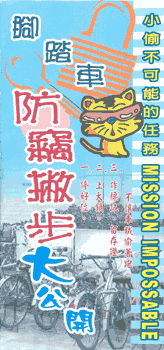
Taipei and correct spelling: Mission Impossable?
Although this post might seem like a cheap shot, errors such in found in this official brochure distributed in MRT stations, among other places, by the Taipei City Police Department are at least as much the rule as the exception, even though it would take very little effort to prevent such mistakes.

Kaohsiung to revise English signage
According to a CNA story in the Taipei Times, the Gaoxiong/Kaohsiung City Government has decided to “correct and update all English translations of signage at 132 scenic spots” in preparation for the city’s hosting of the World Games in 2009.
A “group of specialists” from an ESL magazine are the chief advisers to the city government, which I suppose is better than just one randomly selected foreigner. Still, I wonder what these “specialists” know about signage — or romanization, for that matter. And will anyone check to ensure the signs are made correctly?
Here’s what is probably going to happen: Gaoxiong will replace some old signs with poor English and worse romanization with signs in tiny, unreadable English (probably still with mistakes) and sloppy romanization in a system that most foreigners actively dislike.
Deputy Mayor Cheng Wen-lung (鄭文隆), who is convener of a city committee formed to develop Kaohsiung’s English living environment, said yesterday that in addition to the changes, the committee was considering standardizing the English translations of food names in the area as a way to help foreign athletes — as well as the large number of foreign visitors who are expected at the upcoming World Games — recognize Chinese and local cuisines.
The city plans to update English translations on all of the city’s key signage within one month.
source: Kaohsiung looks to improve its English signage for games, CNA, June 28, 2006
prospects for Chinese writing reform: important new work
John DeFrancis — whose name should be familiar to most readers of this site, especially for his essential work The Chinese Language: Fact and Fantasy, which contains his refutation of the ideographic myth — has just published a new article: “The Prospects for Chinese Writing Reform.”
This article is the first in the new, electronic-format releases of Sino-Platonic Papers. Moreover, these new issues will be available free of charge.
- The Prospects for Chinese Writing Reform (PDF, approx. 2.4 MB)
- The Prospects for Chinese Writing Reform (HTML format, approx. 100 KB)
I strongly recommend reading this.
PRC legislator calls for compulsory minority language education
A member of the Standing Committee of the PRC’s National People’s Congress has called for members of China’s ethnic minorities to be educated in not only Mandarin but also in their native languages.
“Minority children today are reluctant to learn their own ethnic languages, and if the trend continues, these languages will disappear,” said Zhang Meilan, a member of the Hani minority group. Zhang made her comments on Sunday in an address to fellow lawmakers on the draft amendment to the Compulsory Education Law, which is in its final hearing.
Zhang also made the suggestion before the amendment was submitted to the legislature, but her proposal was omitted from the draft.
On Sunday, Zhang urged the legislature again to include an article in the amendment to make bilingual education compulsory for minority children in the nine-year free education from elementary school to junior high.
The legislature is expected to vote on the draft amendment on Thursday….
Zhang said that if her suggestion was accepted, the Ministry of Education and the Ethnic Affairs Committee should invest in bilingual education, providing a fund for minority language preservation.
Unfortunately, this will probably not be accepted. And even if it does pass, it will probably never receive much more than lip service.
source: Chinese lawmaker calls for compulsory minority language education, Xinhua, June 26, 2006