Recently, Victor Mair posted an image from Taichung of an apostrophe r representing “Mr.” (Alphabetic “Mr.” and “Mrs. / Ms.” in Chinese)
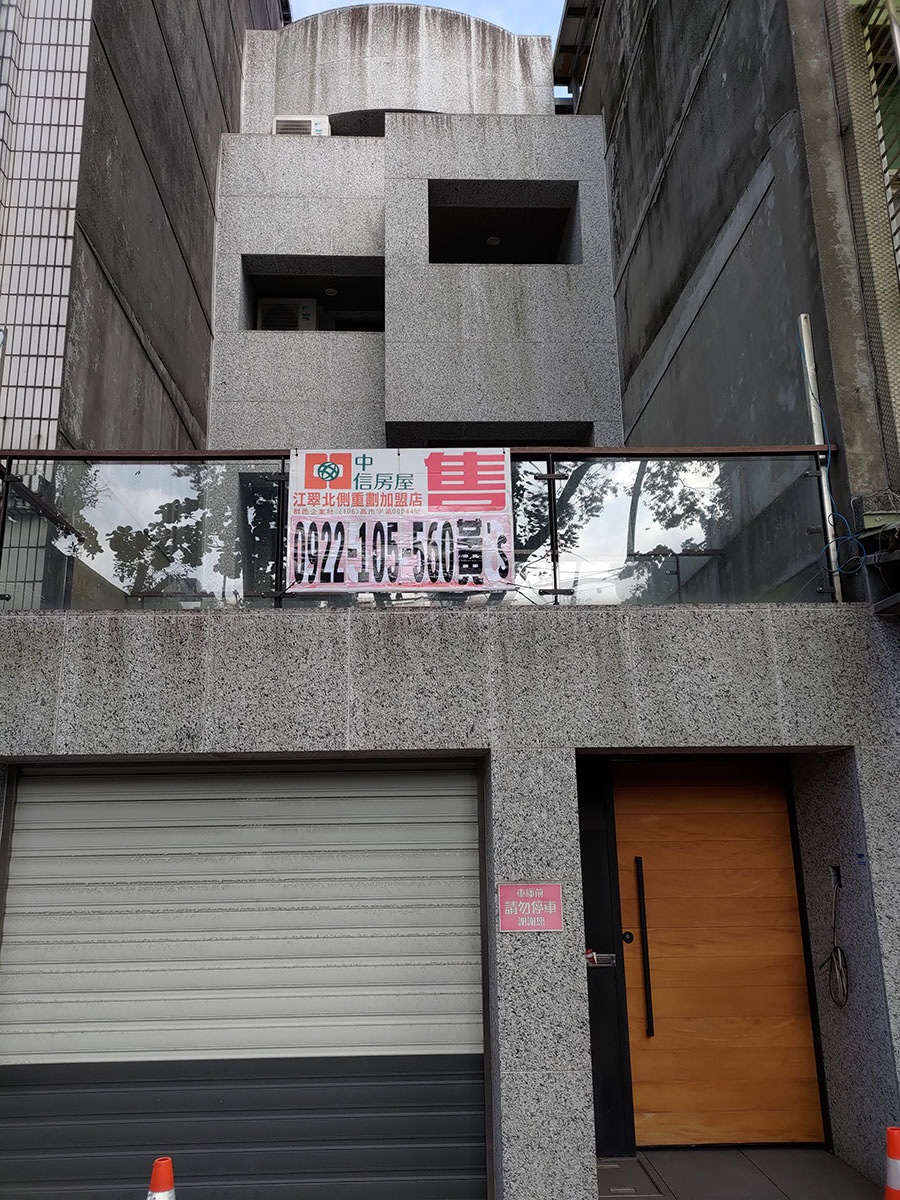
Here’s a companion image for a Ms. Huang.

Recently, Victor Mair posted an image from Taichung of an apostrophe r representing “Mr.” (Alphabetic “Mr.” and “Mrs. / Ms.” in Chinese)
Here’s a companion image for a Ms. Huang.
Recent years have been difficult for postsecondary foreign language programs in the United States, with enrollments down 16.6% overall between fall 2016 and fall 2021. Anecdotal evidence points to even steeper declines since then.
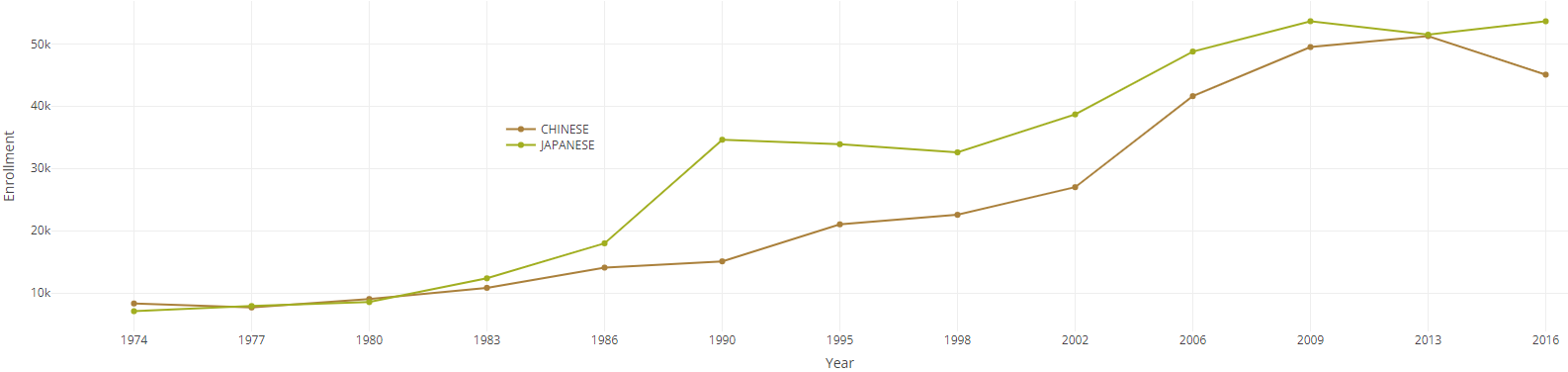
This post provides a look at the some of the numbers from the most recent report by the Modern Language Association, focusing especially on the case of Chinese/Mandarin, with some other languages (esp. Japanese) tossed in by way of comparison.
Among the fifteen most commonly taught languages other than English, only three — Korean, American Sign Language, and Biblical Hebrew — showed gains, at 38.3%, 9.1%, and 0.8%, respectively.
Thus, Mandarin and Japanese are among those in decline. Although in total enrollments Mandarin is now ahead of Italian, and Japanese has moved ahead of German, that’s simply because those two Asian languages didn’t fall as far as those two European ones.
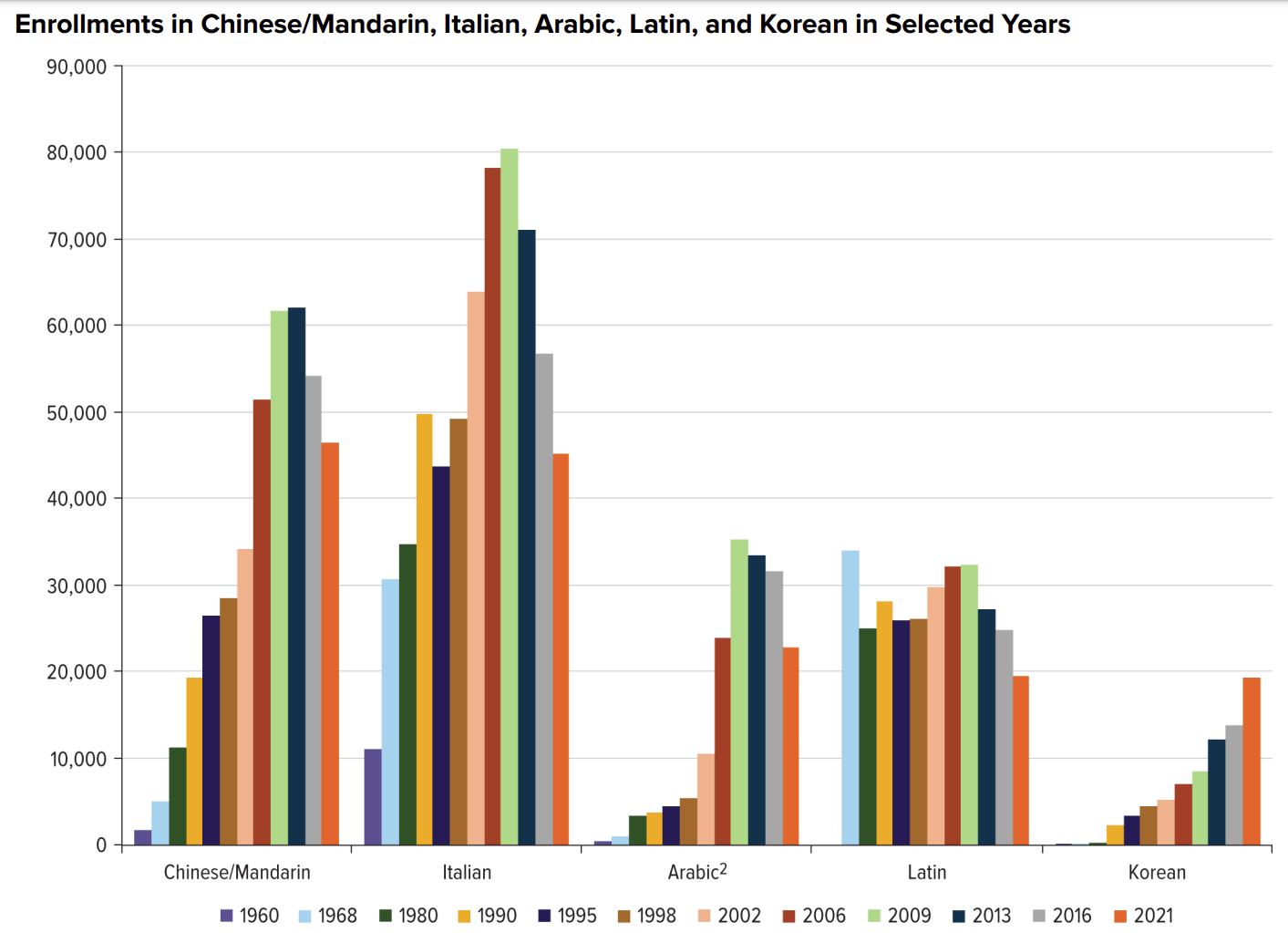
(source: MLA report)
From the MLA report:
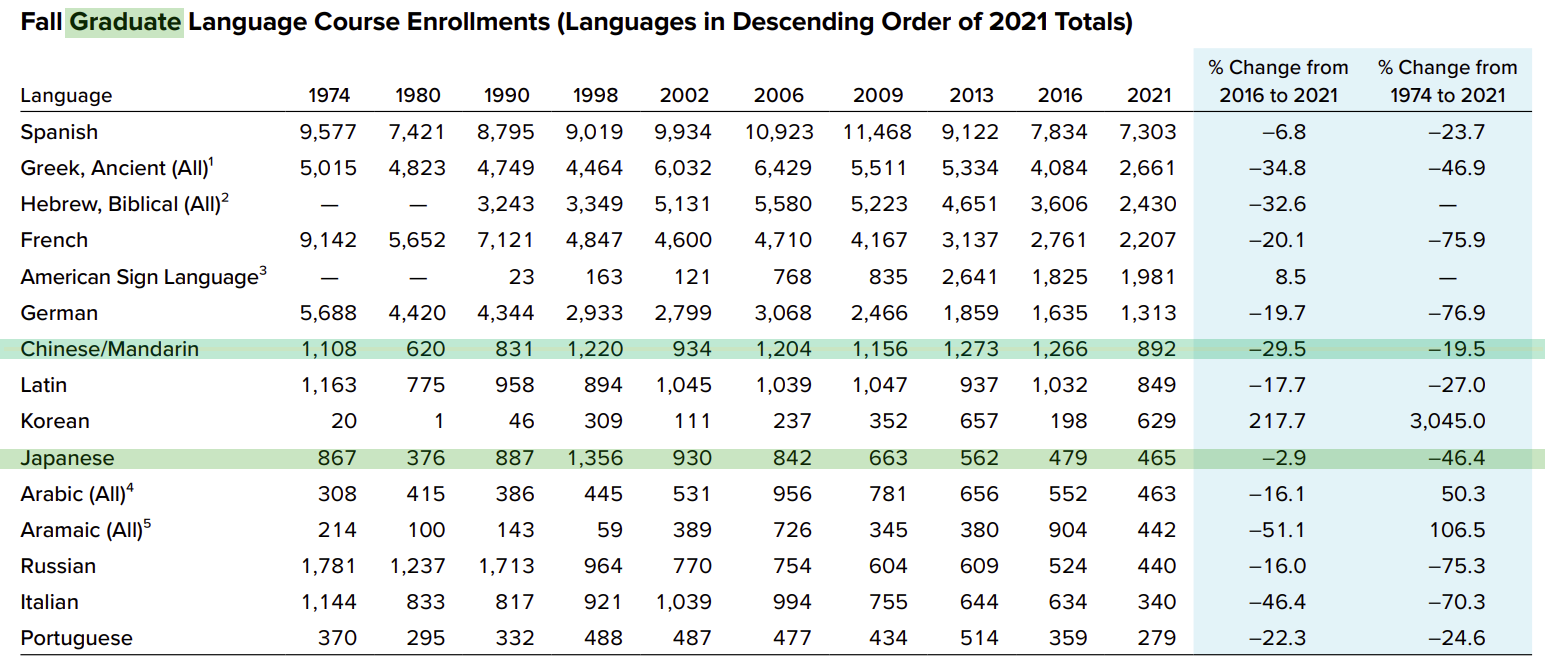
Chinese/Mandarin enrollments … showed steep declines…. Chinese/Mandarin enrollments fell 14.3% overall and 23.9% at two-year schools, 12.5% at four-year schools, and 29.5% at the graduate level…. Chinese/Mandarin enrollments have been dropping at two-year institutions since 2009, and at four-year institutions since 2013. Graduate enrollments in Chinese/Mandarin have remained fairly steady for the last twenty years; the drop from 2016 to 2021, from 1,266 to 892, is the first time graduate enrollments in Chinese/Mandarin have fallen below 1,000 since 2002.
From the five uses of “Chinese/Mandarin” in the previous paragraph, longtime readers of Pinyin News will note that the MLA acted upon my earlier recommendation to aggregate those two terms rather than treat them separately. But don’t worry: the MLA report doesn’t give the wordy “Chinese/Mandarin” every time in its report. (Although in general use I prefer “Mandarin,” in this post I often use “Chinese” simply to aid people making Google searches.)
Now for some graphs and tables, some directly from the MLA report, others I made using the MLA’s data.
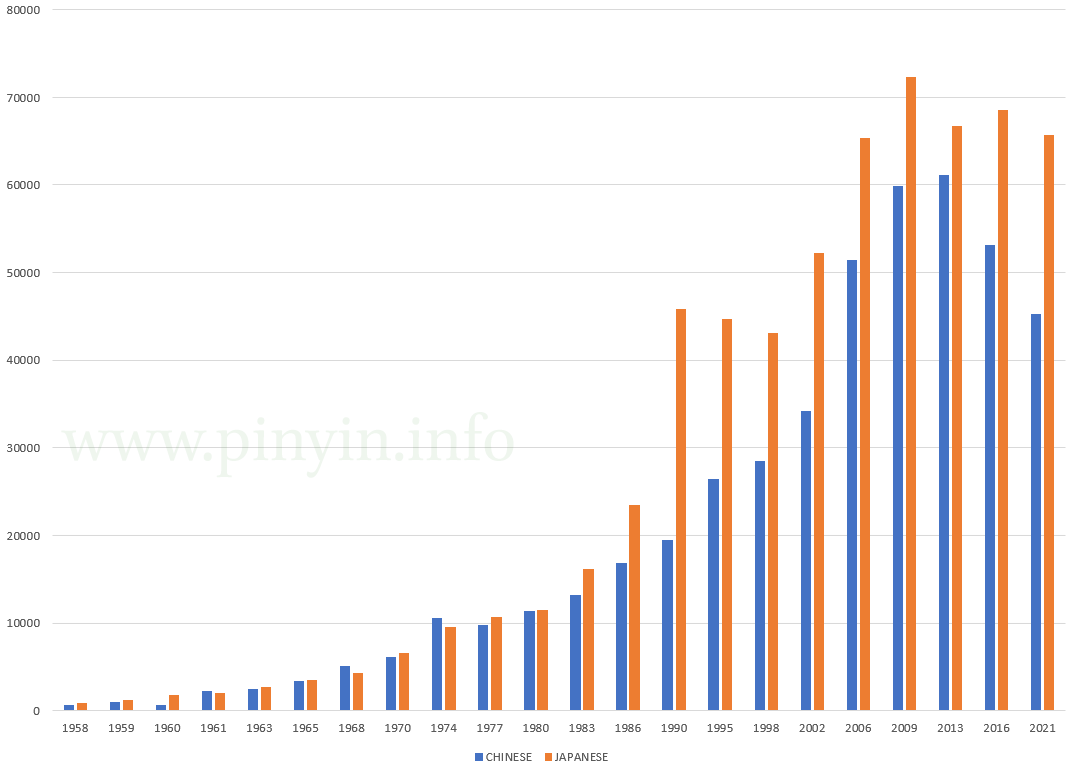
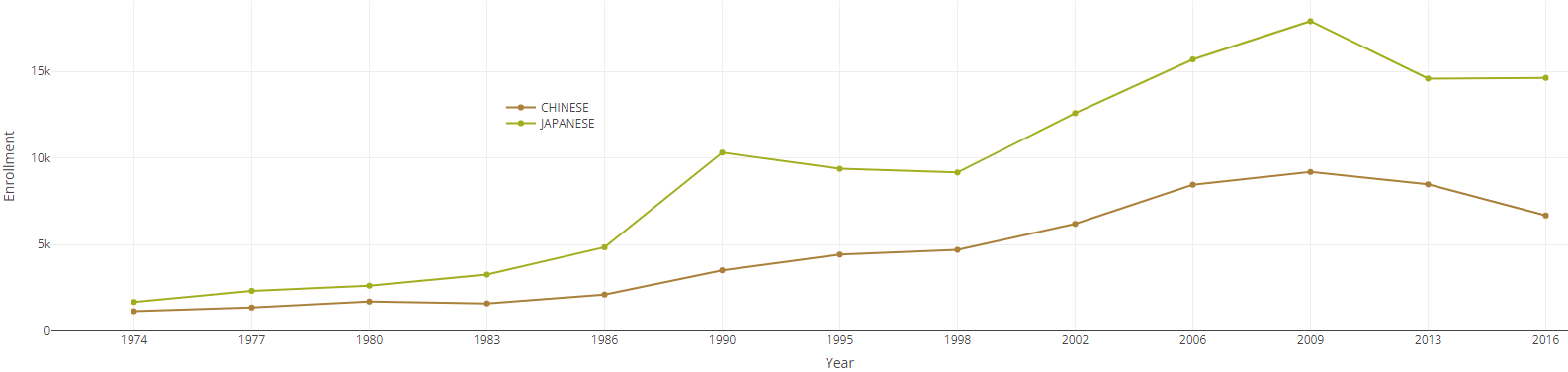
In one encouraging sign for Mandarin, it had a 3:1 ratio of introductory to advanced undergraduate enrollments, making it one of just five languages that had a 4:1 or better ratio, along with Biblical Hebrew (2:1), Portuguese (3:1), Russian (3:1), and German (4:1). This is important because on average it takes more time for native speakers of English to reach the same level in Mandarin than they might achieve in, say, two years of French.
Also, although the number of enrollments is down for Mandarin, that language beat the reduction trend by having a slight increase in the number of institutions offering it at the graduate level: 54 in 2021, up from 52 in 2009. On the other hand, Chinese enrollments overall were reported by 105 fewer institutions in the survey.
As this table from the MLA report shows, Mandarin programs around the United States have been decreasing, stable, or increasing at about the same rates as programs for other foreign languages — which is to say, mainly decreasing. Japanese, however, is continuing to do well given the recent environment.
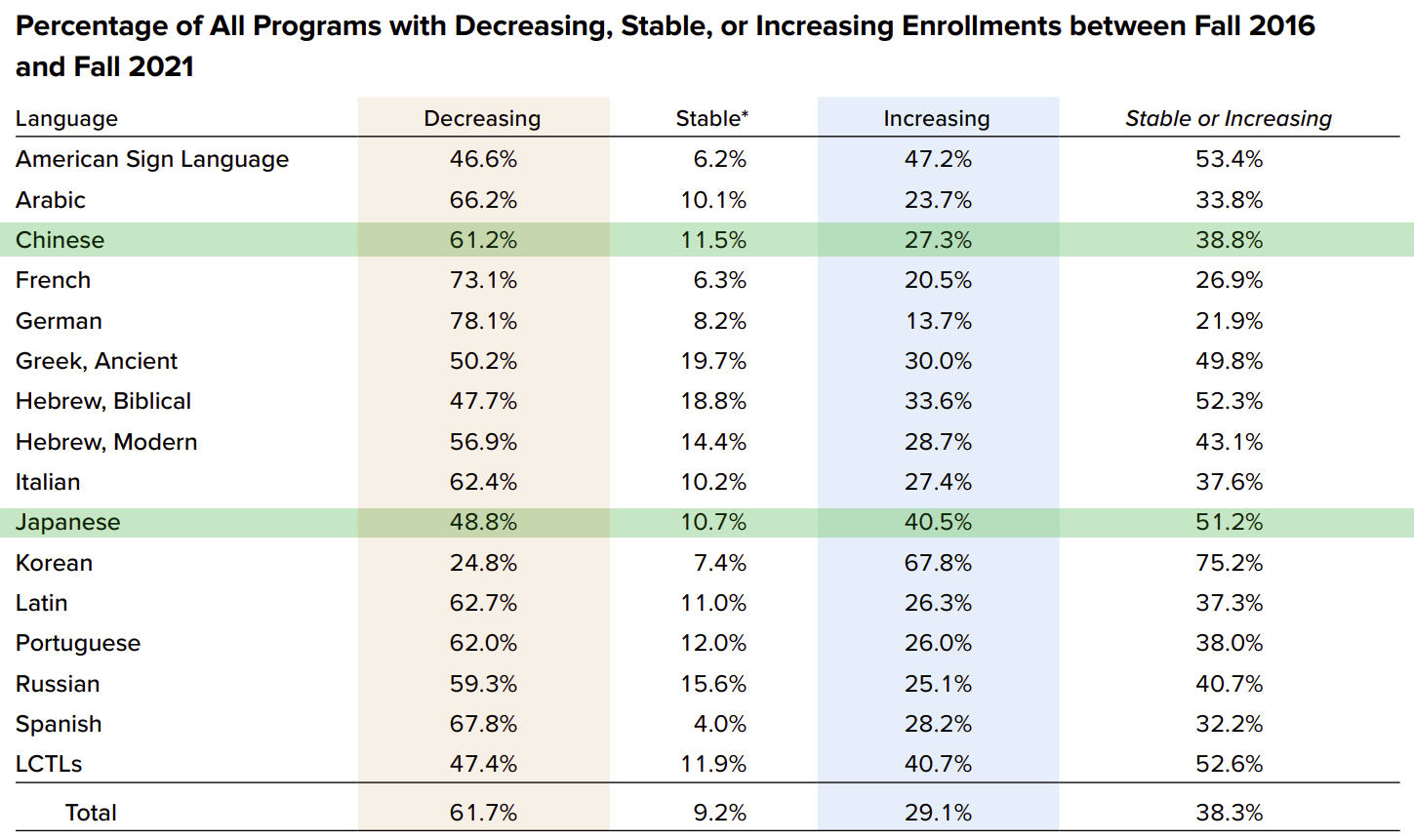
The figures are about the same for introductory programs, so I won’t bother to reproduce that table (12b).
sources:
Further reading:
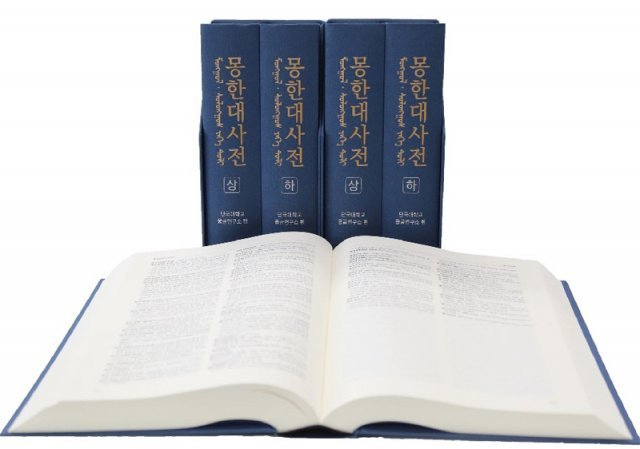
Dankook University’s Mongolian Research Institute has released what is being called the world’s largest Mongolian dictionary (actually a Mongolian–Korean dictionary), the 몽한대사전.
The two-volume work, which was more than ten years in the making, has some 85,000 headwords and more than 3,000 pages.
Source:
단국대, 15년만에 세계 최대 몽골어 사전 ‘몽한대사전’ 편찬, Donga Ilbo, April 5, 2023.

North Korea is a scary, scary, scary place. Fortunately, at least for those of us not living in that People’s Paradise, every so often the country also provides important linguistic tips, which I am duty-bound to pass along to you.
For example, did you know that names without final consonants are “anti-socialist”? The wise authorities in North Korea have reportedly come to that conclusion and are presently dedicated to the task of cleansing that evil. Since October, “notices have been constantly issued at the neighborhood-watch unit’s residents’ meeting to correct all names without final consonants. People with names that don’t have a final consonant have until the end of the year to add political meanings to their name to meet revolutionary standards,” a resident of North Korea’s North Hamgyong told Radio Free Asia.
In meetings and public notices, officials have gone so far as to instruct adults and children to change their names if they are deemed too soft or simple …, another source said….
The government has threatened to fine anyone who does not use names with political meanings, a resident in the northern province of Ryanggang told RFA on condition of anonymity to speak freely.
Naturally, it would be unwise to adopt any sort of name that reminds the government authorities of names in South Korea or elsewhere.
In the past, North Koreans were encouraged to give their children patriotic names that held some ideological or even militaristic meaning, such as Chung Sim (loyalty), Chong Il (gun), Pok Il (bomb) or Ui Song (satellite).
In recent years, though, as the county has become more open to the outside world, North Koreans have been naming their children gentler, more uplifting names that are easier to say, such as A Ri (loved one), So Ra (conch shell) and Su Mi (super beauty), sources inside the country say.
Instead of names that end on harder sounding consonants, children are being given names that end in softer vowels, which is more like names given to children in South Korea.
But recently, North Korean authorities are clamping down on this trend, requiring citizens with the softer names to change to more ideological ones, and even their children’s names, if they aren’t “revolutionary” enough, the sources say.
source: North Korea forcing citizens to change their names to sound more ideological, Radio Free Asia, November 30, 2022
related article in Korean: “남한식 이름 불가” 북, 혁명적 개명 강요 (“South Korean names are not allowed.” North Forces Revolutionary Name Changes), Radio Free Asia, November 28, 2022
Further reading: “북 채택 예고한 ‘평양문화어보호법’, 사상·정신적 이완 방지 조치” (North Korea to adopt Pyongyang Cultural Language Protection Act to prevent ideological and mental relaxation), Radio Free Asia, December 7, 2022.
Although the number of people studying Mandarin in the United States has continued to rise (more about that in a later post), enrollments there in graduate courses in Mandarin have declined.
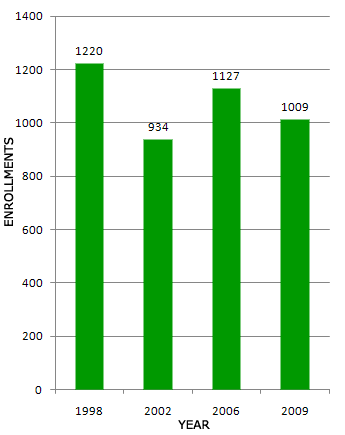

Here’s something I wrote the last time I addressed this topic.
The much-ballyhooed but also much-deserved increase in students studying Mandarin has all been at the undergraduate level. Given that the grad enrollment as a percentage of total enrollment for Mandarin is about the same as that for French (2.63 percent and 2.73 percent, respectively) it might appear that Mandarin has simply reached a “normal” ratio in this regard. But native speakers of English generally need much more time to master Mandarin than to master French. Simply put, four years, say, of post-secondary study of French provides students with a much greater level of fluency than four years of post-secondary study of Mandarin.
Also, there is a great deal more work that needs to be done in terms of translations from Mandarin. I do not at all mean to belittle the work being done in French — or in any other language…. I just mean that Mandarin has historically been underrepresented in U.S. universities given the number of speakers it has and its body of texts that have not yet been translated into English. U.S. universities need to be producing many more qualified grad students who can handle this specialized work. And right now, unfortunately, that’s not happening.
That still holds, except that grad enrollment as a percentage of total enrollment for Mandarin is even lower than before (1.96% vs. 2.37% for French, 1.99% for Spanish, and an impressive 4.68% for Korean).
sources:
I’ve been doing so much on signage lately that I’ve been neglecting the issue of romanization. (Remember romanization?) Here’s something just in from South Korea, a country that rivals Taiwan in making a national pastime of screwing around with its romanization system.
The Ministry of Culture, Sports and Tourism and the Presidential Council on National Competitiveness on Wednesday discussed plans to make the Korean language more accessible worldwide, including working out a Romanization standard for family names, compiling a new Hangul dictionary with about 1 million entries, and building a Hangul cultural center.
The government will come up with standard Romanization for family names this year that will become mandatory for people when they apply for new passports and for government offices that use both Hangul and English on official documents such as birth records and residence registration cards.
In Taiwan, people can choose among romanization systems for the name on their passport. Employing romanization for Hoklo, Hakka, or a language of one of Taiwan’s official tribes is also permitted.
An earlier Romanization project for family names was suspended in 2000 due to controversy over exceptions. The new standard will cost a huge amount of money as the Romanized names of businesses, schools and individuals as well as road signs will have to be changed.
A new Hangul dictionary is to be compiled by 2012, adding a large number of words to the last official dictionary published in 1999, which has about 500,000 entries, and adding easy sample sentences.
Experts have said that the younger generation have trouble understanding the conventional dictionary, as there are too many difficult Chinese characters in explanations and definitions.
The government also plans to compile a multilingual web dictionary comprising about 20 different foreign language sections — such as Vietnamese-Hangul and Thai-Hangul — to help foreigners and Korean nationals overseas.
A Hangul cultural center, to be built at a cost of W35.2 billion [US$27.5 million] by 2012, is to give visitors hands-on experience of the Korean language.
source: Standard Romanization for Korean Names Planned, Chosun Ilbo, June 25, 2009
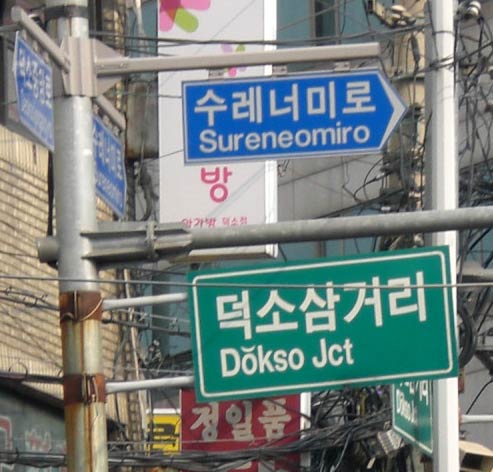
Photo of street signs in Namyangju, Gyeonggi-do (Namyangju, Ky?nggi-do) courtesy of Robert Badger.
The final volumes in what is being touted as the world’s largest Chinese character dictionary are scheduled to be published in May.
The fifteen-volume work (excluding the index) will reportedly cover some 60,000 Chinese characters and include about 500,000 Sinitic words. By comparison, the Zhongwen da cidian (中文大辭典 / Zhōngwén dà cídiǎn), published in Taiwan in the 1960s covers 49,905 Chinese characters.
The project was initiated by the Institute of Oriental Studies of Dankook University, South Korea, in 1978.
The first volume of the 『漢韓大辭典 』 (in Mandarin: Hàn-Hán dà cídiǎn; “Dictionary of Chinese characters Korean use,” as it is translated on the institute’s Web site) was issued in 1999. Last year, volumes 10-12 were published.
The project has reportedly cost more than W20 billion (US$21.3 million).
Yet more work may still be needed.
Prof. Kim Eon-jong of the Department of Korean Literature in Classical Chinese at Korea University said, “This project has great significance from the standpoint of cultural history. But it’s a pity that the institute hastened the final stage. It must complement and supplement the dictionary later.”
sources:
I haven’t provided any news from North Korea in quite some time. Truly, I am wicked human scum whose frantic attempts to stifle the true voice of the people will be thwarted.
So here are some remarks from this year from North Korea’s official news agency (found on the Internet on a .jp domain — heh).
First off, in case anyone was wondering which of the world’s languages is wonderful beyond compare, it’s Korean:
There are more than 5,000 languages in the world, none of which can compare with the Korean written and spoken languages delicate in expression, rich in meaning and abundant in vocabulary.
Part of the reason for this is that Korean, at least as spoken in North Korea, has been rid of lots of foul loan words. Ah, purity!
More than tens of thousands of common vocabularies and terminology have been purified from Chinese and foreign words. A lot of inherent Korean words have been discovered and arranged and the Korean written and spoken language has developed into a new system with inherent Korean words as the main.
(Kidding aside, there really is a certain logic to this, given the problems that adopting Sinitic words and their Chinese characters into Korean caused for literacy.)
OK, back to linguistic reality, as defined by Pyongyang:
The Korean people are proud of having the Pyongyang cultured language and are embodying in their linguistic life thoroughly.
The Pyongyang cultured language is the standard one of the nation, which is fully reflecting the national characteristics and constantly developing in accordance with the requirements of the times.
The Koreans are a nation of one and the same blood who have lived in a territory with same culture down through history. They have developed the Korean language into the Pyongyang cultured language, centering around Pyongyang, the hub of the politics, economy and culture, since the liberation of the country from the Japanese colonial rule.
The Korean language, with abundant vocabularies, can correctly distinguish the differences between various objects and their meanings and clearly express people’s feelings and emotion, color, taste and etiquette.
Its pronunciations are fluent, intonations soft and sounds beautiful.
The Pyongyang cultured language comprehends the superior linguistic factors of the national language.
In particular, all the words of foreign origin which are difficult to understand have been removed and a vocabulary system has been established on the basis of home-grown words. As a result, the Pyongyang cultured language protects the purity of the Korean language on a high level.
Chinese and Japanese words had been brought into the Korean language in the past owing to the flunkeyism of feudal rulers and the Japanese imperialists’ moves to obliterate the Korean language. Foreign words including them have been arranged into Korean ones.
So now you know.
sources:
And for lagniappe: KCNA Random Insult Generator