
Cantonese
Archived Posts from this Category
news and discussions related to romanization
Archived Posts from this Category
Posted by Pinyin Info on 21 Aug 2008 | Tagged as: Cantonese, Chinese, Mandarin, languages, teach Chinese
Ozaru’s link in a comment on my previous post led me eventually to a report on “community languages” in higher education in Britain. The report provides numbers for those in degree programs for various foreign languages.
| Language | 1996 | 2001 | 2005 | 2007 | % change 1996-2007 | % of total in 1996 | % of total in 2007 |
|---|---|---|---|---|---|---|---|
| French | 5655 | 4077 | 3964 | 3700 | -34.57 | 33.02 | 28.83 |
| Italian | 837 | 786 | 639 | 2461 | 194.03 | 4.89 | 19.18 |
| Spanish | 2155 | 2331 | 2547 | 1401 | -34.99 | 12.58 | 10.92 |
| German | 2288 | 1736 | 1503 | 610 | -73.34 | 13.36 | 4.75 |
| Russian and Eastern European | 418 | 380 | 425 | 409 | -2.15 | 2.44 | 3.19 |
| Mandarin | 165 | 165 | 352 | 392 | 137.58 | 0.96 | 3.05 |
| Modern Middle Eastern | 214 | 260 | 362 | 378 | 76.64 | 1.25 | 2.95 |
| Japanese | 272 | 249 | 331 | 306 | 12.50 | 1.59 | 2.38 |
| Portuguese | 128 | 117 | 118 | 141 | 10.16 | 0.75 | 1.10 |
| Other Asian | 161 | 171 | 142 | 118 | -26.71 | 0.94 | 0.92 |
| African | 54 | 57 | 57 | 67 | 24.07 | 0.32 | 0.52 |
| Scandinavian | 65 | 36 | 57 | 19 | -70.77 | 0.38 | 0.15 |
| Other European | 2200 | 1507 | 1667 | 1647 | -25.14 | 12.85 | 12.83 |
| Other non-European | 2514 | 1900 | 1248 | 1185 | -52.86 | 14.68 | 9.23 |
| ALL | 17126 | 13772 | 13412 | 12834 | -25.06 | 100 | 100 |
(Adapted from Table 3.3 in the report)
If I understand the report correctly, the figures are not for total enrollments, just for students majoring or minoring in the languages in question. Thus, the actual enrollment numbers are likely much higher, though certainly not distributed evenly across the languages.
I’m pleased to note that the number of students in Mandarin programs has more than doubled in the last dozen years, though this doesn’t match the even more impressive growth rate for Italian. (I have no idea why Italian received such a boost, especially during a period in which most other European languages were shedding students.)
Mandarin now ranks sixth (or perhaps fifth, depending on how many Polish majors there are) among foreign language majors, with 3 percent of foreign language majors concentrating on this.
On the other hand, because native English speakers must devote a great deal more time and effort to learning Mandarin than most other languages, the levels of learning and achievement aren’t the same. Simply put, for most native English speakers Mandarin is damn hard, and students won’t gain nearly the same level of fluency in four years as they would studying most other languages.
For example, in 2002 Goldsmiths, University of London, which is the “largest provider of community languages in a PGCE,” set up its Postgraduate Certificate in Education in community languages, starting with Arabic, Mandarin, and Punjabi, and adding Urdu in 2004. So far all of the students enrolled in the Mandarin program have had “some knowledge of the language as a community/family/heritage language.” In other words, most — perhaps all — students have been ethnic Chinese and have a background in the language beyond the classroom.
Although the College does not especially seek to attract students who have some knowledge of the language as a community/family/heritage language, all the students accepted so far do have this background. This may change in the next five to ten years, as more non-native speaker students graduate with UK degrees in Mandarin, and some may wish to go on to teach it. However, this will only take place if there is good progression in the language from school to university level so that graduates can reach a high enough level in the language to teach up to A level. Currently, this is not the case, and those who have applied so far do not have this level of expertise.
Ouch. So it’s not that non-Chinese didn’t apply to the program, it’s that none of them were judged up to the requisite level of fluency to teach the language, despite having attained unversity degrees in Mandarin. (This only reinforces my worry about the drop in graduate enrollments in Mandarin in the United States.)
The report also notes, “There are no degree courses in the four most widely used community languages in England: Urdu, Cantonese, Punjabi and Bengali, although SOAS will offer a degree course in Bengali from autumn 2008.”
The situation is more promising for those taking A-levels in “Chinese.” (NB: The chart does not distinguish between Cantonese and Mandarin — even though these have separate oral exams — but lumps them together as “Chinese.” The majority will be Cantonese.)

(The figures for Spanish have not been included in the chart because it seems likely that most pupils study this as a foreign language rather than a community language: in 2007, 63,978 candidates sat GCSE and 7,152 A-level Spanish. Hindi is not included in this chart as it is not available at GCSE or A-Level.)
The total number of A-Level presentations in these languages in 2007 is 5347, indicating potential numbers in a good position to continue their studies in these languages in higher education. The ‘retention rate’ for most of languages listed above is high. This is a percentage calculated by comparing the numbers sitting a GCSE examination in a given year compared with those sitting an A-level in the same language two years later. It has to be regarded as a proxy measure, however, as not all those sitting A-levels took the relevant examination two years earlier. The retention rate over all languages (i.e. including French, German and Spanish), between GCSEs sat in 2005 and A-levels in 2007, is 7.5%. Most of the languages likely to be studied as community languages have a retention rate considerably higher than those typically studied as ‘foreign’ languages. Chinese is the most spectacular, with a retention rate of 78%, followed by Polish (51%) and Russian (42%). Only Bengali (3%) and Punjabi (4%) have retention rates below the overall figure. The high retention rate for the majority indicates that community language learners can, generally speaking, be regarded as committed students, and potentially good candidates for continued study of these languages in higher education.
source:
further reading:
Posted by Pinyin Info on 18 Aug 2008 | Tagged as: Cantonese, Chinese, Classical Chinese, Hanyu, Hokkien, Hoklo, Japanese, Mandarin, Taiwanese, languages
From the way the U.S. media talk about the boom in Mandarin classes, it’s easy to get the impression that Mandarin is about to become the most studied language in the United States. So I offer the following overdue reality check.
The data come from the results of a large survey of foreign-language enrollments in U.S. post-secondary schools. The survey was conducted by the Modern Language Association. I started work on this post when the results were released in November 2007; but, well, I got distracted.
This post has lots of tables and figures, so for those who don’t want to scan through everything I offer some basic points up front.
A few summary remarks of my own:
OK, now on to some details.
Look below at the growth for American Sign Language since 1990. If Mandarin had had that sort of growth (4,820 percent!) the pundits would no doubt be telling us that the Chinese had already taken over the planet and were going to rule the entire galaxy within the next decade. (And don’t get me started about the supposed Mandarin in Serenity/Firefly.) But American Sign Language just doesn’t seem to get the same sort of respect, despite the fact that it still has more than 50 percent more enrollments than Mandarin. Arabic, which has also had a much faster growth rate than that of Mandarin, hasn’t received the same level of hype either.
| Enrollments | 1990 | 2006 | % Growth 2002-06 | % Growth 1990-2006 |
|---|---|---|---|---|
| American Sign Language | 1,602 | 78,829 | 29.7 | 4820.7 |
| Arabic | 3,475 | 23,974 | 126.5 | 589.9 |
| Korean | 2,286 | 7,145 | 37.1 | 212.6 |
| Mandarin | 19,490 | 51,582 | 51.0 | 164.7 |
| Hebrew | 12,995 | 23,752 | 4.2 | 82.8 |
| Portuguese | 6,211 | 10,267 | 22.4 | 65.3 |
| Italian | 49,699 | 78,368 | 22.6 | 57.7 |
| Spanish | 533,944 | 822,985 | 10.3 | 54.1 |
| Japanese | 45,717 | 66,605 | 27.5 | 45.7 |
| French | 272,472 | 206,426 | 2.2 | -24.2 |
| German | 133,348 | 94,264 | 3.5 | -29.3 |
| Russian | 44,626 | 24,845 | 3.9 | -44.3 |
| Total | 1,125,865 | 1,489,042 | 12.7 | 32.3 |
| Change between Surveys | 1995-98 | 1998-2002 | 2002-06 |
|---|---|---|---|
| Spanish | 8.3% | 13.7% | 10.3% |
| French | -3.1% | 1.5% | 2.2% |
| German | -7.5% | 2.3% | 3.5% |
| American Sign Language | 165.3% | 432.2% | 29.7% |
| Italian | 12.6% | 29.6% | 22.6% |
| Japanese | -3.5% | 21.1% | 27.5% |
| Mandarin | 7.5% | 20.0% | 51.0% |
| Russian | -3.8% | 0.5% | 3.9% |
| Arabic | 23.9% | 92.3% | 126.5% |
| Hebrew * | 20.6% | 44.0% | 4.2% |
| Portuguese | 6.0% | 21.1% | 22.4% |
| Korean | 34.0% | 16.3% | 37.1% |
| Total | 5.0% | 16.6% | 12.7% |
* Modern and Biblical Hebrew combined
Below: Russian may not have the top number of enrollments, but it certainly has some motivated students, given the high numbers of them in advanced courses.
| Intro Enr. | Advanced Enr. | Total Enrollment | Ratio of Intro Enr. to Advanced Enr. | |
|---|---|---|---|---|
| Russian | 17,527 | 6,569 | 24,096 | 2.67:1 |
| Portuguese | 7,387 | 2,422 | 9,809 | 3.05:1 |
| German | 72,434 | 18,758 | 91,192 | 3.86:1 |
| French | 160,736 | 40,927 | 201,663 | 3.93:1 |
| Korean | 5,511 | 1,397 | 6,908 | 3.94:1 |
| Greek, Ancient | 13,250 | 3,176 | 16,426 | 4.17:1 |
| Mandarin | 41,193 | 9,262 | 50,455 | 4.45:1 |
| Spanish | 669,432 | 142,602 | 812,034 | 4.69:1 |
| Japanese | 55,161 | 10,585 | 65,746 | 5.21:1 |
| Latin | 26,787 | 4,383 | 31,170 | 6.11:1 |
| Hebrew, Modern | 7,665 | 1,250 | 8,915 | 6.13:1 |
| Arabic | 20,571 | 2,463 | 23,034 | 8.35:1 |
| Italian | 69,757 | 7,593 | 77,350 | 9.19:1 |
| Hebrew, Biblical | 7,854 | 705 | 8,559 | 11.14:1 |
| American Sign Language | 72,694 | 5,249 | 77,943 | 13.85:1 |
| Other languages | 27,836 | 3,478 | 31,314 | 8.00:1 |
| Total | 1,275,795 | 260,819 | 1,536,614 | 4.89:1 |
One thing I find particularly troubling is that the number of graduate students studying Mandarin has fallen. (Please click on the link in the previous sentence, since the relevant table is too wide to fit on this page.) The much-ballyhooed but also much-deserved increase in students studying Mandarin has all been at the undergraduate level. Given that the grad enrollment as a percentage of total enrollment for Mandarin is about the same as that for French (2.63 percent and 2.73 percent, respectively) it might appear that Mandarin has simply reached a “normal” ratio in this regard. But native speakers of English generally need much more time to master Mandarin than to master French. Simply put, four years, say, of post-secondary study of French provides students with a much greater level of fluency than four years of post-secondary study of Mandarin.
Also, there is a great deal more work that needs to be done in terms of translations from Mandarin. I do not at all mean to belittle the work being done in French — or in any other language. In fact it pains me that the MLA’s list of languages being studied included neither Old French nor Provençal, both of which I have studied and love dearly. I just mean that Mandarin has historically been underrepresented in U.S. universities given the number of speakers it has and its body of texts that have not yet been translated into English. U.S. universities need to be producing many more qualified grad students who can handle this specialized work. And right now, unfortunately, that’s not happening.
| Two-Year Colleges | Undergrad Programs | Grad Programs | Total | |||||
|---|---|---|---|---|---|---|---|---|
| Language | 2002 | 2006 | 2002 | 2006 | 2002 | 2006 | 2002 | 2006 |
| Cantonese | 47 | 96 | 128 | 82 | 5 | 0 | 180 | 178 |
| Literary Sinitic | 0 | 0 | 56 | 101 | 18 | 12 | 74 | 113 |
| Japanese, Classical | 0 | 0 | 8 | 23 | 11 | 7 | 19 | 30 |
| Taiwanese | 0 | 0 | 34 | 21 | 13 | 0 | 47 | 21 |
| Tibetan | 0 | 0 | 43 | 56 | 35 | 64 | 78 | 120 |
| Tibetan, Classical | 0 | 0 | 8 | 11 | 20 | 33 | 28 | 44 |
The figures in the table above are probably too low. Literary Sinitic (”classical Chinese”) is probably especially underrepresented because often too little differentiation is given between it and modern standard Mandarin. But at least the numbers can provide minimum figures.
| Language | Ratio of Intro Enr. in 2-Year Schools to Intro Enr. in 4-Year Schools |
|---|---|
| Greek, Ancient | 0.00:1 |
| Hebrew, Biblical | 0.01:1 |
| Latin | 0.04:1 |
| Hebrew, Modern | 0.07:1 |
| Portuguese | 0.11:1 |
| Russian | 0.15:1 |
| German | 0.20:1 |
| Italian | 0.23:1 |
| French | 0.24:1 |
| Arabic | 0.26:1 |
| Mandarin | 0.26:1 |
| Korean | 0.28:1 |
| Japanese | 0.39:1 |
| Spanish | 0.49:1 |
| American Sign Language | 1.47:1 |
| Other languages | 0.24:1 |
American Sign Language sticks out here as the only language that more people take at the introductory level at junior colleges than at universities. Roughly twice as many people take introductory Spanish in universities as at junior colleges. Introductory Japanese classes are surprisingly popular at the two-year college level, well above the level for introductory Mandarin, though Mandarin is not unpopular itself.
| Language | 1998 | 2002 | 2006 | % Change 2002–06 |
|---|---|---|---|---|
| Hindi/Urdu | 1314 | 2009 | 2683 | 33.55 |
| Vietnamese | 899 | 2236 | 2485 | 11.14 |
| Tagalog/Filipino | 794 | 1142 | 1569 | 37.39 |
| Sanskrit | 363 | 487 | 607 | 24.64 |
| Hmong | 15 | 283 | 402 | 42.05 |
| Thai | 272 | 330 | 307 | -6.97 |
| Indonesian | 223 | 225 | 301 | 33.78 |
| Samoan | 207 | 201 | 280 | 39.30 |
| Cantonese | 39 | 180 | 178 | -1.11 |
| Tibetan | 80 | 78 | 120 | 53.85 |
| Literary Sinitic | 32 | 74 | 113 | 52.70 |
| Pashto | – | 14 | 103 | 635.71 |
| Punjabi | 32 | 99 | 103 | 4.04 |
| Total | 4270 | 7358 | 9251 | 25.73 |
Although more U.S. postsecondary students are studying languages other than English than ever before, that’s unfortunately not because U.S. students as a whole have finally embraced the study of languages. Rather, there are simply more students now. Relatively speaking, enrollments in foreign languages are much lower than they were 30 years ago.

If “ancient” foreign languages such as Latin and Ancient Greek were included in the graph, the imbalance between the 1960s and the present in foreign-language enrollments would be even greater.
source: Enrollments in Languages Other Than English in United States Institutions of Higher Education, Fall 2006 (PDF), MLA, November 13, 2007
Posted by Pinyin Info on 03 Jun 2008 | Tagged as: Cantonese, China, Chinese, Chinese characters, Classical Chinese, Sino-Platonic Papers, Tibet, Victor H. Mair, dictionary, languages, linguistics, tonal languages
Sino-Platonic Papers has rereleased for free its sixth volume of reviews, mainly of books about China and its history and languages (5.6 MB PDF).
The reviews are by David Utz, Xinru Liu, Taylor Carman, Bryan Van Nordan, and Victor H. Mair.
Contents
- Review Article by David A. Utz of Ádám Molnár, Weather-Magic in Inner Asia. With an Appendix, “Alttürkische fragmente über den Regenstein,” by P. Zieme. Indiana University Uralic and Altaic Series, 158. Bloomington, Indiana: Indiana University, 1994.
- Graham Parkes, ed., Heidegger and Asian Thought. Honolulu: University of Hawaii Press, 1987. Reviewed by Taylor Carman and Bryan Van Norden.
- Beijing Daxue Nanya Yanjiusuo [Peking University Institute for South Asian Studies], ed. Zhongguo zaiji zhong Nanya shiliao huibian (Collection of South Asian Historical Materials from Chinese Sources). 2 vols. Shanghai: Shanghai Guji Chubanshe, 1995. Reviewed by Xinru Liu.
The following 23 reviews are by the editor of Sino-Platonic Papers.
- Ronald E. Emmerick and Edwin G. Pulleyblank. A Chinese Text in Central Asian Brahmi Script: New Evidence for the Pronunciation of Late Middle Chinese and Khotanese. Serie Orientale Roma, LXIX. Rome: lstituto ltaliano per ii Medio ed Estremo Oriente, 1993.
- YIN Binyong and SU Peicheng, eds. Kexuede pingjia Hanyu hanzi [Scientifically Appraise Sinitic and Sinographs]. Zhongguo yuwen xiandaihua congshu (Chinese Language Modernization Series), 1. Peking: Huayu Jiaoxue Chubanshe (Sinolingua), 1994.
- WU Chang’an. Wenzi de toushi — Hanzi lunheng [A Perspective on Culture -- Balanced Discussions on the Sinographs]. Wenhua Yuyanxue Congshu [Cultural Linguistics Series]. N.p. (Changchun?): Jilin Jiaoyu Chubanshe, 1995.
- ZHOU Shilie, comp. Tongxingci cidian [Dictionary of Homographs]. Peking: Zhongguo Guoji Guangbo Chubanshe, 1995. (Reviewed twice from different perspectives in the same issue.)
- KANG Yin. Wenzi Yuanliu Qianshi (The Origin and Development of Chinese Ideographs) (sic). N.p.: Guoji Wenhua Chubanshe, 1992.
- DUAN Kailian. Zhongguo minjian fangyan cidian [A Dictionary of Chinese Folk Topolecticisms]. Haikou: Nanhai chuban gongsi, 1994.
- CHANG Xizhen, comp. Beiping tuhua [Peking Colloquialisms]. Taipei: Shenge Shiye Youxian Gongsi Chubanshe, 1990.
- ZHANG Xunru. Beiping yinxi xiaoche bian [A Compilation of Words with "er" Suffix in Pekingese]. Taipei: Taiwan Kaiming, 1991; 2nd Taiwan ed.; 1956, first Taiwan ed.
- LI Sijing. Hanyu “er” [] yin shi yanjiu [Studies on the History of the "er" [] Sound in Sinitic]. Taipei: Taiwan Shangwu, 1994.
- Erdengtai, Wuyundalai, and Asalatu. Menggu mishi cihui xuanshi [Selected Explanations of Lexical Items in The Secret History of the Mongols]. Mengguzu lishi congshu [Series on the History of the Mongolian People]. Hohhot: Neimenggu Renrnin Chubanshe, 1980; 1991 rpt.
- Matthews, Stephen and Virginia Yip. Cantonese: A Comprehensive Grammar. Routledge Grammars. London and New York: Routledge, 1994.
- Killingley, Siew-Yue. Cantonese. Languages of the World / Materials 06. München-Newcastle: Lincom Europa, 1993.
- ZHONG Jingwen, chief ed. Yuhai (An Encyclopedia of Chinese Folk Language), Vol. 1: Mimiyu (Chinese Secret Language). Vol. editors ZHENG Shuoren and CHEN Qi. Shanghai: Shanghai Wenyi Chubanshe, 1994.
- Harrell, Stevan, ed. Cultural Encounters on China’s Ethnic Frontiers. Seattle and London: University of Washington Press, 1995.
- Woo, Henry K. H. The Making of a New Chinese Mind: Intellectuality and the Future of China. Hong Kong: China Foundation, 1993.
- Miller, Lucien, ed. South of the Clouds: Tales from Yunnan. Translated by GUO Xu, Lucien Miller, and XU Kun. Seattle and London: University of Washington Press, 1994.
- Hoizey, Dominique and Marie-Joseph Hoizey. A History of Chinese Medicine. Tr. by Paul Bailey. Vancouver: UBC Press; Edinburgh: Edinburgh University Press, 1993.
- Crystal, David. An Encyclopedic Dictionary of Language and Languages. London: Penguin, 1992, 1994.
- Day, Gordon M. Western Abenaki Dictionary. Vol. 1: Abenaki-English. Vol. 2: English-Abenaki. Mercury Series, Canadian Ethnology Service, Papers 128 and 129. Hull, Quebec: Canadian Museum of Civilization, 1994-95.
- Hassrick, Peter H. The Frederic Remington Studio. Cody, Wyoming: Buffalo Bill Historical Center, in association with University of Washington Press (Seattle, London), 1994.
- Jonaitis, Aldona, ed. Chiefly Feasts: The Enduring Kwakiutl Potlatch. Seattle and London: University of Washington Press; New York: American Museum of Natural History, 1991.
- Jerry L. Norman and W. South Coblin. “A New Approach to Chinese Historical Linguistics.” Journal of the American Oriental Society, 115.4 (1995),576-584.
Bits and Pieces
- Letter concerning An Zhimin’s views on the origins of bronze metallurgy in China.
- “Yet again on Tibet.” This is one in a continuing series of discussions with Edwin G. Pulleyblank, W. South Coblin, and others on the origins of the name “Tibet”.
This was first published in February 1996 as issue no. 70 of Sino-Platonic Papers.
Posted by Pinyin Info on 01 Mar 2008 | Tagged as: Cantonese, China, Chinese, Guangzhou, Hokkien, Hoklo, Hong Kong, Minnan, Shanghainese, Sino-Platonic Papers, Taiwanese, dialect, languages, linguistics
The latest new release from Sino-Platonic Papers is one that I think will be of particular interest to readers of Pinyin News. It’s an extensive study of not only the attitudes of speakers of Cantonese and Mandarin toward the status of Cantonese but also their beliefs about its future, especially in Hong Kong: Language or Dialect–or Topolect? A Comparison of the Attitudes of Hong Kongers and Mainland Chinese towards the Status of Cantonese (650 KB PDF), by Julie M. Groves.
This study reports on a comparative survey of three groups of Chinese: 53 Hong Kong Cantonese speakers, 18 Mainland Chinese Cantonese speakers, and 72 Mainland Chinese Putonghua speakers. It was found that the Putonghua speakers held more ‘classic’ views, the majority seeing Cantonese as a dialect. In contrast, only just over half the Hong Kongers and two-fifths the Mainland Cantonese speakers considered it clearly a dialect, while one-third of all respondents favoured a mid-point classification. The differing perspectives held by the groups can be traced to their different political and linguistic situations, which touch issues of identity.
The author notes, “The uncertainties in classification also reflect a problem with terminology. The Chinese word usually translated dialect, fangyan (方言), does not accurately match the English word dialect.” Groves recommends the adoption of Victor Mair’s proposed English word for fangyan: topolect.
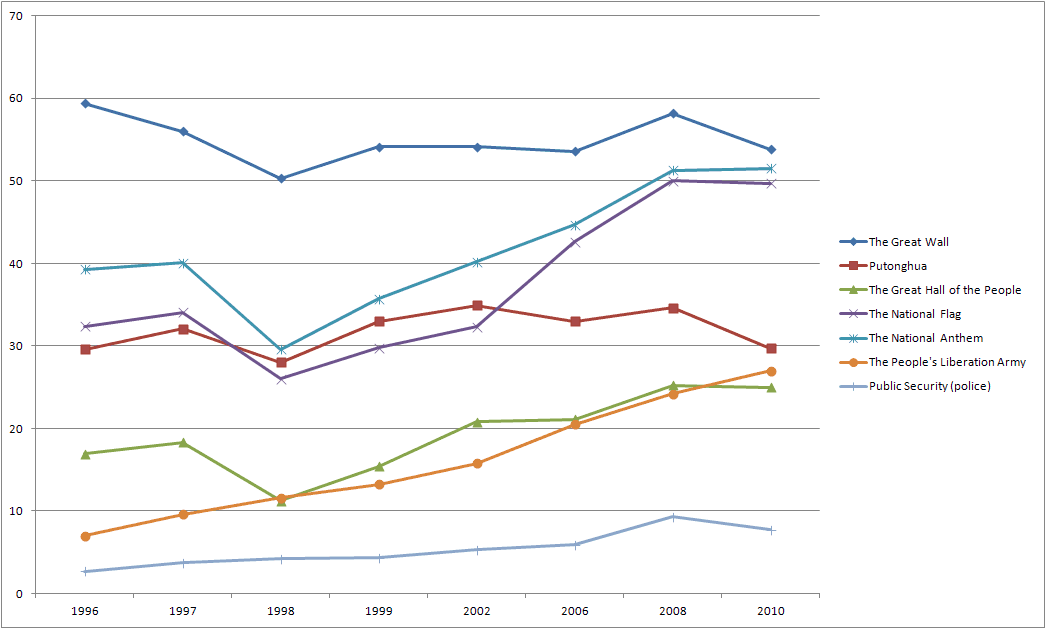
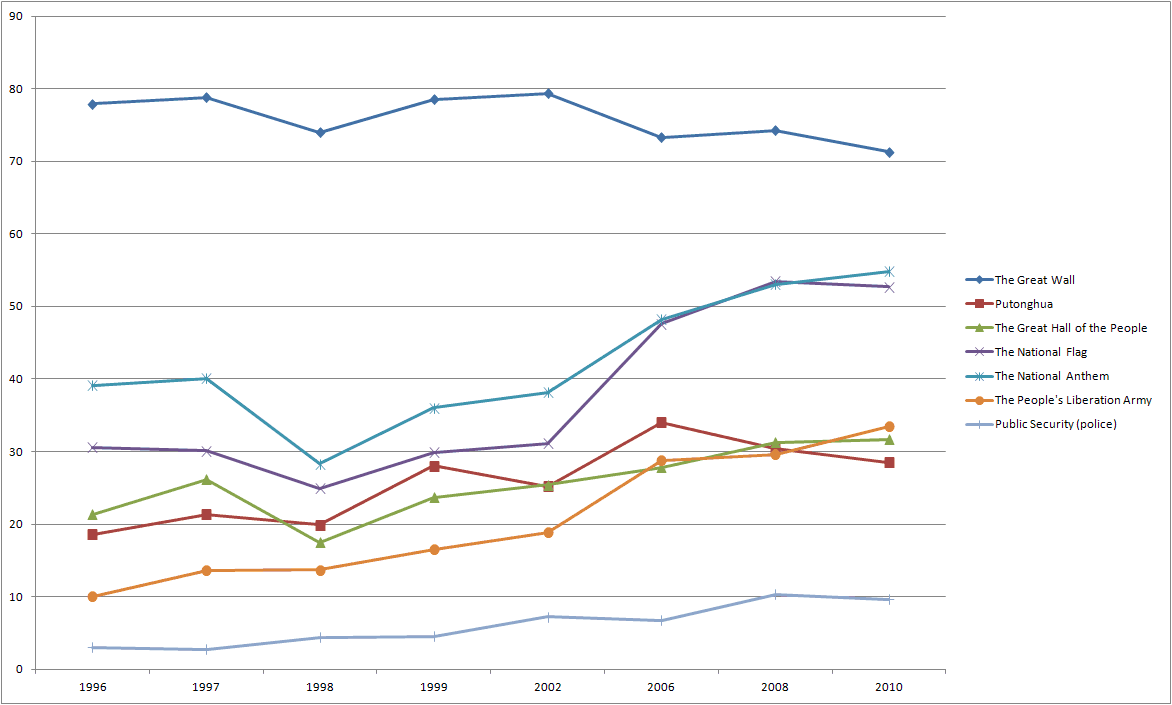
Although this focuses on the dialect vs. language debate, it covers much more than that. Those being surveyed were also asked questions such as:
The results of the study may also prove useful for those interested in the future of other languages of China and Taiwan, such as Taiwanese and Shanghainese.
Here are a couple of the many graphs found in the study.
HK Cant = Hong Kong Cantonese speakers
MCant = mainland Cantonese speakers
MPTH = mainland speakers of Mandarin (”Pǔtōnghuà“)


Posted by Pinyin Info on 11 Dec 2007 | Tagged as: Cantonese, Chinese, Chinese characters, Hong Kong, languages, literacy
Joel of Danwei has posted about an interesting calligraphy scroll presented to Hong Kong superstar Andy Lau.
The characters read “You Are No. 1!”
That’s not a translation: the Cantonese pronunciation of the characters 腰呀冧吧温! (”yiu a nam ba wan!”) approximates the English sentence.
I just love stuff like this.
Read in Mandarin this is just gibberish, especially the character 冧.
Read the whole post for details.
The technique also recalls the cover of Visible Speech, by John DeFrancis, which renders part of the Gettysburg Address phonetically in various scripts, some more closely than others (see the bottom line for Chinese characters with Mandarin pronunciations):

source: If you can read this, you’re Number One!, Danwei, December 6, 2007
Posted by Pinyin Info on 31 Oct 2007 | Tagged as: Cantonese, Chinese, Hanyu, Hong Kong, Mandarin, languages, teach Chinese
The Hong Kong government’s Standing Committee on Language Education and Research (”Scolar” — heh) yesterday launched a HK$200 million (US$25.8 million) campaign to help schools use Mandarin as the medium for instruction.
Half of the money will be used to hire extra teachers, with the other half used to bring in mainland teaching experts.
To qualify for this funding, schools must demonstrate competence in teaching “Chinese” in Mandarin and be ready to switch 40 percent of “Chinese language teaching” from Cantonese to Mandarin within three years. The scheme is expected to start at the beginning of the next academic year and last for more than three years.
Each year about 30 primary and 10 secondary schools will be added to the program.
Scolar Chairman Michael Tien Puk-sun said that his committee “has agreed that Putonghua [i.e., Mandarin] should be used as a medium of instruction for Chinese language subjects in the long term.”
This does not bode well for the future of Cantonese.
sources:
Posted by Pinyin Info on 08 Aug 2007 | Tagged as: Cantonese, China, Chinese, Hanyu, Hokkien, Hoklo, Mandarin, Minnan, Shanghai, Taiwanese, dialect, languages
This week’s news provides a good example of how petty China’s language police can be.
Workers in Shanghai’s metro service must often deal with Chinese who do not speak either Shanghainese or standard Mandarin, so they began to collect useful phrases so staff members could better understand and answer some questions. They focused on Cantonese, Hoklo (a.k.a. Minnan, Southern Fujianese, Taiwanese, etc.), Wenzhouhua (although this is generally classified as part of the same language that contains Shanghainese, it is largely incomprehensible to most people in Shanghai), Wuhanhua (although classified as a Mandarin dialect, it is far removed from standard Mandarin), and Changsha (a dialect of Hunanese). More than fifty metro employees are to study the phrases.
This caught the attention of Shanghai’s Spoken and Written Language Work Committee (Yǔyán Wénzì Gōngzuò Wěiyuánhuì). On Tuesday, Zhu Lei (朱蕾), a committee official, reported that her office had “contacted the Metro management …, stating that the program could violate the country’s language policy to promote the use of Putonghua [i.e., Mandarin].”
“The right way to solve communication barrier is to speak Putonghua,” she is quoted as saying.
sources:
Posted by Pinyin Info on 09 May 2007 | Tagged as: Beijing, Cantonese, China, Chinese, Chinese characters, Classical Chinese, English, Hanyu, Japan, John DeFrancis, Mandarin, Sino-Platonic Papers, Victor H. Mair, alphabet, computers, dialect, dictionary, languages, linguistics, literacy, pinyin, psycholinguistics, romanization, teach Chinese, writing systems
Sino-Platonic Papers has just released online its second compilation of book reviews. Here are the books discussed. (Note: The links below do not lead to the reviews but to other material. Use the link above.)
Invited Reviews
- William A. Boltz, “The Typological Analysis of the Chinese Script.” A review article of John DeFrancis, Visible Speech, the Diverse Oneness of Writing Systems.
- Paul Varley and Kumakura Isao, eds., Tea in Japan: Essays on the History of Chanoyu. Reviewed by William R. LaFleur .
- Vladimir N. Basilov, ed., Nomads of Eurasia. Reviewed by David A. Utz.
Reviews by the Editor
- “Philosophy and Language.” A review article of Françcois Jullien, Procès ou Création: Une introduction a la pensée des lettrés chinois.
Language and Linguistics
- W. South Coblin, A Handbook of Eastern Han Sound Glosses.
- Weldon South Coblin. A Sinologist’s Handlist of Sino-Tibetan Lexical Comparisons.
- ZHOU Zhenhe and YOU Rujie. Fangyan yu Zhongguo Wenhua [Topolects and Chinese Culture].
- CHOU Fa-kao. Papers in Chinese Linguistics and Epigraphy.
- ZENG Zifan. Guangzhouhua Putonghua Duibi Qutan [Interesting Parallels between Cantonese and Mandarin].
- Luciana Bressan. La Determinazione delle Norme Ortografiche del Pinyin.
- JIANG Shaoyu and XU Changhua, tr. Zhongguoyu Lishi Wenfa [A Historical Grammar of Modern Chinese] by OTA Tatsuo.
- McMahon, et al. Expository Writing in Chinese.
- P. C. T’ung and D. E. Pollard. Colloquial Chinese.
- Li Sijing, Hanyu “er” Yin Shih Yanjiu [Studies on the History of the "er" Sound in Sinitic].
- Maurice Coyaud, Les langues dans le monde chinois.
- Patricia Herbert and Anthony Milner, eds., South-East Asia: Languages and Literatures; A Select Guide.
- Andrew Large, The Artificial Language Movement.
- Wilhelm von Humboldt, On Language: The Diversity of Hunan Language-Structure and Its Influence on the Mental Development of Mankind.
- Vitaly Shevoroshkin, ed., Reconstructing Languages and Cultures.
- Jan Wind, et al., eds., Studies in Language Origins.
Short Notices
- A. Kondratov, Sounds and Signs.
- Jeremy Campbell, Grammatical Man: Information, Entropy, Language, and Life.
- Pitfalls of the Tetragraphic Script.
Lexicography and Lexicology
- MIN Jiaji, et al., comp., Hanyu Xinci Cidian [A Dictionary of New Sinitic Terms]
- LYU Caizhen, et al., comp., Xiandai Hanyu Nanci Cidian [A Dictionary of Difficult Terms in Modern Sinitic].
- Tom McArthur, Worlds of Reference: Lexicography, learning and language from the clay tablet to the computer.
A Bouquet of Pekingese Lexicons
- JIN Shoushen, comp., Beijinghua Yuhui [Pekingese Vocabulary].
- SONG Xiaocai and MA Xinhua, comp., Beijinghua Ciyu Lishi [Pekingese Expressions with Examples and Explanations] .
- SONG Xiaocai and MA Xinhua, comp., Beijinghua Yuci Huishi [Pekingese Words and Phrases with Explanations] .
- FU Min and GAO Aijun, comp., Beijinghua Ciyu (Dialectical Words and Phrases in Beijing).
A Bibliographical Trilogy
- Paul Fu-mien Yang, comp., Chinese Linguistics: A Selected and Classified Bibliography.
- Paul Fu-mien Yang, comp., Chinese Dialectology: A Selected and Classified Bibliography.
- Paul Fu-mien Yang, comp., Chinese Lexicology and Lexicography: A Selected and Classified Bibliography.
Orality and Literacy
- Jack Goody. The interface between the written and the oral.
- Jack Goody. The logic of writing and the organization of society.
- Deborah Tannen, ed., Spoken and Written Language: Exploring Orality and Literacy.
Society and Culture
- Scott Simmie and Bob Nixon, Tiananmen Square.
- Thomas H. C. Lee, Government Education and Examinations in Sung China.
- ZHANG Zhishan, tr. and ed., Zhongguo zhi Xing [Record of a Journey to China].
- LIN Wushu, Monijiao ji Qi Dongjian [Manichaeism and Its Eastward Expansion].
- E. N. Anderson, The Food of China.
- K. C. Chang, ed., Food in Chinese Culture: Anthropological and Historical Perspectives.
- Jacques Gemet, China and the Christian Impact: A Conflict of Cultures.
- D. E. Mungello, Curious Land: Jesuit Accommodation and the Origins of Sinology.
Short Notice
- Roben Jastrow, The Enchanted Loom: Mind in the Universe.
In Memoriam
Chang-chen HSU
August 6, 1957 - June 27, 1989
- Hsu Chang-chen, ed., and tr., Yin-tu hsien-tai hsiao-shuo hsüan [A Selection of Contemporary Indian Fiction].
- Hsu Chang-chen, T’o-fu tzu-huiyen-chiu (Mastering TOEFL Vocabulary).
- Hsu Chang-chen, Tsui-chung-yao-te i pai ke Ying-wen tzu-shou tzu-ken (100 English Prefixes and Word Roots).
- Hsu Chang-chen, Fa-wen tzu-hui chieh-koufen-hsi — tzu-shou yü tzu-ken (Les préfixes et les racines de la langue française).
- Hsu Chang-chen, comp. and tr., Hsi-yü yü Fo-chiao wen-shih lun-chi (Collection of Articles on Studies of Central Asia, India, and Buddhism).
This is SPP no. 14, from December 1989. The entire text is now online as a 7.3 MB PDF.
See my earlier post for the contents of the first SPP volume of reviews and a link to the full volume.