aborigines
Archived Posts from this Category
news and discussions related to romanization
Archived Posts from this Category
Posted by site admin on 30 Apr 2008 | Tagged as: Aborigine languages, Taiwan, Yami, aborigines, languages, linguistics
Language Documentation & Conservation, a refereed, open-access journal sponsored by the National Foreign Language Resource Center and published online by the University of Hawai‘i Press, has released its first online book: Documenting and Revitalizing Austronesian Languages, edited by D. Victoria Rau and Margaret Florey.
Half of the chapters in the new book (ISBN 978-0-8248-3309-1) focus specifically on Austronesian languages of Taiwan. I have indicated those with bold text below.
Contents:
Introduction: documenting and revitalizing Austronesian languages
I. International capacity building initiatives
- The language documentation and conservation initiative at the University of Hawai’i at Manoa
- Training for language documentation: Experiences at the School of Oriental and African Studies
- SIL International and endangered Austronesian languages
II. Documentation and revitalization activities
- Local autonomy, local capacity building and support for minority languages: Field experiences from Indonesia
- Documenting and revitalizing Kavalan
- E-learning in endangered language documentation and revitalization
- Indigenous language-informed participatory policy in Taiwan: A socio-political perspective
- Teaching and learning an endangered Austronesian language in Taiwan
III. Computational methods and tools for language documentation
- WeSay, a tool for engaging communities in dictionary building
- On designing the Formosan multimedia word dictionaries by a participatory process
- Annotating texts for language documentation with Discourse Profiler’s metatagging system
There have also been two issues of the journal issued to date, though neither of these has anything specific about languages spoken in Taiwan.
This is indeed a promising beginning. I look forward to more such titles from the journal.
Posted by site admin on 12 Nov 2007 | Tagged as: Aborigine languages, Chinese, Mandarin, Tainan, aborigines, languages, romanization, signage, writing systems
On Sunday President Chen Shui-bian spoke at a ceremony marking the opening of Tackalan Boulevard, which connects the Southern Taiwan Science Park to the Sun Yat-sen Freeway. This name differs from most Taiwan road names in several ways:
Rather, it is from a language spoken in Taiwan hundreds of years ago.
Chen said giving the major road an Aboriginal name was inspiring and symbolic of the trailblazing spirit of the Aboriginal tribes known as the Pingpu.
Authorities chose the name “Tackalan” because the new road crosses Anting Township (安定), which Dutch colonizers called by the Aboriginal name.
Note: “Anting” is bastardized Wade-Giles. The proper spelling — in Hanyu Pinyin, as well as in all of Taiwan’s official romanization systems for the last twenty years is Anding (Āndìng.
Centuries ago, Tackalan was a thriving river-fishing location populated by Aboriginals. It gradually grew into a farming village as the river became congested with silt….
Another of the three major roads [around the science park], Baccloangh Boulevard, is open to traffic, while the third, Siraya East Road — named after a Pingpu tribe — is under construction.
Here are the names as well as Chinese characters given in news reports:
For the spellings in romanization I’m having to take the CNA story’s word for it, which is often not a good idea.
I do not know what the street signs themselves look like. The new guidelines from the Ministry of the Interior, however, do not make me confident that the spellings will follow those of the original languages. (They give, for example “Kaidagelan Boulevard” — a romanization of the Mandarinized 凱達格蘭大道 / Kǎidágélán Dàdào — rather than the proper “Ketagalan Boulevard.”) Thus, the signs may well give Mandarinized forms in Tongyong Pinyin (i.e., not Tackalan but Jhijianong, not Baccloangh but Mujialiou, and not Siraya but Silaya). I’d greatly appreciate pictures, in case any readers are ever in that area.
sources:
Posted by site admin on 07 Aug 2007 | Tagged as: Aborigine languages, Chinese characters, Taiwan, aborigines, languages, romanization
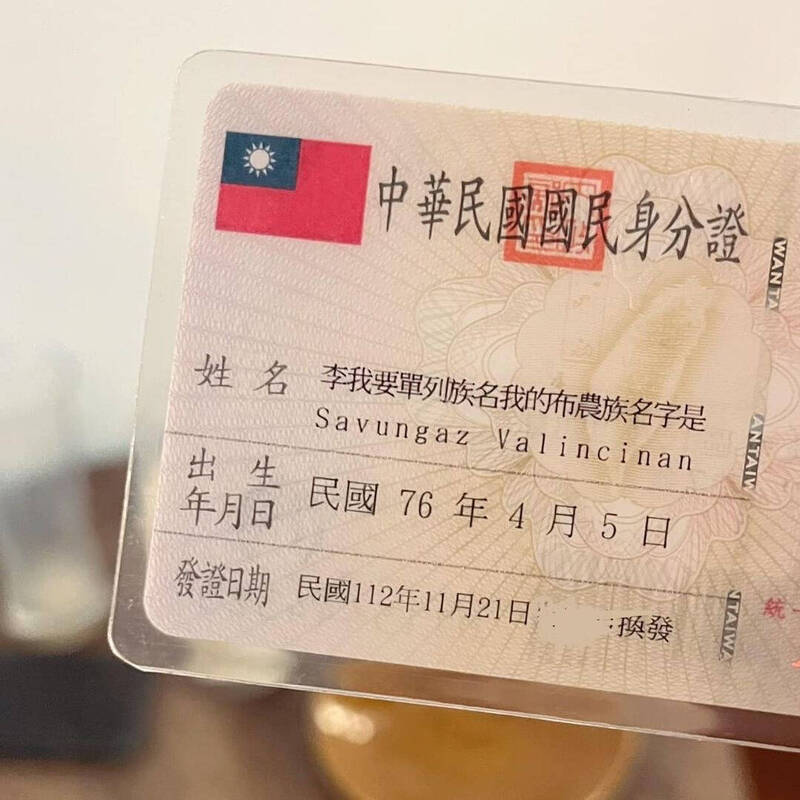
As of January 2007, only 6,613 of Taiwan’s 470,000 Aborigines had officially registered to use their original names (i.e., those in the languages of their tribes, rather than the Sinicized forms that were forced upon Taiwan’s aboriginal population until relatively recently). This low rate, combined with the realization that the procedure was inconvenient for those who had moved away from their home towns, prompted the government to simplify the registration procedure by allowing people to register their names at any household registration office, not just the one for their officially listed household. This has been effect since April 1.
Names may be registered in a variety of forms: with Chinese characters, romanization, or a combination of both.
Yuánzhùmín shēnqǐng huífù chuántǒng míngzi de shǒuxù, jírì qǐ kěyǐ gèng fāngbiàn, cóng jīnnián 4 yuè 1 rì qǐ, bùzài yìngxìng guīdìng zhǐnéng huídào hùjí de bànlǐ gēngmíng shǒuxù, chūwài qiúxué jiùyè de yuánzhùmín zài rènhé yī ge hùzhèng shìwùsuǒ dōu kěyǐ bànlǐ gēngmíng.
Gēnjù Yuánmínhuì [Yuánzhùmín Zú Wěiyuánhuì] de tǒngjì: zhì 96 [i.e., 2007] nián 1 yuè zhǐ, yǐjing huífù chuántǒng míngzi de yuánzhùmín jǐnyǒu 6,613 rén, yǔ yuánzhùmín zǒngrénkǒu shù 47 wàn duō rén xiāngjiào, bùdào bǎi fēnzhī yīdiǎn wǔ, bǐlì fēicháng dī. Hěn yǒu kěnéng shì wèile jiùyè, jiùxué huò qítā yuányīn, líxiāngbèijǐng dào dūhuìqū dǎ pīn de yuánzhùmín yùláiyù duō, ér jiù guīdìng shēnqǐng huífù chuántǒng míngzi, yīdìng yào huídào hùjí suǒzàidì de hùzhèng shìwùsuǒ bànlǐ, ràng bùshǎo yuánzhùmín dǎ tuìtánggǔ. Xīn guīdìng xiūzhèng hòu, yuánzhùmín shēnqǐng gēngmíng zài gèng de dōu kěyǐ bànlǐ.
Gēnjù xiūzhèng xìngmíng tiáolì guīdìng, mùqián yuánzhùmín de chuántǒng míngzi yě kěyǐ yǒu sān zhǒng dēngjì fāngshì:
- chuántǒng míngzi yǐ Hànzì dēngjì, lìrú Xíngzhèngyuàn Yuánmínhuì zhǔrèn wěiyuán de míngzi: 瓦歷斯‧貝林 [Wǎlìsī Bèilín]
- chuántǒng míngzi yǐ Hànzì dēngjì, bìngliè chuántǒng míngzi zhī Luómǎ pīnyīn, lìrú Xíngzhèngyuàn Yuánmínhuì zhèngwù fùzhǔrèn wěiyuán de míngzi: 夷將‧拔路兒 Icyang Parod [Webmaster's note: 夷將‧拔路兒 = Yíjiāng Bálùr in Hanyu Pinyin]
- Hànrén xìngmíng bìngliè chuántǒng míngzi zhī Luómǎ pīnyīn, lìrú Xíngzhèngyuàn Yuánmínhuì chángwù fùzhǔrèn wěiyuán de míngzi: 鄭天財 [Zhèng Tiāncái] Sra Kacaw
source: Yuánzhùmín shēnqǐng huífù chuántǒng míngzi jírì qǐ gè dì kěyǐ shēnbàn (原住民申請回復傳統名字即日起各地可申辦), Chinatimes, April 5, 2007
Posted by site admin on 06 Aug 2007 | Tagged as: Aborigine languages, Chinese, Gaoxiong, Hanyu, Kaohsiung, Mandarin, Taiwan, aborigines, languages
In 1957, Maya, a small town in Taiwan’s Gaoxiong (Kaohsiung) County, was assigned a new name: Sanmin Township (Sānmín Xiāng, 三民鄉), after Sun Yat-sen’s Sānmínzhǔyì (三民主義 / Three Principles of the People). Although the residents of Maya — then, as now, predominantly members of the Bunun tribe — were likely not in favor of this change, Taiwan was then under an authoritarian regime with an assimilationist policy, so there’s little to nothing they could have done.
During KMT rule, when the change to Sanmin was made, a major point of government policy was stressing the Chineseness of Taiwan — even if, such as in this case, the links had to be manufactured. The Kuomintang (Guómíndǎng), after all, was and still officially is the Chinese Nationalist Party, as the Taipei Times likes to remind its readers.
Fortunately, Taiwan no longer has the same political situation as 50 years ago. Some activists are now trying to get the name of the town changed back to Maya. President Chen Shui-bian recently expressed his support for this, which is not surprising considering that the current administration prefers to stress Taiwan’s historical links with just about anyplace but China. In recent years Taiwan’s ties with Austronesia have been receiving increasing attention.
I’m still trying to find out if “Maya” represents the proper spelling or if it’s merely a romanization of a Mandarinized form of the Bunun name. In Chinese characters this place is written 瑪雅鄉 (Mǎyǎ Xiāng / Maya Township). The characters 瑪雅 are also used for the Maya people of southern Mexico and northern Central America.
sources:
further reading: Pinyin News on aborigine names
Posted by site admin on 12 Apr 2007 | Tagged as: Aborigine languages, Taiwan, aborigines, dictionary, languages, linguistics
What is reportedly Taiwan’s first dictionary of language of the Truku (Tàilǔgé 太魯閣) tribe was released yesterday. The Truku are also known as the Sediq. They live mainly in Xiulin, Hualian County, site of the Taroko Gorge, one of Taiwan’s most scenic areas, which takes its name from the tribe (or perhaps vice versa).
The work is based in part on a lexicon compiled in the 1950s, when a pastor at a local church began to translate the Bible into Truku. Six pastors at a local church have been working on the dictionary since 1999.
Words in Truku are created by adding prefix, postfix and midfix to root words. A root word can develop into as many as 40 words, Jiru [Haruq, one of the authors of the dictionary,] explained.
Midfix is added into the middle of a root word by separating the root word.
Taking an example from the dictionary, hakawis a root word meaning “bridge” in Truku, hmhakaw becomes “bridge-building”, mhakaw is a bridge builder, shakaw is the reason to build a bridge and hkagan is the location where the bridge is built.
“Verb tenses and different parts of speech are also constructed by adding prefixes, postfixes or midfixes to a rood word,” Iyuq [Ciyang, another of the authors of the dictionary,] said.
Until recently, the Truku were seen as being part of the Atayal tribe.
sources:
Posted by site admin on 17 Jan 2007 | Tagged as: Aborigine languages, Taiwan, aborigines
Taiwan’s Executive Yuan will ratify the Sakizaya (撒奇萊雅 / Sāqíláiyǎ) as an indigenous tribe on January 17, raising the number of officially recognized tribes here to thirteen.
During Japan’s rule over Taiwan (1895-1945), Japanese ethnologists classified the Sakizaya as members of the Ami. Later scholars, however, have distinguished the two groups as a separate because of linguistic differences and the Sakizaya’s sense of their own identity.
Representatives of the Sakizaya applied in 2004 with the Council of Indigenous Peoples for official recognition.
The Sakizaya live mainly in Hualian City and Hualian County’s townships of Shoufeng, Ruisui, and Fengbin.
I hope to find more information about the tribe’s language, as well as the origins of the tribe’s name.
sources:
Posted by site admin on 12 Jan 2007 | Tagged as: Aborigine languages, Taiwan, aborigines, languages
To help ward off the extinction of the languages of Taiwan’s tribes, the Council of Indigenous Peoples is establishing examinations in these languages. Those young people who pass will be given a 10 percent increase on their exam scores toward entry into high schools and universities. This would be on top of the 25 percent increase aboriginal students already receive automatically.
The first of the examinations will be held in March. Each test will have two parts: listening and speaking.
The council hopes this will encourage young people to retain the languages of their ancestors.
Students can prepare for the tests by studying books issued by the Ministry of Education. Although the ministry’s books have nine levels, tests will be based on only the first three levels.
sources:
Posted by site admin on 11 Jan 2007 | Tagged as: Aborigine languages, Chinese, Chinese characters, Taiwan, aborigines, romanization
Taiwan’s Cabinet-level Council of Indigenous Peoples (formerly the Council of Aboriginal Affairs) has been encouraging members of Taiwan’s tribes to officially register themselves under their “original names,” which are recorded in romanization. But the total of such registrations reached only about half of this year’s goal of 10,000, with the majority of those having been registered in earlier years.
source: