How to learn real Mandarin: an anecdote

The following is a guest post by Professor Victor H. Mair of the University of Pennsylvania’s Department of East Asian Languages and Civilizations.

The personal names used in the original correspondence have been changed to generational designations.

Compared to the Hànzì-centric pedagogical approach which forces little children to memorize extremely difficult and complicated characters like 老鼠 and 蝴蝶 instead of teaching them lǎoshǔ and húdié, today I received some more hopeful and sane news.

A friend of mine is teaching her grandson Mandarin. The way she is doing it is to write out the Xī yóu jì (Journey to the West) in a simple báihuà paraphrase using Pinyin only (with glosses in English for new vocabulary). My friend is a first-generation immigrant to America, and her daughter married a German who was studying in the United States, so that makes the grandson third-generation Chinese-American/German.

The other day, the grandson asked his mom out of the blue: “What’s the difference between shíjiān, shídài, and shífèn?” My friend, the grandmother, explained to me that all of these terms were in the Pinyin text that she had prepared for her grandson, and that she had glossed them as “time” or “period.” She said that the boy’s mother was very pleased, and she was tickled too, because the boy had discerned the common element shí by himself. As my friend (the grandmother) put it, “He spends very little time on Chinese, so we were pleasantly surprised.”

Hearing this account from my friend, I wrote to her: “Thank you so much for the TRULY WONDERFUL story you wrote about your grandson. This is how to learn real Chinese!!!! And you are being a real Chinese teacher to teach your grandson this way. And I’m also happy that your daughter appreciates what you and her son are doing together. Tell your grandson I’m really impressed at the intelligence of his question.”
Hoklo dictionaries: a list

The newly redesigned Tailingua has just issued a useful list of dictionaries of the Taiwanese language and related dialects (PDF).

Here’s a random sample:

  • Dyer, Samuel 萊撒母耳 (1838 ). A Vocabulary of the Hok-keen Dialect as Spoken in the County of Tsheang- Tshew [漳州音字典]. Malacca: Anglo-Chinese College Press.
  • Embree, Bernard L.M. 晏寶理 (1973). A Dictionary of Southern Min [閩南語英語辭典]. Kowloon: Hong Kong Language Institute.
  • Fùxīng wénhuà shìyèshè 復興文化事業社 (2004). Táiwān mǔyǔ yīnbiāo zìdiǎn 臺灣母語音標字典 [Taiwanese mother tongue pronunciation dictionary]. Táinán: Fùxīng Wénhuà Shìyèshè 復興文化 事業社.
  • Hare, G.T. (1904). The Hokkien Vernacular [福建白話英文字典]. Kuala Lumpur: Straits Settlements and Selangor Government Printing Offices.
  • Hóng Guóliáng 洪國良 (2004). Héluòyǔ yīnzì duìzhào diǎn 河洛語音字對照典 [Comparative dictionary of Ho-lo pronunciation]. Gāoxióng: Fùwén 復文.
  • Hóng Hóngyuán 洪宏元 (2009). Xuéshēng Tái–Huá shuāngyǔ huóyòng cídiǎn 學生台華雙語活用辭典 [Bilingual everyday Taiwanese–Mandarin dictionary for students]. Táiběi: Wǔ Nán Túshū Chūbǎn Yǒuxiàn Gōngsī 五南圖書出版有限公司.
  • Hú Xīnlín 胡鑫麟 (1994). Shíyòng Táiyǔ xiǎo cídiǎn 實用臺語小辭典 [Practical pocket Taiwanese dictionary]. Táiběi: Zìlì Wǎnbào Chūbǎnbù 自立晚報出版部.

China and U.S. study abroad programs: update

In one of my posts about a year ago, China and U.S. study abroad programs (Pinyin News, Nov. 23, 2008), I noted that China had become the fifth most popular destination for U.S. students in study abroad programs.

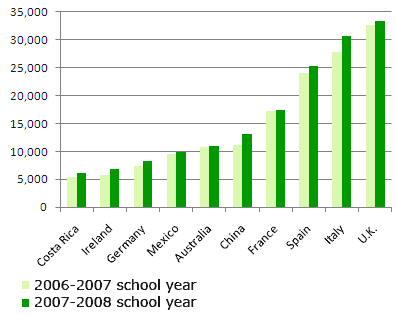
More recent data show that the China has remained in fifth place. In fact, the order in the top ten list has not changed, though the figures for each of the countries have increased.

Top 10 destinations for study abroad by U.S. students in the 2006-07 and 2007-08 school years
China shown as the fifth most popular destination for study abroad. The top destination is the U.K., followed by Italy, Spain, and France. See the link to my source material for the actual numbers.

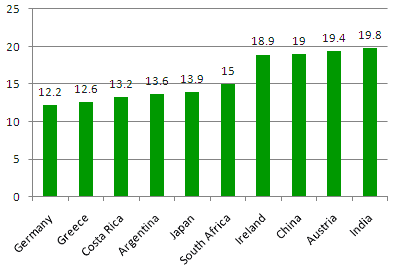
Growth for China as a destination, however, remained strong, at 19.0 percent, while study abroad as a whole increased 8.5 percent. Top growth, however, belonged to India, followed by Austria, then China, and Ireland. If China continues to grow at such rates as a destination, it could knock France out of fourth place in a few years, which would be a dramatic development.

10 highest growth rates for destinations for study abroad by U.S. students (comparing the 2007-08 school year with the 2006-07 school year)

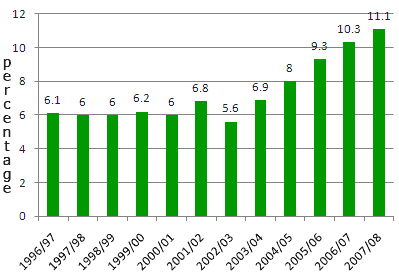
China now accounts for 5 percent of U.S. study abroad, which has helped Asia’s overall growth as a destination region.

Percent of study abroad performed in Asia, 1996-2007
chart showing percentage of study abroad in Asia flat at about 6% from 1996-2000, with growth increasing since 2003 to the present 11.1% for the 2007-08 school year

Some predictions for the next installment:

  • Economic woes are probably going to reduce the rate of study abroad, though that may benefit China, relatively speaking, as students opt for it over more expensive destinations like the U.K. and France.
  • Terrorism could affect India’s numbers, though I expect them to continue to increase dramatically over the long term.
  • And should China reevaluate its currency, that could slow its growth as a destination for U.S. students.

source: Open Doors Report 2009