Chinese calligraphy: ‘in memoryam’

Taiwan’s Ministry of Education has the custom of sending memorial calligraphy banners to the families of recently deceased scholars. This is roughly the equivalent of sending flowers to someone’s funeral. The banners are meant to be displayed at the memorial service. They’re usually sent under the name of the minister, who would almost never review them personally, much less write them himself.

Even so, it was an embarrassment all around when someone noticed that a scroll from the ministry that should have had the stock polite phrase 音容宛在 (yīnróngwǎnzài — “the voice and face [of the deceased] still seem here”) instead had 音容苑在 (yīn-róng yuàn zài — roughly “the voice and face [of the deceased] are in the park”).

Compare: wǎn 宛 苑 yuàn.

This wasn’t a slip in just one scroll. The exact same text was used in some one hundred such scrolls, about seven of which had already been sent out.

While I enjoy Schadenfreude as much as the next person and more than occasionally rail against government sloppiness, which this is certainly an example of, I’m not trying to play “gotcha” here. What interests me particularly about the story is what it says about the state of calligraphy. (For this entry, I’ll not bother to go into detail about how many people would be uncertain of recognizing 宛.)

It turns out that the person who did the calligraphy isn’t an artist but a security guard at the ministry. While that might sound like proof that the ancient art of calligraphy extends through all levels of society, the more accurate conclusion is likely that more or less anyone was able to get the job — he’s obviously not an expert, or he wouldn’t have made the same mistake one hundred times — because relatively few people really care much about calligraphy anymore. Certainly the Ministry of Education could have found a qualified calligrapher if it looked outside its own personnel; but it wouldn’t want to spend the money required and preferred to find someone in house. (I worked for years at a Taiwan government ministry and have seen for myself how things operate.) The people who do such tasks are almost never young. Chinese calligraphy has become a specialist pursuit, and a diminishing one at that, as calligraphers and traditionalists often note with sadness and occasionally alarm.

It may surprise some of my readers to learn that I actually love Chinese calligraphy. (For example, I’m in awe of Huai-su’s “Autobiography.”) I’ve got a large shufa in my living room. Quite a number of people have remarked on how well done it is; not one of them, however, has been able to read it. So let’s not confuse an art form — which, lest we forget, has a fine tradition, too, in plenty of places that use alphabetic scripts — with a good idea for a dominant script for a language.

sources:

romanization on Taiwan ID cards hits a snag

The addition of some Aborigine’s original names to their new national ID cards has been encountering a few problems. I didn’t think twenty characters would be enough space for some names, and I was right. The letters that won’t fit within the twenty spaces are having to be written in by hand. What’s worse, it looks like no one has bothered to give local offices any romanization guidelines for the various langauges of Taiwan’s tribes.

zuì cháng fāshēng de wèntí duō shì Luómǎ pīnyīn de yīnyì kùnrǎo jí wénzì guò cháng, yǒuxiē yuánzhùmín xìngmíng shízài hěn nán zhǎochū fāyīn xiāngjìn de Luómǎ pīnyīn.

My guess would be that lots of people are making up the romanization as they go along. Aargh!

source: Yuánzhùmín jí mínzhòng shēnqǐng huīfù míngzi huàn zhèng — wénzì guò cháng shì kùnrǎo (原住民籍民眾申請復名換證 文字過長是困擾), CNA, February 20, 2006

apostrophes in Hanyu Pinyin

To help answer questions raised by earlier posts, I’ve added a page to my site on apostrophes in Hanyu Pinyin. It begins with the basics.

Here’s all you really need to know about when and where to place apostrophes when writing Mandarin Chinese in Hanyu Pinyin:

Put an apostrophe before any syllable that begins with a, e, or o, unless that syllable comes at the beginning of a word or immediately follows a hyphen or other dash.

Please note there is no “if there is ambiguity” in the rule above.

one book, two languages, three systems

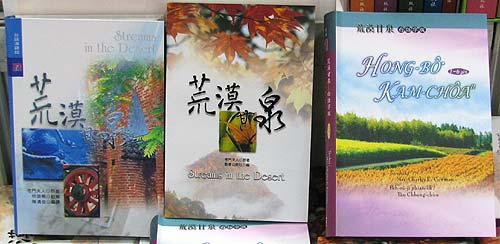
Another discovery at the recent book show was that the Taiwan Church Press has issued three editions of Streams in the Desert: one in a Mandarin translation in Chinese characters, one in a Taiwanese translation in a mixed orthography (mainly Chinese characters, with some romanization), and one in Taiwanese completely in romanization.

Streams in the Desert, a book of devotionals, was written in English by Lettie Cowman, better known as “Mrs. Charles E. Cowman.” Her husband was the founder of the Oriental Missionary Society, which today goes by the name of OMS International. The Cowmans did missionary work in Japan in the early twentieth century.

A representative of the press told me that for every ten copies of the Mandarin version, the company sells two or three of the mixed-script Taiwanese version and one copy of the fully romanized Taiwanese edition.

The fully romanized version sells mainly to people who want to learn Taiwanese rather than those who already speak it, he told me. Its recent publication was an experiment, he added. But I forgot to ask the obvious: Does the press consider the experiment a success?

covers of three editions of 'Streams in the Desert,' as translated into Mandarin and Taiwanese
(from left to right: mixed-script Taiwanese, Mandarin in Chinese characters, and fully romanized Taiwanese)

home of romanization pioneer Lu Zhuangzhang found

The birthplace of Lu Zhuangzhang (盧戇章/卢戆章) (1854-1928), a pioneering writing reformer, has recently been identified in Xiamen, China.

Locals said they knew the house was Lu Zhuangzhang’s ancestral home but didn’t know he was famous for his romanization work.

Lu was “the first Chinese to propose a system of spelling for Sinitic languages,” Victor H. Mair notes in his essay Sound and Meaning in the History of Characters: Views of China’s Earliest Script Reformers, which contains additional information about Lu.

Lu was from Fujian and, as a boy, he grew up in Amoy (Xiamen) where romanized writing of the local language was used widely after it was introduced by Christian missionaries. (A romanized Chinese translation of the Bible had already been made in 1852.) At age 21, Lu moved to Singapore where he studied English. After he returned to Amoy four years later, he assisted an English missionary in compiling a Chinese-English dictionary.

Lu’s Yimu liaoran chujie (First Steps in Being Able to Understand at a Glance), published in Amoy in 1892, was the first book written by a Chinese which presented a potentially workable system of spelling for a Sinitic language. His script was based on the Roman alphabet with some modifications. Among other improvements over the sinographs was linking up syllables into words and separating them with spaces. Lu’s system was designed specifically for the Amoy topolect, but he claimed that his system of spelling could also be adapted for the other languages of China. Although he believed that all of the local languages should be written out with phonetic scripts, Lu advocated that the speech of Nanjing be adopted as the standard for the whole nation, as it was when Matteo Ricci had come to China three centuries earlier. Altogether, Lu worked for 40 years to bring an efficient system of spelling to China. He is now viewed by Chinese language workers as the father of script reform.

Local authorities hope to protect the home as a cultural monument.

Tóng’ān fāxiàn Lú Zhuàngzhāng gùjū

Wǒguó “yǔwén xiàndàihuà” de xiānqū, xiàndài Hànyǔ pīnyīn de fāmíng zhě Lú Zhuàngzhāng, qí gùjū jìnrì zài Xiàmén Tóng’ān bèi fāxiàn, wénwù bǎohù zhuānjiā hūyù bǎohù gāi gùjū.

Lú Zhuàngzhāng de gùjū zài Xiàmén Tóng’ān gǔ zhuāng cūn, shì yī zhuàng yǒu bǎi-yú nián lìshǐ de Mǐnnán hóngzhuān gǔ mínjū, Lú Zhuàngzhāng jiù chūshēng zài zhèlǐ.

Cūnmín gàosu jìzhě, tāmen zhīdao zhè shì Lú Zhuàngzhāng jiā de “gǔ cuò”, dànshì bùzhīdào tā shì “yǔwén xiàndàihuà de xiānqū”, yějiù méi rén qù kèyì bǎohù zhè “gǔ cuò”, yīnwèi yīzhí dōu yǒurén jūzhù, hái méi wánquán bèi huǐhuài.

Huòxī Lú Zhuàngzhāng gùjū yīrán bǎocún zài Tóng’ān, Xiàmén Shì wénhuàjú wénwù chù chùzhǎng Chén Zhìmíng biǎoshì, zhēngqǔ ràng Tóng’ān qū wén guǎn bàn jiāng qí dìngwéi qū jí wénwù bǎohù dānwèi.

Jù liǎojiě, Lú Zhuàngzhāng shēngyú Qīngcháo xián fēng sì nián (1854 nián), shì Xiàmén Tóng’ānrén. Zài chuàngzhì pīnyīn fāng’àn, tuīguǎng jīng zhāng guānhuà (jí Pǔtōnghuà), tuīxíng báihuà kǒuyǔ, cǎiyòng héngpái héngxiě, tíchàng xīnshì biāodiǎn, shǐyòng jiǎntǐ súzì děng fāngmiàn, Lú Zhuàngzhāng zài guónèi kāile xiānhé.

source: Tóng’ān fāxiàn Lú Zhuàngzhāng gùjū, Dōngnán Kuàibào, February 15, 2006

crossword puzzles in Taiwanese

logo of the Presbyterian Church in Taiwan newletter, 1926

At the display for the Taiwan Church Press at the Taipei International Book Exhibition I came across a number of interesting works. The press has issued a 70-volume set of the collected newsletters of the Presbyterian Church of Taiwan. (University and research libraries, take note! So far no sets — NT$150,000 (US$4,600) each — have been sold to America or Europe.) The Presbyterian Church has long been an advocate of the rights of the people of Taiwan to speak Taiwanese without oppression, write in Taiwanese (including in romanization), and enjoy other political and human rights.

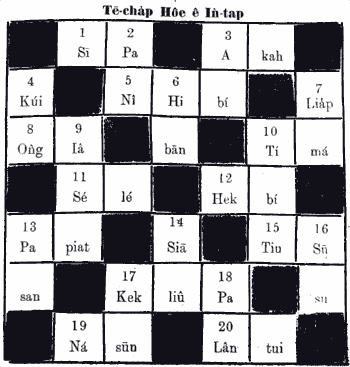
The newsletter, which dates back well into the nineteenth century, was written in romanized Taiwanese until 1969, when the KMT forced a change to Mandarin in Chinese characters. While flipping through a volume of the newsletters from the 1920s, I was startled to see that crossword puzzles in Taiwanese were a regular feature. (Click the thumbnail for a larger image.)

click for fullsize image of crossword puzzle in Taiwanese

It’s one thing to have read of the novels, poems, religious material, and technical manuals written in Taiwanese, it’s another to see something so human and familiar leap out from the page. This really helped bring home for me how much has been lost, especially in terms of opportunities, because of the suppression of romanized Taiwanese, first by the Japanese and then by the KMT.

Interestingly, if you look at the answers below, you’ll see that each of the boxes is meant to be filled in with not an individual letter but with syllabic units.

completed crossword puzzle in Taiwanese, from 1926

I’ve tried my hand at creating some crosswords in Mandarin using Hanyu Pinyin, but in individual-letter, not syllabic style. This is a little tricky. In English, all letters of the alphabet can appear at the beginning, in the middle, or at the end of a word. That’s not so in Mandarin as written in Pinyin. The letters i and u, for example, never come at the beginning of a word. And no word ends with anything other than a, e, i, o, u, g, n, or r. (I’ll finish some of those crosswords one of these days, Gus!)

It would be easier to make a crossword puzzle using bastardized Wade-Giles because that has fewer letters but also more finals. But of course not as many people would be interested in solving it, me included.

For even more on the issue of the romanization of Taiwanese, see the Taiwan section of De-Sinification.

Wang Xuan, innovator in Chinese-character technology, dies at 69

Wáng Xuǎn (王选), an important figure in technology related to the printing of Chinese characters with computers, has died at the age of 69.

In 2001 he was awarded the Supreme Scientific and Technological Award, China’s highest award for achievement in the field of science.

sources: