PRC legislator calls for compulsory minority language education

A member of the Standing Committee of the PRC’s National People’s Congress has called for members of China’s ethnic minorities to be educated in not only Mandarin but also in their native languages.

“Minority children today are reluctant to learn their own ethnic languages, and if the trend continues, these languages will disappear,” said Zhang Meilan, a member of the Hani minority group. Zhang made her comments on Sunday in an address to fellow lawmakers on the draft amendment to the Compulsory Education Law, which is in its final hearing.

Zhang also made the suggestion before the amendment was submitted to the legislature, but her proposal was omitted from the draft.

On Sunday, Zhang urged the legislature again to include an article in the amendment to make bilingual education compulsory for minority children in the nine-year free education from elementary school to junior high.

The legislature is expected to vote on the draft amendment on Thursday….

Zhang said that if her suggestion was accepted, the Ministry of Education and the Ethnic Affairs Committee should invest in bilingual education, providing a fund for minority language preservation.

Unfortunately, this will probably not be accepted. And even if it does pass, it will probably never receive much more than lip service.

source: Chinese lawmaker calls for compulsory minority language education, Xinhua, June 26, 2006

‘furiganified’

No-sword’s post on this is already brief, so I won’t shorten it here other than to note that sentences like “The furigana undermine the kanji at the most fundamental level, but the overall meaning of the poster remains unchanged” are the sort of thing that really make my day.

Just go read the whole post, which discusses something at the intriguingly titled Moji no ura-d?ri (which Matt translates freely as “The Back Streets of Orthography”).

Taiwanese lit program to award first doctorate

The Taiwanese literature program at National Chengkung University will soon be graduating its first doctoral student.

Chen Long-ting’s dissertation on the oral literature of Taiwanese puppet shows has already been accepted.

As a child, Chen loved to go watch puppet shows with his grandmother. In fact, this love was so strong that Chen gave up university studies in Chinese medicine to transfer to the department of drama at Chinese Culture University. Being constantly besieged with questions about “What is Taiwanese culture, anyway?” from foreigners, and discovering that there were precious few Taiwanese who could answer the question, he felt bad, and when choosing a specialty for his MA degree, began to delve into the folk songs that underpin Taiwanese culture. He went out into villages and towns to seek out artists, and did a field survey. When looking into the nature of puppetry and the cultural framework supporting it, Chen discovered a vital vein of primitive literature….

Chen’s dissertation looks at the oral literature in Taiwanese puppet shows. He began from the perspective of research into literature in the Minnan dialect. In an attempt to find an alternate route to investigate folk literature and oral and sung traditions in Taiwanese society, Chen looked primarily at the oral scripts of puppeteers. Chen invested a great deal of time and energy going out into the countryside to cultivate relationships with puppet artists and gather records, tape recordings and DVDs of early Taiwanese puppet theatre.

sources:

additional reading:

Taichung/Taizhong busstop names

Dan of Jidanni.org has come up with a list of Taizhong’s busstops in the mixed style of Hanyu Pinyin and English that has become standard in Taiwan and is becoming so in China.

I hear that this list may actually be implemented! If so, that would be much to Taizhong’s credit, as local governments elsewhere in Taiwan are often not so responsive.

Here are the lists:

Good work, Dan!

Just out of curiousity, I removed the English and numerals from the list and then compared how it would be written in Hanyu Pinyin (the international standard) vs. Tongyong Pinyin (Taiwan’s international embarassment). This revealed that 337 of 633 entries would be written differently in Hanyu Pinyin and Tongyong Pinyin, giving a difference rate of 53.2 percent.

Curse of the chaos crisis?

Professor Victor H. Mair, whose piece on the character-related myth that crisis = danger + opportunity is one of the most popular readings here on Pinyin Info, sent in the following on a variation he has encountered:

Amazing!!! The Chinese are made to have a saying for **every** silly idea that anybody ever dreamed up. As if the “crisis = danger + opportunity” one were not bad enough, people are now compounding the problem by tacking on “chaos”!

The second item is even more unreal. From bad to worse, compounding of compounding.

California congressman Jim Costa speaking:

“So, the fact is, is that. . . . I mean, in crisis — what are the two Chinese symbols for the word “crisis”? One symbolizes in the Chinese alphabet[!!] “chaos,” and the other one reflects . . . . or defines “opportunity.” And so, through crisis and chaos . . . . or through chaos and opportunity you have a crisis. [VHM: THIS IS ***UNREAL***.] I mean, it’s unfortunate during this budget time. During the last three budget recessionary cycles that we lived with, I tried to — of course, I was one of the leaders at the time, in ’91 and ’92 — to get the folks to use this as an opportunity to look at taking a step back and to see how California, how much of our budget was now on autopilot….” (source)

UNBELIEVABLE!!!!!!!!!! And now they even invent an improbable, trisyllabic gloss/pseudoword: w?izh?ngj? (“incipient moment in the midst of danger,” which the exegetically-minded coiner obviously wanted to interpret as “*opportunity in the midst of danger”).

Oh, woe is me! Perhaps the person who concocted this oddity had gotten wind of my deconstruction of the bisyllabic term and rushed to its defense with an explicit “center, midst” to stick in the middle! Sorry, buster, that’s not enough. The main thing you have to fix is the last syllable.

And this is another one that keeps coming up.

(With thanks to Michael Carr and Ivan Aymat for references.)

early Romaji texts

Matt of No-sword has two recent posts (<gue> to fabulas and I just can’t stop talking about old Portugo-Japanese texts online) on translations into Japanese of several books related to Aesop. These books are from the late sixteenth century and are the work of Portuguese Jesuits. And they’re in R?maji.

Here’s a link to the fable of the horse and the ass. For more links, see Matt’s posts.

‘Ma Ying-jeou thought’

Although the election has passed, here’s one more post on a Taiwan campaign banner.
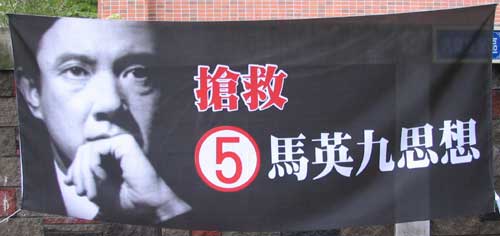
Taiwan campaign banner discussed in this post. It pictures KMT Chairman Ma Ying-jeou looking thoughtful.

This banner reads qiǎngjiù Mǎ Yīng-jiǔ sīxiǎng (“rush to save Ma Ying-jeou thought” / 搶救馬英九思想).
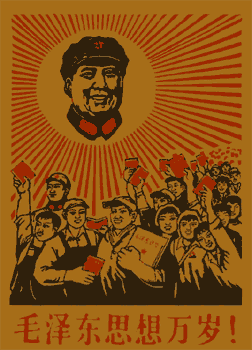
Cultural Revolution image of Chinese masses proclaiming 'Long live Mao Zedong thought!'This is an unusual banner for a number of reasons, not just because even die-hard KMT supporters might be hard pressed to say what exactly “Ma Ying-jeou thought” is. (I’m not trying to set up any punch lines here — really.)

Referring to a prominent figure’s “thought” is much more common in China than in Taiwan and is predominantly associated with Mao Zedong — not the sort of figure to attract votes from pretty much any segment of Taiwan’s electorate.

The standard phrase is Máo Zédōng Sīxiǎng (毛澤東思想 / 毛泽东思想 / “Mao Zedong Thought”). See, for example, the Cultural Revolution-era poster at right, which reads “Mao Zedong Sixiang wansui!” (“Long live Mao Zedong Thought!” / 毛泽东思想万岁). As far as I know, though, people in China didn’t have to urgently rush to save it. Searches on Google and Baidu for “抢救毛泽东思想” (“rush to save Mao Zedong thought”) yield no responses at all. On the other hand, giving a Japanese reading of “banzai!” for wansui (万岁) might change the feeling of urgency some.

Before turning to a look at numbers, I’d like to offer a few more observations about this banner:

  • The candidate isn’t Ma Ying-jeou, though Ma is the only person shown here and the only one to have his name mentioned. The only way to identify this candidate would be through the candidate number. Even Ma being head of the KMT doesn’t help, since candidates’ political affiliations are not given on the ballot other than in presidential elections.
  • A campaign-material color scheme of black and red doesn’t indicate an anarcho-communist candidate but rather a supposedly urgent need to vote for someone. A candidate who uses predominantly black campaign material is one whose election may hang by a thread and so needs all the help he or she can get. But this is usually nothing but a campaign gimmick.

Here’s a table of the results of Google searches for the “thought” of some prominent political figures, with Confucius thrown in for good measure, as he was more of a real philosopher than all the rest of them put together. Also, to give a sense of the relative numbers of Web pages, I’ve added the search results for 的, the most frequently used Chinese character; this provides a very rough and unscientific ratio of about 2.4 Web pages in China for every 1 Web page in Taiwan.

I ran four variations on each main search. In addition to looking for the exact phrase of “[someone’s] thought” I checked the results as restricted to .tw domains, .cn domains, Taiwan governmental domains, and PRC governmental domains.

Search phrase Translation Total .tw .cn .gov.tw .gov.cn
de 769,000,000 95,100,0000 246,000,000 15,800,000 35,900,00
毛澤東思想 Mao Zedong thought 2,330,000 8,200 1,140,000 174 342,000
孔子思想 Confucius thought 64,000 3,160 21,500 200 2,860
鄧小平思想 Deng Xiaoping thought 27,800 256 14,900 12 1,660
孫中山思想 Sun Yat-sen thought 10,300 1,210 2,720 196 361
江澤民思想 Jiang Zemin thought 4,120 59 573 5 98
胡錦濤思想 Hu Jintao thought 2,400 34 1,140 0 198
蔣介石思想 Chiang Kai-shek thought 850 15 251 0 17
馬英九思想 Ma Ying-jeou thought 326 31 1 0 0
李登輝思想 Lee Teng-hui thought 85 52 2 0 0
蔣中正思想 Chiang Kai-shek thought

(alternate form)

54 27 0 7 0
蔣經國思想 Chiang Ching-kuo thought 34 11 7 0 0
陳水扁思想 Chen Shui-bian thought 33 7 6 0 0

Thus, the phrase “[somebody’s] thought” is overwhelmingly a PRC usage and associated with Mao Zedong more than with all the others put together and multiplied by 20. So what’s it doing here with Ma Ying-jeou’s name?

Taishan dictionary

A recently published dictionary of Taishan — Táishān fāngyīn zìdiǎn (台山方音字典), edited by Dèng Jūn (邓钧) and Lín Róngyào (林荣耀) — has been selling relatively well, according to news reports. But I haven’t been able to find out much more, such as if the book is available for purchase online.