more Crazy English

A couple of days ago I promised a “long, critical study of Crazy English” will be released soon. It’s still in preparation. But you can now read a study from a couple of years ago by Amber Woodward, the same author who wrote the forthcoming piece. The 2006 study is Learning English, Losing Face, and Taking Over: The Method (or Madness) of Li Yang and His Crazy English.

The article prominently quotes a comment added to a post here on Pinyin News. So comment away, everyone, cuz you just might end up in an international journal.

This is issue no. 170 of Sino-Platonic Papers.

further reading:

President-elect Ma favors Hanzi-only writing of Taiwanese: report

If the Chen Shui-bian administration had bothered to do much of anything really useful to promote Taiwanese, especially as a written language, then we probably wouldn’t be faced with crap like this.

President-elect Ma Ying-jeou met last week with Chen Fang-ming (陳芳明), the chairman of the Graduate Institute of Taiwanese Literature at National Chengchi University (Zhèng-Dà). Although Professor Chen is a former DPP official and supported Frank Hsieh in the recent election, the two reportedly found much to agree on, such as that the idea that Chinese characters are all that are needed for literature in Taiwanese; romanization and other such phonetic spellings, they agreed, aren’t necessary.

Zǒngtǒng dāngxuǎnrén Mǎ Yīngjiǔ jīntiān bàihuì Zhèng-Dà Táiwān wénxué yánjiūsuǒ suǒzhǎng Chén Fāngmíng, tā biǎoshì liǎng rén jīntiān tándào běntǔhuà, zhuǎnxíng zhèngyì, běntǔ wénxué, dàxué píng jiàn děng yìtí, lìng tā yǒu “kōnggǔzúyīn” zhī gǎn, liǎng rén hěn duō kànfǎ dōu bùmóu’érhé, lìrú Chén Fāngmíng rènwéi zhǐyòng Zhōngwén xiě, Héluòhuà niàn, jiùshì Táiyǔ wénxué, bùyīdìng kèyì yào yòng Luómǎzì, yīn lái pīn.

This is certainly discouraging though not unexpected news for romanization supporters — and for those whose idea of Taiwanese lit isn’t stuck in the Qing dynasty or even earlier. But there’s always hope that this is another of those times in which Ma is simply persuaded by or agreeing with whatever is in front of him; and he may change his mind later. Regardless, though, it doesn’t augur well for a modern Taiwanese literature or for government work on — much less promotion of — romanization over the next four years.

source and further reading:

Crazy English in the New Yorker

The latest issue (April 28, 2008) of the New Yorker has an article on the China’s Crazy English (Fēngkuáng Yīngyǔ / 疯狂英语) method: Crazy English: The national scramble to learn a new language before the Olympics, by Evan Osnos.

Li Yang Crazy English (as it is properly known, after Li Yang, the company’s founder, chief spokesman, and head cheerleader) uses untraditional and emphatic but not always proven methods, including shouting and vowel-associated gesticulations, to help students overcome their fear of using English and remember the sounds of their vocabulary words.

Chinese nationalism is also a big part of its approach.

From the article:

A long red-carpeted catwalk sliced through the center of the crowd. After a series of preppy warmup teachers, firecrackers rent the air and Li bounded onstage. He carried a cordless microphone, and paced back and forth on the catwalk, shoulder height to the seated crowd staring up at him.

“One-sixth of the world’s population speaks Chinese. Why are we studying English?” he asked. He turned and gestured to a row of foreign teachers seated behind him and said, “Because we pity them for not being able to speak Chinese!” The crowd roared.

Li professes little love for the West. His populist image benefits from the fact that he didn’t learn his skills as a rich student overseas; this makes him a more plausible model for ordinary citizens. In his writings and his speeches, Li often invokes the West as a cautionary tale of a superpower gone awry. “America, England, Japan—they don’t want China to be big and powerful!” a passage on the Crazy English home page declares. “What they want most is for China’s youth to have long hair, wear bizarre clothes, drink soda, listen to Western music, have no fighting spirit, love pleasure and comfort! The more China’s youth degenerates, the happier they are!” Recently, he used a language lesson on his blog to describe American eating habits and highlighted a new vocabulary term: “morbid obesity.”

Li’s real power, though, derives from a genuinely inspiring axiom, one that he embodies: the gap between the English-speaking world and the non-English-speaking world is so profound that any act of hard work or sacrifice is worth the effort. He pleads with students “to love losing face.” In a video for middle- and high-school students, he said, “You have to make a lot of mistakes. You have to be laughed at by a lot of people. But that doesn’t matter, because your future is totally different from other people’s futures.”

Very soon Sino-Platonic Papers will be issuing a long, critical study of Crazy English. Look for the announcement of that here in Pinyin News.

further reading:

The ancient Yue

This week’s rerelease from Sino-Platonic Papers is Tattooed Faces And Stilt Houses: Who Were The Ancient Yue? (1.6 MB PDF), by Heather Peters.

Here’s the introduction:

Recent archeological evidence excavated at Hemudu, a site in northern Zhejiang Province south of Shanghai (Zhejiang Provincial Museum 1978), suggests that were we to step back in time to the 5th millennium B.C. in southern China, we would find people cultivating wet rice, raising water buffalo and living in houses perched high on stilt posts. Culturally, these people differed radically from the millet growing pit dwellers found in the Yellow River Valley region; their discovery has raised new and important questions regarding the development of culture and civilization in southern China.

At long last Chinese archeologists have begun to reinterpret the developments of early civilization in southern China. In so doing they have emphasized the emergence of a southern cultural complex which they call “Yue” (越). The Yue culture, as defined by Chinese archeologists, spans both the Neolithic and early state period.

As more and more archeological data are retrieved from southern China, Chinese archeologists are asking the question, who were the people who created this Yue culture? Were they ethnically different from the people who lived in northern China? What language(s) did they speak? One favorite theory at the moment is that the Yue people were ancestral to the various Tai speaking populations, i.e. the Tai Lue, Tai Neu, Tong, Shui, Bu Yi and the Zhuang, living today primarily in southwestern China.

This was originally published in April 1990 as issue no. 17 of Sino-Platonic Papers.

Find Chinese characters online by drawing them with your mouse

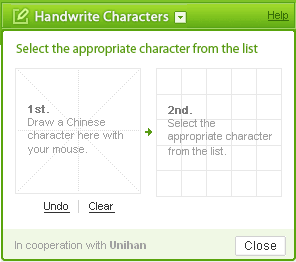
Nciku, a Web site that bills itself as “more than a dictionary,” has a nifty feature that allows users to find Chinese characters by drawing them with a mouse.

interface for the character-drawing tool

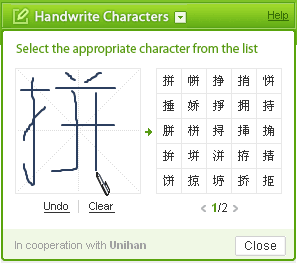
As you draw, possible character matches will appear in the box to the right of your drawing, with the results refined as your drawing progresses. You don’t need to know the canonical stroke order to get this to work, nor do your calligraphy skills need to be perfect, as this example shows.
, showing the results with a sloppily drawn ? (the 'pin' of 'Pinyin')

Once you see the correct character offered as a choice, click on it and it will be entered into the search box for the site’s online dictionary. This dictionary feature can handle multiple-character input and will even prompt you with likely choices to fill out your search.

via Keywords

Hongshan culture: SPP

Just out from the archives of Sino-Platonic Papers is The Development of Complexity in Prehistoric Northern China, by Sarah M. Nelson of the University of Denver.

This deals with Hongshan culture (Hóngshān wénhuà / 紅山文化 / 红山文化), a neolithic culture that flourished in what is now northeastern China more than 5,000 years ago.

From the introduction:

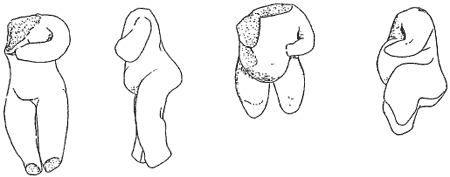
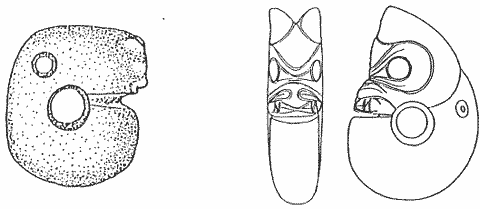
Far to the north of the Central Plain of China (the Zhongyuan), in Liaoning province and Inner Mongolia, nearly two millennia before the florescence of the Shang dynasty, a complex society known as the Hongshan culture arose, with a mixed economy of herding and agriculture. Some two dozen major sites are known, along with many smaller ones, spread over about 100,000 square km. Hongshan presents a puzzle for Chinese archaeologists because of its amalgam of non-Chinese traits (for example nude female figurines and the “Goddess Temple” featuring over-life-sized statues of women) with some early manifestations of such quintessentially Chinese characteristics as round and square outdoor platforms for altars, the use of jade for emblems of power, and possibly dragon iconography.

Sino-Platonic Papers no. 63 was originally published in December 1994.

neolithic female nude figures from Hongshan culture in northeastern China

image of stone carved in the shape of a pig dragon

Kyrgyzstan won’t switch to Roman alphabet yet: report

High-ranking Kyrgyz officials are now reportedly saying that having Kyrgyzstan switch from the Cyrillic to the Roman alphabet would cost more money than the country can afford for the project at present. A later switch has not been ruled out.

sources:

Ideography

This week’s rerelease from Sino-Platonic Papers is The Prestige of Writing: 文, Letter, Picture, Image, Ideography, by Haun Saussy, who is currently a professor of Chinese and comparative literature at Yale.

This work contains a memorable, wry disclaimer:

WARNING. The following section contains passages from the writings of Ernest Fenollosa which may be objectionable to some readers. The reproduction of these statements does not indicate endorsement or approval of their content by the author or editors, who decline all responsibility for any damages, direct or incidental, that may be attributed to the reading of them.

The author explains: “The need for such a disclaimer was brought home to me by the reactions of two sinological colleagues who refereed an earlier version of this paper.” Just in case anyone’s wondering why that might be the case, see Fennolosa, Pound and the Chinese Character, by George A. Kennedy, and The Ideographic Myth, by John DeFrancis.

Here is the introduction:

The disparagement of writing is a motif common, I suppose, to all traditions that have writing. Writing is often seen as inadequate to represent speech or thought. But another response to the inadequacy of writing has been to exalt some other kind of writing — occasionally a language reformer’s pet project, but more frequently the writing of the angels, the writing of the citizens of some utopia, of the scholars of some faraway kingdom, or of the forces of nature itself. Imagined writings of this sort telescope critique and critique’s wishful compensation. They attribute wonders — praestigia — to a medium most often noticed in its falterings.

Since Chinese writing became known in Europe, it has often been pressed into service as the model of this perfected writing. This enthusiasm must appear outlandish to those whose ‘native’ writing-system is Chinese. But it is not enough to show that the indigenous and foreign perceptions of Chinese writing are at variance, or even that the tales told of Chinese script do not stand up to linguistic scrutiny: there is an inventive element to all intercultural interpretation, a fit between its observations and the intellectual needs of its proponents, that expert testimony simply shoves aside. The proper way to analyze an intellectual tangle of this sort, it seems to me, is not to hold it to the standard of specialist univocity, but to situate it ethnographically among the conceptions it echoes or answers. Which aspects of which utopias still beckon, and which have definitely gone on to feed intellectual history, is another question deserving patient consideration.

This is issue no. 75 of Sino-Platonic Papers. It was originally published in February 1997.