Romanization to be allowed on some Taiwan ID cards

The new type of Taiwan’s national ID card (shēnfènzhèng/身分證) will be coming out soon. For the first time, this card will allow the use of romanization — albeit in very limited ways. The use of romanization is being allowed because members of Taiwan’s indigenous tribes had complained, with good reason, that the old ID cards did not permit them to use their real names but only sinicized versions of their names.

The languages of Taiwan’s tribes are not related to Mandarin, Taiwanese, or any of the other so-called Sino-Tibetan languages. Moreover, the 400-and-some syllables of Mandarin are not adequate to accurately represent the languages of any of these tribes, which means Chinese characters can’t handle those names properly.

I spoke earlier today with an official at Taiwan’s Ministry of the Interior, who helped clarify some of the points of the new policy:

  • the space allotted to romanized names is limited to twenty or fewer letters. Supposedly this will be sufficient; but I doubt it.
  • 0nly aborigines will be allowed to use romanization on their ID cards; everyone else will be limited to Chinese characters
  • all ID cards, including those with romanization, must include Chinese characters; thus, Taiwan’s aborigines aren’t allowed to shed the sinicized versions of their names

The above policy applies to “foreigners” as well. In other words, if I become an ROC citizen — as I probably would if the government dropped its insistence that I first abandon my U.S. citizenship — I would not be permitted to have “Mark Swofford” on my identification card. I would have to be identified as “史偉凡” and only as “史偉凡.” I would not be allowed to include a romanized version: Shi Wei-fan (and certainly not Shǐ Wěifán either).

Hmph!

And even if I could have my real name on the ID card, I’d have to omit my middle name, because with that included my name wouldn’t fit within twenty spaces.

deerly contested elections

Yeah, yeah, I know: For that pun I should be locked up. But, believe me, it’s in the spirit of Taiwan’s current electoral season.

Here, for example, is an image from the campaign literature for Zhāng Hóng-lù (張宏陸). Zhang has chosen a deer as his mascot because the final syllable of his name sounds like the Mandarin word for deer, lù (鹿). (Yes, that’s supposed to be a deer, not the result of some unholy experiment involving Rudolph the red-nosed reindeer and an inflatable Bambi.)

Note the quasi romanization, on both the collar and headphones, of @ for “a,” which is a prefix for personal names. Thus, “@-lu” stands for “A-lu,” which is a meant as a friendly nickname for Zhang.

The A prefix might be familiar to Westerners through Lu Xun’s “The True Story of Ah-Q” (阿Q正傳). (Lu Xun, by the way, was an important advocate of romanization.) The association in the campaign literature, however, is definitely intended to be with Taiwan’s president, Chen Shui-bian, whose nickname of “A-bian” was written in romanization on much of Chen’s campaign merchandise. Chen even refers to himself in the third person as “A-bian.” (For some reason most people in Taiwan don’t seem to find this affectation by Chen as disconcerting as Americans found Bob Dole’s odd habit of referring to himself as “Bob Dole.”)

Zhang is of course from the same political party as Chen.

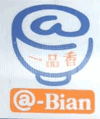
As for the use of @ for “a,” this might be copied from Chen-related merchandise, though the only images I found in a quick search had “a-bian” rather than “@-bian.” The “a,” however, is often found within a circle, which may have led subsequent designers to the @ usage. There is, however, a small chain of soup-noodle stores named “@-Bian.”

The @ is of course a vague allusion to the Internet, with the intent of looking “modern.” The @ usage was copied (perhaps incorrectly) from some of Chen’s merchandise, affectations of modernity being pointless when it comes to otherwise unpretentious noodle stores.

The headphones on the deer, however, are a mystery to me. Then there’s the fact that they aren’t on the deer’s ears. Perhaps they’re a vague attempt to appeal to the youth vote.

Bei-Bei jing-jing wel-wel comes-comes you-you

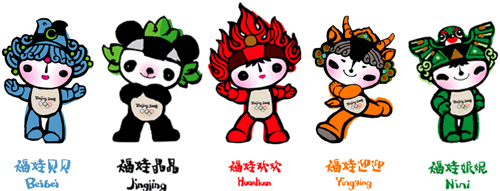
Beijing has unveiled its five mascots for the 2008 Olympics, the Friendlies Fuwa. They are dubbed Beibei, Jingjing, Huanhuan, Yingying, and Nini. Here’s Jingjing, the friendly PRC panda, with his gun. In case you’re wondering, yes, that’s an official image.

OK, back to language-related matters. These aren’t just saccharine names for cutesy figures: there’s a pattern. Note how each name is a doubled syllable, which is a common way to form affectionate nicknames in Mandarin. (My wife, for example, is named Hsin-chun, but many in her family refer to her as Hsin-hsin.)

Taking the first syllable of each of the mascot names yields “bei jing huan ying ni,” or, more properly, “Beijing huanying ni,” which is “Beijing welcomes you” in Mandarin. If tones are indicated this would be written Běijīng huānyíng nǐ; but tone indications are completely unnecessary here for easy comprehension of the meaning. Although Mandarin is a tonal language, most clearly written texts do not need to have all or even most tones indicated for comprehension by fluent speakers.

Let’s look at the sentence “Beijing huanying ni” when written in characters. It’s “北京欢迎你” in simplified Chinese characters. In traditional characters it would be written “北京歡迎你.” But the names of the mascots aren’t all written with these same characters. For that matter, not even all the tones are the same:

Beijing welcomes you mascot names
character tone character tone
běi bèi
jīng jīng
huān huān
yíng yíng

北北 (lit. “North-north”) just doesn’t make for a catchy mascot name. But, basically, the only way to use Chinese characters to indicate the third-tone bei sound of “Beijing” is with the 北 character. So the mascot namers went with a different character — and consequently a different tone, too. They opted for bèi.

By the way, readers of Chinese characters have no choice but be accustomed to characters being pronounced with a variety of tones. Some 80 percent of Chinese characters that have more than one pronunciation — and these are quite common — are associated with at least two tones.

Chinese does have a word pronounced bèibèi. It is written in characters thusly: 孛孛. The meaning is “radiant,” which sounds nice enough for a mascot name. But almost no one knows this old word. For that matter, most people don’t even know the obscure 孛 character and thus wouldn’t know it’s supposed to be pronounced bei. (Note how a character doesn’t have to have a large number of strokes to be obscure.)

Thus, 孛孛 obviously wouldn’t work. So the designers used a bèi that is rather more precious. When 贝 is doubled, the association is with baobei (treasure), as in something a mother might call her child (just as an Italian woman might sometimes fondly refer to her child as “tesoro”). Thus, an English translation of “Beibei” would be something like “Precious.” (Normally I’m opposed to translating names. But in this case some translation is appropriate, as these names are most certainly designed to be cute as a button and so should be revealed as such.)

Let’s move on to Jingjing. Using, say, the “proper” character for Beijing’s jing would yield 京京, which means “intense (of sorrow).”

念我独兮、忧心京京。
哀我小心、癙忧以痒。

I think how I stand alone,
And the sorrow of my heart grows intense. (tr. James Legge)

Even though that’s such an ancient term that almost no one would know it now, it’s probably still not the sort of thing Beijing’s Olympic planners would want as a mascot name. So 晶, which has the same pronunciation (including tone) as Beijing’s jing was selected. An English translation of “Jingjing” would be something like Crystal, or perhaps Sparkles.

Huan and ying are used unchanged. Indeed, Huanhuan is found as a personal name; an English version of this name would be “Joy.” But “Yingying” doesn’t translate well; “Welcome” is about the best I can think of at the moment.

With Nini, again we have a different character and a different tone. (Then there’s the selection of ni rather than the more polite form of nin. This might make an interesting entry by itself.)

Mandarin does have a word pronounced “nǐnǐ.” It means “luxuriant; exuberant; flourishing” — perhaps not entirely out of line for a name. But then comes the matter of the character; this word is written 苨苨. But 苨 is used only in 苨苨. Although in this case the phonetic part of the character (as opposed to the “radical”) is relatively clear, 尼, the character is nonetheless not nearly common enough for people to know whether it is pronounced (probably, that is — because Chinese characters are not unlike a spelling system that’s two thousand years out of date) , , , or . And at any rate, even if people did know the correct pronunciation, they still wouldn’t know the meaning of 苨苨. In short, 苨苨 is also a bad choice.

There’s a more common “nini,” which has different tones: níní (泥泥). This has two meanings: (1) damp (from dew), and (2) luxuriant; thick (of vegetation). The 泥 character, unlike 苨, is not uncommon. Nonetheless, the word níní (泥泥) is obscure, which would lead most people to guess at the meaning, and most of them would probably guess something like “muddy.” So this choice wouldn’t be a good one either.

The marketing managers decided to use 妮 (), which is used in nīr (妮儿/妮兒), a word for “girl.” This yields the decidedly twee “Nīnī,” which might be translated as “Girly.” (Note that the phonetic is the same as in the above: 尼.)

Here are Precious, Crystal, Joy, Welcome, and Girly:
Olympic mascots

sad state of ‘native-language education’ in Taiwan

Today’s Taipei Times has an interesting article on the state of teaching Taiwan’s “native languages.” (This means Taiwanese (a.k.a. Hokkien, Minnan, etc.), Hakka, and the languages of Taiwan’s tribes, but not Mandarin.) From the look of things, the government has basically botched the situation, despite having thrown twice as much money toward these languages as is being spent on English.

Although some of the problems and expenses are to be expected, given how new this is and how much resistance there has been from conservative forces, I’d say that things are still far from acceptable. A large part of the problem is that the government can’t even decide on a script for these languages: sometimes romanization (various systems), sometimes Chinese characters, sometimes zhuyin. It’s a mess.

No progress in native-language education has been made in schools despite the central government promising to encourage local culture and language education three years ago, native-language teachers said yesterday.

Liu Feng-chi (???), director of the Taiwan Association of Mother Language Teachers and a teacher of Hoklo (also known as Taiwanese), said he felt cheated that the government had “not taken in any of our suggestions to improve native-language education in school” over the past three years.

Liu said the Ministry of Education had not put much effort into reform nor native-language education. Classes in schools were not being planned carefully and lack continuity, he said.

“Classes [for native languages] should continue after elementary school so that students can keep learning the languages in junior high,” Liu said.

Association executive director Huang Hsiu-jen (???) said teachers of Hoklo are being “reselected” every year and must undergo a “disrespectful” selection process.

Huang said the selection committee was sometimes composed of teachers who did not speak Hoklo themselves.

“The selection team tends to choose young Hoklo teachers who can sing and dance in class, while older teachers like us end up with no job,” Huang said.

Liu also said that the salary for teachers was based on the number of hours worked in a week and that the hourly wage was a mere NT$320.

Furthermore, native language teachers are called “assistant teachers,” and schools do not provide them with health insurance, Liu added.

The association also expressed concern that many schools were using the time reserved for language classes to teach other subjects, and that many language teachers were required to teach mathematics or science as well.

Meanwhile, Perng Fuh-yuan (???), section chief at the ministry’s Department of Elementary Education, said there are more than 300,000 children learning native languages in the country.

Perng said the selection process applied not only to language teachers but to teachers in general, and that former language teachers were added to the selection committee to provide specialist advice.

“It is hard for students to continue native-language classes in junior high school under all of the exam pressure,” he said. “However, schools have tried to incorporate these languages into extracurricular activities connected to the school, such as Hoklo language clubs.”

The ministry spends NT$400 million (US$11.9 million) annually on native-language courses, while English classes have NT$200 million per year in funding. Elementary school students are required to take at least one period of native-tongue classes per week.

Taiwan’s native tongues include Hoklo, Hakka and a variety of Aboriginal languages.

source: Native-language teachers lash ‘disrespectful’ ministry, Taipei Times, November 18, 2005.

Zhuang writing

An article from Xinhua discusses writing in Zhuang. The Zhuang, China’s largest “national minority” group, live mainly in Guangxi. Their language is written with the Roman alphabet.

The first paragraph discusses a prize for literature in Zhuang. One of the winners was a folk song, the other a novella. While I have nothing against folk songs, I find the novella potentially far more interesting as it wouldn’t necessarily fit within the framework of what multiculturalism has come to be in today’s China: “We love minorities as long as they wear colorful costumes, have some songs and dances, bring in tourists, and don’t spout other than the Party line.” (It wasn’t always so. In the period just after the 1949 revolution, the Communist authorities initially worked to give real support to minority groups — to the extent of registering many people as Zhuang who insisted that, no, they were Han!)

The novella, though, has a rather folksy title, Shorty A-he, so it may be just more in the colorful, old-fashioned-countryside-folk mode. Although there’s nothing necessarily wrong with that, I hope there’s more to Zhuang literature than this. Otherwise, it’s going to end up a museum piece.

我国首届壮文文学奖日前揭晓,李从式的山歌《深情重如山》和陆登的中篇小说《短脚阿和》等5篇以壮文创作的作品获奖。众多语言学专家认为,文学艺术给壮文普及插上一对翅膀,对传承壮族文化起着重要作用。”民族语言文字在传播、培育民族文化中发挥着重要作用,以艺术形式推广不仅有利于普及壮文,还能更加鲜明地体现出壮族文化的内涵。”广西少数民族语言文字研究处主任杜宰经说。

壮族是我国人口最多的少数民族,11月29日是壮文诞辰48年纪念日。壮族文化源远流长,壮文早在隋唐时期就有了雏形,但过去一直没有形成统一使用的民族语言文字,直到1957年国务院才经过语言文字专家仔细研究,通过了以拉丁字母为基础的拼音壮文方案。据统计,我国壮语人口已经超过1700万人。作为中国学者和壮文研究者集体智慧的结晶,壮文已经在广西、云南文山等一些地方得到普及和应用。现行的标准壮语是以广西武鸣音为标准音、以壮族北部方言为基础方言的壮民族共同语。

广西贝贝特文化传播有限公司副总经理李庭华说:”过去壮文普及仅仅依托教育模式,通过设立壮汉双语教学学校,培养了数以十万计的壮文教育人才,但是文学艺术才是一个民族文化特色的本质所在,通过艺术表现力才能更好地展现一个民族的魅力。”

“今年广西在第五届壮族文学奖里增设了壮文文学奖,以文学艺术竞赛模式促进了壮文文学创作队伍的扩大,有益于建立独特的壮文文学读者群,从而推动壮语普及和壮族文化发展。”李庭华说。

为了普及壮文,广西之前还举办过农民学壮文学科技等一系列颇具特色的壮文培训班,将壮文扫盲与脱贫致富相结合。”过去学壮文学科技致富脱贫,现在学壮文学艺术陶冶情操。”李庭华笑着说。

source: Shǒujiè Zhuàngwén wénxué jiǎng jiēxiǎo Zhuàngyǔ pǔjí dāchéng yìshù kuàichē, (首届壮文文学奖揭晓 壮语普及搭乘艺术快车), Xinhua, November 4, 2005.

Pinyin Info in the news

Nathan Bierma‘s most recent column on linguistics for the Chicago Tribune‘s Tempo section contains excerpts from an e-mail interview with yours truly.

Much of the piece focuses on Professor Victor H. Mair’s explanation, here on Pinyin Info, of how “crisis” is not “danger” plus “opportunity” in Chinese characters .

The French have a saying about incomprehensible communication. Americans say, “It’s Greek to me.” But the French say “C’est du chinois” — meaning, “It’s Chinese.”

Chinese characters are so complex that they make a good metaphor for failure to communicate. But an American copy editor living in Taiwan is trying to demystify Chinese characters and demolish a few myths about how they work.

Mark Swofford runs the Web site www.pinyin.info, a site dedicated to Pinyin, the standard system of writing Chinese words in the Roman alphabet (the alphabet used to write English).

“Most of what most people think they know about Chinese — especially when it comes to Chinese characters — is wrong,” Swofford writes at the site. “This Web site is aimed at contributing to a better understanding of the Chinese languages and how Romanization can be used to write languages traditionally associated with Chinese characters (such as Japanese, Korean and especially Mandarin Chinese).”

The Mandarin Chinese word for “crisis,” for example, is represented with an intricate symbol made with several strokes, but the word’s pronunciation can be spelled in Pinyin as “weiji” (plus a few accent marks).

Using the Pinyin system makes it easier for students to learn to speak Chinese languages, Swofford says, because Chinese characters are so complex and misunderstood — such as the frequently misinterpreted character for “weiji,” a favorite of motivational writers and speakers.

Seeking a better system

Swofford says he started his Web site in part out of frustration with the confusing and inconsistent ways street names were written in the Roman alphabet when he moved to Taiwan.

“As a professional copy editor, I found the plethora of misspellings more than just a nuisance,” Swofford says. “I started compiling lists of street and place names so that I would be able to know the correct spellings.”

Swofford’s Pinyin site features news articles about Chinese writing, original essays about Pinyin, spelling quizzes, song lyrics written in Pinyin and sample chapters of books on Pinyin.

“The Mandarin Chinese language has about 410 distinct syllables, not counting variations based on tones,” Swofford writes by e-mail from Taiwan, where he is a copy editor at Kainan University. “All can be written simply and unambiguously using the Roman alphabet.”

Swofford lists all of the syllables written in Pinyin, alongside the characters they represent, at www.pinyin.info/romanization.

“One needn’t be a student of Mandarin or a scholar to make use of the readings on my site,” Swofford says. “Most of the readings are in English and require no prior knowledge of anything about the Sinitic [Chinese] languages.”

Victor Mair is an avid reader and regular contributor to Pinyin.info. Mair is professor of Chinese language and literature at the University of Pennsylvania, where he teaches a course called “Language, Script and Society in China.”

Mair believes that Western teachers often overemphasize the need to learn and read Chinese characters. By learning Chinese with a Romanized alphabet instead of characters, he says, students are able to start speaking the language more quickly.

`Crisis’ clarified

Chinese characters themselves are often misunderstood, Mair says. Many students and scholars fail to realize there is a difference between Chinese characters and Chinese languages, he says, which can lead to problems because the meaning of the characters depends on the language and culture where they are used.

This confusion is partly to blame for the common claim of self-help books that the Chinese character for the word “crisis” means both “danger” and “opportunity.”

“A whole industry of pundits and therapists has grown up around this one grossly inaccurate formulation,” Mair writes at Pinyin.info. “The explication of the Chinese word for `crisis’ as made up of two components signifying `danger’ and `opportunity’ is due partly to wishful thinking, but mainly to a fundamental misunderstanding about how terms are formed in Mandarin and other Sinitic languages.”

According to the myth, to write the Chinese character for “crisis,” you combine the character for “danger” and the character for “opportunity.”

That’s based on a partial truth: the word pronounced “weiji” is made up of two characters, pronounced “wei” and “ji.” But while “wei” means danger, “ji” doesn’t mean “opportunity.”

“The `ji’ of `weiji,’ in fact, means something like `incipient moment; crucial point (when something begins or changes),'” Mair writes. “Thus, a `weiji’ is indeed a genuine crisis, a dangerous moment. . . . A `weiji’ in Chinese is every bit as fearsome as a crisis in English.”

The word “ji” only means “opportunity” in some cases, such as when it combines with the word “hui” (“occasion”) to make the word “jihui,” for “opportunity.” Its meaning changes depending on what other word it’s blending with. The crisis-means-opportunity myth, Mair says, is founded on a faulty understanding of the way languages work.

“There will always be some degree of misinterpretation about other peoples and their languages,” Mair writes by e-mail, “but I’m hoping to reduce misunderstanding through critical thinking and clear education.”

Here’s the article: Debunking misconceptions about Chinese characters. (Reading the piece, however, requires jumping through some registration hoops. Perhaps Bierma will later add it to his archive of some of his work, which contains much of interest.) It was published in the Chicago Tribune on November 9, 2005.

Hanyu Pinyin address plates in Taizhong

Today’s Taipei Times has a photo displaying a sample of a new address plate for buildings. The new-style plates are larger and feature romanization. The choice of Hanyu Pinyin, however, might change if the KMT fails to hold the mayorship of Taizhong (usually spelled Taichung, following bastardized Wade-Giles), as the choice of romanization systems has become partisanized, to the dismay even of many within the DPP who would prefer a more practical approach to the issue.

Note, too, the logo in the upper left corner. Although the logo is fine in the case of the address plates, many of the newer street signs in Taizhong are less legible because of the logo’s placement. I’ll supply examples later.

source: Sign of the times, Taipei Times, November 9, 2005.

Chinese man forbidden to use letter ‘D’ for son’s name

no sign with the letter 'D'[Updated version.] A Mr. Hu (胡) in Dengfeng, China, wants to give his son the name “胡D”. In case anyone’s not clear on this, yes, that’s a letter from the alphabet, not a Chinese character that happens to look like the letter D. (The name would have been the same had the baby been a girl, he said.) But this is being blocked.

The hospital where the baby was born refused to issue a birth certificate under that name. The doctor in charge of the hospital was quoted as saying that he had consulted the local public security authorities responsible for newborn registrations. “We think it is better to name newborns with simplied Chinese characters instead of rare and strange characters,” he explained.

So for the time being, the baby’s parents have had to assign a name written with a Chinese character: . By most practical measures, though, 镝 would fall under the heading of rare characters. The majority of literate Chinese would not recognize this character. Indeed, the majority of college-educated Chinese would not recognize the character, which is used to indicate the element dysprosium. On the other hand, almost everyone would recognize the letter D.

Thus, this isn’t a case of a name being rejected because it’s “rare and strange,” because in China the letter D is not rare but common and the character 镝 is certainly quite rare. (Whether 镝 is also strange I’ll leave to others.) And in China perhaps not even one in ten thousand would know how to write that character by hand.

In Mandarin, 镝 is pronounced essentially the same as the English letter D. Half the letters of the English alphabet have names that sound at least fairly close to Mandarin syllables, and thus they could be represented by Chinese characters. These are A, B, D, E, G, I, K, O, P, R, T, U, and Y. This, however, is seldom seen.

I wonder what would have happened if he had chosen a letter that doesn’t correspond to a Mandarin syllable. In support of his desired name for his son, Mr. Hu cited the example of Lu Xun’s “The True Story of Ah Q,” one of the most famous short stories in Chinese literature. Even in the Mandarin original, the character is referred to with the letter Q, as “阿Q.” (Lu Xun, by the way, was a strong supporter of romanization for Mandarin, as shown in essays such as “An Outsider’s Chats about Written Language.”)

The reverse situation — of using English letters to represent Mandarin morphemes — is fairly common among young Internet users.

The Hu family, however, has not given up. “When I find out laws and regulations to support the original name, I will apply to have it revised,” Mr. Hu said.

source: Child named with English letter, causing controversy, Xinhua, November 5, 2005.

earlier story (in Mandarin): “胡D” míngzi nán jiànlì, zhǐhǎo jiào “胡镝” [Hú Dī], Hénán bàoyè wǎng, October 26, 2005.

See also this earlier Pinyin News story: 911 Restaurant?!.