prohibited macrons?

Signs leading to a temple in Japan’s Nara Prefecture feature a variety of romanizations. Inconsistent romanization is hardly newsworthy in itself, this being common in East Asia. But things get a little more interesting as the article progresses.

Akihiko Yonekawa, a Japanese language professor at Baika Women’s University, says that “Muroji” is not a proper phonetic spelling, so if that is the goal it should be spelled “Murooji.” According to the direct transcription of kana characters, it would be “Murouji,” but that does not comply with Hepburn’s principles. The professor notes that prohibiting macrons made the whole process more difficult.

West Japan Railway Co. agrees. Forgoing the Hepburn system, the railway firm uses macrons for names with long vowel sounds, like Kyoto.

Macrons were used in romanization for decades after World War II, but in 1986 the transport ministry prohibited them.

“We don’t know the details as to the change,” says a transport ministry official.

“But we presume that Roman characters with macrons were not used for many of the road signs in the past, and those officials in charge of the changes might have thought it would be difficult for foreigners to understand the Roman alphabet with added macrons, since there are no macrons in English.”

As far as Yonekawa is concerned, the problem comes down to indifference. “Japanese people stick to how kanji are used appropriately, but they show little interest in other types of characters,” he says with a sigh.

Difficult for foreigners to understand the Roman alphabet with added macrons? Perhaps what the official means is that without macrons even the most ignorant foreigners can imagine that they know how to pronounce Japanese correctly. But with them they might have cause to doubt. Is that really such a bad thing?

source: Long vowels spell confusion for temple, International Herald Tribune & Asahi Shimbum, March 7,2006
too many romanization systems for Taiwanese in textbooks, say critics

Groups favoring the promotion of Taiwanese (also called Hokkien, Hoklo, Minnan, and all sorts of other names) are urging Taiwan’s Ministry of Education to come to a consensus on what phonetic system should be used to teach it, according to an article in the Taipei Times.

The article, however, is a bit confused in its facts, so I’m presenting it for what it’s worth and hoping commenters here can help set matters straight. Certainly, though, the variety of systems — and for some of these I use the word loosely — being used in textbooks is a hindrance to effective teaching of the language.

Some might be surprised to know that Tongyong Pinyin is not Taiwan’s official romanization system for Taiwanese, though its schemes were approved for Mandarin and Hakka. I tend to think of Tongyong for Mandarin as more of a nationalist marketing scheme than a romanization. I know there are more than a few people who hold the same view of Tongyong for Taiwanese.

As long as I’m on the subject, I’d like to remind people that, despite the misinformation that has been spread by some of its supporters, Tongyong is not one system that covers all the languages of Taiwan.

Native-language interest groups yesterday urged the Ministry of Education to speed up the creation of a unified phonetic system for the Hoklo language (commonly known as Taiwanese) to preserve Taiwanese culture.

Lee Shang-hsien (???), director of the Taiwan Pik Hap Cultural Association which promotes the Hoklo language, said that different versions of elementary school Hoklo textbooks used three different phonetic systems.

At the moment, Hoklo text books use either Tongyong pinyin, the Hanyu Romanization system, or the Taiwanese Language Phonetic Alphabet (TLPA).

Lee said that the three systems did not reflect regional Hoklo accents, and added that the Hoklo language could not be preserved and passed on to the next generation without a unified phonetic system.

Language teacher Su Huang-hung (???) said that Hoklo originally had eight tones, but due to the similarity of the second and sixth tones, most phonetic systems regarded Hoklo as a seven-tone language.

Using the Tongyong pinyin system reduces Hoklo to only five tones, Su said.

In addition, Hoklo pronunciation changes according to syntactic context, she added.

However, Tongyong pinyin marks these cases as variant pronunciations, creating a situation in which many students do not know the original pronunciation of the words they study, Su said.

Hanyu pinyin and the TLPA are almost entirely identical, since the TLPA system was derived from Hanyu pinyin by the Ministry of Education many years ago, said Lu Ching-ching (???), a member of the ministry’s Native Language Promotion Committee.

Lu said there were similarities among the three systems, and that all three have advantages and disadvantages.

The committee’s main problem was to reach a consensus and decide on one system or to incorporate the three systems into one, she said.

Discussions are still taking place at the ministry on unifying the phonetic system, Lu added.

Huang Yu-chi (???), director of the Taiwan Association for Students Abroad, said that many overseas Taiwanese return during summer and winter vacations and hope to learn their mother tongue, but the lack of a unified phonetic system makes it difficult for them to do so.

Other representatives said that not only students, but also foreigners and foreign spouses need to learn Hoklo and are in need of a unified system.

source: Culture groups urge ministry to expedite Hoklo writing rules, Taipei Times, February 23, 2006

romanization on Taiwan ID cards hits a snag

The addition of some Aborigine’s original names to their new national ID cards has been encountering a few problems. I didn’t think twenty characters would be enough space for some names, and I was right. The letters that won’t fit within the twenty spaces are having to be written in by hand. What’s worse, it looks like no one has bothered to give local offices any romanization guidelines for the various langauges of Taiwan’s tribes.

zuì cháng fāshēng de wèntí duō shì Luómǎ pīnyīn de yīnyì kùnrǎo jí wénzì guò cháng, yǒuxiē yuánzhùmín xìngmíng shízài hěn nán zhǎochū fāyīn xiāngjìn de Luómǎ pīnyīn.

My guess would be that lots of people are making up the romanization as they go along. Aargh!

source: Yuánzhùmín jí mínzhòng shēnqǐng huīfù míngzi huàn zhèng — wénzì guò cháng shì kùnrǎo (原住民籍民眾申請復名換證 文字過長是困擾), CNA, February 20, 2006

one book, two languages, three systems

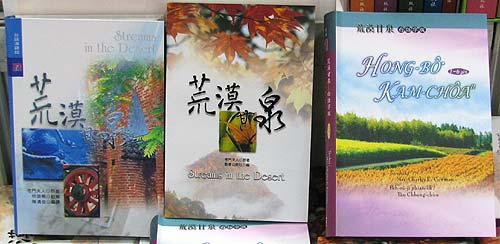
Another discovery at the recent book show was that the Taiwan Church Press has issued three editions of Streams in the Desert: one in a Mandarin translation in Chinese characters, one in a Taiwanese translation in a mixed orthography (mainly Chinese characters, with some romanization), and one in Taiwanese completely in romanization.

Streams in the Desert, a book of devotionals, was written in English by Lettie Cowman, better known as “Mrs. Charles E. Cowman.” Her husband was the founder of the Oriental Missionary Society, which today goes by the name of OMS International. The Cowmans did missionary work in Japan in the early twentieth century.

A representative of the press told me that for every ten copies of the Mandarin version, the company sells two or three of the mixed-script Taiwanese version and one copy of the fully romanized Taiwanese edition.

The fully romanized version sells mainly to people who want to learn Taiwanese rather than those who already speak it, he told me. Its recent publication was an experiment, he added. But I forgot to ask the obvious: Does the press consider the experiment a success?

covers of three editions of 'Streams in the Desert,' as translated into Mandarin and Taiwanese
(from left to right: mixed-script Taiwanese, Mandarin in Chinese characters, and fully romanized Taiwanese)

home of romanization pioneer Lu Zhuangzhang found

The birthplace of Lu Zhuangzhang (盧戇章/卢戆章) (1854-1928), a pioneering writing reformer, has recently been identified in Xiamen, China.

Locals said they knew the house was Lu Zhuangzhang’s ancestral home but didn’t know he was famous for his romanization work.

Lu was “the first Chinese to propose a system of spelling for Sinitic languages,” Victor H. Mair notes in his essay Sound and Meaning in the History of Characters: Views of China’s Earliest Script Reformers, which contains additional information about Lu.

Lu was from Fujian and, as a boy, he grew up in Amoy (Xiamen) where romanized writing of the local language was used widely after it was introduced by Christian missionaries. (A romanized Chinese translation of the Bible had already been made in 1852.) At age 21, Lu moved to Singapore where he studied English. After he returned to Amoy four years later, he assisted an English missionary in compiling a Chinese-English dictionary.

Lu’s Yimu liaoran chujie (First Steps in Being Able to Understand at a Glance), published in Amoy in 1892, was the first book written by a Chinese which presented a potentially workable system of spelling for a Sinitic language. His script was based on the Roman alphabet with some modifications. Among other improvements over the sinographs was linking up syllables into words and separating them with spaces. Lu’s system was designed specifically for the Amoy topolect, but he claimed that his system of spelling could also be adapted for the other languages of China. Although he believed that all of the local languages should be written out with phonetic scripts, Lu advocated that the speech of Nanjing be adopted as the standard for the whole nation, as it was when Matteo Ricci had come to China three centuries earlier. Altogether, Lu worked for 40 years to bring an efficient system of spelling to China. He is now viewed by Chinese language workers as the father of script reform.

Local authorities hope to protect the home as a cultural monument.

Tóng’ān fāxiàn Lú Zhuàngzhāng gùjū

Wǒguó “yǔwén xiàndàihuà” de xiānqū, xiàndài Hànyǔ pīnyīn de fāmíng zhě Lú Zhuàngzhāng, qí gùjū jìnrì zài Xiàmén Tóng’ān bèi fāxiàn, wénwù bǎohù zhuānjiā hūyù bǎohù gāi gùjū.

Lú Zhuàngzhāng de gùjū zài Xiàmén Tóng’ān gǔ zhuāng cūn, shì yī zhuàng yǒu bǎi-yú nián lìshǐ de Mǐnnán hóngzhuān gǔ mínjū, Lú Zhuàngzhāng jiù chūshēng zài zhèlǐ.

Cūnmín gàosu jìzhě, tāmen zhīdao zhè shì Lú Zhuàngzhāng jiā de “gǔ cuò”, dànshì bùzhīdào tā shì “yǔwén xiàndàihuà de xiānqū”, yějiù méi rén qù kèyì bǎohù zhè “gǔ cuò”, yīnwèi yīzhí dōu yǒurén jūzhù, hái méi wánquán bèi huǐhuài.

Huòxī Lú Zhuàngzhāng gùjū yīrán bǎocún zài Tóng’ān, Xiàmén Shì wénhuàjú wénwù chù chùzhǎng Chén Zhìmíng biǎoshì, zhēngqǔ ràng Tóng’ān qū wén guǎn bàn jiāng qí dìngwéi qū jí wénwù bǎohù dānwèi.

Jù liǎojiě, Lú Zhuàngzhāng shēngyú Qīngcháo xián fēng sì nián (1854 nián), shì Xiàmén Tóng’ānrén. Zài chuàngzhì pīnyīn fāng’àn, tuīguǎng jīng zhāng guānhuà (jí Pǔtōnghuà), tuīxíng báihuà kǒuyǔ, cǎiyòng héngpái héngxiě, tíchàng xīnshì biāodiǎn, shǐyòng jiǎntǐ súzì děng fāngmiàn, Lú Zhuàngzhāng zài guónèi kāile xiānhé.

source: Tóng’ān fāxiàn Lú Zhuàngzhāng gùjū, Dōngnán Kuàibào, February 15, 2006

crossword puzzles in Taiwanese

logo of the Presbyterian Church in Taiwan newletter, 1926

At the display for the Taiwan Church Press at the Taipei International Book Exhibition I came across a number of interesting works. The press has issued a 70-volume set of the collected newsletters of the Presbyterian Church of Taiwan. (University and research libraries, take note! So far no sets — NT$150,000 (US$4,600) each — have been sold to America or Europe.) The Presbyterian Church has long been an advocate of the rights of the people of Taiwan to speak Taiwanese without oppression, write in Taiwanese (including in romanization), and enjoy other political and human rights.

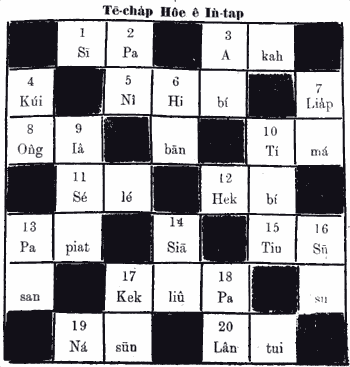
The newsletter, which dates back well into the nineteenth century, was written in romanized Taiwanese until 1969, when the KMT forced a change to Mandarin in Chinese characters. While flipping through a volume of the newsletters from the 1920s, I was startled to see that crossword puzzles in Taiwanese were a regular feature. (Click the thumbnail for a larger image.)

click for fullsize image of crossword puzzle in Taiwanese

It’s one thing to have read of the novels, poems, religious material, and technical manuals written in Taiwanese, it’s another to see something so human and familiar leap out from the page. This really helped bring home for me how much has been lost, especially in terms of opportunities, because of the suppression of romanized Taiwanese, first by the Japanese and then by the KMT.

Interestingly, if you look at the answers below, you’ll see that each of the boxes is meant to be filled in with not an individual letter but with syllabic units.

completed crossword puzzle in Taiwanese, from 1926

I’ve tried my hand at creating some crosswords in Mandarin using Hanyu Pinyin, but in individual-letter, not syllabic style. This is a little tricky. In English, all letters of the alphabet can appear at the beginning, in the middle, or at the end of a word. That’s not so in Mandarin as written in Pinyin. The letters i and u, for example, never come at the beginning of a word. And no word ends with anything other than a, e, i, o, u, g, n, or r. (I’ll finish some of those crosswords one of these days, Gus!)

It would be easier to make a crossword puzzle using bastardized Wade-Giles because that has fewer letters but also more finals. But of course not as many people would be interested in solving it, me included.

For even more on the issue of the romanization of Taiwanese, see the Taiwan section of De-Sinification.

KMT chairman reiterates support for Hanyu Pinyin

Taipei Mayor Ma Ying-jeou, who also serves as chairman of the Kuomintang, recently gave an interview (video) with the BBC’s Mandarin service. He also took questions from callers. One dealt with the issue of romanization.

Ma, who will almost certainly be the KMT’s presidential candidate in 2008 and will likely win if the DPP doesn’t get its act together, again backed Hanyu Pinyin for Taiwan.

I haven’t yet watched the entire piece, which lasts an hour, so I’ll use a newspaper report of this:

Duìyú pīnyīn wèntí, Mǎ Yīngjiǔ biǎoshì, Hànyǔ Pīnyīn suī bù wánměi, dànshì quánshìjiè shǐyònglǜ dá bǎi fēnzhī 80 zhì 90, rúguǒ Táiwān jiānchí Tōngyòng Pīnyīn, wúfǎ yǔ guójì jiēguǐ, zhōngjiāng shòudào shānghài.
(On the question of romanization, Ma said that although Hanyu Pinyin isn’t perfect its international use rate is 80 or 90 percent. If Taiwan persists in using Tongyong Pinyin, Taiwan won’t be able to participate in international links and will finally suffer for it.)

Ma, who also serves as mayor of Taipei, initiated the change of the capital city’s romanization system to Hanyu Pinyin, a move widely applauded by Taiwan’s foreign community.

If anyone watches the whole video, I’d appreciate hearing just when in the broadcast Ma made his remarks on this.

sources:

Taiwan’s Aborigines urged to officially adopt original names

Taiwan’s Cabinet-level Council of Indigenous Peoples is encouraging the members of the island’s twelve tribes to officially adopt their original, non-Sinified names. (Good for the Council of Indigenous Peoples. It’s about time.)

These names will be recorded using the Roman alphabet.

Earlier this evening, however, I heard a television report that many local officials were unaware that this name change was legal, much less encouraged. This doesn’t surprise me in the least. I’ve run into more than my share of officials who, because they misunderstand the laws it’s their job to deal with, make life difficult for those who want to get things done. (I”m hoping that renewing my residency will go more smoothly next month than it has in the past.)

Here’s a look at parts of Taiwan’s Full Name Registration Law:

Chapter 1 Local Legislation Authority

Section 1 Republic of China (ROC) nationals may have only one name, and said full name should be the official name stated in the census records.

So why must Aborigines who file to officially use their original, non-Sinified names have not only their names in romanization but also in Chinese characters (and thus are likely Sinified and therefore different than their original name)?

Taiwan indigenous peoples should be registered under their customary full names. Indigenous peoples registered under a Han’s full name should apply for restitution of traditional full name; those who have restituted their traditional full name should apply for the restitution of their Chinese full name; however an individual is entitled to a single restitution application.

Huh? (It’s late, so I’m not going to bother checking the Mandarin-language original to see if that’s any clearer.)

Section 2 The full name registered in the census record should be written in words found in the Ministry of Education Mandarin dictionary or Tzu-Yuan (origin of Chinese phrase or expression), Tzu-Hai (Chinese words collection), Kanghsi and other general dictionary; however, an exemption to paragraph 1 is the registered traditional full name of indigenous peoples which should be written using the Romanization system.
Full names that are not written with words found in any of the aforementioned general dictionaries shall not be registered.

That’s normal.

The Ministry of the Interior is renewing national ID cards from January 1 to December 31, 2006. This hadn’t been done in years.

Lin Chiang-yi, a council official and an Amis tribe member, said his council was asking the Ministry of the Interior to set up a “one-stop window” in counties with large aboriginal populations where people could officially change their Chinese name back to their aboriginal name.

Although a 1995 act allowed aboriginals to substitute their Chinese name with an aboriginal one, only 1,000 aboriginals have adopted their own name so far, Lin continued.

The official said his council was working to persuade several aboriginal communities to make the change en masse, with the purpose of increasing the number of aboriginals who go by their aboriginal name to 10,000.

With a population of 426,000 representing 12 different tribes, aboriginals account for nearly 2 percent of the country’s population.

source: Aboriginals encouraged to adopt indigenous names, CNA, January 31, 2006