Kaohsiung to revise English signage

According to a CNA story in the Taipei Times, the Gaoxiong/Kaohsiung City Government has decided to “correct and update all English translations of signage at 132 scenic spots” in preparation for the city’s hosting of the World Games in 2009.

A “group of specialists” from an ESL magazine are the chief advisers to the city government, which I suppose is better than just one randomly selected foreigner. Still, I wonder what these “specialists” know about signage — or romanization, for that matter. And will anyone check to ensure the signs are made correctly?

Here’s what is probably going to happen: Gaoxiong will replace some old signs with poor English and worse romanization with signs in tiny, unreadable English (probably still with mistakes) and sloppy romanization in a system that most foreigners actively dislike.

Deputy Mayor Cheng Wen-lung (鄭文隆), who is convener of a city committee formed to develop Kaohsiung’s English living environment, said yesterday that in addition to the changes, the committee was considering standardizing the English translations of food names in the area as a way to help foreign athletes — as well as the large number of foreign visitors who are expected at the upcoming World Games — recognize Chinese and local cuisines.

The city plans to update English translations on all of the city’s key signage within one month.

source: Kaohsiung looks to improve its English signage for games, CNA, June 28, 2006
Taichung/Taizhong busstop names

Dan of Jidanni.org has come up with a list of Taizhong’s busstops in the mixed style of Hanyu Pinyin and English that has become standard in Taiwan and is becoming so in China.

I hear that this list may actually be implemented! If so, that would be much to Taizhong’s credit, as local governments elsewhere in Taiwan are often not so responsive.

Here are the lists:

Good work, Dan!

Just out of curiousity, I removed the English and numerals from the list and then compared how it would be written in Hanyu Pinyin (the international standard) vs. Tongyong Pinyin (Taiwan’s international embarassment). This revealed that 337 of 633 entries would be written differently in Hanyu Pinyin and Tongyong Pinyin, giving a difference rate of 53.2 percent.

‘Ma Ying-jeou thought’

Although the election has passed, here’s one more post on a Taiwan campaign banner.

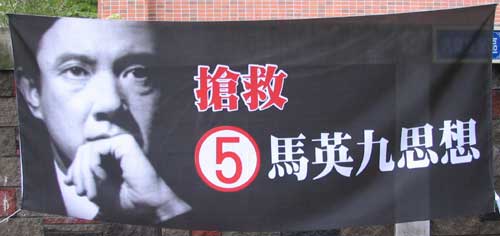
Taiwan campaign banner discussed in this post. It pictures KMT Chairman Ma Ying-jeou looking thoughtful.

This banner reads qiǎngjiù Mǎ Yīng-jiǔ sīxiǎng (“rush to save Ma Ying-jeou thought” / 搶救馬英九思想).

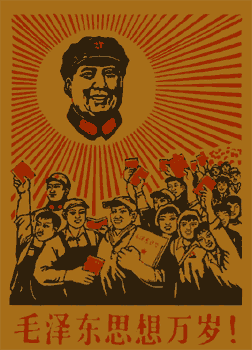
Cultural Revolution image of Chinese masses proclaiming 'Long live Mao Zedong thought!'This is an unusual banner for a number of reasons, not just because even die-hard KMT supporters might be hard pressed to say what exactly “Ma Ying-jeou thought” is. (I’m not trying to set up any punch lines here — really.)
Referring to a prominent figure’s “thought” is much more common in China than in Taiwan and is predominantly associated with Mao Zedong — not the sort of figure to attract votes from pretty much any segment of Taiwan’s electorate.

The standard phrase is Máo Zédōng Sīxiǎng (毛澤東思想 / 毛泽东思想 / “Mao Zedong Thought”). See, for example, the Cultural Revolution-era poster at right, which reads “Mao Zedong Sixiang wansui!” (“Long live Mao Zedong Thought!” / 毛泽东思想万岁). As far as I know, though, people in China didn’t have to urgently rush to save it. Searches on Google and Baidu for “抢救毛泽东思想” (“rush to save Mao Zedong thought”) yield no responses at all. On the other hand, giving a Japanese reading of “banzai!” for wansui (万岁) might change the feeling of urgency some.

Before turning to a look at numbers, I’d like to offer a few more observations about this banner:

  • The candidate isn’t Ma Ying-jeou, though Ma is the only person shown here and the only one to have his name mentioned. The only way to identify this candidate would be through the candidate number. Even Ma being head of the KMT doesn’t help, since candidates’ political affiliations are not given on the ballot other than in presidential elections.
  • A campaign-material color scheme of black and red doesn’t indicate an anarcho-communist candidate but rather a supposedly urgent need to vote for someone. A candidate who uses predominantly black campaign material is one whose election may hang by a thread and so needs all the help he or she can get. But this is usually nothing but a campaign gimmick.

Here’s a table of the results of Google searches for the “thought” of some prominent political figures, with Confucius thrown in for good measure, as he was more of a real philosopher than all the rest of them put together. Also, to give a sense of the relative numbers of Web pages, I’ve added the search results for 的, the most frequently used Chinese character; this provides a very rough and unscientific ratio of about 2.4 Web pages in China for every 1 Web page in Taiwan.

I ran four variations on each main search. In addition to looking for the exact phrase of “[someone’s] thought” I checked the results as restricted to .tw domains, .cn domains, Taiwan governmental domains, and PRC governmental domains.

Search phrase Translation Total .tw .cn .gov.tw .gov.cn
de 769,000,000 95,100,0000 246,000,000 15,800,000 35,900,00
毛澤東思想 Mao Zedong thought 2,330,000 8,200 1,140,000 174 342,000
孔子思想 Confucius thought 64,000 3,160 21,500 200 2,860
鄧小平思想 Deng Xiaoping thought 27,800 256 14,900 12 1,660
孫中山思想 Sun Yat-sen thought 10,300 1,210 2,720 196 361
江澤民思想 Jiang Zemin thought 4,120 59 573 5 98
胡錦濤思想 Hu Jintao thought 2,400 34 1,140 0 198
蔣介石思想 Chiang Kai-shek thought 850 15 251 0 17
馬英九思想 Ma Ying-jeou thought 326 31 1 0 0
李登輝思想 Lee Teng-hui thought 85 52 2 0 0
蔣中正思想 Chiang Kai-shek thought

(alternate form)

54 27 0 7 0
蔣經國思想 Chiang Ching-kuo thought 34 11 7 0 0
陳水扁思想 Chen Shui-bian thought 33 7 6 0 0

Thus, the phrase “[somebody’s] thought” is overwhelmingly a PRC usage and associated with Mao Zedong more than with all the others put together and multiplied by 20. So what’s it doing here with Ma Ying-jeou’s name?

quote of the day

Wǒ de mùbēi shàng
qǐng wèiwǒ kèxià Luómǎ pīnyīn de chuántǒng míngzi
zài yòng Hànzì jiāzhù yìyīn
wǒ yào wǒ de zǐsūn xúnzhe jiāzú de chuántǒng mìngmíng fāngshì
ràng zhèxiē zǔxiān de míngzi liúchuán xiàqù

我的墓碑上
請為我刻下羅馬拼音的傳統名字
再用漢字加註譯音
我要我的子孫循著家族的傳統命名方式
讓這些祖先的名字流傳下去

Rough translation:

On my tombstone
please carve my traditional name using romanization
then use a Chinese character phonetic transcription
I want my descendants to follow the family’s traditional name system
Let these ancestors’ name pass down through the generations

from Mùbēi shàng de míngzi (墓碑上的名字), by Kaing Lipay, a member of one of Taiwan’s indigenous peoples.

see also Q?ng zài w? de mùb?i kèshang chuánt?ng míngzi (??????????????????), CNA, June 10, 2006

Kaohsiung’s signage in English and romanization

Chih-Hao Tsai has a good post (in Mandarin) on the English and romanization in Kaohsiung’s signage: Gāoxióng Shì de Yīngwén lùbiāo — kǎoyàn nǐ de yǎnlì. He notes especially how the text in Latin letters is too small. The post also links to some of his other many writings on the topic.

I’ve had related conversations with officials in the Banqiao City Government and Taipei County Government. Upon hearing my complaints that new signs’ English and romanization are ridiculously small, the officials invariably answer me with something like, “It can’t be too small because we’re following the rules.”

Meanwhile, cities around Taiwan continue to waste taxpayer money putting up signs that don’t help.

campaign poster, zhuyin, and the color purple

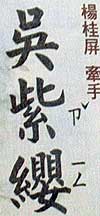
closeup of banner, showing zhuyin for two characters

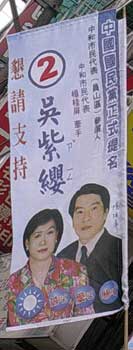
campaign banner with zhuyin to help people read the candidate's nameI’ve already written some about campaign banners and literacy. But it’s campaign season again in Taiwan, with elections for neighborhood chiefs to be held this Saturday, and Taffy of Taiwanease.com and Tailingua has sent me a photo of a campaign banner that features zhuyin fuhao (also known as bopo mofo) alongside the characters for the candidate’s given name. That’s the sort of thing I can’t resist.

The banner is interesting not only in that it gives zhuyin but also that it gives zhuyin for just some of the characters. For the name Wú Zǐ-yīng (吳紫纓) we are given:

ㄗˇ

ㄧㄥ

(See detail at top right.)

That zhuyin is not used for all of the characters in the name indicates that those who created the banner regarded the zhuyin as advisable for two of the characters. Yet the only character here that is particularly uncommon is the last one: 纓. It is used for yīngzi (纓子), a word for “tassel.”

吳, used for the family name Wu, is a fairly common character and is not displayed with zhuyin.

On the other hand, 紫, which is used for zǐsè (紫色/purple), is roughly the 1,700th most common character. Thus, people of voting age in Taiwan should know this character; yet evidently that cannot be taken for granted. This rank would also mean that people living in China’s countryside, though not in the cities, could be declared “literate” even without being able to read or write this character. (This helps illustrate how standards in China are too low. And, even so, literacy figures there are greatly exaggerated.)

Please permit me to stress the obvious: There is nothing in the least bit obscure in Taiwan or China about the Mandarin word for “purple.” Zǐsè is a word that essentially all native speakers of Mandarin would know, regardless of education, just as essentially all native speakers of English would know the word “purple.” But because the powers that be continue to emphasize the exclusive use of Chinese characters, a sizable number of people are incapable of reading (much less writing) the word for “purple.” This extends even to thousands of other words within people’s vocabularies, a situation that would not exist if romanization were permitted as an orthography.

(I’m still wondering why no bloggers who focus more on Taiwan politics have picked up on what I wrote about before: Ballots in Taiwan do not identify a candidate’s political party in any way (not even a logo), except for presidential elections, which are the one election in which everyone already knows for sure the party affiliation of the major candidates. Am I the only person who thinks this is significant? But it’s off-topic for this site, so I’ll not pursue this further here.)

Oh, if anyone’s curious, the title of the Alice Walker book The Color Purple is translated in Taiwan as Zǐsè zǐ-mèihuā (紫色姊妹花).

new MRT signage

David has posted on the inconsistent use of Tongyong Pinyin in the Taipei-area MRT system. I’ve already put a comment there, so I’ll not duplicate everything here.

I spend a lot of time complaining about signage, and my experiences in trying to get some errors in the MRT system corrected have, predictably, been frustrasting. But there is something I do really like: the font for the MRT signage. (See the photos with David’s post.) Does anyone recognize it?

For those of you not in Taiwan, the MRT is the Metropolitan Rapid Transit system for the Taipei area. Most of the system takes the form of a subway. One line, however, is elevated, as is a section of a different line (which also runs on ground level for several miles).

Ma Ying-jeou speaks of Taipei County adopting Hanyu Pinyin

In another sign that Tongyong Pinyin’s days in Taipei County are numbered (not that Tongyong was ever used here much in the first place), Taipei Mayor (and KMT Chairman) Ma Ying-jeou said this on Tuesday:

mùqián Táiběi Shì yǔ Táiběi Xiàn lù míngzi de pīnfǎ bùyī, Táiběi Shì cǎi Hànyǔ Pīnyīn, Táiběi Xiàn cǎi Tōngyòng Pīnyīn, wèilái kěyǐ tǒngyī yòng Hànyǔ Pīnyīn (目前台北市與台北縣路名的拼法不一,北市採「漢語拼音」,北縣採「通用拼音」,未來可以統一用「漢語拼音」)

Although he didn’t state specifically that Taipei County most definitely will use Hanyu Pinyin (which wouldn’t be his announcement to make), he certainly seems to back that happening. Of course, that’s no big surprise; but I like to chronicle such things anyway.

source: Mǎ Yīngjiǔ: Táiběi Xiàn-Shì hézuò; Yīngwén lù míngzi kěyǐ cǎi Hànyǔ Pīnyīn (馬英九:台北縣市合作 英文路名可採漢語拼音), CNA, April 18, 2006