And the language used for the PRC side is …

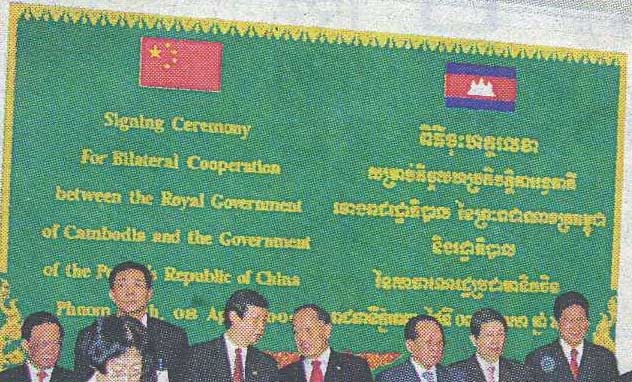
Mark Liberman of Language Log has just added another to the series of Victor H. Mair’s guest posts on English in China. This one features an interesting news photo from the ceremony for the signing of an agreement between China and Cambodia.

photo of banner for a signing ceremony between Cambodia and China, with the text for China given in English, not Mandarin; click for larger image

And I wonder what language the agreement is in.

As Mair, who is also an occasional contributer to Pinyin Info, wrote in his initial post:

Judging from all that I have seen and heard during the last couple of years, however, it is apparent that the role of English in China will continue to grow at an exponential rate. The implications of this massive expansion of English in China will inevitably have a corresponding impact upon local language usage. In fact, the profound effects of the current surge in English usage upon Mandarin and other Chinese languages is already obvious in many respects.

sources:

Taiwan’s MPS2 romanization system is not the same as Yale

Taiwan does not now nor has it ever officially used the Yale romanization system. But that hasn’t stopped the relatively common belief that the Yale romanization system for Mandarin can be found on some official signage here.

What most people take as Yale is in fact MPS2, a Taiwan-devised romanization system that dates from the mid 1980s. MPS2 was developed Taiwan in a vain attempt to counter the growing popularity around the world of Hanyu Pinyin. In other words, it was basically the Tongyong Pinyin of the 1980s, though its supporters (there must have been some) never embraced it with the same level of nationalistic fervor as Tongyong Pinyin has received from some quarters. Little wonder, then, that most people — including many who really should know better — don’t seem to have noticed that MPS2 even exits, much less that a great deal of the island’s signage remains in this system.

To some degree the confusion of MPS2 for Yale is understandable, given that the two systems have many points in common on which they differ with Hanyu Pinyin. Here are some examples.

-au rather than -ao

MPS II and Yale Hanyu
au ao
bau bao
chau chao
dau dao
gau gao
hau hao

-ung rather than -ong

MPS II and Yale Hanyu
chung chong
dung dong
gung gong
hung hong

chr, jr, r, shr

MPS II and Yale Hanyu
chr chi
jr zhi
r ri
shr shi

ts- instead of c-

MPS II and Yale Hanyu
tsai cai
tsan can
tsau cao
tseng ceng
tsou cou
tsu cu
tsung cong
tsz ci

And neither uses Hanyu Pinyin’s abbreviated vowel forms (such as -ui for -uei, -iu for -iou, and -un for -uen). But here we can begin to see some of the differences between MPS2 and Yale.

MPS II Yale Hanyu
chuei chwei chui
duei dwei dui
tzuei dzwei zui

Yale often uses w as a medial where other systems would use u.

MPS II Yale Hanyu
shuei shwei shui
suan swan suan
guang gwang guang

Yale often uses y as a medial where other systems would use i

MPS II Yale Hanyu
jia jya jia
niau nyau niao
chiung chyung qiong

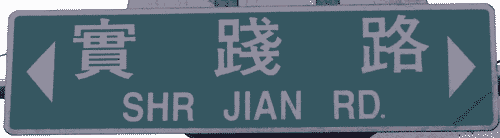
This sign, in Banqiao, would read Shrjyan in Yale, not Shrjian, which is MPS2.
street sign reading 'SHR JIAN RD'

To review all of the similarities and differences among these and other systems, see my comparison chart of romanization systems.

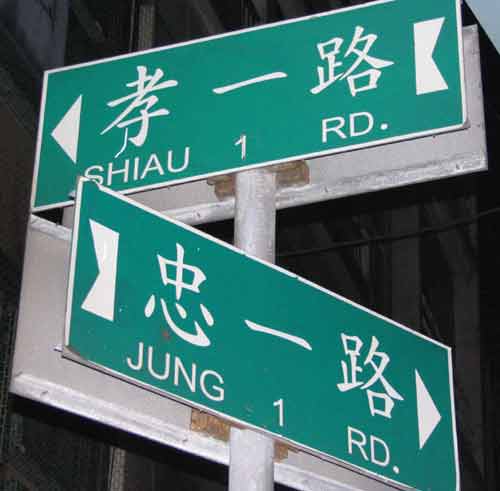
To close, here are some more signs in MPS2. What in Hanyu Pinyin is written zhong is jung in both MPS2 and Yale. What in Hanyu Pinyin is xiao, however, is written differently in MPS2 and Yale: shiau and syau, respectively.

photo of street signs in Jilong. One sign reads 'JUNG 1 RD', the other 'SHIAU 1 RD'
This photo was taken in Jilong.

Guangzhou subway to switch from Pinyin to English-Pinyin mix

Guangzhou’s Metro will be reportedly be changing from Hanyu Pinyin to a mix of English and Pinyin in the naming of its stations. Thus, for example, “Guangzhou Huochezhan” will become “Guangzhou Train Station” (or something like that) and Tiyu Xilu will become Tiyu West Road.

If the official website of the Guangzhou Metro is anything to go by, the Pinyin presently used there is terrible. The official website is infected with the Pinyin-crippling diseases of InTerCaPiTaLiZaTion and FailUreToSePaRateWords. 体育西路, for example, is given not as Tǐyù Xīlù but as TiYuXiLu. Horrible! And, of course, there are some typos too, which make matters even worse, such as TiYuZhongZin for what should be Tǐyù Zhōngxīn.

The last time I was in Guangzhou the subway didn’t exist, so I haven’t seen this signage for myself. Can anyone supply photos of station signage in Guangzhou? I’d also appreciate receiving photos of official Pinyin signage from elsewhere in China. (Photos can be sent to the address on my contact info page.)

And, of course, there’s no word on supplying what ought to be a basic: additional signage in romanized Cantonese.

I have written the authorities there seeking details about the conversion but have not received a reply.

source and resources:

typo of the day

Ain’t it the truth.

sign in Guangzhou Province with 'ticketing hell' rather than 'ticketing hall'

Jìzhě zuórì (5 rì) qiánwǎng Dōngguǎn shìqū mǒu qìchē zǒngzhàn bànshì, zài zhàn qián guǎngchǎng xià le gōngjiāochē biàn xúnzhǎo shòupiàotīng wèizhi. Zǒuláng shàng xuángguà zhe yīkuài jùdà de zhǐshì pái, zhǐmíng chángtú shòupiàotīng de wèizhi, dàn Hànzì xiàmian pèishàng de Yīngwén ràngrén dàchī-yījīng, hèrán xiě zhe: Ticketing Hell (Zhōngwén zhíyì wéi “shòupiào dìyù”). Yuánlái shì dàtīng de Yīngwén “Hall” bèi wùxiě wéi “Hell” (dìyù).

Zhè kuài zhǐshì pái de bèimiàn xiě zhe bùtóng de nèiróng, Zhōngwén shì “xíngrén tōngdào”, Yīngwén xiězuò “Pedestrain chenneling”. Zhuānyè rénshì gàosu jìzhě, “chenneling” bùzhī hé yì, shì zìjǐ shēngzào de cíhuì, kěnéng shì xiǎng xiě “channeling” ér chūxiàn le pīnxiě cuòwù, dàn “channeling” shì “gōuqú” de yìsi, “tōngdào” yībān xiězuò “channels”.

Zài guǎngchǎng de lìngyī cè, gōngjiāo zhàn de zhǐshì pái shàng bùzài xiě Yīngwén, érshì gǎiyòng Pīnyīn, dànshì xiězuò “gongjiaozan”, “zhàn” zì de pīnyīn yěshì cuòwù de.

Yǒu chéngkè gàosu jìzhě, zhèxiē zhǐshì pái yǐjing guà le hǎojǐ nián le, yīzhí méiyǒu huàn xiàlái. Rúguǒ wàibīn kànjian, bùzhī zuò hé gǎnxiǎng.

source: Yīngwén pīnxiě cuòwù: yīzìzhīchā shòupiàotīng biàn “dìyù” (英文拼写错误 一字之差售票厅变“地狱”), Guǎngzhōu Rìbào, November 4, 2006

Banqiao street names

Although Banqiao — spelled “Panchiao” in bastardized Wade-Giles and “Banciao” in Tongyong Pinyin — is one of Taiwan’s most populous cities, it doesn’t get much attention, overshadowed as it is by its neighbor Taipei.

To a certain degree that’s deserved: With a population of some 542,000 (which, if it were transplanted to the United States, would make it that nation’s 26th largest city), Banqiao really ought to have more of interest. But, still, it has been my home for about nine years and it isn’t completely awful. (How’s that for a recommendation?) And the city has been improving, especially with the development around the enormous new train station and the equally enormous Taipei County Government Hall. (David has a few additional photos of Banqiao. I’m amazed I have yet to run into him on the street, especially since foreigners tend to stick out here.)

Until a few years ago, street signs in Banqiao were relatively uniformly in MPS2 (often confused with the Yale romanization system), along with the usual assortment of mistakes and smatterings of other systems. Then signs in Tongyong Pinyin began to replace some but not all of those in MPS2. Last year’s elections, however, saw the DPP lose power in both Taipei County (Banqiao is the county’s largest city) and Banqiao itself. So a move toward Hanyu Pinyin can be expected — eventually. As far as I know, though, the city’s department of transportation, which is in charge of such signage, is still under the erroneous belief that the city must follow the central government’s guidelines and thus use Tongyong. Jilong (Keelung) is another example of a city under a pan-blue administration that thinks it has to use Tongyong.

For people’s reference, I have compiled a list of Banqiao street names in Chinese characters, Hanyu Pinyin (with tone marks), and the mix of romanization and English generally seen in Taiwan.

resource:

PRC gov’t project has primary name in English, not Mandarin

This one had me confused at first. When I saw the photo I was expecting this to be another story about a typo. Here, after all, is a sign with 泰达 on both sides, which is “Taida,” not “Teda,” in Pinyin. And I’ve grown so used to seeing Pinyin described as “English” that at first at didn’t realize what was meant. But there’s something else going on here, something much more interesting:
street sign with TEDA AVENUE on one side and TAIDA AVENUE on the other; but the Hanzi are the same on both sides

泰达大街两侧的路牌上,“泰达”的英文标识出现了“TEDA”和“TAIDA”两种写法,前者是“泰达”的英文拼法,后者则是“泰达”二字的汉语拼音。从开发区地名办了解到,泰达大街正式的英文写法为“TEDAAVENUE”,而“TAIDA”的写法是不正确的。

But this still isn’t very clear. I did some digging and found that the street name refers to the nearby Tianjin Economic-technological Development Area (TEDA), the Mandarin name for which is Tiānjīn Jīngjì Jìshù Kāifāqū (天津经济技术开发区).

In other words, this street really does have a name originating in English: TEDA. The Chinese characters for the street name, 泰达 (Tàidá), are secondary. They have nothing to do with the Mandarin name of the park; rather, they are an awkward transliteration of TEDA, the acronym of the English name.

This practice extends beyond the name of the street into references to the name of the industrial park itself. “泰达” is all over the park’s official Web site, which, significantly, is at www.TEDA.gov.cn. Thus, English trumped Mandarin in naming a PRC-government-sponsored industrial park in a Mandarin-speaking region of China, despite PRC regulations against just this sort of situation.

So the original story in Hanzi becomes a little clearer if put into Pinyin:

TEDA Dàjiē liǎngcè de lùpái shàng, “Tàidá” de Yīngwén biāozhì chūxiàn le “TEDA” hé “Taida” liǎng zhǒng xiěfǎ, qiánzhě shì “泰达” de Yīngwén pīnfǎ, hòuzhě zéshì “Tàidá” èr zì de Hànyǔ Pīnyīn. Cóng kāifāqū dìmíng bàn liǎojiě dào, TEDA Dàjiē zhèngshì de Yīngwén xiěfǎ wéi “TEDA Avenue”, ér “TAIDA” de xiěfǎ shì bu zhèngquè de.

This, by the way, is also an example of how capitalizing everything on street signs can sometimes lead to confusion.

resources:

Chinglish International Airport revisited

I’ve just heard from a well-placed source that the official English name for Taiwan’s main international airport, formerly Chiang Kai-shek International Airport, has been finalized. The form “Taiwan Taoyuan International Airport” will not be used after all. Instead, it will be “Taipei/Taiwan Taoyuan International Airport.”

Huh?

I’m still seeking confirmation.

Korean romanization — again

It’s not just Taiwan that can’t seem to get its romanization situation resolved well. “Calls for a revision of the current Romanization system for the Korean alphabet, Hangul, are gaining more ground as confusion continues on the roads, signboards and government documents after the introduction of the current form in July 2000,” reports the Korea Times.

Some 75 percent of South Koreans think the government-enacted Romanization system does not reflect the original pronunciation of Hangul properly, a survey conducted by the Yoido Institute, a think tank of the opposition Grand National Party (GNP) showed yesterday.

Of the 2,150 adults polled last week, 66.1 percent wanted the current system to be revised despite the expected financial cost, according to the survey conducted on the occasion of the 560th Hangul Day which falls on Oct. 9.

I make no claims of knowledge of which romanization system would be best for Korea, so be sure to read my comments with that in mind. But I do know to be wary of polls conducted by political parties.

Hangul was first Romanized using the McCune-Reischauer (M-R) system in the early 20th century, when a number of foreign missionaries came to the Choson Kingdom. But the country’s Romanization system underwent flip-flopping policies in the following decades.

“Confusions we experience today have been caused largely due to the arbitrary attitudes of armchair linguists and some misguided government officials,’’ said Kim Bok-moon, professor emeritus of Chungbuk National University.

Scraping the traditional M-R system, which had prevailed in the past decades, the government adopted a new system on July 7, 2000, shifting “Pusan,’’ “Kobukson (turtle ship) and “kimchi’’ into “Busan,’’ “Geobukseon’’ and “gimchi.’’

The English-language media, including the state-funded Yonhap News Agency, had resisted the change for a period of time. But, as time went by, all the news media gave in to the new system except The Korea Times, which has maintained the M-R system concluding that it is the most similar to actual pronunciation.

Let alone the tremendous cost of the revision, the main problem of the current system is that it does not ensure the exact pronunciation of the original sound of various Korean words.

No romanization system — or any other script, for that matter — ensures the exact pronunciation of the words of a language for people who do not know how that system works. It seems unlikely that the South Korean government would have promulgated an inherently unworkable system, such as the bastardized version of Wade-Giles is for Mandarin Chinese. (Proper Wade-Giles, of course, could work perfectly well for Mandarin, though I certainly don’t recommend it.)

And the author shouldn’t have written “the exact pronunciation of the original sound of various Korean words” but simply “the exact pronunciation of Korean words.”

Kim, who serves as president of the Research Institute for Korean Romanization (KOROMA), has made sole efforts to end the confusion, submitting a petition to then President Kim Dae-jung and presenting a Constitutional petition.

In a seminar at the National Assembly yesterday, he presented the disastrous result of an experiment that he conducted along with KBS TV about the new system in Itaewon, downtown Seoul, and at the Kimpo International Airport.

When he asked foreign people to read “Yeoksam-dong (???)’’ and “Geobukseon (???),’’ the majority of them pronounced them “ioksaemdong (????)’’ and “jiobuksion (?????),’’ far different from the actual sound.

Oh, no. Not another “let’s ask a random and probably clueless foreigner how to pronounce something” poll. These mean nothing. There are plenty of people in the United States who would mangle even the pronunciations of items on a menu in a Mexican restaurant; but that doesn’t mean Spanish orthography needs revision.

Because a committee under Taiwan’s Ministry of Education approved a romanization method for Taiwanese last week, some grandstanding member of the legislature is almost certainly going to force some executive-branch official who doesn’t know the system to read out loud something that was written in it, thus “proving” the system doesn’t work. It might already have happened.

According to Kim, 16 out of the newly Romanized 21 vowels of Hangul are out of sync with actual sounds when they are read by English-speaking people, who have no knowledge about the premise that “eo’’ would be pronounced as “?.’’ He has devised his own system, which he claims ensures the best pronunciations.

“Disasters that many critics expected have already begun. We can easily find serious confusion here and there,’’ Kim told The Korea Times. “We have to correct the mistake without delay before it is too late, and adopt a proper system.’’

Romanization systems seldom work well when forced into the mold of an anglicization. I wonder if romanized Korean is commonly but mistakenly referred to in Korea as “English.”

And, of course, there’s always an appeal to nationalism:

One example of what Kim cited as “losses of national interests’’ was “Koguryo’’ and “Dokdo,’’ which became objects of historical and even territorial rows with China and Japan during the past couple of years.

At a time when China spelled the ancient Korean kingdom as “Koguryo,’’ South Korea’s English-language dailies, except for The Korea Times, wrote it as “Goguryeo.’’ It was later unified into Koguryo as even the UNESCO’s World Heritage called it Koguryo.

A set of South Korean tiny islets in the East Sea, Dokdo had also been divided into “Tokto’’ and “Dokdo.’’ The Korea Times agreed to unify it into Dokdo at the recommendation of the government as an exceptional case. But the foreign news media and Web sites are still left confused between them.

The article closes:

Critics say the Romanization system should be revised in a way that best reflects the characteristics of the Korean language and the reunification of the two Koreas should also be taken into consideration.

North Korea has a system similar to the M-R system, which writes its cities and places in English as “Pyongyang,’’ “Kaesong’’ and “Mt. Kumgang’’ _ not “Pyeongyang,’’ “Gaeseong’’ and “Mt. Gumgang.’’

North Korea once proposed the unification of the different Romanization systems used by South and North Korea in a meeting of linguists from the two Koreas in Berlin, Germany, in 2002.

++++++

source: Hangul Romanization Revision Proposed, Korea Times, September 26, 2006

some comments here: More romanization debate, The Marmot’s Hole, September 29, 2006

read about hangul here: Hangul Day, Language Log, October 9, 2005