preliminary meeting on writing Taiwanese

The Ministry of Education sponsored a gathering on Saturday to conduct preliminary discussions on how to write Taiwanese. The hope is that a decision can be reached soon on an orthography.

I would hope that by now there’s sufficient worry about the future of Taiwanese that scholars will stop arguing among themselves about which system to use. Maybe soon they’ll finally come together. But I suspect that instead they’re going to continue to bicker as the clock runs out on Chen Shui-bian’s second term.

I haven’t seen any reports on how Saturday’s gathering went.

Jiàoyùbù jīntiān xiàwǔ zhàokāi “Mǐnnán yǔyán yīnbiāo” zuòtánhuì, yāoqǐng xiāngguān lǐngyù xuézhě zhuānjiā, Táiyǔ wén zuòjiā, mínjiān tuántǐ dàibiǎo yánshāng tǎolùn. Jiàoyù Bùzhǎng Dù Zhèng-shèng zhǐchū, jǐnguǎn huìyì méiyǒu gòngshí, tuīdòng tǒngyī de Mǐnnányǔ yīnbiāo xìtǒng hái zài tǎolùn jiēduàn, Jiàoyùbù jiāng zūnzhòng zhuānjiā yìjian, qīdài jǐnkuài gěi shèhuì yī ge dá’àn.

Dù Zhèng-shèng zhǐchū, zhìdìng tǒngyī de Mǐnnányǔ yīnbiāo xìtǒng, zàixué lǐ shàng yǒu kùnnan, ér gè bùtóng pàibié yěyǒu bùtóng jiānchí, Jiàoyùbù qīdài xuézhě néng chōngfèn gōutōng, tǎolùn chū gòngshí, Jiàoyùbù yě huì zūnzhòng zhuānyè, jiànlì yī tào shìhé shèhuì xūyào de Mǐnnányǔ yīnbiāo xìtǒng.

Jiàoyùbù Guóyǔ tuīxíng wěiyuánhuì zhǐchū, mùqián shǐyònglǜ bǐjiào gāo de Mǐnnányǔ pīnyīn xìtǒng bāokuò jiàohuì luómǎzì pīnyīn, Táiwān Mǐnnányǔ pīnyīn xìtǒng yǔ Tōngyòng Pīnyīn, lìngwài hái yǒu TLPA Mǐnnányǔ jí gǎiliáng shì TLAP děng xìtǒng, yóuyú quēfá tǒngyī de zhěnghé bǎnběn, shǐ xuéxiào tuīxíng xiāngtǔ yǔyán kèchéng shí, yě zāoyù bùzhī shǐyòng hézhǒng bǎnběn de kùnnan.

Jiàoyùbù Guóyǔ Huì biǎoshì, jīntiān de huìyì zhǐshì zhèngshì huìyì de “huì qián huì,” mùdì shì zài gè pài xuézhě zhuānjiā jiāoliú yìjian, chōngfèn gōutōng, qīdài wèilái tòuguò hézuò jiāoliú, zhěnghé chū yī tào fúhé mínzhòng qīdài yǔ xūqiú de pīnyīn xìtǒng.

source: Mǐnnányǔ yīnbiāo xìtǒng Dù Zhèng-shèng: zūnzhòng zhuānjiā yìjian (閩南語音標系統 杜正勝:尊重專家意見), CNA, March 18, 2006

Taiwan’s first written language — in romanization

About 80 percent of the “Sinkang Manuscripts” (新港文書) have been deciphered in the ongoing collaboration project between Academia Sinica‘s Institute of Taiwan History and Institute of History and Philology. These documents, in the language of the Siraya people, were written in a romanization system devised by the Dutch colonists in Taiwan in the seventeenth century. Although the Dutch were forced out of Taiwan in the 1660s, writing in this system continued for at least 150 years.

The name Siraya, however, has been applied to the people of that group only since the period of Japanese rule (1895-1945). It was derived from the group’s pronunciation of the word for “I.” The documents get their name from Sinkang Sia, the largest Siraya settlement near the Dutch stronghold Fort Zeelandia.

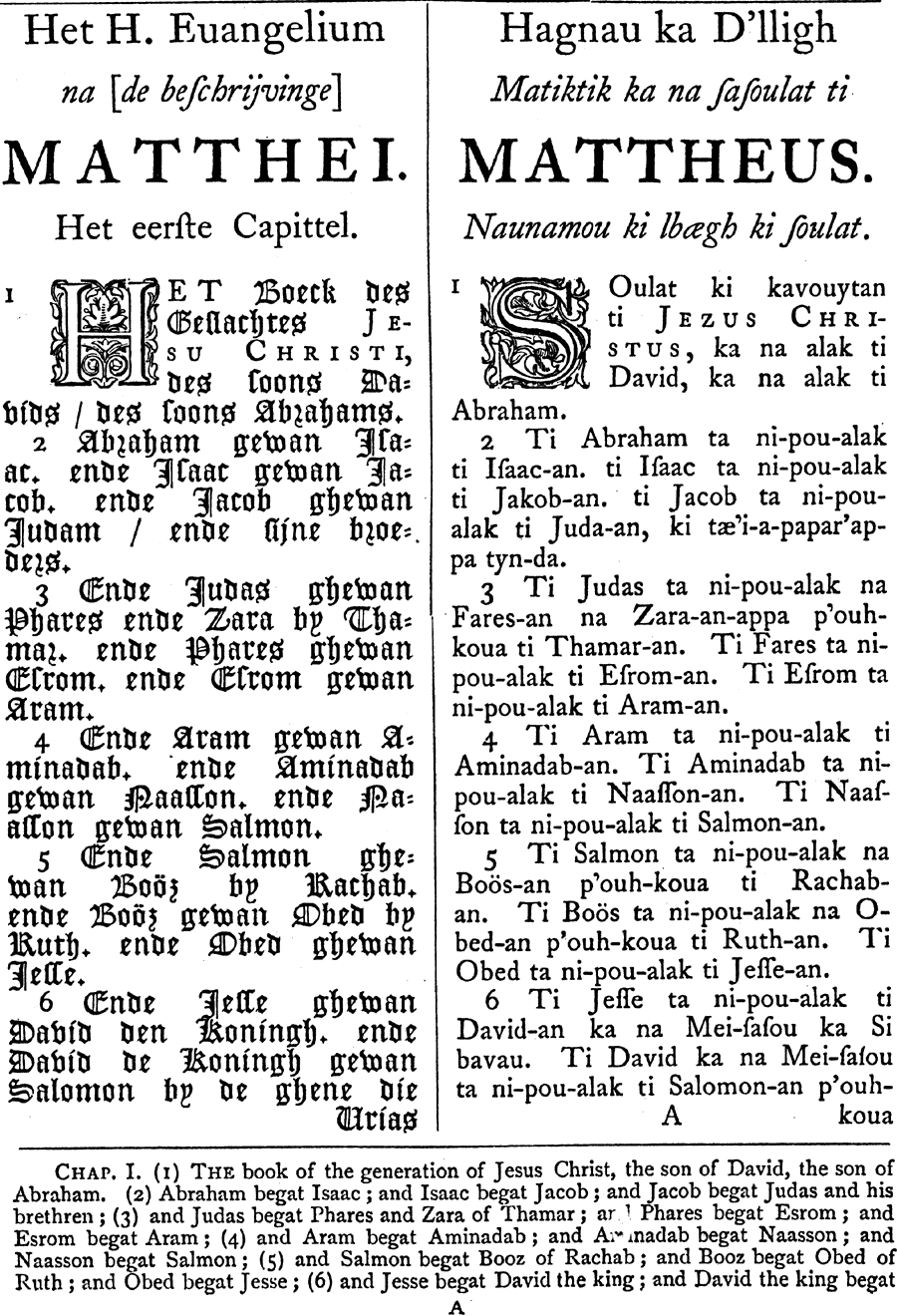
click for an image of the first page of the Book of Matthew in SirayaMost of the documents are records of land contracts and business transactions. Some are bilingual: in Siraya and Dutch, or Siraya and Chinese. One long bilingual document is a translation by the Dutch of the Book of Matthew.

One of the articles cited below states, “The orthography of the Sinkang Manuscripts also embodies a vestige of 17th-century Europe where the italic style of lettering was still unknown in Dutch and Germanic writings.” This sample, however, makes me wonder. Any paleographers or font specialists out there?

The manuscripts also show that some words were borrowed from Hoklo, the Sinitic language now often referred to as Taiwanese

a transcript of a Siraya document: transcript of bilingual Siraya, Chinese document

sources:

too many romanization systems for Taiwanese in textbooks, say critics

Groups favoring the promotion of Taiwanese (also called Hokkien, Hoklo, Minnan, and all sorts of other names) are urging Taiwan’s Ministry of Education to come to a consensus on what phonetic system should be used to teach it, according to an article in the Taipei Times.

The article, however, is a bit confused in its facts, so I’m presenting it for what it’s worth and hoping commenters here can help set matters straight. Certainly, though, the variety of systems — and for some of these I use the word loosely — being used in textbooks is a hindrance to effective teaching of the language.

Some might be surprised to know that Tongyong Pinyin is not Taiwan’s official romanization system for Taiwanese, though its schemes were approved for Mandarin and Hakka. I tend to think of Tongyong for Mandarin as more of a nationalist marketing scheme than a romanization. I know there are more than a few people who hold the same view of Tongyong for Taiwanese.

As long as I’m on the subject, I’d like to remind people that, despite the misinformation that has been spread by some of its supporters, Tongyong is not one system that covers all the languages of Taiwan.

Native-language interest groups yesterday urged the Ministry of Education to speed up the creation of a unified phonetic system for the Hoklo language (commonly known as Taiwanese) to preserve Taiwanese culture.

Lee Shang-hsien (???), director of the Taiwan Pik Hap Cultural Association which promotes the Hoklo language, said that different versions of elementary school Hoklo textbooks used three different phonetic systems.

At the moment, Hoklo text books use either Tongyong pinyin, the Hanyu Romanization system, or the Taiwanese Language Phonetic Alphabet (TLPA).

Lee said that the three systems did not reflect regional Hoklo accents, and added that the Hoklo language could not be preserved and passed on to the next generation without a unified phonetic system.

Language teacher Su Huang-hung (???) said that Hoklo originally had eight tones, but due to the similarity of the second and sixth tones, most phonetic systems regarded Hoklo as a seven-tone language.

Using the Tongyong pinyin system reduces Hoklo to only five tones, Su said.

In addition, Hoklo pronunciation changes according to syntactic context, she added.

However, Tongyong pinyin marks these cases as variant pronunciations, creating a situation in which many students do not know the original pronunciation of the words they study, Su said.

Hanyu pinyin and the TLPA are almost entirely identical, since the TLPA system was derived from Hanyu pinyin by the Ministry of Education many years ago, said Lu Ching-ching (???), a member of the ministry’s Native Language Promotion Committee.

Lu said there were similarities among the three systems, and that all three have advantages and disadvantages.

The committee’s main problem was to reach a consensus and decide on one system or to incorporate the three systems into one, she said.

Discussions are still taking place at the ministry on unifying the phonetic system, Lu added.

Huang Yu-chi (???), director of the Taiwan Association for Students Abroad, said that many overseas Taiwanese return during summer and winter vacations and hope to learn their mother tongue, but the lack of a unified phonetic system makes it difficult for them to do so.

Other representatives said that not only students, but also foreigners and foreign spouses need to learn Hoklo and are in need of a unified system.

source: Culture groups urge ministry to expedite Hoklo writing rules, Taipei Times, February 23, 2006

one book, two languages, three systems

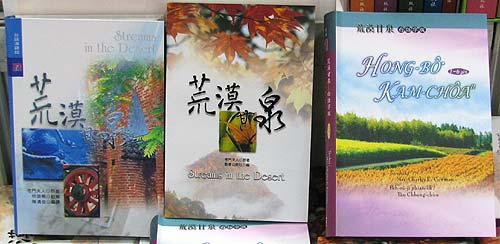
Another discovery at the recent book show was that the Taiwan Church Press has issued three editions of Streams in the Desert: one in a Mandarin translation in Chinese characters, one in a Taiwanese translation in a mixed orthography (mainly Chinese characters, with some romanization), and one in Taiwanese completely in romanization.

Streams in the Desert, a book of devotionals, was written in English by Lettie Cowman, better known as “Mrs. Charles E. Cowman.” Her husband was the founder of the Oriental Missionary Society, which today goes by the name of OMS International. The Cowmans did missionary work in Japan in the early twentieth century.

A representative of the press told me that for every ten copies of the Mandarin version, the company sells two or three of the mixed-script Taiwanese version and one copy of the fully romanized Taiwanese edition.

The fully romanized version sells mainly to people who want to learn Taiwanese rather than those who already speak it, he told me. Its recent publication was an experiment, he added. But I forgot to ask the obvious: Does the press consider the experiment a success?

covers of three editions of 'Streams in the Desert,' as translated into Mandarin and Taiwanese
(from left to right: mixed-script Taiwanese, Mandarin in Chinese characters, and fully romanized Taiwanese)

crossword puzzles in Taiwanese

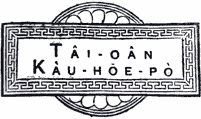
logo of the Presbyterian Church in Taiwan newletter, 1926

At the display for the Taiwan Church Press at the Taipei International Book Exhibition I came across a number of interesting works. The press has issued a 70-volume set of the collected newsletters of the Presbyterian Church of Taiwan. (University and research libraries, take note! So far no sets — NT$150,000 (US$4,600) each — have been sold to America or Europe.) The Presbyterian Church has long been an advocate of the rights of the people of Taiwan to speak Taiwanese without oppression, write in Taiwanese (including in romanization), and enjoy other political and human rights.

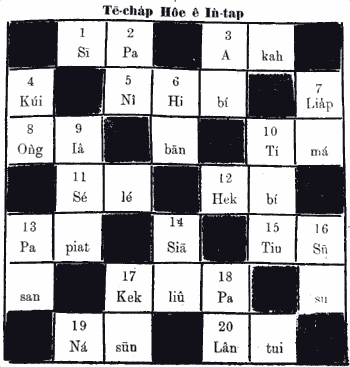
The newsletter, which dates back well into the nineteenth century, was written in romanized Taiwanese until 1969, when the KMT forced a change to Mandarin in Chinese characters. While flipping through a volume of the newsletters from the 1920s, I was startled to see that crossword puzzles in Taiwanese were a regular feature. (Click the thumbnail for a larger image.)

click for fullsize image of crossword puzzle in Taiwanese

It’s one thing to have read of the novels, poems, religious material, and technical manuals written in Taiwanese, it’s another to see something so human and familiar leap out from the page. This really helped bring home for me how much has been lost, especially in terms of opportunities, because of the suppression of romanized Taiwanese, first by the Japanese and then by the KMT.

Interestingly, if you look at the answers below, you’ll see that each of the boxes is meant to be filled in with not an individual letter but with syllabic units.

completed crossword puzzle in Taiwanese, from 1926

I’ve tried my hand at creating some crosswords in Mandarin using Hanyu Pinyin, but in individual-letter, not syllabic style. This is a little tricky. In English, all letters of the alphabet can appear at the beginning, in the middle, or at the end of a word. That’s not so in Mandarin as written in Pinyin. The letters i and u, for example, never come at the beginning of a word. And no word ends with anything other than a, e, i, o, u, g, n, or r. (I’ll finish some of those crosswords one of these days, Gus!)

It would be easier to make a crossword puzzle using bastardized Wade-Giles because that has fewer letters but also more finals. But of course not as many people would be interested in solving it, me included.

For even more on the issue of the romanization of Taiwanese, see the Taiwan section of De-Sinification.

‘language with no boundaries’

I read today that scientists in Japan have demonstrated that paddy birds are able to distinguish between English and Mandarin — well, at least if they’re given an incentive to do so. The researchers didn’t use Japanese because the birds were already used to hearing that language.

This might have implications beyond just the category of “hmm, researchers have been spending a lot of time playing recordings of English and Mandarin Chinese translations of Genji Monogatari (The Tale of Genji) and Wagahai wa Neko de Aru (I Am a Cat)(?!) to birds.”

“Humans are able to distinguish between languages, even ones they don’t know, from the intonation and pronunciation, and it seems that paddy birds have the same ability,” [Keio University professor Shigeru] Watanabe said. “If we study common traits, such as brain structure, this may shed light on the mechanisms of speech recognition.”

According to the article, monkeys, mice, and other mammals have already been shown to have the ability to distinguish between a variety of languages, but this is “the first time that birds have been scientifically found to possess the same ability.”

Mammals distinguishing between languages brings to mind the much-reported efforts of the PRC to push some pandas on Taiwan, which took a turn toward the silly last month when China announced the pandas were being “taught” Taiwanese/Hoklo/Hokkien (or the Minnan dialect [sic], as China likes to refer to it).

“We began our language training with songs because music is a language with no boundaries,” said Li, the 25-year-old keeper who has taken care of No.19 since he was born.

“Girls are more gifted than boys in learning languages,” said Xu, No.16’s keeper, adding that the female cub began to react when they translated her nickname Huangmao Yatou (meaning a chit of girl in Chinese) into Minnan dialect.

“No. 19, however, is too naughty to study,” said Li….

“We immediately started our training program because the two cubs not only need to adapt themselves to the climate and geographical environment of the tropical island, but also to understand the language of their new keepers and visitors,” said Li Desheng, director assistant of the center.

“It’s not an easy task for the pandas as they are already familiar with the Sichuan dialect of their current keepers. They need more time to improve,” said Li Desheng.

China’s strained claims that this isn’t all one big propaganda ploy hit an especially rocky patch about a week ago when the results of a nationwide vote for the pandas’ names were announced. The winning names are Tuántuán and Yuányuán, more examples of reduplication in naming.

The source of these names is the Mandarin word tuányuán (?? / ??), which means “reunify.”

Fat chance Taiwan will accept them now.

Supposedly 100 million people voted in the name-selection process. Maybe it’s true. There are probably at least that many people there who would love a chance to vote for something.

sources:

Just a cartoon. Not to be taken seriously.
It's a cartoon. Not to be taken seriously.

The ‘g’ in Ang Lee

Ang Lee (李安), the director of Brokeback Mountain, Crouching Tiger, Hidden Dragon, The Ice Storm, Sense and Sensibility, Eat Drink Man Woman, and many other films, was recently back here in his homeland of Taiwan.

I’ve long wondered how Lee ended up with such an odd form for the romanization of his name. I’m not referring to the spelling of his family name, Lee. Although the Anglicization of “Lee” for 李 is not standard in any of the main romanization systems, that particular spelling is almost certainly more common in Taiwan than “Li,” which is the form in most romanization systems other than Gwoyeu Romatzyh. In Gwoyeu Romatzyh, which nominally was Taiwan’s official romanization system until 1986 — long after Lee acquired a passport and had gone to the United States — is written Lii; but I’ve never seen that spelling used for a name here.

No, what puzzles me is the g in his given name of “Ang.” In Mandarin, this is one of those relatively rare syllables spelled the same in basically all of the main romanization systems: an. So where is that g from? (Please don’t read through the rest of this message in any kind of suspense, because I still don’t know the answer to that question, though I’m hoping one of my readers will.)

For those unfamiliar with Mandarin, Ang Lee’s given name is not originally pronounced like American English’s bang without the b or sang without the s. Rather, the a is similar to that in the English word father; the n is about as you’d expect; and there’s no g. So the name is pronounced something like the French (not English) version of Anne or the end of the German Autobahn.

The Ang spelling doesn’t appear to come from Taiwanese. Even in Taiwanese 安 would be romanized as an, not ang, in the dominant systems. (Correct me if I’m wrong, please. I know almost no Taiwanese.) Also, at the time Lee would have adopted the Ang spelling, the use of Taiwanese romanization for names would most certainly have been intensely frowned upon by the authorities if not forbidden outright. Moreover, I don’t think Lee is even ethnically Taiwanese/Hokkien.

Of course, he may have chosen to use a spelling other than what he was made to use on his passport. But people in Taiwan seldom do that unless they adopt an “English” name, which “Ang” is certainly not. The g might be there to help prevent people from thinking he’s a woman named Ann. But if that were the concern, why not simply adopt an English name?

Poagao, who met Ang Lee in Taipei last week, met back in September with Lee’s little brother, who’s known as Khan (or perhaps Kan) Lee. As Poagao notes, there’s something strange with that name, too:

One thing I’d like to know is why “Ang” gets an unneccesary ‘g’ (it should be “An”), while “Kan” is one ‘g’ short (it should be “Kang”). Did Ang steal his little brother’s ‘g’ at some point?

Ang Lee’s brother’s name is Lǐ Gǎng in Hanyu Pinyin. (Theoretically, it could also be Lǐ Gàng or Lǐ Gāng because 崗 is one of many Chinese characters with multiple pronunciations.) The use of k rather than g comes from the Wade-Giles romanization system. In Taiwan, most people’s passports have names romanized using improper, bastardized Wade-Giles, which helps create a lot of confusion — as if Wade-Giles itself weren’t confusing enough already. Moreover, Taiwan’s passport office operates on the principle of chabuduo jiu keyi, which in this context is a close approximation of the English saying “close enough for government work.” In other words, if a spelling looks more or less correct it will probably pass — unless, that is, it has Hanyu Pinyin’s x or q in it, in which case it would probably be rejected. (I’m not making this up. I’ve spoken with people in the passport office about this.)

In looking through Lee Ang’s biography I noticed that he has two sons, one of whom is named “Haan,” at least according to the Internet Movie Database’s credits for Pushing Hands, one of Lee’s early movies. At first, I thought this might be a two-syllable given name that had been run together: Ha’an (or Ha-an, following the style used in Taiwan). Could this be the same an as in Ang Lee’s name — just this time without the mysterious g? But it turns out that Haan is a one-syllable name.

Here’s the character: 涵.

A doubled vowel in romanized Mandarin usually indicates the use of Gwoyeu Romatzyh’s tonal spelling. But the “Haan” spelling would be for third tone, while Haan’s name should be pronounced with a second tone. (This would be written “Harn” in Gwoyeu Romatzyh.)

So perhaps the IMDB entry is a typo, and the real spelling should be Han, as expected. Or maybe those in the Lee family just like funny spellings.