certifying Mandarin teachers in Taiwan

Taiwan’s Ministry of Education hopes to introduce a certification system for teachers of Mandarin as a foreign language. David has already stated what I would:

It would be interesting to know whether knowledge of Hanyu Pinyin and simplified characters is necessary to obtain certification. It does seem like a good idea, but unless the standards for certification are set at a high level then it won’t achieve much.

sources:

Shanghai students to focus more on Pinyin at first

Some 20 percent fewer characters will have to be learned during a child’s first two years of school in Shanghai, with more attention being devoted to Pinyin. I’d be happier if this were everywhere, including areas where the native language is Mandarin, but this is good news nonetheless.

Shanghai primary school students will be required to learn 20 percent fewer Chinese characters but spend more time on pinyin in their first two school years, the Shanghai Education Commission said yesterday.

The reform is meant to ease the study burden by making language learning less of a chore.

Starting in the spring semester which beings next week, first-year students will be required to recognize 364 Chinese characters compared with the previous 460.

Altogether 205 characters will be canceled in first two school years out of the former 1,000-plus.

“Despite the city’s education reform, studies we’ve performed in the past months still suggested that young pupils were over-burdened with character recognition and writing tasks. And that reduces a child’s interest in learning,” said Qu Jun, the education commission’s vice director.

Most of the characters eliminated from the requirement list were considered complicated. The canceled contents might be left for extracurricular self-study or postponed to be taught later, authorities said.

It wouldn’t be much help if students have to learn those characters during the same years anyway, just outside of school. Postponing the memorizing of them is the only way for this to make any real difference.

But commission officials said that they haven’t worked out any punishments yet for those who violate the rule.

Also, teachers are being required to spend more time on pinyin — a system that translates Chinese characters into the Roman alphabet — during the first two years of school.

The final paragraph above has a serious error. Pinyin is not “a system that translates Chinese characters into the Roman alphabet.” This sort of thinking is behind a lot of the confusion related to the nature of Chinese characters, the sinitic languages, and Pinyin. The distinction is important: Pinyin is for the Mandarin language, not for Chinese characters.

source: Primary students learn less Chinese characters, Shanghai Daily (via Xinhua), February 10, 2006

Taipei street names and tone marks

Here’s another in my series on official signage in the Taipei area.

Taipei has more than 630 different street names. Although none of these are homophonous, five pairs of names should have tone marks added to the Hanyu Pinyin so that the names will be easily distinguished from one another.

But whoever makes the signs should be especially careful because the only official signage with tone marks I’ve seen in the Taipei area has been ugly and inept. (But those signs were in Taipei County, not Taipei City.)

Chinese characters Pinyin and English mix
景華街 Jǐnghuá St.
景化街 Jǐnghuà St.
同安街 Tóng’ān St.
通安街 Tōng’ān St.
萬慶街 Wànqìng St.
萬青街 Wànqīng St.
五常街 Wǔcháng St.
武昌街 Wǔchāng St.
向陽路 Xiàngyáng Rd.
襄陽路 Xiāngyáng Rd.

Note the use of an apostrophe in “Tong’an.” For more on this, see ‘Hot-Milk Road’ and other street-name errors.

For a related entry, see Taipei street names and the monosyllabic myth.

‘Hot-Milk Road’ and other street-name errors

Just 3.6 percent of Taipei’s street names need apostrophes. But those that need them really do need them, and Taipei’s ill-advised, counterproductive, and downright annoying InTerCaPiTaLiZaTion on street signs is no substitute for doing things right.

Because Taipei continues to omit required apostrophes from street names, one of the city’s main thoroughfares is labeled the Mandarin equivalent of Hot-Milk Road. This is because according to the rules of Hanyu Pinyin RENAI is RE+NAI, not REN+AI. Thus, rather than a road named after rén’ài (love for one’s fellow man; humanity; 仁愛), Taipei has rènǎi (hot milk) road (熱奶路).

I’m not going to bother giving all of the misleading readings, as I did in my earlier entry on mistakes in Taipei’s MRT system. But there are plenty of awkward results of Taipei’s mistakes.

Below are all of Taipei’s street names that require an apostrophe. Almost all of these contain the character 安 (an).

Note the tone marks on Tóng’ān St. (同安街) and Tōng’ān St. (通安街). More about those in a later entry.

Chinese characters Pinyin and English mix
保安街 Bao’an St.
北安路 Bei’an Rd.
博愛路 Bo’ai Rd.
長安東路 Chang’an E. Rd.
長安西路 Chang’an W. Rd.
大安路 Da’an Rd.
惠安街 Hui’an St.
民安巷 Min’an Ln.
寧安街 Ning’an St.
農安街 Nong’an St.
仁愛路 Ren’ai Rd.
瑞安街 Rui’an St.
泰安街 Tai’an St.
同安街 Tóng’ān St.
通安街 Tōng’ān St.
萬安街 Wan’an St.
西安街 Xi’an St.
新安路 Xin’an Rd.
信安街 Xin’an St.
興安街 Xing’an St.
鍚安巷 Yang’an Ln.
永安街 Yong’an St.
詔安街 Zhao’an St.

mistakes in Taipei’s MRT system

If Taipei’s MRT (mass rapid-transit) system doesn’t finally get its Pinyin right when the next set of stations opens later this year, I propose that the 永安 (Yǒng’ān / “perpetual peace”) station be renamed 庸暗 (Yōng’àn / “ignorant”) station, in accord with how the error in the romanization of the name has gone uncorrected for several years.

Given the nature of the error, mine is a relatively polite suggestion. The way the station name is written now, “Yongan,” actually much more strongly suggests the distinctly rude “yòng gàn” (用幹 / use fuck). The problem with this and other MRT station names has two main causes:

  1. The first rule of Hanyu Pinyinwords, not syllables, are the basic units when writing in romanization — has not been followed properly. (中文)
  2. Taipei has continued its long and ignoble tradition of leaving out required apostrophes in romanization.

A little more now on the second point. In the bad old days of not so many years ago, when Taipei used bastardized Wade-Giles for signs marking streets and MRT stations, the lack of apostrophes made the majority of such signs unreliable. (The capital city’s appallingly sloppy spelling didn’t help, either.) Since 25 percent of Mandarin’s syllables require apostrophes when written in Wade-Giles, that made for a lot of missing apostrophes — and a huge mess.

Fortunately, Taipei has now adopted Hanyu Pinyin, which, incidentally, requires no apostrophes whatsoever within individual syllables. The system, however, does require an apostrophe between some syllables. Although these are very seldom required — the apostrophe occurs in only about 2 percent of Mandarin words written in Hanyu Pinyin — they’re still a crucial part of the system and cannot be omitted. (I don’t want to overburden this post, so later I’ll add a separate Web page explaining the rules for Pinyin’s syllable boundaries and when to use apostrophes.)

The following MRT stations have their names miswritten at present. These need correcting on all MRT maps, station signage, etc.: 唭哩岸站, 大安站, 景安站, and 永安市場站.

Chinese characters for MRT station name Proper Hanyu Pinyin Incorrect current form How the incorrect current form is read according to Pinyin’s rules
唭哩岸 Qili’an Qilian qi+lian
ㄑㄧ ㄌㄧㄢ (乞憐)
大安 Da’an Daan (This doesn’t have a proper reading. It’s just wrong regardless.)
景安 Jing’an Jingan jin+gan
ㄐㄧㄣ ㄍㄢ (金幹)
永安[市場] Yong’an Yongan (This doesn’t have a proper reading. But it strongly suggests a typo
for yong+gan
ㄩㄥ ㄍㄢ 用幹)

Please, Taipei Department of Transportation and Taipei Rapid Transit Corp., don’t make us beg for mercy (乞憐, qǐlián)! Give us proper Pinyin. We need Qili’an (ㄑㄧ ㄌㄧ ㄢ), not Qilian (ㄑㄧ ㄌㄧㄢ).

I should probably add that the solution is most emphatically not to use InTerCaPiTaLiZaTion, a horrible perversion of proper style that should never have been used in Taipei and should never be adopted elsewhere. All uses of InTerCaPiTaLiZaTion and Taipei’s “nicknumbering” system should be removed from the MRT system when the new maps and signage are made.

‘language with no boundaries’

I read today that scientists in Japan have demonstrated that paddy birds are able to distinguish between English and Mandarin — well, at least if they’re given an incentive to do so. The researchers didn’t use Japanese because the birds were already used to hearing that language.

This might have implications beyond just the category of “hmm, researchers have been spending a lot of time playing recordings of English and Mandarin Chinese translations of Genji Monogatari (The Tale of Genji) and Wagahai wa Neko de Aru (I Am a Cat)(?!) to birds.”

“Humans are able to distinguish between languages, even ones they don’t know, from the intonation and pronunciation, and it seems that paddy birds have the same ability,” [Keio University professor Shigeru] Watanabe said. “If we study common traits, such as brain structure, this may shed light on the mechanisms of speech recognition.”

According to the article, monkeys, mice, and other mammals have already been shown to have the ability to distinguish between a variety of languages, but this is “the first time that birds have been scientifically found to possess the same ability.”

Mammals distinguishing between languages brings to mind the much-reported efforts of the PRC to push some pandas on Taiwan, which took a turn toward the silly last month when China announced the pandas were being “taught” Taiwanese/Hoklo/Hokkien (or the Minnan dialect [sic], as China likes to refer to it).

“We began our language training with songs because music is a language with no boundaries,” said Li, the 25-year-old keeper who has taken care of No.19 since he was born.

“Girls are more gifted than boys in learning languages,” said Xu, No.16’s keeper, adding that the female cub began to react when they translated her nickname Huangmao Yatou (meaning a chit of girl in Chinese) into Minnan dialect.

“No. 19, however, is too naughty to study,” said Li….

“We immediately started our training program because the two cubs not only need to adapt themselves to the climate and geographical environment of the tropical island, but also to understand the language of their new keepers and visitors,” said Li Desheng, director assistant of the center.

“It’s not an easy task for the pandas as they are already familiar with the Sichuan dialect of their current keepers. They need more time to improve,” said Li Desheng.

China’s strained claims that this isn’t all one big propaganda ploy hit an especially rocky patch about a week ago when the results of a nationwide vote for the pandas’ names were announced. The winning names are Tuántuán and Yuányuán, more examples of reduplication in naming.

The source of these names is the Mandarin word tuányuán (?? / ??), which means “reunify.”

Fat chance Taiwan will accept them now.

Supposedly 100 million people voted in the name-selection process. Maybe it’s true. There are probably at least that many people there who would love a chance to vote for something.

sources:

Just a cartoon. Not to be taken seriously.
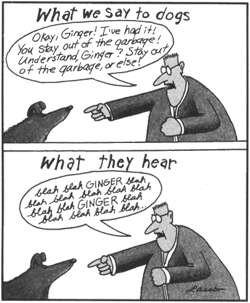
It's a cartoon. Not to be taken seriously.

Taiwan’s Aborigines urged to officially adopt original names

Taiwan’s Cabinet-level Council of Indigenous Peoples is encouraging the members of the island’s twelve tribes to officially adopt their original, non-Sinified names. (Good for the Council of Indigenous Peoples. It’s about time.)

These names will be recorded using the Roman alphabet.

Earlier this evening, however, I heard a television report that many local officials were unaware that this name change was legal, much less encouraged. This doesn’t surprise me in the least. I’ve run into more than my share of officials who, because they misunderstand the laws it’s their job to deal with, make life difficult for those who want to get things done. (I”m hoping that renewing my residency will go more smoothly next month than it has in the past.)

Here’s a look at parts of Taiwan’s Full Name Registration Law:

Chapter 1 Local Legislation Authority

Section 1 Republic of China (ROC) nationals may have only one name, and said full name should be the official name stated in the census records.

So why must Aborigines who file to officially use their original, non-Sinified names have not only their names in romanization but also in Chinese characters (and thus are likely Sinified and therefore different than their original name)?

Taiwan indigenous peoples should be registered under their customary full names. Indigenous peoples registered under a Han’s full name should apply for restitution of traditional full name; those who have restituted their traditional full name should apply for the restitution of their Chinese full name; however an individual is entitled to a single restitution application.

Huh? (It’s late, so I’m not going to bother checking the Mandarin-language original to see if that’s any clearer.)

Section 2 The full name registered in the census record should be written in words found in the Ministry of Education Mandarin dictionary or Tzu-Yuan (origin of Chinese phrase or expression), Tzu-Hai (Chinese words collection), Kanghsi and other general dictionary; however, an exemption to paragraph 1 is the registered traditional full name of indigenous peoples which should be written using the Romanization system.
Full names that are not written with words found in any of the aforementioned general dictionaries shall not be registered.

That’s normal.

The Ministry of the Interior is renewing national ID cards from January 1 to December 31, 2006. This hadn’t been done in years.

Lin Chiang-yi, a council official and an Amis tribe member, said his council was asking the Ministry of the Interior to set up a “one-stop window” in counties with large aboriginal populations where people could officially change their Chinese name back to their aboriginal name.

Although a 1995 act allowed aboriginals to substitute their Chinese name with an aboriginal one, only 1,000 aboriginals have adopted their own name so far, Lin continued.

The official said his council was working to persuade several aboriginal communities to make the change en masse, with the purpose of increasing the number of aboriginals who go by their aboriginal name to 10,000.

With a population of 426,000 representing 12 different tribes, aboriginals account for nearly 2 percent of the country’s population.

source: Aboriginals encouraged to adopt indigenous names, CNA, January 31, 2006