one woman’s writing in ‘symbolic code’

A 70-year-old woman in Tainan, Taiwan, who can read relatively few Chinese characters has reportedly come up with her own “symbolic code” for writing the words to songs. I’d love to see it. Unfortunately, however, she is “afraid others might laugh” and so covers all her writing with white-out once she has memorized the song.

Tainan great-grandmother Lin Li Yuda, 70, wanted to learn some songs, but unfortunately she could not read. But she was determined to do so anyway, and now, eight years later, she has memorized over 100 songs and can flawlessly recall the words to even the longest of folk songs, which can run to 1700 words or more.

Lin worked as a laborer in the construction industry before retiring, carrying bricks and cement. Even this tough labor could not bow her. Eight years ago, she began to weaken, and decided to retire. She now works as a volunteer at the Nanhua Community. Lin heard that singing was good for exercising the abdomen and had other health benefits, so she began to learn songs from other elderly people.

Lin was illiterate, however, and the songbooks her teachers passed out were incomprehensible to her. She could only follow the sounds the others made. But Lin was not ready to give up. She thought long and hard, and came up with an idea: she would learn to write the songs down.

After she began, the whole world was Lin’s singing teacher. Now, whenever she has a moment, she grabs her songbook and asks people to recite the words to her one by one. At her age, her memory is not as good as it used to be, and sometimes she has to ask about a word several times. Lin says that at the beginning, she felt embarrassed about her shortcomings, but everyone was very patient with her, and willingly repeated the lyrics again and again until she learned them.

By relying only on learning from others, however, Lin was unable to remember the songs. So Lin took to making notes beside the words using her own “symbolic code.” Quite often, a song sheet of Lin’s will be a forest of red symbols. When she has learned the song, Lin quickly covers her notes with white-out, because, she says shamefacedly, she is “afraid others might laugh.”

Over the past eight years, Lin has memorized over 100 songs, and knows each one practically word for word….

The most difficult thing for Lin is songs with foreign words in them. One song, “The Butterfly Maid of Nagasaki,” has the Japanese phrase “chocho san” in it, and this nearly tripped Lin up. She says that the person who taught her the song had to repeat it many times before she mastered it. In fact, even Lin’s great-grandson, who is now in primary school, can act as her teacher. When she meets a character she doesn’t know, she rushes to ask someone so that she can make a note….

source: Illiterate great-grandmother memorizes songs using unique symbols, Taiwan Headlines translation of a story from United Daily News, February 23, 2006

pigpen principles

Newspapers and magazines have so much misinformation about Chinese characters that I seldom bother to mention specific instances. But I expect better than this from the New York Times, even though this is but soft news:

The two designers chose 20 stellar examples of a concept defined by the Japanese ideogram katei. It is the joining of two symbols — ka being house and tei being garden — that defines home in Japanese.

Oy. First, katei is not written with one “ideogram” [sic] but two Chinese characters / kanji:

家庭

(Somebody help me out if I got that wrong. I don’t know Japanese.) In Mandarin this is jiātíng, meaning “family.” Nishikawa Yūko has a long discussion about notions of katei in “The Modern Japanese Family System: unique or universal?” (Multicultural Japan. Palaeolithic to Postmodern. Donald Denoon, Mark Hudson, Gavan McCormack, and Tessa Morris-Suzuki, eds. Cambridge University Press, pp. 224-232).

Second, Chinese characters / kanji do not represent an ideographic form of writing.

Third, the Japanese language is not defined by symbols. Language comes first, writing later.

Fourth, calling Chinese characters “symbols” is at best problematic; this is part of what feeds the ideographic myth. (See the second point.)

I’m all for good design, but it shouldn’t be explained in terms of myths. Otherwise, perhaps architects and interior designers should be putting functioning pigpens inside houses, or at least a little covered shrine to a pig. After all, if we’re going to be guided by how characters look, is not the very essence of “home” (家) in Japan and China defined by having a pig (豕) under a roof (宀)?

source: Homes and Gardens, Living in Harmony, New York Times, March 9, 2006

Unicode in Japan

No-sword links to an interesting page titled Unicode in Japan: Guide to a technical and psychological struggle. There’s a lot of useful information in this.

The Web page also touches some on script reform in postwar Japan; for the full story, see Literacy and Script Reform in Occupation Japan: Reading Between the Lines, by J. Marshall Unger. Pinyin Info offers a chapter-long selection from this book.

Other pages on that site include a Unicode tutorial, which is billed as “a page of Unicode terms, FAQs, and mistakes.”

My pet peeve about Unicode is its continuing, incorrect reference to Chinese characters as “ideographs.”

more on the Aborigine names and ID cards

Another article:

以恢復原住民傳統姓名為宗旨的籐文化協會今天指出,最近推動復名時發現,身分證、戶籍謄本等戶政系統尚未全面進行版本更新,讓復名作業仍舊困難重重。

籐文化協會常務理事 Kaing Lipay (該映‧犁百,阿美族)下午表示,雖然新身分證為了配合原住民姓名已經在正面姓名欄位上作「放寬字數」、「並列羅馬拼音」的版更,但背面的父母欄、配偶欄卻未能配合放寬,且戶籍謄本上的姓名欄不但沒放寬字數,也不能加注羅馬拼音。

最奇怪的是,Kaing Lipay 說,現在羅馬拼音的名字在戶政系統上只能以「點」來區隔,這樣的方式未來在護照上將如何表現?護照上的名字以點區隔是其他國家所未見的,未來是否會有問題,希望有關單位能夠深入了解。

另外,Kaing Lipay 指出,原住民姓名欄位上有中文不得超過十五個字,英文不得超過二十個字母的限制,導致高雄縣三民鄉有一位男性民眾羅馬拼音長達二十字,其中無法再以加點的方式區隔,讓他非常苦惱,希望能再次復名。

但是,如果民眾因為行政作業疏失必須再次復名就會被計算為第二次改名,根據「姓名條例」規定一個人只能改名兩次,Kaing Lipay 說,這不是民眾的疏失,建議戶政單位能以「誤登」的方式處理,以免有損原住民復名的權益。

籐文化協會已接獲不少民眾反映,在進行恢復原住民傳統姓名作業時,依舊耗日費時,推究原因,Kaing Lipay 認為,戶政機關沒有一個「標準作業程序」,且缺乏全面配套措施,導致原住民復名困難重重。

Why on earth do reporters find it so hard to grasp that not everything written in an alphabet is “English”?

戶籍系統尚待更新 原住民復名作業困難重重, CNA, March 5, 2006

sign-language variants abound in China

Different signs are used in different parts of China. This is no surprise in itself, but it’s nice to see this reported in China. According to the article below, in Guangdong some 70 percent of the target audience for CCTV’s sign-language news are unable to understand the signs used on the show. Moreover, new signs are being created all the time.

Xiàmén gēn Quánzhōu de shǒuyǔ bù yīyàng, gēn Shànghǎi de shǒuyǔ yě bù yīyàng, gègè dìfang de shǒuyǔ dōu yǒu gèzì de tèdiǎn.

Xiàmén tèxiào jiàoyánshì fùzhǔrèn Huáng Zǒngzhì shuō, bǐfang “zuò zuòyè”, Xiàménrén shì liǎng ge quántou shàng-xià bǐhua, érhòu yòushǒu shǒuzhǐ héngfàng zài zuǒshǒu shǒuzhǎng xià, gòuchéng yī ge “yè” (业) zì; Quánzhōurén zéshì liǎngshǒu bǐhua yèpiàn de xíngzhuàng. Guǎngzhōu lóngyǎrén duì “xìngzāilèhuò” de dútè biǎodá shì gēbo jiājǐn, liǎng zhī xiǎo bì xiàngshàng wānqū wòquán, yǒushíhou huì bèi [cuò]wù rènwéi gēbo bù shūfu.

Zài rú “Pānyú” yī cí de dǎfǎ tōngcháng shì Pīnyīn dǎfǎ, ér Guǎngzhōurén zé dǎ “dà fānshǔ” de xiàngxíng, yīnwèi Pānyú shèngchǎn dà fānshǔ.

Jùxī, Guǎngdōng qī chéng lóngyǎrén kànbudǒng Yāng-Shì [i.e., CCTV] de “shǒuyǔ xīnwén”, Xiàmén yòng de shì quánguó tōngxíng de biāozhǔn shǒuyǔ, dànshì Xiàmén de lóngyǎrén chángcháng wúfǎ lǐjiě wàidì shǒuyǔ. Huáng zhǔrèn shuō, měi nián de xīn cíhuì bùduàn chūxiàn, gè dì de xíguàn yòu yǒu bùtóng, yīxiē shǒuyǔ lǎoshī hé lóngyǎrén bùdébù zìjǐ chuàngzào xīn de biǎodá fāngshì. Zhèxiē xīn fāngshì tōngguò miànbù biǎoqíng hé qítā fǔzhù xìng de dòngzuò, jiāoliú de shuāngfāng hěn kuài jiù huì shúxī.

source: Shǒuyǔ yěyǒu fāngyán, Xiàmén Wǎnbào, March 6, 2006

prohibited macrons?

Signs leading to a temple in Japan’s Nara Prefecture feature a variety of romanizations. Inconsistent romanization is hardly newsworthy in itself, this being common in East Asia. But things get a little more interesting as the article progresses.

Akihiko Yonekawa, a Japanese language professor at Baika Women’s University, says that “Muroji” is not a proper phonetic spelling, so if that is the goal it should be spelled “Murooji.” According to the direct transcription of kana characters, it would be “Murouji,” but that does not comply with Hepburn’s principles. The professor notes that prohibiting macrons made the whole process more difficult.

West Japan Railway Co. agrees. Forgoing the Hepburn system, the railway firm uses macrons for names with long vowel sounds, like Kyoto.

Macrons were used in romanization for decades after World War II, but in 1986 the transport ministry prohibited them.

“We don’t know the details as to the change,” says a transport ministry official.

“But we presume that Roman characters with macrons were not used for many of the road signs in the past, and those officials in charge of the changes might have thought it would be difficult for foreigners to understand the Roman alphabet with added macrons, since there are no macrons in English.”

As far as Yonekawa is concerned, the problem comes down to indifference. “Japanese people stick to how kanji are used appropriately, but they show little interest in other types of characters,” he says with a sigh.

Difficult for foreigners to understand the Roman alphabet with added macrons? Perhaps what the official means is that without macrons even the most ignorant foreigners can imagine that they know how to pronounce Japanese correctly. But with them they might have cause to doubt. Is that really such a bad thing?

source: Long vowels spell confusion for temple, International Herald Tribune & Asahi Shimbum, March 7,2006

misunderstandings of biblical proportions

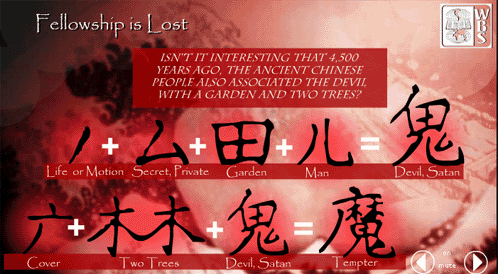
“Based on the evidence, we believe the inventors of ancient Chinese characters knew the God of the Bible,” says the Web site of the World Bible School of Cedar Park, Texas.

The presentation there titled Ancient Chinese characters: coincidence or design? (alternate title: Ancient Chinese: Language of God?”) features many examples of people seeing what they want to see in Chinese characters. The wishful thinking and folk etymologies grow ever more strained in the school’s surprisingly long Flash presentation. (The good stuff doesn’t come until about thirty pages in.)

phony etymology of Mandarin Chinese word 'yao' (want)Typical example: “Why would the creators of the Chinese characters choose 2 words- “West” (which indicates a direction) and “Woman” to mean desire? It makes no sense unless we remember one [一] man [儿], in a garden [囗], in the west [西] was the first to desire a woman [女].” (Click the image at right for a better look.)

In other words, according to this site, the character for “want” (要, yào) is semantically linked with
一 (, “one”)
+ 儿 (rén (as a radical), person (as a radical))
+ 囗 (wéi, a non-independent radical for “surround”)
+ 女 (, woman)

The creators of the site imply that this reveals the hand of God. So it seems a sort of “intelligent design” is trying to graft itself onto Sinology. But the truth is that Chinese characters don’t work the way the creators of this site seem to believe; indeed, Chinese characters have, well, evolved over the millennia.

Let’s look at the character for “want” over the years:

Here’s some information on its history:

Originally meant ‘waist’ (now written 腰 yāo), borrowed for a homophonous word meaning ‘want’. Two hands pointing to a 女 () woman’s waist (later they seemed to point to her head). The hands now look similar to 西 ‘west’. (source: Wenlin)

The important point here is that character came about through the borrowing of a character for a homophonous word. This is common in the history of Chinese characters. Indeed, phonetic elements, though often obscured by the passage of time and changes in language, are more common than any other.

For information on how Chinese characters really work, as opposed to how some people want to believe they work, see Chinese, a detailed reading available on this site.

Perhaps not surprisingly, none of the fanciful examples in the Flash presentation have any relationship with the real nature of Chinese characters. They’re all the equivalent of the folk etymology of the English word assume: “to assume means ‘to make an ass out of you and me.’”

To close, here’s another example of a real doozy from the bible-school site. Have fun.

example of phony etymology of Chinese characters

a geisha by any other character

This has to do with Memoirs of a Geisha. But I don’t give a hoot about what is probably a profoundly silly movie that I have no intention of paying money to see. Nor do I care about Beijing’s profoundly silly objections to it. What I’m interested here is how Chinese characters were manipulated for the name.

In Mandarin, the word for “geisha” is yìjì, which is written 藝妓 in traditional Chinese characters and 艺妓 in “simplified” Chinese characters. The word for “memoirs” is huíyìlù, written 回憶錄 (回忆录 in simplified characters).

Thus, Memoirs of a Geisha could be translated as Yìjì huíyìlù, which it has been up to a point. (This is something of a surprise in itself, because Western movies tend to be completely retitled in Taiwan, Hong Kong, and China rather than have their titles translated into Mandarin. There’s a tedious sameness to most of these titles, which tend to imitate titles of other popular movies and throw in 愛 (ài, love) a lot.)

As written in Chinese characters, the title in Taiwan of the movie is 藝伎回憶錄, not the expected 藝妓回憶錄. Note the difference in the second character:

vs.

The form in the movie title has the “person” radical 亻, while the original form has the “woman” radical 女.

The one with the woman radical is strongly associated with prostitution. Here are a few of the many prostitution-related words that contain this character:

  • 娼妓 chāngjì n. prostitute; streetwalker
  • 娼妓館 chāngjìguǎn p.w. brothel
  • 妓館 jìguǎn p.w. brothel
  • 妓女 jìnǚ n. prostitute
  • 妓院 jìyuàn p.w. brothel
  • 營妓 yíngjì n. prostitutes serving military units
  • 箏妓 zhēngjì n. zither-playing courtesan

Even a word for male prostitute takes this character: 妓男 (jìnán).

Here, by way of contrast, are some of the words containing the character with the “person” radical:

  • 伎巧 (also 技巧) jìqiǎo n. (1) technique; skill; craftsmanship; dexterity (2) acrobatic gymnastics
  • 才伎之士 cáijìzhīshì f.e. a person of outstanding ability in craftsmanship
  • 歌舞伎 gēwǔjì n. (1) (trad.) female dancer/singer (2) (Jp.) Kabuki
  • 鬼蜮伎倆 guǐyùjìliǎng id. devilish stratagem; evil tactics
  • 故技/伎 gùjì n. old trick/tactics
  • 故伎重演 gùjìchóngyǎn f.e. play the same old tricks; be up to one’s old tricks again
  • 賤伎 jiànjì n. inferior/lowly arts
  • 伎而止此 jì’érzhǐcǐ f.e. One’s cleverness stops here.
  • 伎/技倆 jìliǎng n. (1) trick; intrigue; maneuver (2) skill; dexterity; craft
  • 伎藝 jìyì n. (1) mechanical arts (2) expert skill

So the switch from 妓 to 伎 was an attempt to soften the connotations of prostitution, changing Memoirs of a Geisha (i.e. prostitute, in common association, whether that’s just or not) to Memoirs of a Skilled Performer. It also brings to the fore the phonetic basis for Chinese characters as it is no coincidence that 妓 and 伎 are pronounced the same. This same phonetic basis, however, is why the revised name isn’t really different; it just looks different. All this is the written equivalent of fancy footwork. It doesn’t really change a thing. Yìjì is the word for geisha, so that’s what is going to come to mind, not “skillful performer” — not unless the movie-title’s usage somehow becomes widely used and longlasting. But I doubt it.

After all, the translators could have adopted another word for geisha, gējì, which takes both forms: 歌伎 and 歌妓. So why not use 歌伎 and get rid of that troublesome 妓 character without bending any usage? Because the main word for geisha is still yìjì, and geji is also used for prostitutes (there’s that word again) who sang and danced. And maybe some people would have been expecting a musical because of 歌 (, song).

Although it might sound sophisticated for the translators to have played with Chinese characters this way, it’s not really all that different from naming a band Wyld Stallyns instead of Wild Stallions.

Memoirs of a Wyld Stallyn? Hmm. Now that might have potential.

source: ‘Memoirs of a Geisha’ Lost in Political Din, IPS, February 7