Pinyin.Info home readings rules tools systems Pinyin News links contact

November 2006

Monthly Archive

new book on language policy in Taiwan during the Japanese era

Posted by site admin on 30 Nov 2006 | Tagged as: Chinese, Hanyu, Hokkien, Hoklo, Japan, Japanese, Mandarin, Minnan, Taiwan, Taiwanese, dialect, literacy

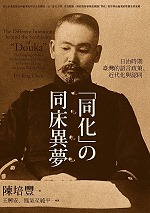
photo of the cover of the book discussed in this postWhile browsing at Eslite the other day I happened across a new book that sounds interesting: Tónghuà de tóngchuángyìmèng: Rìběn zhì shíqī Táiwān de yǔyán zhèngcè, jìndài huà yǔ rèntóng (同化的同床異夢: 日治時期臺灣的語言政策、近代化與認同), by Chen Pei-feng (Chén Péi-fēng / 陳培豐).

Although the book is written in Mandarin and has essentially no English, it has a strange but intriguing English title: The Different Intentions Behind the Semblance of “Douka”: The Language Policy, Modernization, and Identity in Taiwan during the Japan-Ruling Period. This doesn’t quite match the Mandarin.

I’d be interested in hearing from anyone who has read this.
signage snafus in Taizhong/Taichung/Taijung…

Posted by site admin on 30 Nov 2006 | Tagged as: Chinese, Mandarin, Taichung, Taiwan, Taizhong, Tongyong, pinyin, romanization, signage, writing systems

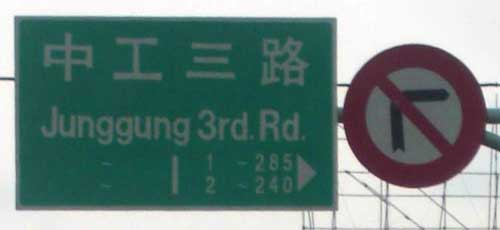
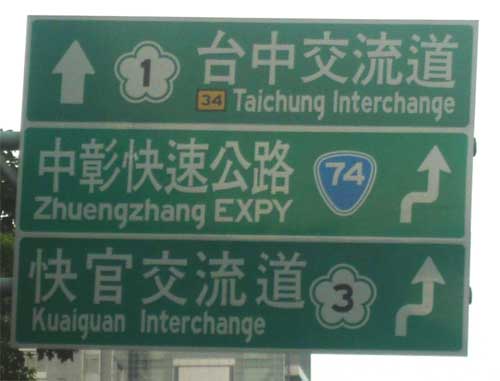
An observant reader, Sonarchic, sent in the top two photos below, both of which were taken in Taizhong (Taichung), Taiwan. The first one is especially interesting in that what would be written zhong in Hanyu Pinyin is here written two different ways: chung and zhueng.

sign with what is written Z-H-O-N-G in Hanyu Pinyin spelled here both C-H-U-N-G and Z-H-U-E-N-G

Here’s an older street sign.

sign with what is written Z-H-O-N-G in Hanyu Pinyin spelled here J-U-N-G (MPS2)

I’ve appended two photos I took myself in Taizhong about two years ago.

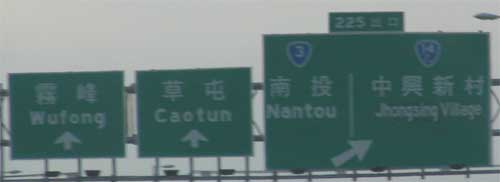
The first was taken on a highway near Taizhong. Since highways are under the central government’s jurisdiction, these signs are in Tongyong Pinyin.

sign with what is written Z-H-O-N-G in Hanyu Pinyin spelled here J-H-O-N-G (Tongyong Pinyin)

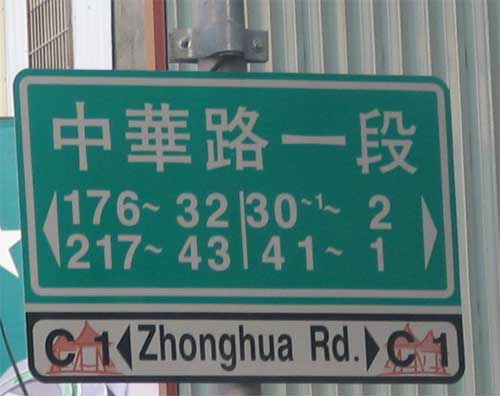
And here is a relatively new street sign with Taizhong itself. Note the use of Hanyu Pinyin, which, despite reports to the contrary, is not limited in Taiwan to Taipei City. I don’t know what “C1″ refers to; I certainly hope it’s not a variant of Taipei’s idiotic nicknumbering system. Note also how any mention of the road’s sections (duan) are omitted from the romanization — very bad. Moreover, it has always seemed to me that Taizhong’s street signs suffer from too much information: just look at all those numbers. That can’t be good for readability.

sign with what is written Z-H-O-N-G in Hanyu Pinyin actually spelled Z-H-O-N-G

So, to wrap up, these signs in and near Taizhong, give us:

All that for a simple zhong (中).

‘write the fancy’, Taiwan tells foreigners

Posted by site admin on 25 Nov 2006 | Tagged as: Taiwan

In line with yesterday’s remarks on the Taiwan government’s absurd approach to communicating with foreigners by putting up websites in poor English, here’s something from Taiwan’s National Police Agency, which is part of the Ministry of the Interior.

text reads 'What a Fancy Taiwan! Write the fancy. Win a camera!'

Do you think what the most unique part of Taiwan is? Except in Taiwan you will never see the following in the whole world, 101 Building, Gods of folk religion or aboriginal teenagers. If you are a foreigner living here, before November 30, 2006, please write an essay telling us what your coolest experience is in Taiwan and you might win a new digital camera.

In Forumosa’s thread on this, the poster “redwagon” has perhaps said it best:

image of Taiwan with four figures: a Taiwanese opera singer, an aboriginal teenage girl, a rice farmer, and a kung-fu guy

OMFG. Finally some of our tax money gets spent on something useful. Our entertainment.

If I didn’t know for a fact that it’s not possible to register a .gov.tw domain privately, I’d have thought it was a send up.

Or, maybe it’s a trap, in the ‘hundred flowers’ style. They aim to trick us to send our rants in, blinded by our lust for cheap digital cameras, and then deport us for not appreciating Taiwanese culture.

There’s still almost a week left in which to submit your own entry. A number of the more sarcastic entries remain, probably because those in charge of the site have no idea what’s going on.

source: What a Fancy Taiwan!, accessed November 24, 2006.

Taiwan’s “more amiable English services”

Posted by site admin on 24 Nov 2006 | Tagged as: English, Taipei, Taiwan, languages, signage

logo to promote Taiwan's English-language environment; an image of the island of Taiwan appears with a smile and a large A+, with a globe in the backgroundWith the end of the year approaching, it is once again time for Taiwan to tout the quality of the island’s English environment by putting together a “carnival” and tossing online a website in awkward English.
Perhaps word got back to the powers that be that the English in last year’s site was bad beyond belief, because this year’s site to promote English has largely left out use of that particular language! Much of the English that is there, while not so howlingly inept as that in last year’s site, is still awkward, clichéd bullshit. Here’s an example:

The Logo features close affiliation between the globe and the smiling Taiwan, symbolizing Taiwan’s linkage to the world. The expression of “English-friendly Environment” that circles the globe and the sign of “A+” on Taiwan fully convey the ideas of creating a quality and friendly internationalized environment, as well as broadening the scope of social participation. To advance Taiwan’s connection with the world, and provide better services to foreign friends who visit Taiwan, the Research, Development and Evaluation Commission of the Executive Yuan is going to use the Logo as the basis to design a emblem that identifies a quality English-friendly environment, which will be advertised and promoted through a certificating mechanism, in order to increase the number of popular locations that offer quality English services, so that foreign friends can not only easily identify those locations but also get access to more amiable English services.

One of the few parts of the site with any useful information is the page of “Important Achievements of Creating an English Living Environment.” Some of the things listed there even are important achievements. Nonetheless, Taiwan has many fundamental problems with its approach to English — and to romanization, too. One of the biggest of these problems is that English and romanization are treated as last-minute details of little importance.

I could go on and on about this; but it’s all too depressing.

source: 2006 English Carnival

story in Pinyin

Posted by site admin on 23 Nov 2006 | Tagged as: Chinese, Mandarin, pinyin, romanization

Zhang Liqing has submitted another item written in Hanyu Pinyin. This time it’s a story, “Lā Tuǐ,”, by Táo Dàzú (Christopher L. Potter).

Here’s the opening:

Wǒ xiǎng gěi nǐ jiǎng yī ge zhēnshí d gùshi. Wǒ shíjiǔ suì d shíhou, Yuènán Zhànzhēng jiéshù bù jiǔ. Wǒ juédìng bù huí dàxué niànshū, yīnwei wǒ bù zhīdao wèishénme yào niànshū. Dìqiú hěn dà, měi gè rén dōu huì yǒu hǎo duō jīhuì. Qíshí shì wǒ bù zhīdao wǒ yào xué shénme zhuānyè huòzhě jiānglái zhǎo shénme gōngzuò. Zǒng’éryánzhī, wǒ bù zhīdao wǒ zhè yī bèizi yào zuò shénme. Nà gè shíhou wǒ xiǎng “bù zhīdao” shì hěn yánzhòng d wèntí. Yúshì wǒ juédìng táobì wǒ èr-niánjí d qiūjì xuéqī.

You can read the entire story on this site. Enjoy!

And the language used for the PRC side is …

Posted by site admin on 22 Nov 2006 | Tagged as: China, English, languages, signage

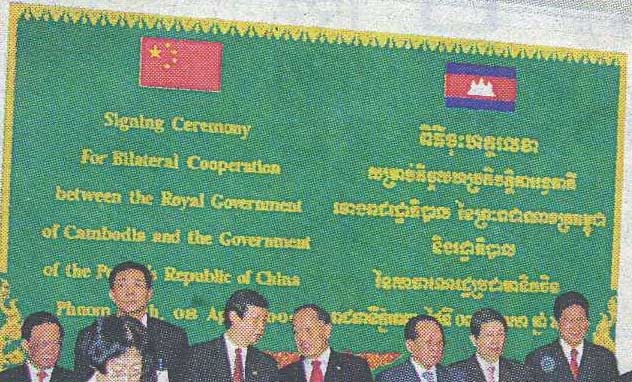
Mark Liberman of Language Log has just added another to the series of Victor H. Mair’s guest posts on English in China. This one features an interesting news photo from the ceremony for the signing of an agreement between China and Cambodia.

photo of banner for a signing ceremony between Cambodia and China, with the text for China given in English, not Mandarin; click for larger image

And I wonder what language the agreement is in.

As Mair, who is also an occasional contributer to Pinyin Info, wrote in his initial post:

Judging from all that I have seen and heard during the last couple of years, however, it is apparent that the role of English in China will continue to grow at an exponential rate. The implications of this massive expansion of English in China will inevitably have a corresponding impact upon local language usage. In fact, the profound effects of the current surge in English usage upon Mandarin and other Chinese languages is already obvious in many respects.

sources:

National Book Award winners named

Posted by site admin on 21 Nov 2006 | Tagged as: general

Just a note here to record that neither of this year’s two China-related finalists for the National Book Award ended up winning. (The winners were announced last week.) But I’m certain that Peter Hessler’s Oracle Bones and Gene Luen Yang’s American Born Chinese have sold well and will continue to do so for having been selected as finalists.

only 33% of Chinese small businesses use computers: study

Posted by site admin on 21 Nov 2006 | Tagged as: China, computers, software

Only 33 percent of small businesses (1-99 employees) in China have a computer, according to a recent study by Access Markets International.

China’s low rate of PC penetration among small businesses, however, is higher than that of some other highly populous countries in Asia, namely the Philippines at 24 percent, India at 22 percent, and Indonesia at 18 percent.

About 40% of the non-PC SBs in India, over a third in China, and about a quarter each in Indonesia and the Philippines have expressed their intent to buy PCs in the next 12 months….

Most of the non-PC SBs in these four countries are small — with 1-9 employees each. The bulk of SBs in these countries belongs to the wholesale and retail vertical sector. The exception is China, where more than 50% of non-PC SBs are in the manufacturing vertical.

What hinders them from buying PCs? The primary hurdle is the belief that PCs are not relevant to their line of business. About 30% of non-PC SBs in India and 14% in China told AMI that they just have not thought about buying PCs. A significant portion of SBs believe that a simple fax and phone is enough for their business. Lack of knowledge about the installation and operation of PCs is also a powerful deterrence.

source: Huge untapped market for non-PC SBs opening up, AMI Partners, November 13, 2006

via Most Small Chinese Businesses Don’t Use Computers, China Tech News, November 20, 2006

Next Page »