Danwei notes that Adsotran‘s Search Chinese News in English function is now live.
source: Cheat sheet for foreign journalists and PR people, Danwei.org, August 17, 2006

Danwei notes that Adsotran‘s Search Chinese News in English function is now live.
source: Cheat sheet for foreign journalists and PR people, Danwei.org, August 17, 2006
An ethnic culture research worker in Funing County, Yunnan Province, China, has come across an old Zhuang book of songs. What makes this manuscript particularly interesting is that the songs are written down not in a regular script but rather in something similar to Naxi pictographs, i.e. pictures that serve as mnemonic references to the text rather than as real pictographs or real writing.
The article I read on this is a little vague, so I’m hoping someone can come up with some images of the manuscript or a more scholarly source.
source: Yúnnán fāxiàn Zhuàngzú gǔlǎo xíngtài túhuà wénzì — kān pìměi Dōngbā wénhuà (云南发现壮族古老形态图画文字 堪媲美东巴文化), CCTV.com, August 16, 2006
The latest version of Opera, my favorite Web browser, now has a feature called “widgets.” These are basically the same as Firefox’s extensions. (Many of the features Firefox gets credit for were taken from Opera, so turnabout is fair play.)
Of particular interest to readers of this site is the GTranslation widget, which ties in with Google’s and BabelFish’s translation engines. This will allow you to input text and even Web pages in [Mandarin] Chinese and view them in English. Well, sort-of English. But at least it’s free!
Thus, this widget is Opera’s equivalent of Firefox’s translation extensions.
GTranslation was written by Shoust.
I know that many of my readers are still tied to Microsoft’s Internet Explorer. I strongly recommend trying Opera or Firefox, which are faster, more secure, and generally better in most every way.
Jason Frazier has used the free Microsoft keyboard layout creator to devise a keyboard method for entering Pinyin texts with tone marks. This will work on Windows 2000 and XP systems.
Basically, to type a vowel with a tone mark, first press the key corresponding to the tone you want and then the vowel (or “v” for ü). Many may find this method preferable to using an online tool that converts Pinyin tone numbers to tone marks (my own online converter being desperately in need of an update) or a separate program such as Wenlin (or its free but tremendously useful demo version).
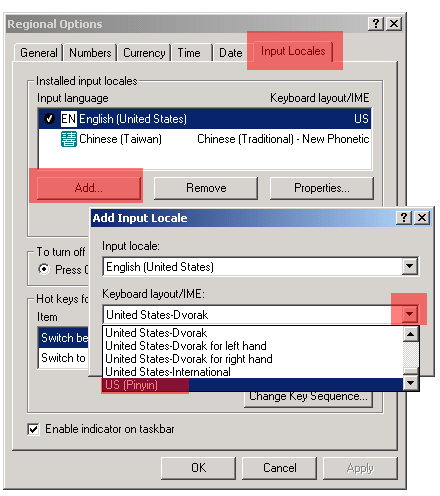
To download and install this Pinyin-entry tool, follow the directions on Jason’s Web page. I’ve added a screenshot below to help clarify part of the installation process.
A-giâu’s attempt at reconstructing some of the Sinitic names on Malaysia’s list of forbidden personal names (which I posted on yesterday) had me feeling a little guilty that I didn’t do more research on this. So I did some additional digging and came up with an article that listed some of the Hanzi (Chinese characters).
Here are the Sinitic names, as given in the article (see ref. below). I’ve added romanization in Pinyin and approximate English translations. A few of these, though, have me perplexed. What, for example, is so bad about Hor Kianh (??)?
| source’s romanization | Hanzi | Romanization in Pinyin (Mandarin) | English translation |
|---|---|---|---|
| Ah Chwar | 阿蛇 | Ā Shé | Snake |
| Ang Mor | 紅毛 | Hóngmáo | Westerner (figuratively; literally: “red hair”) |
| Heoy Kay | 火雞 | Huǒjī | Turkey |
| Hor Kianh | 虎仔 | Hǔzi | Tiger |
| Khiow Koo | 駝背 | Tuóbèi | Hunchback |
| Tok Sim | 毒心 | Dúxīn | Evil Mind |
| Tua Pooi | 大肥 | Dà Féi | Fatty |
| Tua Bug | 大目 | Dà Mù | Big Eyes |
| source’s romanization | Hanzi | Romanization in Pinyin (Mandarin) | English translation |
|---|---|---|---|
| Ai Chai | 矮仔 | Ǎizi | Dwarf |
| Chow Kow | 臭狗 | Chòu Gǒu | Smelly Dog |
| Chow Tow | 臭頭 | Chòu Tóu | Stinky Head |
| Sor Chai | 傻仔 | Shǎzi | Fool |
| Kou Lou | 高佬 | Gāo Lǎo | Tall Devil |
| Tai Ngan | 大眼 | Dà Yǎn | Big Eyes |
| Soh Low | 傻佬 | Shǎ Lǎo | Stupid Imp |
| Tai Yee | 大耳 | Dà Ěr | Big Ears |
| source’s romanization | Hanzi | Romanization in Pinyin (Mandarin) | English translation |
|---|---|---|---|
| Ar Loo | 阿驢 | Ā Lǘ | Donkey |
| Hwai Sze | 壞死 | Huàisǐ | Bad Death |
| Chang Chee | 娼妓 | Chāngjì | Prostitute |
| Ho Sze | 猴子 | Hóuzi | Monkey |
| Sun Choo | 山豬 | Shānzhū | Wild Boar |
| Tha Thaw | 大頭 | Dàtóu | Wastrel, Silly Person (lit. “Big Head”) |
| Chue Sze | 豬仔 | Zhūzi | Piggy |
| Sze Kwee | 死鬼 | Sǐguǐ | Devil |
source: Jiazhang wèi háizi qumíng xuzhi: Agou, Jizi, A-Zhuàng jìn yòng (????????? ????????), China Press (Malaysia), July 30, 2006
Danwei notes that Beijing’s Olympics committee has come up with its version of the icons for the sports of the games. These graphics are modeled after seal script, a style of writing that came to prominence about two thousand years ago.

Above are the icons for baseball, shooting, sailing, softball, cycling, and golf hockey.
Here’s part of how the committee describes the items:
Named “the beauty of seal characters” and with strokes of seal characters as their basic form, the Pictograms of the Beijing 2008 Olympic Games integrate pictographic charm of inscriptions on bones and bronze objects in ancient China with simplified embodiment of modern graphics, making them recognizable, rememberable and easy to use.
Although seal script can still be seen on name chops (seals) and some calligraphy, few people can read it well if at all.
additional resources:
source: New Olympic Icons, Danwei, August 7, 2006
From Xinhua:
The language spoken by the Chinese Miao ethnic group in southwest China’s Guizhou Province is in danger of disappearing, a local political advisor has warned.
“Native people in Miao villages communicate in their own language less and less,” said Han Kan, vice chairman of the Ethnic and Religious Affairs Committee of the Guizhou Provincial People’s Political Consultative Conference, citing a report made by his organization.
In the Tianzhu County of the Qiandongnan Autonomous Prefecture of Miao and Dong Nationalities where Miao people live in a compact community, only 32 out of 112 Miao language-speaking villages use their own language, according to the report.
In Qiandongnan’s Taijiang County, where the Miao population accounts for 97 percent of the total, 40 out of 180 Miao villages no longer use the Miao language.
In Danzhai County, also in Qiandongnan, only 60 percent of the people — mostly over 50 years old — speak their own language. In 1999, the figure was 85 percent.
I hate writing a post about a non-Sinitic language of China without S. Robert Ramsey’s invaluable The Languages of China at hand. But I won’t be able to get to my copy of this for several more days and I’ve been putting off finishing far too many posts as it is.
source: Language of China’s Miao ethnic group may disappear, Xinhua, July 27, 2006
