new MRT signage

David has posted on the inconsistent use of Tongyong Pinyin in the Taipei-area MRT system. I’ve already put a comment there, so I’ll not duplicate everything here.

I spend a lot of time complaining about signage, and my experiences in trying to get some errors in the MRT system corrected have, predictably, been frustrasting. But there is something I do really like: the font for the MRT signage. (See the photos with David’s post.) Does anyone recognize it?

For those of you not in Taiwan, the MRT is the Metropolitan Rapid Transit system for the Taipei area. Most of the system takes the form of a subway. One line, however, is elevated, as is a section of a different line (which also runs on ground level for several miles).

Wenlin: ‘software for learning Chinese’

I get a lot of questions about how to do some sort of conversion involving Chinese characters. Most of the time, my answer is something like, “Get Wenlin. Even the free, non-expiring demo version (4 MB) will do what you need — and a lot more.”

For those of you who aren’t familiar with Wenlin, Random Stuff That Matters has posted a five-minute movie (with sound) of Wenlin in action (14.5 MB).

The range of what Wenlin can do extends far beyond what the movie shows. A lot of people might not notice that even in the demo a wide range of options are available under

  • EditMake Transformed Copy

My favorite, which is available only with the full version, is

  • EditMake Transformed CopyPinyin Transcription

Oh, it is a thing of beauty. (That function, though, works only in the full version, not the demo.)

For those of you who have the full version, I thought I’d share a little-known feature of Wenlin: its ability to search for regular expressions.

Let’s say you are trying to remember a chengyu (set phrase) about studying, but all you can recall is that it contains the sound “rubu.” You’re not sure of the characters. You’re not even sure of the tones. First you look up entries beginning with “rubu” in Wenlin’s electronic edition of the ABC Chinese-English Comprehensive Dictionary:

  • ListWords by Pinyin
  • Then enter rubu and hit OK.

This will take you to rùbùfūchū and rúbùshèngyī. But neither of those is what you’re looking for. Now what? Here’s where regular expressions come in handy.

Hit Ctrl+F to search for something within the current page.

In the Find box, enter

  • re=r(u|ū|ú|ǔ|ù)b(u|ū|ú|ǔ|ù)

This will yield:

  • chǒngrǔbùjīng 寵辱不驚[宠–惊] f.e. unmoved by honors/disgrace
  • lèirúbùgān 淚濡不乾[泪–干] f.e. be drowned in tears
  • nièrúbùyán 囁嚅不言[嗫—] f.e. 〈wr.〉 move the mouth without speaking
  • xuérúbùjí 學如不及[学—] f.e. study as if one could never learn enough

Bingo!

The reason for using OR pipes to separate the possibilities instead of putting them together — i.e., the reason for writing (u|ū|ú|ǔ|ù) instead of [uūúǔù] — is that the regex library sees non-ASCII characters as strings of bytes (UTF-8); thus, without the pipes you could end up with extra garbage or not find what you intend to at all. This might be fixed in the next version.

surname-spelling scrap

Danwei has picked up on a story of someone in China with the surname of Xiè being issued an air ticket under the name Jiě. The reason behind the mixup is that the character used for this woman’s name, 解, is most often pronounced “jie,” as in jiěfàng (liberate; emancipate), jiějué (solve; resolve; settle), liǎojiě (understand; comprehend; find out; acquaint oneself with), and jiěshì (expound; interpret; analyze). Thus, it is but one of the many Chinese characters that has more than one pronunciation.

When she and some of her relatives went to the travel agency to get the matter cleared up, however, an argument broke out. Before long, people from the travel agency were using poles to beat the family.

(Maybe not my strongest entry, but there was no way I was going to pass up a chance to post on a story titled “Is personal safety another argument for Chinese romanization?”)

sources:

language acquistion through immersion — 17th-century proposals for Latin

Sorry for my lack of posts recently. My Internet connection at home has been out for more than a week. I’m writing this from work during my lunch break.

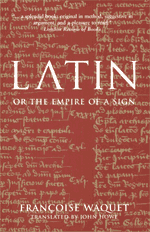
While reading Latin or the Empire of a Sign (title in the original French: Le Latin ou l’empire d’un signe XVIe-XXe Siècle), by Françoise Waquet, I came across mention of several proposals from the seventeenth century and later for the creation of “Latin towns.”
cover of book on Latin

The originators of these projects started from a double observation: on the one hand the weakness of Latin after a long and difficult learning process; on the other, the speed with which a child suddenly immersed in a foreign environment learns to speak its language. In 1621 Antoine de Laval suggested that the King of France “create a Latin colony for Monseigneur the Dauphin his son and for all the princes, great lords, nobles and other children of good houses”: the exclusive use of Latin and the “pleasant” methods of instruction that would be adopted would guarantee rapid and perfect mastery of spoken Latin. Along similar lines, but more modest, was Jean Cécile Frey’s proposal for a Latin college which children would enter at the age of two; there, along with their masters and servants, they would use nothing but the Latin language in conversation and play. Thus at the age of five they would speak “more Latin, and in a more Attic fashion” than children who had spent ten painful years at school. Daniel Georg Morhof believed that it would take about twenty years to establish a Latin town where even the artisans would speak Latin; to get started all that would be needed were six or seven good Latinists, who would teach Latin to poor children of both sexes; these would then learn a profession; they in their turn would then teach Latin to their apprentices, and in this way a Latin society would take shape

Of course, nothing came of these proposals for Latin — or any of the others to follow for that language. The concept of language villages for English, though — that’s another story.

Another anecdote:

Gasparo Gozzi noted that at Padua, in the unanimous judgement of the professors, hardly a tenth of the students — perhaps thirty out of 300 — “had a middling understanding of the Latin language”. How could they follow lectures in an unintelligible language? “It is true,” Gozzi added, “that after such lectures, the students go to hear the explanation at a private school.”

I stumbled across this book while browsing in a bookstore and been having a lot of fun reading it, and not just because of the parallels between the situation with Latin and those of Literary Sinitic (Classical Chinese) and Chinese characters. Highly recommended.

Zhou Youguang in the news again

Guangming Ribao has a long piece this week on Zhou Youguang, one of the main people behind the creation of Hanyu Pinyin: Zhōu Yǒuguāng: bǎisuì xīngchén, wénhuá cànrán (周有光:百岁星辰 文华灿然, Guāngmíng Rìbào, April 23, 2006). This also has lots of photos.

For autobiographical material by him in English, see A devotion that goes beyond words, from the South China Morning Post in the late 1990s.

For a selection of writings by him, see The Historical Evolution of Chinese Languages and Scripts (中国语文的时代演进 Zhōngguó yǔwén de shídài yǎnjìn).

tribe says its dialect needs official recognition for exam

Aborigines from Kangke (寒溪) Village, who are a branch of northern Taiwan’s Atayal tribe, protested last week against the Council of Indigenous People’s tribal language examination policy, requesting that the Kangke dialect be included.

The Kangke dialect has long been different from other Atayal languages because it was influenced by the Japanese language during the period of Japanese occupation.

The council plans to begin tribal language examinations next year, yet the Kangke dialect is not listed as one of the official dialects of the Atayal tribe, said Fang Hsi-en (方喜恩), an indigenous rights activist. In the examination policy, the Kangke dialect is incorporated into the Squliq and the C’uli’ dialects.

Fang said that to pass the tribal language exams, students in Kangke Village must now study either the Squliq or the C’uli’ dialects using a romanized spelling system because the Kangke dialect is nothing like them.

The scores on the language exam (which has no writing, by the way) can have a real effect on people’s lives. Under an affirmative action program set up by the Ministry of Education, members of Taiwan’s tribes are entitled to have their high school and college entrance exam scores raised by 25 percent. Under a policy expected to be made effective next year, those who pass a tribal language exam would have an additional 10 percent added to their scores.

Fang said that the system was unfair for Kangke students because the council did not classify their dialect as an official one. He said the tribal language examination should not be linked with entrance exams scores in any way.

Lee Su-min (李淑敏), the head of the Parent-Teacher Association at Kangke Elementary School, said that such a classification also stunted the preservation of the dialect and the Kangke culture….

In response to the protests, Wang Chiui (汪秋一), the director of the Department of Education and Culture at the council, said that the tribal language examination policy is still being discussed with the education ministry.

But the goal of the language examination was to promote tribal language education, Wang said.

Wang reminded the protestors that the language exam was in fact oral and that he would request that the council include the Kangke dialect in the exam.

If included, a representative from the village will also be invited to be an oral examiner, he said.

I wish someone had asked some of the linguists at Academia Sinica about this. Just how different is Kangke from what is currently officially recognized as Atayal? What’s the extent of the influence of Japanese on the language? Is it just a matter of some loan words? How many?

sources: