Today marks the fiftieth anniversary of the official approval of Hanyu Pinyin, which scholars had been working on for several years, at the Fifth Session of the First National People’s Congress of the People’s Republic of China on February 11, 1958.
Category Archives: writing systems
Pinyin in space
Stories about the official approval last September of the name of “Chiayi” for an asteroid/planetoid/minor planet (not to be confused with Pluto, the “dwarf planet“) discovered by astronomers with Taiwan’s National Central University drew my attention to the fact that another minor planet already bears the name of the university — and that they named it using Tongyong Pinyin: “Jhongda” (i.e., Zhōng-Dà, the short form of the school’s name in Mandarin, Guólì Zhōngyāng Dàxué).
There are plenty of planetoids bearing names in Hanyu Pinyin, e.g. Chongqing, Guangzhou, Guizhou, Beijingdaxue [i.e., Beijing Daxue], Beishida [i.e., Bei-Shi-Da], and Zirankexuejijin [i.e., Ziran Kexue Jijin].
Omitting spaces is common in the names as a whole, though some of them have spaces. And some have hyphens.
Although the statistics of diacritical characters in minor planets’ names (a list after my own heart) shows that, as of June 1997, 667 (4.83%) of the 13,805 named minor planets had diacritical characters in their names, I didn’t spot any Hanyu Pinyin names with tone marks. The mark for first tone doesn’t appear on the list even once.
I wish they’d followed Tongyong when naming asteroid Chiayi, because that way they would have ended up with the same spelling that Hanyu Pinyin uses: Jiayi. But I guess the solar system’s big enough for Wade-Giles as well.
Here are some Google search figures from Taiwan government domains.
- 532 from gov.tw domains for “chia-i”
- 1,380 from gov.tw domains for “jiayi”
- 2,660 from gov.tw domains for “chia-yi”
- 997,000 from gov.tw domains for “chiayi”
Should Ma Ying-jeou win next month’s presidential election in Taiwan, both the executive and legislative branches of government would be in the hands of the no-longer-opposed-to-Hanyu-Pinyin Kuomintang, and the national folly of Tongyong Pinyin could soon cease to exist as an official system not just in Taiwan but everywhere throughout the known universe … except on planetoid no. 145534 (“Jhongda”), a big chunk of rock in orbit somewhere past Mars.
sources:

- Minor planet officially named ‘Chiayi’, Taipei Times, October 17, 2007
- Lulin Observatory names newly-found planet after Chiayi, China Post, October 16, 2007
- Minor Planet Names: Alphabetical List
- International Astronomical Union Minor Planet Center
- Statistics of Diacritical Characters in Minor Planets Names, Laboratory of Small Bodies of the Solar System
Pinyin in/as art

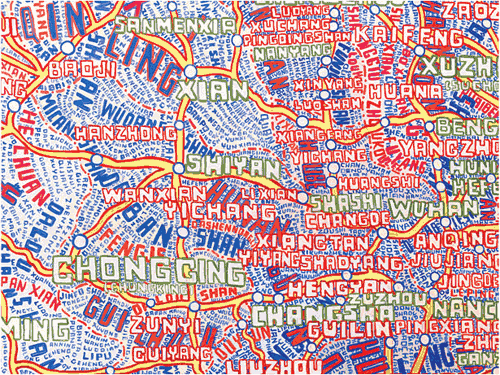
Detail of the painting China (2006), by Paula Scher.
The map has a few misspellings; but that’s not what’s important here.
Paula Scher has made some other works that might especially appeal to those interested in scripts, especially her terrific Publikum Calendar for 2007. It’s the sort of thing I think Languagehat would have hanging on his wall. (This is a Flash site, so I can’t provide a better link. Click on “2007” near the bottom right of the screen, and then click on the names of individual months.)
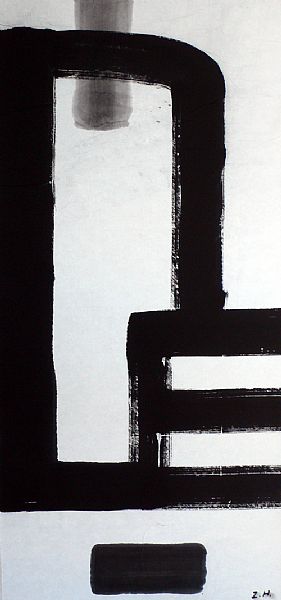
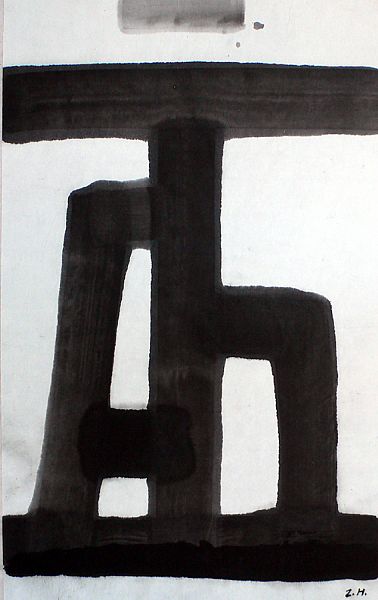
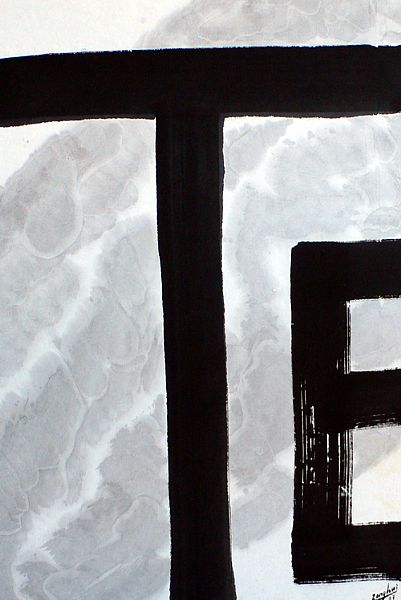
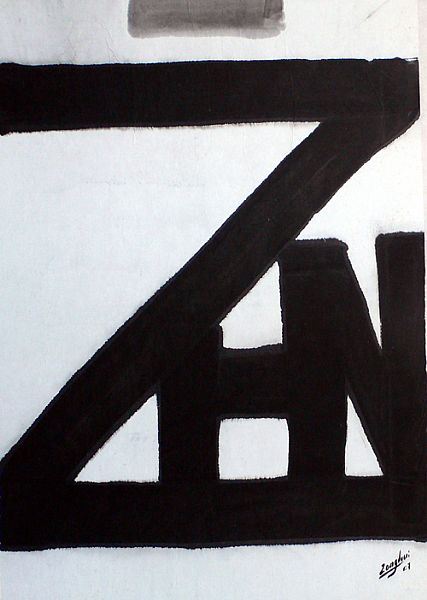
The artist Xu Zonghui (Xú Zōnghuī / 徐宗揮 / 徐宗挥) takes a different approach, starting from the Chinese tradition of ink on rice paper. A few of his works in a recent show in Spain use the Roman alphabet, one with Hanyu Pinyin’s “de.”
Here are a few others with the Roman alphabet:
![]()
![]()
![]()
What, no “Ching” (Jing)?
sources and further reading/viewing:
- Paula Scher: Gobbledy — Gook, by Nada Ray, video
- Xu Zonghui, Godoy World Art
- Paula Scher, the artist’s own site (Many thanks to VHM for telling me about this.)
- And of course there’s always Xu Bing.
Sexism in Mandarin: a study
This week’s free rerelease from Sino-Platonic Papers is Covert Sexism in Mandarin Chinese (1.9 MB PDF), by David Moser (of Why Chinese Is So Damn Hard fame).
Here’s part of the introduction:
Like other cultures, China has a long history of sexist social conventions, and the Chinese language is pervaded with evidence of these. Research in this area has usually sought to identify and catalog aspects of Chinese that embody these sexist cultural traditions, such as sexist idioms, demeaning words for wife, derogatory terms of address for women, or the large number of characters containing the female radical (女) with negative connotations. Such elements tend to be rather easily identifiable and have been some of the earliest aspects to be targeted for linguistic reform. (The Chinese Communist Party, for example, in their attempts to elevate the status of women and eradicate vestiges of feudalism, has from time to time officially discouraged use of pejorative terms of address for women and wives.) Notable contributions have already been made in such research, but there are certain kinds of sexism in the Chinese language that are more subtly embedded in the grammar in such a way that they often escape conscious attention. This article attempts to shed light on some of these phenomena, since it is often in these hidden patterns of linguistic usage that sexist assumptions and notions are most powerfully present.
This is issue no. 74 of Sino-Platonic Papers. It was first published in January 1997.
more Dungan
Since earlier this month when I wrote a post on Dungan-language radio, I’ve discovered that Olli Salmi has some great Dungan material on his website, including a paper he wrote and a couple of stories in Dungan, including one he has translated into English.
- Central Asian Dungan as a Chinese Dialect
- Laohu Dai Dacaidi (“Tiger and the Woodchopper”): in English translation, and in Dungan in the Cyrillic alphabet and Dungan in the Roman alphabet
- Lixin: in Dungan in the Cyrillic alphabet and the Roman alphabet
And for lagniappe he offers “An Unofficial Practical Orthography for the Kiowa Language.”
massive Korean dictionary of Chinese characters nears completion
The final volumes in what is being touted as the world’s largest Chinese character dictionary are scheduled to be published in May.
The fifteen-volume work (excluding the index) will reportedly cover some 60,000 Chinese characters and include about 500,000 Sinitic words. By comparison, the Zhongwen da cidian (中文大辭典 / Zhōngwén dà cídiǎn), published in Taiwan in the 1960s covers 49,905 Chinese characters.
The project was initiated by the Institute of Oriental Studies of Dankook University, South Korea, in 1978.
The first volume of the 『漢韓大辭典 』 (in Mandarin: Hàn-Hán dà cídiǎn; “Dictionary of Chinese characters Korean use,” as it is translated on the institute’s Web site) was issued in 1999. Last year, volumes 10-12 were published.
The project has reportedly cost more than W20 billion (US$21.3 million).
Yet more work may still be needed.
Prof. Kim Eon-jong of the Department of Korean Literature in Classical Chinese at Korea University said, “This project has great significance from the standpoint of cultural history. But it’s a pity that the institute hastened the final stage. It must complement and supplement the dictionary later.”
sources:
- World’s Biggest Chinese Character Dictionary Nearly Complete, Chosun Ilbo, January 9, 2008
- 세계 최대 ‘한한대사전’ 완간 눈앞, KBS News, April 11, 2007
Mandarin borrow-ing English grammatical forms
Putting English words in Mandarin sentences is of course extremely common in Taiwan and elsewhere in Asia, generally because this is thought to look cool and modern. But last month I was surprised to see Mandarin sentences with just English’s -ing added — and not one but two examples of this.
The image here is from a poster for the DPP’s presidential candidate, Frank Hsieh, that came out in March but which I didn’t see until a few days ago. It reads 台灣維新ing (“Táiwān wéixīn-ing“): “Taiwan is modernizing.” (Click the image to see the whole poster.)
The other example I noticed was in a newspaper headline about the Hong Kong pop diva Faye Wong: 明年拚老三 天后暫不復出 李亞鵬王菲 積極做人ING (Míngnián pīn lǎosān — tiān hòu zàn bù fùchū — Lǐ Yàpéng, Wáng Fěi jījí zuòrén-ing. “Next year work hard to produce third child — superstar temporarily not appearing — Li Yapeng and Faye Wong are energetically working on making a baby.”)
There are several other interesting things about the Faye Wong headline, such as the way in most other contexts zuòrén (lit. “be/make a person”) means something like “be a mensch.” But I don’t want to digress too much lest I never finish this post.
In both of these examples, -ing is used to emphasize the currentness of the actions. But it is of course possible in Mandarin to stress that something is going on now — and to do so without borrowing forms from English. For example, with zài:
- Lǐ Yàpéng, Wáng Fěi jījí zài zuòrén
- Táiwān zài wéixīn
Has anyone seen or heard other examples of this -ing grafting?
sources:
- 明年拚老三 天后暫不復出 李亞鵬王菲 積極做人ING, China Times, November 30, 2007
- “Táiwān wéixīn-ing” — Xiè Chángtíng quánguó xiàoyuán xúnhuí yǎnjiǎng (「台灣維新ing」謝長廷全國校園巡迴演講), Frank Hsieh’s blog, March 27, 2007
For lagniappe: lyrics to the Faye Wong song “Bù liú” in Pinyin, which has lots of examples of Mandarin’s bǎ.
Dungan-language radio
The state radio station of Kyrgyzstan offers a weekly broadcast in Dungan, which is basically a spin-off of northwestern Mandarin with lots of loan words from Persian, Arabic, and Russian. Of particular interest is that the language — which, permit me to note again, is basically Mandarin — is written with an alphabet (at present, one based on the Cyrillic alphabet). Chinese characters are of course not necessary and are not used. For details of the language, script, and people, see Implications of the Soviet Dungan Script for Chinese Language Reform, by Victor H. Mair, and Ethnolinguistic Notes on the Dungan, by Lisa E. Husmann and William S-Y. Wang (available online in Schriftfestschrift: Essays in Honor of John DeFrancis on His Eightieth Birthday, pp. 71-84).
The Dungan radio show is broadcast on Mondays between 6:35 and 7:05 p.m., Taipei time (4:35-5:05 a.m. U.S. central standard time). The show usually starts closer to 6:40 and ends about 7:03.
I made a recording of the latest broadcast (Dec. 31, 2007): Dungan radio broadcast (23 MB mp3).
[Here’s another: Dungan radio broadcast, January 14, 2008 (23 MB mp3).]
I mainly understand words, not entire sentences, though my comprehension improves a little with repeated listenings.
This Kyrgyz radio station (Кыргызское радио) is available through at least three different Internet links:
- www.radio.kg/RadioKTR.asx
- www.radio.kg/RadioKTR.ram
- mms://212.42.102.212:8554/RadioKTR, which is what you get by using the “Kyrgyz radio” link on the Web site for the State Broadcast Company of the Kyrgyz Republic
I have had the best luck with link no. 1.
I made the recording with Total Recorder for Windows and edited it in Audacity.
I’ve heard that Mac users can get good results with Audio Hijack.