Chabuduo jiu keyi?

When it comes to signage and much else in Taiwan, the phrase chàbuduō jiù kěyǐ (差不多就可以) might qualify as the country’s unofficial motto. “Close enough for government work” is probably the best idiomatic translation.

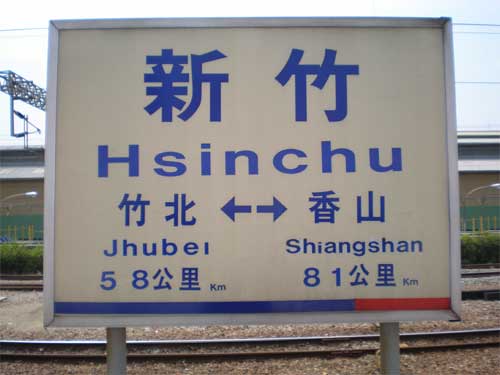
The railway-station sign in this photo in many ways exemplifies this.

Hsinchu Jhubei Shiangshan

Rather than list all of the errors and oddities of this sign, I thought I’d let readers have a go at this one. How many errors and problematic points can you find?

Banqiao’s orificial signage

David, who for just a little while longer lives in the same Banqiao neighborhood as I, sent me a photo of a street sign in our highly populated but little-discussed city.

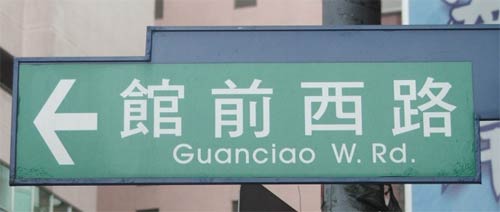
'Guanciao W. Rd.': streetsign in Banqiao, Taiwan, labeled in misspelled Tongyong Pinyin and English

The sign tells us this is “Guanciao” West Road. In Hanyu Pinyin this would be “Guanqiao.” Guanqiao? The only word in my biggest Mandarin-English dictionary under that spelling is guānqiào (關竅/关窍), which is defined as “orifices on the human body.” Hmm. Taiwan might have the questionable taste of having many a road still named after a dead dictator, but orifices?

This oddity is explained by the fact that Banqiao is simply continuing its tradition of typos — even on relatively new signs. (The style of the sign and the choice of Tongyong Pinyin both indicate this went up within the past few years.)

Guanciao (Guanqiao) should be Guancian. (In Hanyu Pinyin, 館前西路 is written Guǎnqián Xīlù.) It’s worth noting this is not a tiny lane but a road in a well-traveled part of town.

As long as I’m putting up yet another post with photos and doing further damage to my reputation of having one of the Taiwan blogosphere’s fastest-loading, least Turtonesque sites*, I might as well go ahead and add one more so I can mention something else about this sign.

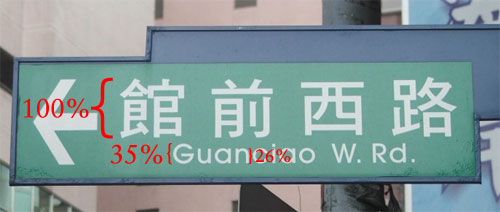
Let’s look at the relative size of the Chinese characters and the alphabetic text. The majority of the letters are but one quarter of the height of the Chinese characters.

sign showing the relative percentages of the height of the letters/Hanzi on the sign

Although in this particular case the lettering might not be too small, this style often leads to nearly illegible romanization, especially on signs posted high above streets.

* Just in terms of the average number photos per post, that is. (But that’s in part because I’m a lousy photographer.) Congratulations, Michael, on reaching two thousand posts!

Taipei’s new busstop signs

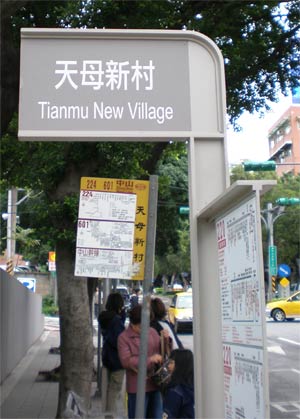
white on gray busstop sign reading 'Tianmu New Village', with Chinese charactersThe Taipei City Government has begun to replace busstop signs throughout the city.

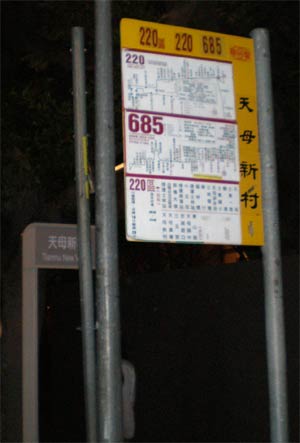
The color scheme of the new signs, however, is a poor choice because white letters against a gray background offer little contrast, especially at night.

Here, for example, is are daytime and nighttime shots of the same stop, taken from different angles.

shot of the busstop signs during the day nighttime shot of the busstop sign, showing the low level of contrast at night

The stop is not lit well, so the nighttime photo had to be taken with a flash. So this photo, though the focus came out a little fuzzy, represents an improvement over what people would normally see at night.

Two weeks ago I wrote the Taipei City Government’s Department of Transportation for clarification about the policies associated with this signage but have not received an answer. Everyone I have spoken with in that office has been friendly; but the system is unfortunately still stuck in its ways.

At least InTerCaPiTaLiZaTion doesn’t seem to be in effect. And the new style for displaying bus routes does provide more information to those who cannot read Chinese characters.

List of busstops for the Taipei 220 bus, as given on the new style (spring 2007) of busstop signage. Click for larger image.
(click for larger image)

Banqiao signage SNAFU

Here’s an example of the mixing of romanization systems and addition of errors that used to be common in Taipei before the city switched to Hanyu Pinyin. These signs are on a corner in Banqiao, Taipei County, not far from Banqiao City Hall.

First, let’s set the scene. We have two types of signs, both with a mix of romanization and English. One set of signs gives street names; the other points toward places of possible interest.
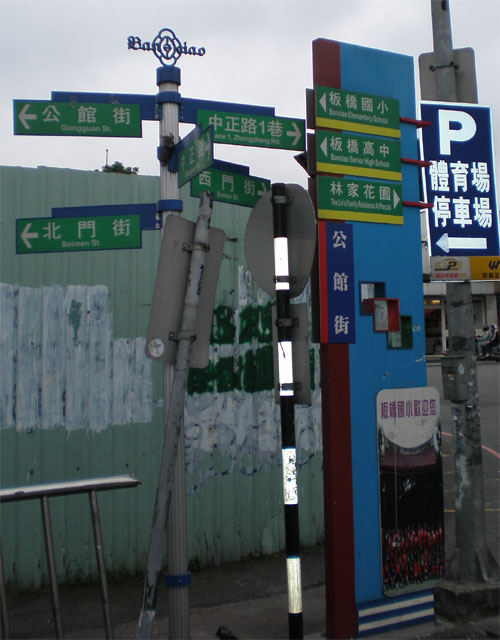
establishing shot of signage (at one corner) discussed in this post

The blue-panel signage on the right represents something introduced during the term of the previous mayor, a member of the Democratic Progressive Party. And since the DPP backs Tongyong Pinyin for Mandarin, that’s the romanization system used most of the time on such signs. A number of the photos on these signs feature the previous mayor, who had relatively little recognition among the public since he had succeeded someone else’s term rather than being elected to his own. He put his photo on all sorts of things. But he failed to be elected to the city’s top spot. His challenger, the current mayor of Banqiao, spreads her name recognition by having her recycling speech broadcast from the city’s trash trucks.
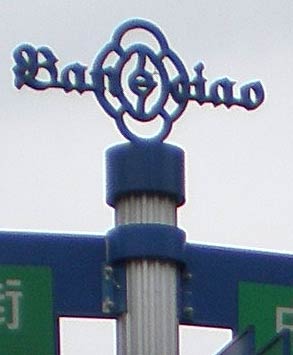
photo of the top piece on a streetsign pole in Banqiao. It reads OK, now note the cap on the signpost. It reads “Ban ciao” in black letter. Although I spotted several of these today, I’d never seen any before, which would mean it’s very likely that a KMT-led city administration under a KMT-led county government is putting up new signs in Tongyong Pinyin, a romanization system the Kuomintang (Guomindang) opposes. (The KMT used to oppose Hanyu Pinyin as well, which is how Taiwan ended up with MPS2, the Tongyong Pinyin of the 1980s.) Similarly, Banqiao has relatively new signs in prominent places around the city that read (in a particularly clumsy script face) “Bravo Banciao.” (What exactly about Banqiao is worthy of such a cheer is not stated.) Even though the city administration is under the mistaken impression that it must use Tongyong (and it does suffer from this idea), that doesn’t mean it has to go around putting up new signage in this.

To get back to the cap, the likely story is that the transportation department had some leftover money in its budget which had to be spent lest the following year’s budget be cut; but rather than spend it on fixing errors, which would involve study and actual work, people decided to make something that the boss thinks would look cool.

I wonder, though, how many Taiwanese would even recognize this reads “Banciao” unless they had it specifically pointed out to them. A few months ago I spotted an innocent-looking teenager shopping with her mother. The girl was wearing a shirt with the following text:

'f uck you' written in black letter

Although it’s almost certain she would know both English words and understand their meaning together, I think it extremely unlikely she knew what words were on her shirt.

OK, let’s have a closer look at the signs themselves.
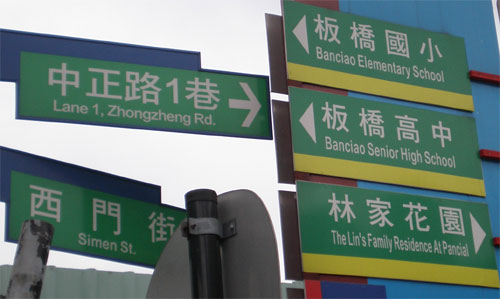
detail of signs discussed in this post

Here we have

  • “Zhongzheng” (Hanyu Pinyin)
  • “Simen” and “Banciao” (Tongyong Pinyin for what would be “Ximen” and “Banqiao” in Hanyu Pinyin)
  • “Panchial” (bastardized Wade-Giles of “Panchiao” plus a typo, for what would be “Banqiao” in Hanyu Pinyin)

And then there’s the matter of “The Lin’s Family Residence At Panchail,” which would be much better written simply “Lin Family Residence” or by the most commonly used English name “Lin Family Gardens.”

So that’s three romanization systems, a typo, and clumsy English on official signage at just one corner — to say nothing of how relatively small the alphabetic text is. And there’s no solution in sight.

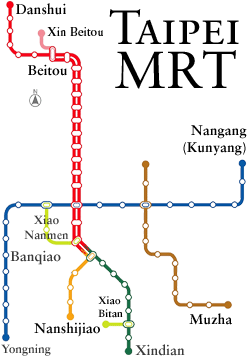
Taipei MRT stations — a list giving Hanyu Pinyin with tone marks

outline map of the Taipei MRT systemWhen Taipei’s MRT system — which is mainly a subway system but which also has elevated portions and even sections at ground level — opened, most of its signage was in bastardized Wade-Giles, with the “English” pronunciation of the station names broadcast in the cars resembling a hideous parody of the speech of an especially clueless foreign visitor. Fortunately, the romanization was switched to Hanyu Pinyin and the English announcements were re-recorded to give pronunciations that much more accurately reflected the Mandarin station names.

Unfortunately, English announcements have been added in recent months that feature a high-pitched voice that is probably intended to be ke’ai (“cute”) but which is actually cloying. These must die, die, die! But I’m straying from the main topic.

Anyway, the MRT’s current signage, nicely designed as most of it is, does not give any tone marks. Nor does it provide Pinyin for the station names that are translated into English. And there are also a few mistakes that really need to be corrected in the official forms of the names.

So, I have updated and added some minor corrections to the lists I put up long ago on my first Web site, Romanization.com. The new versions, here on Pinyin Info, are here: Taipei MRT stations in Chinese characters, Hanyu Pinyin, and some English.

confusing road signs to be corrected: MOTC

Taiwan’s Ministry of Transportation and Communications is calling on the public to report confusing or unclear highway signs.

The ministry’s Institute of Transportation (Jiāotōngbù Yùnshū Yánjiūsuǒ) has set up a toll-free telephone line for people who want to report such signs. The number is 0800-231-900, extension 5. Or people can make submissions through the institute’s Web site (Mandarin only).

I doubt that the ministry can be convinced that the awkward typography and tiny lettering of the romanization on many signs are indeed errors that need correction. Still, it’s worth a try. But as for the use of Tongyong Pinyin….

Signs will be corrected within 15 days, according to the ministry.

sources:

lane – 4 = street + $

A neighborhood along a small lane in Taipei has found a change in the name of their street highly profitable. What was once Jilong Road Section 3 Lane 4 is now Dunnan Street. The area’s lǐzhǎng (neighborhood head) worked for three years to get the change approved.

Although the story below doesn’t mention this, the television report I saw on this had several people in the neighborhood stating that a prime consideration for them was the elimination of the dreaded number four from their address.

Another factor in the boost in the price of real estate there is the new name, Dunnan Street (Dūnnán Jiē / 敦南街), which (intentionally) closely resembles the name of one of one of Taipei’s priciest roads: the nearby Dunhua South Road (Dūnhuà Nánlù / 敦化南路).

Qiángbì shàng xiě zhe Jīlóng Lù 3 duàn 4 xiàng, dàn pángbiān de lùpái quèshì dàdà de “Dūnnán Jiē” 3 ge zì, méicuò zhè tiáo xiàngzi bànnián qián zhèngshì gǎimíng jiào Dūnnán Jiē. Dūnnán Jiē zhùhù: “yěyǒu gǎi Jīlóng Lù, yěyǒu gǎi Hépíng Dōnglù, xiànzài gǎi.. ‘Dūnnán Jiē,’ luànqībāzāo.”

Bùguǎn zhīqián shì jǐ xiàng jǐ hào, zài lǐzhǎng 3 nián de bēnzǒu xià, xiànzài quánbù gǎimíng jiào Dūnnán Jiē, ménpái yī huàn, shēnjià mǎshàng bù yīyàng, fáng zhòng yèzhě yùgū měi píng 30 wàn de hángqíng, tiào dào 40 wàn, huànsuàn yī hù 30 píng de fángzi, xiàn zhǎng 300 wàn. Fáng zhòng yèzhě Yáng Kūn-zhōng: “Yībān rén de kèbǎn yìnxiàng, yǒu gēn Dūnhuà Nánlù yǒuguān de, fángjià kěnéng huì bǐjiào hǎo yīdiǎn.” TVBS jìzhě Gǔ Cǎi-yàn: “Zhèlǐ jiùshì Dūnnán Jiē le, hòumian zhèige háo zhái, píngjūn yī píng yào 5-60 wàn, kējì shǒufù Guō Tái-míng, yīkǒuqì, céngjīng zài zhèbiān mǎi le 4 hù fángzi.” Jiù lián guō tái míng yě céngjīng shì Dūnnán Jiē de wūzhǔ, dēngjì zài tā hé qīzi de míngxià. Dūnnán Jiē zhùhù: “(shénme) Guō Tái-míng, (zěnyàng) màidiào le ba.” Bùguò gǎimíng jiào Dūnnán Jiē zhīhòu, bùyòng dǎzháo diànzǐ dàhēng línjū de zhāopai, fángjià yǐjing yǒu lā tái de xiàoguǒ, zhǐnéng shuō jiào shénme lù míng, zhēn de yǒu chà.

source: Jīlóng Lù xiǎoxiàng gǎimíng “Dūnnán Jiē” — fángjià dà zhǎng (基隆路小巷改名「敦南街」 房價大漲), TVBS, January 20, 2007

Gaoxiong receives funding to upgrade the city’s English

The government of Gaoxiong (Kaohsiung) has recently secured funding from the Executive Yuan to

  • waste on so-called translation agencies that wouldn’t know real English if it bit them on the ass,
  • print up some signs on which the English is so small as to be almost unusable,
  • put up even more signs in a romanization system few people know but many think is ridiculous at best,
  • um, create an “English-friendly environment” in advance of the World Games, which will be held in the city in 2009.

The stories didn’t mention how much money will be involved in this. The project will be headed by the recently promoted Xǔ Lì-míng (許立明 / Xu Liming / Hsu Li-ming).

Let’s all hope the city does a much better job than is to be expected from past experience throughout Taiwan.

sources: